Private Power Pole Inspection Sydney: The 2026 Homeowner’s Guide
Did you know that the tilting timber pole at the edge of your driveway isn't the responsibility of the council or Ausgrid, but is actually your legal liability? For many residents, the first time they consider a private power pole inspection in Sydney is when a defect notice arrives, threatening a total power disconnection within 30 days. It's a high-stakes situation that can leave you feeling vulnerable and confused about your next steps.
We understand that the threat of losing power or the fear of a bushfire risk on your property is incredibly stressful. You shouldn't have to navigate complex NSW Service and Installation Rules alone. This 2026 guide is designed to provide professional reassurance and clear, actionable steps to ensure your property remains safe and compliant with current network standards.
We will explore the specific requirements for Level 2 ASP contractors, the mandatory timelines for Ausgrid defect resolutions, and the critical maintenance checks needed to protect your home. By the end of this guide, you'll know exactly how to manage your infrastructure and keep the lights on without the stress of regulatory fines or emergency failures.
Key Takeaways
• Understand where your legal liability begins at the point of attachment and why maintaining private power poles is a mandatory requirement for Sydney property owners.
• Discover the rigorous two-step process involved in a professional private power pole inspection sydney, including ground-line checks for rot and structural assessments for verticality.
• Learn how to respond to Ausgrid or Endeavour Energy defect notices to avoid power disconnection by meeting strict 30 and 60-day compliance deadlines.
• Compare the long-term benefits of galvanised steel versus treated timber to make an informed decision on replacement poles that balance durability and maintenance.
• Identify why only an authorised Level 2 ASP is qualified to perform certified work on your electrical infrastructure to ensure safety and regulatory compliance.
Table of Contents
• Understanding Your Responsibility for Private Power Poles in Sydney
• The Professional Inspection Process: What a Level 2 ASP Checks
• Navigating Ausgrid and Endeavour Energy Defect Notices
• Steel vs. Timber: Choosing the Right Replacement Pole
• Why High Demand Electrical is Sydney's Private Pole Specialist
Check out our Private Power Pole Installation
What Is Your Responsibility for Private Power Poles in Sydney?
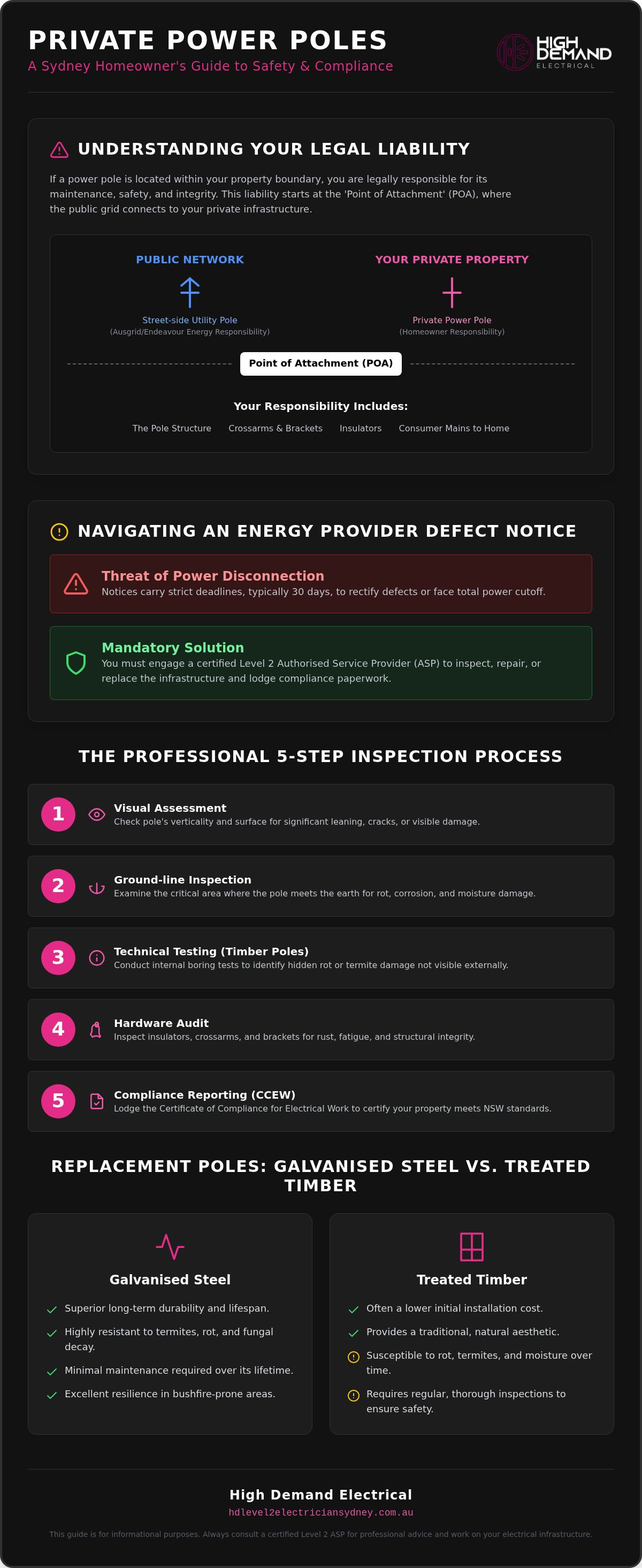
Many Sydney property owners assume that every wooden or steel pole on their street belongs to the network provider. This is a dangerous misconception. A private power pole is the essential infrastructure that bridges the gap between the public electricity grid and your home's internal wiring. Unlike the standard Utility pole located on a public nature strip, a private pole sits within your property boundaries. This physical location fundamentally changes your legal standing. Under the NSW Service and Installation Rules, the responsibility for the structural integrity and electrical safety of these poles rests entirely with the homeowner.
The technical transition happens at the Point of Attachment (POA). This is the specific location where the service lines from the street connect to your property's infrastructure. From this point forward, the network provider's liability ends and yours begins. Because these assets involve high-voltage connections, only an authorised Level 2 ASP can legally perform repairs, installations, or a comprehensive private power pole inspection sydney residents require for compliance.
Identifying Your Electrical Boundary
Locating your boundary starts with a simple visual check. In most Sydney suburbs, if the pole is located inside your fence line or provides power exclusively to your dwelling, it's likely your asset. You're responsible for the pole itself, the crossarms, the insulators, and the consumer mains running to your switchboard. If you're unsure, check your property title or look for a private meter box mounted on the pole. Recognising this boundary is the first step in avoiding the sudden shock of an Ausgrid defect notice. For a detailed breakdown of these components, you can refer to our private power pole guide for Sydney homeowners.
Why Regular Inspection is Mandatory in NSW
Safety is the primary driver for mandatory checks. In the metropolitan fringes of Sydney, leaning or decaying poles present a severe bushfire risk during the summer months. Ausgrid and Endeavour Energy now conduct regular aerial and ground patrols, issuing strict notices to owners with non-compliant infrastructure. Beyond the risk of fire, a falling pole can cause catastrophic property damage or personal injury. If a pole fails and you don't have a record of a recent private power pole inspection sydney, your insurance provider may reject your claim based on failure to maintain clauses. A comprehensive electrical safety inspection from a Level 2 ASP provides the professional reassurance that your home is both safe and legally protected.
What Does a Level 2 ASP Check During a Professional Inspection?
A professional private power pole inspection sydney residents can rely on is a methodical, technical operation. It isn't just a cursory glance from the driveway; it is a comprehensive safety audit required by network providers. Our Level 2 ASPs follow a strict protocol to ensure every component of your electrical infrastructure is structurally sound and electrically safe. We aim to identify potential hazards before they escalate into costly emergency repairs or power outages.
Step 1: Visual Assessment.
We evaluate the pole's verticality and surface condition. A significant lean or visible cracks in timber can indicate immediate failure risk or foundation instability.
Step 2: Ground-line Inspection.
We examine the critical zone where the pole meets the earth. This area is most susceptible to moisture, fungal growth, and corrosion, which can compromise the pole's base.
Step 3: Technical Boring Test.
For timber assets, we perform internal testing to identify hidden rot or termite damage that isn't visible on the surface.
Step 4: Hardware Audit.
We inspect the insulators, cross-arms, and brackets for rust or structural fatigue. Loose or damaged hardware can lead to arcing or fallen lines.
Step 5: Compliance Reporting.
Upon completion, we lodge the necessary Certificate of Compliance for Electrical Work (CCEW) to certify your property meets current NSW standards.
Timber vs. Steel Inspection Techniques
The material of your pole dictates the technical approach we take. Timber poles require boring tests, where we drill small pilot holes to check for internal decay or "termite highways" common in Sydney's humid climate. If the wood is soft or hollow, the pole is condemned for safety. For galvanised steel poles, we focus on ground-line rust. We often excavate the 250mm inspection zone below ground level to ensure the protective coating hasn't failed. If you suspect your pole is showing signs of age, it's vital to consult a Level 2 specialist before a minor rust spot becomes a major safety hazard.
Assessing the Point of Attachment
The Point of Attachment (POA) is where the network's service line meets your property infrastructure. We meticulously check for weathered or frayed consumer mains that could lead to short circuits or fire hazards. Our inspectors verify that the bracketry is secure and that the service line maintains the mandatory height clearances over driveways and structures as specified in the NSW Service and Installation Rules. Any encroachment by vegetation is also noted, as this is a frequent trigger for Ausgrid defect notices during the bushfire season.
How Do You Navigate Ausgrid and Endeavour Energy Defect Notices?
Receiving a formal defect notice from Ausgrid or Endeavour Energy can be a jarring experience for any Sydney homeowner. This document is a legal notification stating that your electrical infrastructure fails to meet the safety standards set out in the NSW Service and Installation Rules. It isn't merely a suggestion for maintenance. It is a directive that requires immediate action to prevent your property from being disconnected from the grid. Many residents only become aware of these issues when a routine network patrol triggers a private power pole inspection sydney authorities use to identify high-risk assets. If you've already received a letter, our dedicated electrical defect notice Sydney guide walks through the full rectification process step by step.
These notices typically result from visible structural or electrical failures. Common triggers include poles that have developed a dangerous lean, service lines that have sagged below mandatory height clearances, or significant vegetation encroachment that poses a fire risk. In the 2026 regulatory environment, network providers have increased the frequency of these inspections to mitigate bushfire risks, particularly in Sydney's leafy metropolitan fringes. Ignoring these warnings is not an option, as the network provider has the legal authority to cut power to your home to protect the broader community.
Time is your most critical factor once a notice is issued. While the formal legal framework allows 30 days to engage a contractor and 60 days to complete repairs, the initial 21-day compliance window is often the most vital period for communication. Contacting a Level 2 ASP within this timeframe demonstrates an intent to rectify the issue, which can prevent the network from escalating their enforcement actions. We act as your authorised representative, handling the technical dialogue with the utility provider to ensure your power remains connected throughout the process.
Interpreting Your Defect Letter
Your letter will contain technical jargon that can be difficult to decode without industry experience. Terms like "structural decay at ground line," "low conductor clearance," or "exposed consumer mains" each carry different levels of urgency and cost. Our role is to translate these findings into a clear assessment. We determine if the cited safety risk allows for a targeted repair, such as retensioning a wire, or if the structural integrity of the pole has failed to the point that a full replacement is the only legal solution.
The Rectification Roadmap
Once you have the notice, the path to compliance is highly regulated. We begin by booking an urgent site assessment to verify the network's findings. Following this, we lodge a Notice of Service Work (NOSW) with Ausgrid or Endeavour Energy to formalise the repair project. After our Level 2 technicians complete the necessary work, we conduct rigorous safety testing and submit a Certificate of Compliance for Electrical Work (CCEW). This official documentation notifies the authority that the defect has been cleared, ensuring your property is marked as compliant in their database.
Steel vs. Timber: Which Is the Right Replacement Pole?
When a professional private power pole inspection sydney reveals that your existing asset is structurally unsound, you face a critical decision between galvanised steel and treated timber. This choice shouldn't be based on the initial price tag alone. You must consider the specific environmental conditions of your Sydney property, including soil moisture levels, termite activity, and proximity to the coast. While timber has been the traditional standard, the modern shift toward steel reflects a desire for increased longevity and reduced maintenance obligations over a 30-year lifecycle. Our private power pole installation team can help you weigh up both options against your property's conditions.
Selecting the right material is about balancing your upfront investment with the reality of future replacement cycles. A failing pole is a safety liability that requires a permanent, robust solution. Our Level 2 ASP team provides the technical guidance needed to ensure your new installation meets all NSW Service and Installation Rules while suiting your property's specific layout and aesthetic requirements.
Galvanised Steel Poles: The Modern Sydney Choice
Galvanised steel has become the preferred standard for residential Sydney installations due to its superior resistance to the elements. Unlike timber, steel is entirely immune to termite infestations and fungal rot, both of which are rampant in Sydney's humid climate. Its slimmer profile is a significant advantage for homeowners with narrow driveways or tight property lines where space is at a premium. A steel pole provides a clean, unobtrusive look that fits perfectly with modern architectural styles.
In coastal suburbs where salt air accelerates the decay of traditional materials, galvanised steel offers a high level of protection against atmospheric corrosion. It is essentially a "set and forget" solution. Once installed, it requires significantly less frequent physical testing compared to timber, making it the most cost-effective option for busy homeowners looking for long-term professional reassurance. If your current pole has failed its assessment, contact our Level 2 team for a professional replacement quote that ensures your property remains safe and compliant.
Treated Timber Poles: When Tradition Wins
Hardwood timber poles remain a viable choice for specific applications, particularly in heritage-listed areas or large rural acreage sites on the Sydney fringe. These poles are treated with specialised preservatives to extend their service life, though they still require periodic boring tests to monitor for internal decay. When we install timber, we use high-grade hardwood and ensure the pole is fitted with a professional cap. This capping is vital as it prevents moisture from entering the grain at the top, which is the leading cause of premature timber failure.
Timber poles are categorised by specific stress grades. Selecting the correct grade is essential for supporting the tension and weight of your consumer mains safely. While timber offers a traditional look that blends into established gardens, it does demand more vigilant monitoring over time. Homeowners must be prepared for regular ground-line checks to ensure that moisture hasn't compromised the base of the pole, especially after periods of heavy Sydney rain.
Why Is High Demand Electrical Sydney's Private Pole Specialist?
Choosing a specialist for your private power pole inspection sydney is a decision that impacts your property's long-term safety and legal compliance. At High Demand Electrical, we don't just perform a check; we provide a comprehensive safety audit backed by years of infrastructure experience. We've compiled our technical expertise into the Private Power Pole Guide for Sydney Homeowners to help residents understand their obligations before a crisis occurs. Safety isn't a suggestion. It's our standard.
Our status as authorised Level 2 ASPs for both the Ausgrid and Endeavour Energy networks means we're qualified to work on any residential or commercial pole in the Greater Sydney region. This dual authorisation is critical. It allows us to act as a rapid responder when you receive a defect notice, ensuring we can communicate directly with your specific network provider to prevent a power disconnection. We provide transparent pricing and exhaustive safety documentation for every project, giving you the professional reassurance that your electrical assets are in expert hands. Browse our full Level 2 electrician Sydney services for the complete range of grid-side work we're accredited to perform.
Local Knowledge of Sydney Infrastructure
Sydney's unique geography presents distinct challenges for electrical infrastructure. From the salt-heavy air of the Eastern Suburbs to the dense urban property lines of the Inner West, we understand how local conditions affect pole longevity — and the same coastal corrosion patterns apply to our work for Northern Beaches properties. Our expertise in Level 2 ASP Electrical Services extends to complex sites where standard electrical contractors cannot operate. We maintain a fleet of specialised machinery designed for pole extraction and installation in restricted spaces, ensuring that even the most difficult jobs are completed with surgical precision.
Ready to Secure Your Power Supply?
Don't wait for a leaning pole or an Ausgrid warning letter to compromise your home's safety. Booking a private power pole inspection sydney with our team is the most effective way to identify hidden rot or electrical fatigue early. The High Demand guarantee focuses on three pillars: absolute safety, total regulatory compliance, and a professional service that respects your schedule. We're ready to secure your infrastructure today. Contact High Demand Electrical for a Sydney pole inspection quote and ensure your property remains connected and compliant.
Secure Your Property and Power Supply Today
Maintaining your electrical infrastructure isn't just about avoiding network fines; it's about protecting your home from fire risks and structural failures. You now understand that your liability begins at the point of attachment and that only a Level 2 ASP has the legal authority to certify your assets. Whether you're choosing the durability of galvanised steel or managing an existing timber pole, proactive maintenance is the only way to stay ahead of strict 2026 Ausgrid compliance deadlines.
Don't wait for a defect notice to arrive or for a storm to expose hidden rot. A professional private power pole inspection sydney provides the documented proof of safety your insurance provider and the network require. High Demand Electrical is Level 2 ASP Accredited and Ausgrid & Endeavour Energy Authorised, offering a 24/7 emergency defect response to keep your property powered and protected.
Book your Sydney private power pole inspection with a Level 2 ASP to ensure your infrastructure remains safe and compliant. Taking action now gives you professional reassurance that your home is ready for the seasons ahead and your power supply is secure.
Powering Your Needs with Expertise
If you’re looking for a reliable, experienced, and prompt electrician, look no further than High Demand Electrical. We cater to all your electrical needs, from routine maintenance to emergency repairs and complete system installations. Our skilled team is committed to providing professional service that ensures your electrical systems run smoothly. Whether it's a small task or a large project, give us a call today. Let us meet all your electrical demands with the quality and reliability you deserve.