Find Out How Much Backup Power Your Home May Need
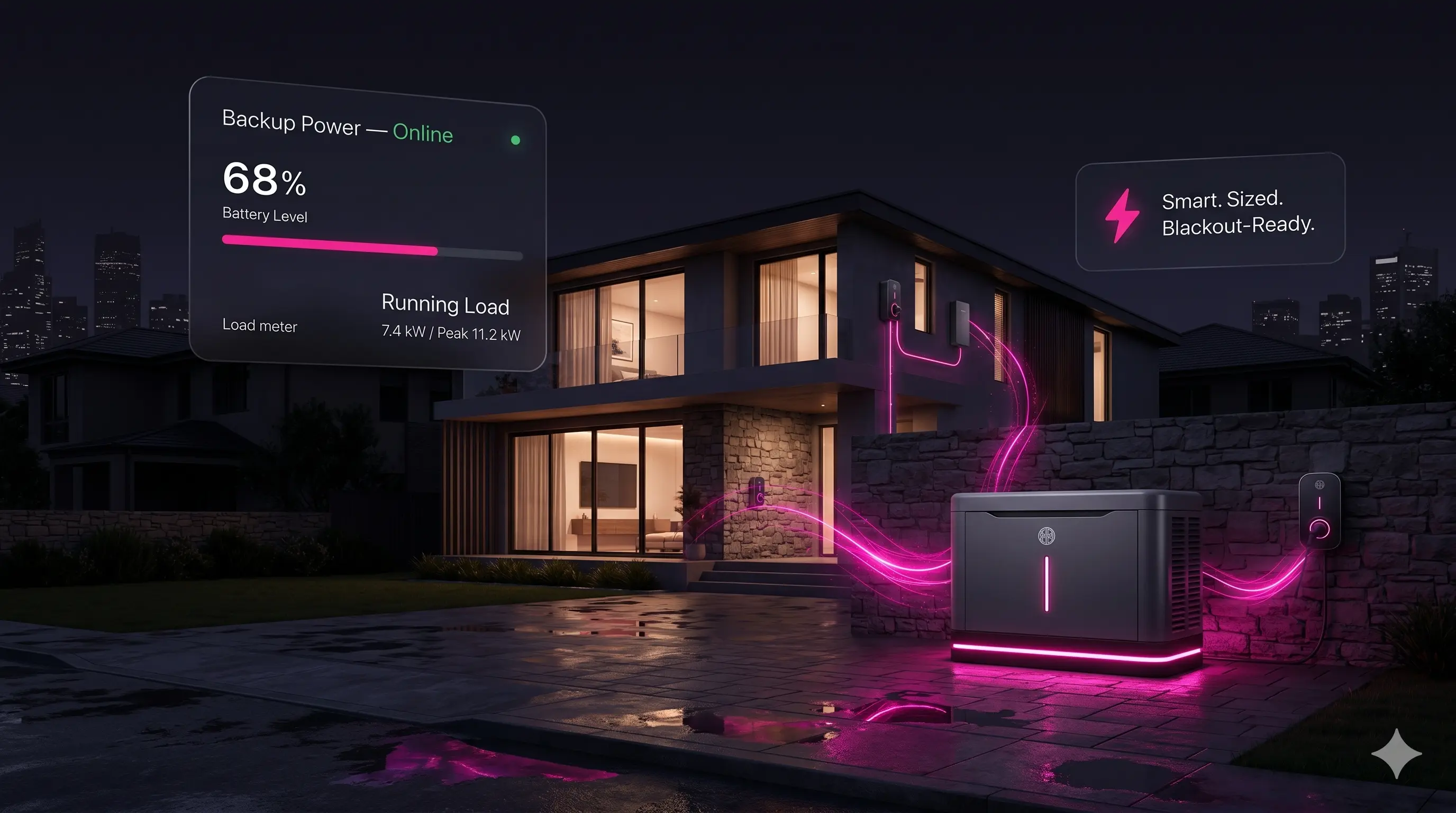
Got Your Number? Book Your Generac Install.
As an accredited Generac dealer and Level 2 ASP, we'll confirm your load on-site, recommend the right Guardian model (10, 13 or 20 kVA) and handle switchboard, ATS and grid-compliant installation end to end.
Ready to Confirm the Right Generator for Your Home?
High Demand Electrical - Generator Load Calculator
FAQs
Explore our frequently asked questions to learn more about the specialised services provided by our certified Level 2 Electricians.
It depends on what you want to keep running. Add up the running watts of your essential appliances, allow for the largest start-up surge (motors like air-con and pool pumps draw 2–3× their running power on start-up), then add around 20% headroom. Our calculator does this for you and suggests a Generac size — a Level 2 electrician confirms it on site.
List the appliances you would want during a blackout, add their running watts together, then add the single biggest start-up surge on top. That total, plus a safety margin, gives the continuous capacity your generator needs. The calculator works it out instantly from the appliances you select.
It can, if it is sized for your total load. Smaller units are ideal for essential circuits — fridge, lights, comms and a couple of rooms — while larger Generac units can run most or all of a home. The right choice depends on your appliances and whether you are on single or three-phase power.
Most Sydney homes run on single-phase, and Generac's home standby range covers single-phase setups well. Three-phase is usually considered for larger homes, higher demand, or properties already on a three-phase supply. A licensed electrician can confirm which suits your switchboard.
A portable generator is moved into place and started manually. A standby generator is permanently installed, connected to your switchboard through an automatic transfer switch, and starts on its own within seconds of an outage. Standby units like Generac are the typical choice for hands-off home backup.
They run on gas — natural gas or LPG — rather than petrol or diesel, so there's no refuelling during an outage. The Guardian gas models are approved as Type A gas appliances in Australia. The right fuel option depends on what's available at your property.
Yes. A transfer switch safely isolates your home from the grid and switches it to generator power, protecting your wiring and anyone working on the network. An automatic transfer switch does this the moment the power drops. Installing it is electrical work for a licensed electrician.
The electrical side — the transfer switch, switchboard work and connecting to your supply — must be done by a licensed electrician, and any supply-side or metering work requires a Level 2 ASP electrician. High Demand Electrical is Level 2 ASP accredited and an accredited Generac dealer, so we can handle the full installation.
Standby generators go outside, with clearances for ventilation, exhaust and noise, and away from windows and boundaries. Placement and any council or noise requirements vary by property and area, so it's best to confirm during a site assessment. We'll advise on a compliant location as part of your quote.
No, it gives an estimate only. A licensed electrician should check your switchboard, supply, available capacity and proposed generator location before confirming the right system. Use your PDF estimate as the starting point and we'll take it from there.
Powering Your Needs with Expertise
If you’re looking for a reliable, experienced, and prompt electrician, look no further than High Demand Electrical. We cater to all your electrical needs, from routine maintenance to emergency repairs and complete system installations. Our skilled team is committed to providing professional service that ensures your electrical systems run smoothly. Whether it's a small task or a large project, give us a call today. Let us meet all your electrical demands with the quality and reliability you deserve.