Avoid Audit Failures: Electrical Checklist for Facility Managers
A working electrical maintenance checklist has one job: catch a fault before it becomes a fire, an outage, or a compliance breach. That means three actions get done straight away, on every site, no exceptions: a visual panel inspection, an RCD (safety switch) test, and a thermal (IR) scan under load. Everything else in this guide slots into a monthly, quarterly, or annual tier, assigned to either your facility staff or a licensed electrician.
TL;DR:
- Thermal imaging under load should be conducted quarterly to detect hotspots four to eight weeks before failure risks escalate.
- Insulation resistance tests and contact resistance checks are key annual tasks, with more frequent testing for critical sites like hospitals or data centers.
- Proper safe work practices include verifying circuit de-energization, using lockout/tagout procedures, and maintaining detailed records of all tests and actions.
- Only licensed electricians should perform open panel work or interpret complex readings, while facility staff handle visual and functional checks.
- Documenting precise measurements, images, and follow-up actions is essential to support maintenance claims and ensure regulatory compliance.
Table of Contents
- What should be on your electrical maintenance schedule each month, quarter and year?
- System-by-system checks: what to inspect on every major component
- Safe work practices and the paperwork that protects you
- Which tools actually tell you a system is failing?
- When does an electrical issue stop being a checklist item?
- Who's actually behind this checklist?
- What this checklist gets right that most templates miss
- Sources
What should be on your electrical maintenance schedule each month, quarter and year?
Not every task belongs to the same person or the same date on the calendar. Facility staff can safely handle visual checks with the power live and the panel closed. Anything involving an open panel, load testing, or interpretation of readings needs a licensed electrician, and that split is where most maintenance programs quietly fall apart.
Monthly work stays visual and functional: check panels for discolouration or unusual smells, glance over visible wiring for damage, press-test GFCI/AFCI buttons, and run a quick functional check on emergency lighting. None of this requires opening an enclosure.
Quarterly work is where a contractor should be on site. That means thermal imaging under load, RCD timing tests against the tiered inspection schedule most facilities now follow, and a check of UPS battery condition and alarms. This is also a sensible interval to schedule test and tag for portable equipment and extension leads used across the site, since compliance testing on that gear is usually assessed on the same cycle.
Annual work is the deep dive: insulation resistance testing with a megger, contact resistance testing on breakers and switchgear, transformer oil analysis where applicable, and a full generator load bank test. High-criticality sites, think data centres, hospitals, or anything running life-safety equipment, should tighten these intervals rather than stretch them.
| Tier | Typical tasks | Who performs it |
|---|---|---|
| Monthly | Panel visuals, GFCI/AFCI press tests, emergency lighting quick check | Facility staff |
| Quarterly | Thermal imaging under load, RCD timing test, UPS battery check | Licensed electrician/contractor |
| Annual | Insulation resistance, contact resistance, transformer oil test, generator load bank | Licensed electrician/contractor |
What Should You Inspect on Every Major System Component?
A frequency schedule tells you when. This section tells you where to actually look on each piece of equipment.
Distribution panels are the most common source of silent degradation. Check for:
- Discolouration, scorch marks, or corrosion on the enclosure and busbars.
- Loose terminals, torqued to manufacturer specifications, not "firm by feel."
- Label accuracy against the current circuit schedule.
- IR hotspots at connection points, which is often the earliest sign of trouble.
Loosened lugs and terminals are behind a disproportionate share of electrical failures, and they're usually invisible until an IR scan or a torque check exposes them. That's why annual torque verification earns its place on the checklist even on panels that look fine from the outside. If an inspection turns up a board that's undersized, overloaded, or genuinely past its service life, it's usually more cost-effective to plan a full switchboard upgrade than to keep patching individual faults as they surface.
Switchgear and protective devices need more than a glance. Run contact resistance tests, check mechanism lubrication on breakers that cycle infrequently, and verify trip timing against manufacturer tolerances.
Transformers get a visual pass every visit, cooling fins checked for blockage, and periodic oil sampling (DGA) on a schedule matched to the unit's criticality. Record a simple pass/fail against the lab's reference values rather than filing the raw report and moving on.
Generators and ATS units follow a two-speed rhythm. Monthly no-load start and run checks plus a monthly ATS transfer test cover the baseline. But monthly no-load starts alone aren't enough protection against long-term failure. Diesel units especially need at least one annual loaded run through a load bank to prevent wet stacking and confirm rated output. If your maintenance checks reveal a generator nearing end of life, undersized for current loads, or repeatedly failing its load bank test, our team also handles generator installation and connection for a straightforward replacement.
- Start and run the generator monthly under no load.
- Exercise the ATS monthly to confirm automatic transfer.
- Schedule an annual load bank test at rated capacity.
- Document transfer timing and fuel/oil condition at every test.
UPS and batteries need alarm checks and battery impedance testing on a schedule, with replacement triggered by measured impedance drift rather than age alone.
Emergency lighting gets a monthly functional test (does it come on?) and an annual 90-minute duration test to confirm the battery still holds a full discharge cycle, a detail industry checklists consistently flag as the most skipped test on site.
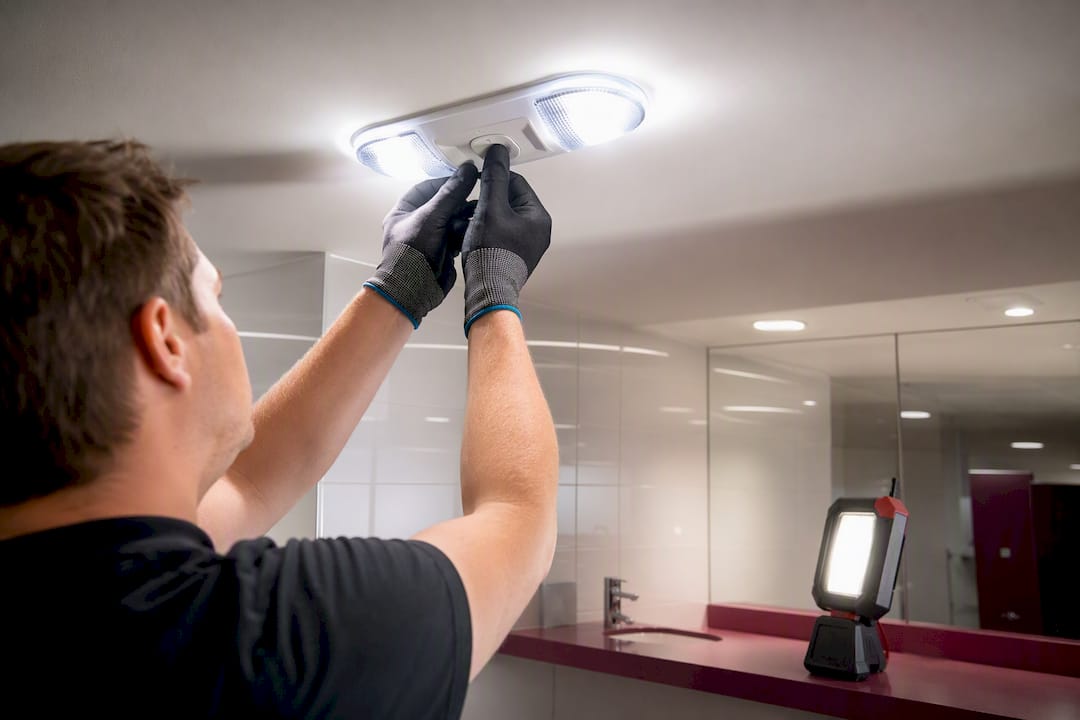
Grounding and bonding rounds it out: visual inspection of conductors and clamps, resistance measurements at grounding points, and bond continuity checks across bonded metal components.
Statistic worth building a schedule around: thermal imaging can detect a hot spot four to eight weeks before it fails outright, which is roughly the window you need to schedule a repair before it becomes an emergency callout.
What Safe Work Practices and Paperwork Protect You?
Before anyone opens a panel, isolation comes first. Verify the circuit is de-energised, discharge any capacitors, apply lockout/tagout, and confirm zero voltage with a tested meter, the sequence NECA's recommended practice lays out for safe internal work. These steps mirror the safe work principles behind NFPA 70E and they are not optional shortcuts for "just a quick look."
Internal work on switchgear, panels, or anything de-energised for testing sits squarely with a licensed electrician. That's a legal boundary, not a preference, and it's where a facility manager's job is to schedule the work, not perform it.
Every test needs a record, not a mental note:
- Date and technician name.
- Measured readings (resistance values, IR temperatures, timing results).
- Photos of the component and any defect found.
- Corrective action taken and follow-up date if the issue isn't fully resolved.
Keep these records for the life of the equipment where possible. A documented maintenance history is often the difference between a smooth insurance claim and a denied one after an electrical fire.
Pro Tip: A one-line note like "checked, fine" is worthless in a dispute. Write the actual number, attach a photo, and note what you'd expect to see next time.
Which tools actually tell you a system is failing?
The right test depends on what you're trying to catch, and running the wrong one wastes a site visit.
- IR thermography needs the circuit loaded to at least 30 to 40% of capacity to give a useful reading, scanning an unloaded panel tells you almost nothing. A delta-T of more than a few degrees above ambient on a similar load-bearing connection usually warrants a closer look.
- Megger testing (insulation resistance) flags degrading insulation before it arcs. Readings trending down over successive tests matter more than any single number.
- Contact resistance and breaker timing tests belong on the annual tier, and a result outside manufacturer tolerance means the device gets replaced, not "monitored."
- Competency matters as much as the equipment. IR cameras and meggers should be operated by someone trained on that specific instrument, with calibration current, not whoever happens to be free that day. Insulated hand tools are non-negotiable for anyone working near live components during these tests.
When does an electrical issue stop being a checklist item?
Some findings can't wait for the next scheduled visit.
- Repeat or increasing breaker trips. One trip is a nuisance; a pattern that keeps returning after a reset is a job for professional electrical fault finding, not another maintenance cycle. If the trips trace back to one device, our guide to working out which appliance is tripping your power walks through the isolation process, and on extreme heat days our heatwave circuit breaker trips guide explains the seasonal pattern.
- Visible arcing, burn marks, or a burning smell. Isolate the area and call for emergency attendance immediately.
- Thermal scan hotspots above threshold, especially on load-bearing connections.
- RCDs failing their test cycle or persistent flicker affecting critical equipment.
Critical facilities, hospitals, data centres, anything running life-safety systems, get bumped to the top of that list automatically. Persistent flicker or intermittent faults tend to predict failure earlier than waiting for a full outage, so treat "it's happening again" as urgent, not routine.
Who's actually behind this checklist?
This guide draws on the standards a certified Level 2 electrical contractor works to every day. Christopher, contributing here, works within that certification framework covering complex installations and switchboard work across NSW.
Hdlevel2electriciansydney runs this exact checklist on commercial, strata, and residential sites across Sydney, backed by 24/7 emergency response and more than 300 five-star reviews from clients who've needed it acted on, not just written down.
- Free site inspections for Level 2 work, no obligation.
- Thermal imaging and switchboard upgrades handled by licensed Level 2 electricians.
- Emergency make-safe response available around the clock.
| If you need | Contact for |
|---|---|
| A baseline inspection before setting a schedule | Electrical safety inspection |
| Ongoing contractor-led maintenance | Level 2 electrical maintenance Sydney |
| An urgent fault right now | Emergency electrician Sydney |
Get in touch with Hdlevel2electriciansydney for a free Level 2 site inspection or urgent attendance, day or night.
What Does This Checklist Get Right That Most Templates Miss?
Most electrical maintenance templates are written for homeowners changing a smoke alarm battery. That's the wrong starting point for a facility manager who has to defend a maintenance decision to an insurer or an auditor. The gap isn't knowledge, it's assignment: generic checklists tell you what to check but never who's qualified to check it, and that ambiguity is exactly where liability lands.

The most overrated item on the conventional list is the annual "comprehensive inspection" treated as a single event. A once-a-year deep dive catches problems that thermal imaging, done quarterly and under real load, would have flagged months earlier. If you only have budget for one upgrade to an existing program, add quarterly IR scans under load before you add anything else.
What I'd prioritise first, always, is documentation discipline. Not because paperwork is glamorous, but because a measured reading with a photo is the only thing that turns "we maintain this equipment" from a claim into evidence. Everything else on this checklist is a technical task. That one is a business decision.
— Christopher
Frequently Asked Questions
Related switchboard, safety and compliance guides
- Common electrical hazards addressed by a Level 2 electrician
- Common problems with electrical storm damage in Sydney and how we fix them
- Switchboard maintenance Sydney: how often & what to check
- Protection from prospective short circuit currents: what SIRNSW requires
- Thermal imaging electrical inspection: practical guide
- Switchboard upgrades: what every homeowner needs to know
- Why every Sydney home needs an electrical safety inspection
- Emergency lighting requirements NSW: what building owners must do
- Maintained vs non-maintained emergency lighting: the Australian guide
- Level 2 electrician cost in NSW: 2026 price guide
- The Sydney homeowner's winter electrical safety checklist
Sources
For the standards behind these thresholds, see NECA's recommended practice on isolation and inspection cycles, and the Micron Group checklist for RCD and emergency lighting intervals.
Recommended
Related Services

Powering Your Needs with Expertise
If you’re looking for a reliable, experienced, and prompt electrician, look no further than High Demand Electrical. We cater to all your electrical needs, from routine maintenance to emergency repairs and complete system installations. Our skilled team is committed to providing professional service that ensures your electrical systems run smoothly. Whether it's a small task or a large project, give us a call today. Let us meet all your electrical demands with the quality and reliability you deserve.