Maintained vs non-maintained emergency lighting: the Australian guide
Maintained emergency lighting stays on continuously and switches to battery power when mains fails. Non-maintained lighting stays off during normal operation and only activates on mains failure. The single most important selection rule: choose maintained for areas where occupants are unfamiliar with the layout, and non-maintained for staff-only zones where people know the escape routes. Both types must comply with AS/NZS 2293, which requires routine function testing every six months and a full rated‑duration discharge test (typically 90 minutes) every 12 months. If you need a certified installer or compliance test in Sydney, Hdlevel2electriciansydney handles both.
Table of Contents
- What exactly are maintained, non-maintained and sustained emergency fittings?
- How maintained and non-maintained systems actually work
- Where each type is typically used across different building types
- Advantages and disadvantages: maintained vs non-maintained
- What AS/NZS 2293 requires: testing, records and responsibilities in Australia
- How to choose between them and what to ask your installer
- A practical testing checklist and sample log template
- Key takeaways
- The case for getting this decision right the first time
- Hdlevel2electriciansydney: certified testing, supply and compliance for Sydney buildings
- Useful sources and further reading
What exactly are maintained, non-maintained and sustained emergency fittings?
The terminology trips people up more than the technology does. Here is a plain breakdown of each type.
Maintained fittings are continuously illuminated. They draw from mains power during normal operation and automatically switch to their internal battery when mains supply is lost. Exit signs above stairwells and foyer downlights are the most common examples. Occupants see them every time they enter the building, which is precisely the point.
Non-maintained fittings are dark during normal operation. They only energise when mains power fails, drawing entirely from their battery. Self-contained bulkhead units in plant rooms, storage areas and staff corridors are typical applications. Because they are off most of the time, their lamp and driver components tend to accumulate less wear between tests.
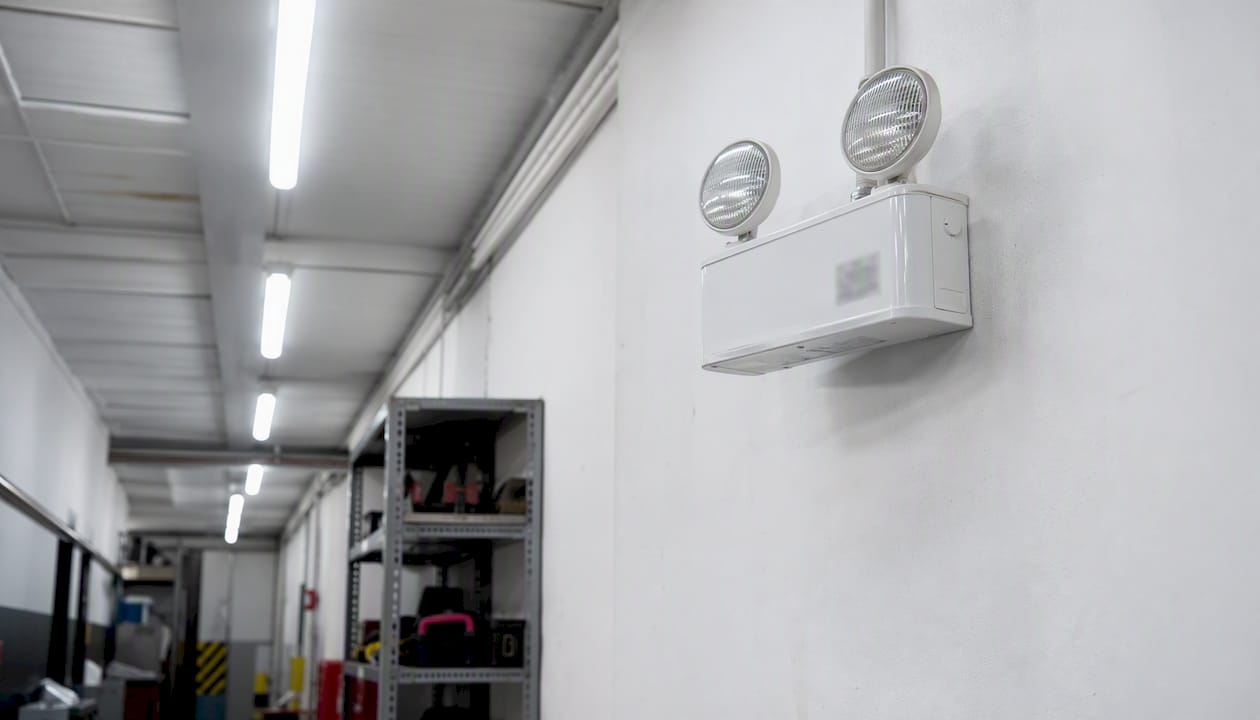
Sustained (or combined) fittings are a hybrid: they contain two separate lamp circuits, one connected to mains for normal illumination and one connected to the battery for emergency use. The fitting stays lit at all times, but the two circuits operate independently. You will also see the term switchable used for fittings that can be wired as either maintained or non-maintained at installation.
A practical wiring note worth knowing:
- Maintained fittings wired as switchable can often be reconfigured for non-maintained operation at the fitting’s terminal block.
- Dedicated non-maintained fittings cannot be converted to maintained operation without replacing the fitting entirely.
- If you are retrofitting an existing installation, check the fitting label before assuming it can be rewired.
How maintained and non-maintained systems actually work
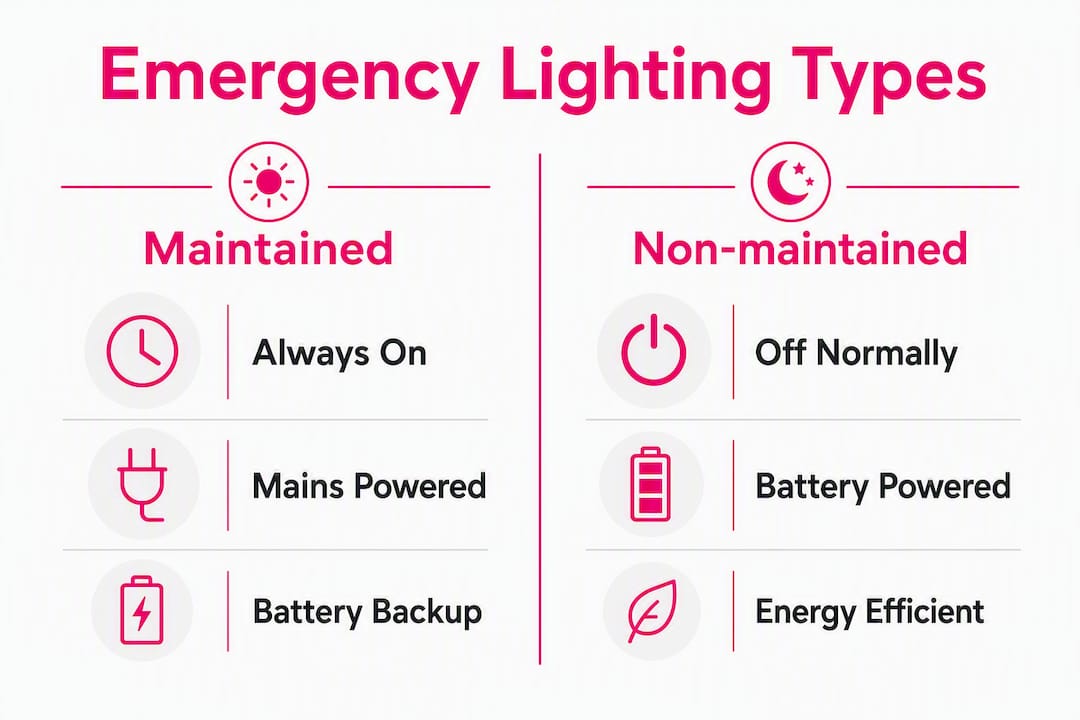
Both types share the same core components: an LED lamp or lamp array, a charge circuit, a sealed battery (usually NiCd or lithium), and a monitoring circuit. The difference is in how power flows under normal conditions.
During normal mains operation, a maintained fitting powers its lamp directly from mains while simultaneously trickle-charging its battery. A non-maintained fitting does nothing visible; it simply keeps its battery charged and waits.
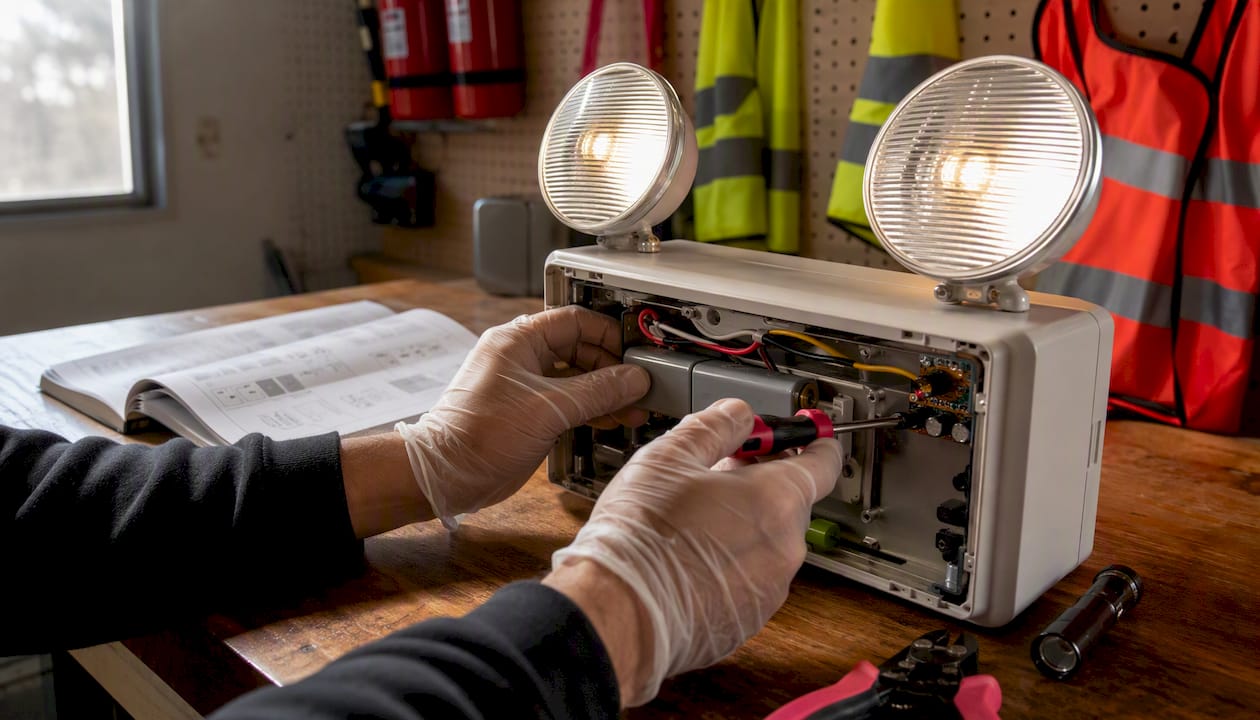
On mains failure, both types switch to battery power and illuminate. The transition is near-instantaneous for self-contained units. Central battery systems, used in larger commercial buildings, feed multiple fittings from a single battery bank and can offer more granular monitoring, but they require a more complex installation and a dedicated battery room.
Rated duration is the period a fitting must sustain full light output on battery alone. Under AS/NZS 2293, the standard rated duration is a minimum of 90 minutes. This is not a target; it is a minimum. Any fitting that fails to deliver at least 90 minutes during the annual discharge test must be repaired or replaced and re-tested before the building is considered compliant.
Battery condition is the most common failure point for both types. Non-maintained units tend to have longer component life because they are not energised continuously, but the battery degrades regardless of whether the lamp runs. Tracking battery age is the single most effective way to avoid surprise failures during the annual discharge test.
Where each type is typically used across different building types
Occupant familiarity drives the decision more than any other factor. Here is how that plays out across common building types.
1. Public assembly and visitor areas
Cinemas, shopping centres, hotel lobbies, theatres and function venues almost always specify maintained fittings. Visitors arrive unfamiliar with the layout, often in low-ambient conditions (a darkened cinema, for example), and need continuous visual cues to locate exits before an emergency occurs. A non-maintained fitting that activates only on mains failure gives those occupants no prior reference point.
2. Workplaces and staff-only zones
Open-plan offices, warehouses and manufacturing floors with regular staff typically suit non-maintained fittings in back-of-house areas. Staff know the escape routes. Running maintained fittings in a warehouse 24 hours a day adds energy cost with minimal safety benefit for people who walk those aisles daily.
3. Strata and mixed-use buildings
Strata lobbies, lift foyers and common corridors serving residents and visitors warrant maintained fittings. Back-of-house areas such as bin rooms, plant rooms and car park service corridors can use non-maintained units. A well-designed strata installation often uses both, with maintained fittings on the public path of travel and non-maintained in areas accessible only to maintenance staff.
4. Hospitality and licensed venues
Hotels, restaurants and licensed clubs carry a high proportion of unfamiliar occupants, often in low-light conditions. Maintained fittings are standard throughout guest-accessible areas. Back-of-house kitchens and service corridors can use non-maintained, provided staff are regularly briefed on escape routes.
5. Healthcare and aged care facilities
Continuous illumination is standard in corridors, wards and common areas. Patients and residents may be disoriented or mobility-impaired; a fitting that only activates on mains failure is not appropriate where occupants need constant orientation cues.
6. Industrial and plant rooms
Non-maintained fittings are the norm in plant rooms, electrical switchrooms and storage areas accessed only by qualified personnel. The energy saving is real, and the safety case for continuous illumination is weak when access is restricted.
7. Mixed-use recommendation matrix
| Building zone | Preferred type | Rationale |
|---|---|---|
| Public foyers and lobbies | Maintained | Unfamiliar occupants need continuous visual cues |
| Cinemas and theatres | Maintained | Low ambient light; visitors unfamiliar with layout |
| Staff offices and open plan | Non-maintained | Regular occupants know escape routes |
| Warehouses and plant rooms | Non-maintained | Restricted access; energy saving justified |
| Strata common corridors | Maintained | Mixed occupant familiarity |
| Back-of-house service areas | Non-maintained | Staff-only access |
| Aged care corridors | Maintained | Occupants may be disoriented or mobility-impaired |
Advantages and disadvantages: maintained vs non-maintained
| Factor | Maintained | Non-maintained |
|---|---|---|
| Visibility before emergency | Always visible; occupants can locate exits at any time | Not visible until mains fails; no pre-emergency orientation |
| Energy use | Higher; lamp runs continuously from mains | Lower; lamp is off during normal operation |
| Component wear | Higher lamp and driver wear due to continuous operation | Lower lamp wear; battery still degrades regardless |
| Typical failure mode | Lamp failure or battery failure | Battery failure (most common); lamp failure less frequent |
| Maintenance cost | Lamp replacements more frequent | Fewer lamp replacements; battery replacement similar |
| Suitability for public areas | Strong; recommended for visitor-facing zones | Weak; not recommended where occupants are unfamiliar |
| Suitability for staff-only areas | Acceptable but often over-specified | Strong; cost-effective and compliant |
| Conversion flexibility | Switchable units can be rewired as non-maintained | Cannot be converted to maintained without replacement |
Non-maintained lighting is more energy efficient in day-to-day operation because it remains off until needed, which makes it cost-effective for areas with familiar occupants. That energy saving is real, but it should not be the primary reason to specify non-maintained in a public-facing area. The perceived cost saving from fitting non-maintained units in a hotel lobby, for example, is a false economy when weighed against the safety and liability exposure of occupants who cannot locate exits before the emergency begins.
What AS/NZS 2293 requires: testing, records and responsibilities in Australia
AS/NZS 2293.2 sets the testing obligations for emergency lighting in Australian buildings. The requirements are not optional and apply regardless of whether your system is maintained or non-maintained.
Testing schedule
| Test type | Frequency | Who should carry it out |
|---|---|---|
| Visual inspection (lamp, indicator, physical damage) | Monthly | Building manager or trained facilities staff |
| Routine function test (brief discharge, confirm operation) | Every 6 months | Qualified electrician or trained tester |
| Rated-duration discharge test (full 90-minute discharge) | Every 12 months | Qualified electrician; Level 2 contractor for complex systems |
| Re-test after repair or replacement | Immediately after repair | Qualified electrician |
NSW workplace guidance aligns with AS/NZS 2293.2: routine function tests every six months and a full rated-duration discharge test (minimum 90 minutes) every 12 months. SafeWork NSW identifies emergency lighting as a key safety factor in workplace compliance.
Emergency and exit lights in Australian workplaces must be inspected and tested regularly, with failed fittings repaired or replaced and re-tested before the building is considered compliant. A fitting that fails the 90-minute discharge test cannot simply be noted in the log and left; it must be remedied.
Recordkeeping
Every test must be recorded in a logbook. The logbook is your evidence of compliance during a SafeWork NSW audit, an insurance claim, or a fire investigation. Records should include the date, the tester’s name and licence number, the fitting ID or location, the test type, the result, any remedial action taken, and the date the next test is due.
Who is responsible?
The building owner or occupier carries the legal duty to maintain compliant emergency lighting. In practice, that means engaging a qualified electrician for compliance testing and keeping the logbook current. For complex systems, central battery installations, or buildings with a large number of fittings, a Level 2 contractor is the appropriate choice.
How to choose between them and what to ask your installer
Decision checklist
Work through these questions before specifying either type:
- Who uses this area? Visitors and members of the public unfamiliar with the layout need maintained fittings on their path of travel.
- What are the ambient light conditions? Low-light environments (cinemas, restaurants with mood lighting) increase the case for maintained fittings.
- What are the hours of operation? A 24-hour facility with shift workers who know the building well can justify non-maintained in staff areas.
- Are escape routes clearly signed and unobstructed? Non-maintained fittings rely on occupants already knowing the route; if signage is poor, maintained is safer.
- What is the existing wiring? Retrofitting maintained fittings into a non-maintained circuit requires rewiring; check before specifying.
Questions to ask your installer
- What battery chemistry does the fitting use, and what is the rated service life?
- Can you confirm the fitting meets the 90-minute rated duration under AS/NZS 2293?
- What test regime do you recommend, and will you provide a logbook template?
- Is the fitting switchable, and can it be rewired if our building use changes?
- What warranty covers the battery separately from the fitting?
- Do you offer an ongoing maintenance contract that includes the annual discharge test?
Red flags in quotes
- No reference to AS/NZS 2293 anywhere in the quote or specification.
- No mention of a test log or logbook service.
- Vague or absent warranty on batteries (battery warranty should be stated separately from the fitting warranty).
- A quote that specifies non-maintained throughout a building with significant public access without any justification.
Pro Tip: Ask your installer to label each fitting with its installation date and battery replacement date at the time of fitting. This single habit reduces the risk of unexpected failures during the annual discharge test and makes logbook entries faster and more accurate.
A practical testing checklist and sample log template
Monthly visual check
- Confirm the charge indicator light is active on each fitting.
- Check for physical damage to the fitting, lens or housing.
- Confirm the fitting is not obstructed by new shelving, signage or stored goods.
- Note any fittings showing a fault indicator and log them for follow-up.
Six-monthly function test
- Simulate mains failure (isolate the circuit) and confirm each fitting illuminates.
- Check that illumination covers the intended escape path.
- Restore mains and confirm the fitting returns to normal charge mode.
- Record the result, tester name, licence number and date in the logbook.
Annual 90-minute rated-duration discharge test
- Isolate the circuit and allow each fitting to run on battery for the full 90 minutes.
- Confirm each fitting maintains adequate light output for the full duration.
- Any fitting that fails must be repaired or replaced and re-tested before the log is closed.
- Record battery age, test result, remedial action and next test due date.
Sample logbook columns
| Date | Tester name | Licence no. | Fitting ID / location | Test type | Result | Remedial action | Next test due |
|---|---|---|---|---|---|---|---|
| 12 March | J. Smith | EC123 | Exit-1 / Main lobby | 90-min discharge | Pass | Nil | March |
| 12 March | J. Smith | EC123 | BH-4 / Plant room | 90-min discharge | Fail | Battery replaced March; re-tested pass | March |
Monthly visual checks and regular logbook records are best practice; a failed duration test requires immediate repair or replacement and re-testing to remain compliant.
Pro Tip: Write the battery installation date directly on the battery with a permanent marker at the time of replacement. Most emergency lighting batteries have a limited service life, typically a few years; a battery approaching that age should be replaced proactively rather than waiting for a test failure.
Key takeaways
Maintained fittings suit public-facing areas; non-maintained suit staff-only zones, and AS/NZS 2293 requires six-monthly function tests and an annual rated-duration discharge test for both types in Australian buildings.
| Point | Details |
|---|---|
| Primary selection rule | Choose maintained for public areas with unfamiliar occupants; non-maintained for staff-only zones. |
| AS/NZS 2293 test cadence | Routine function testing every six months; full rated-duration discharge test (minimum 90 minutes) every 12 months. |
| Battery is the weak link | Battery failure is the most common cause of test failure in both maintained and non-maintained systems. |
| Switchable fittings | Maintained fittings can often be rewired as non-maintained; dedicated non-maintained units cannot be converted. |
| Hdlevel2electriciansydney | A certified Level 2 contractor in Sydney offering site inspections, AS/NZS 2293 testing, and electrical maintenance packages. |
The case for getting this decision right the first time
Most building owners treat the maintained vs non-maintained choice as a cost question. It is not. It is a risk question, and the cost framing leads to predictable mistakes: non-maintained fittings installed in hotel corridors to save on energy, or maintained fittings over-specified in a warehouse where the energy cost adds up over years with no meaningful safety benefit.
The part that tends to get overlooked is occupant psychology. A maintained exit sign does something a non-maintained fitting cannot: it builds a mental map for every person who walks past it on an ordinary day. When the emergency happens, that map is already there. A non-maintained fitting, however bright it is when it activates, cannot give an unfamiliar visitor the spatial memory they need to move confidently toward an exit in a smoke-filled corridor.
The compliance side is more straightforward than people expect. AS/NZS 2293 is clear, the test schedule is fixed, and the logbook requirement is not onerous if you set it up properly from the start. The buildings that struggle with compliance are almost always the ones that deferred the logbook setup, lost track of battery ages, or assumed the annual test would be fine without checking battery installation dates first.
Specifying the right type from the outset, labelling batteries at installation, and booking the annual discharge test before it becomes urgent are the three habits that keep a building compliant without drama.
Hdlevel2electriciansydney: certified testing, supply and compliance for Sydney buildings
Getting the right emergency lighting system specified, installed and kept compliant is straightforward when you have a certified contractor who knows AS/NZS 2293 from the inside. Hdlevel2electriciansydney is a Level 2 electrical contractor in Sydney with over 300 five-star reviews, available 24/7 for emergency callouts, routine testing and full compliance packages.
The team handles site inspections, maintained and non-maintained fitting supply and installation, switchable fitting retrofits, full rated‑duration discharge testing every 12 months, logbook setup and ongoing commercial electrical compliance documentation. Free site inspections are available for Level 2 work, so you can get a clear picture of your current system and what it needs before committing to any work. If a fitting fails its annual test, the team can respond the same day to repair or replace it and get your logbook back in order. Contact Hdlevel2electriciansydney to book your site inspection or schedule your next AS/NZS 2293 compliance test.
Useful sources and further reading
- AS/NZS 2293 — Standards Australia: the primary Australian standard governing emergency lighting design, installation and testing.
- Liberty Test and Tag — emergency exit light testing services: practical guidance on Australian testing obligations and the 90-minute discharge requirement.
- Liberty Test and Tag — NSW testing frequency guide: NSW-specific context on SafeWork NSW requirements and test schedules.
- TF Installations — maintained vs non-maintained overview: detailed explanation of switchable fittings and wiring considerations (UK practice; verify against AS/NZS 2293 for Australian applications).
- Safelincs — testing and maintenance best practice: logbook and monthly check guidance applicable to Australian sites.
- Prolec — non-maintained emergency lighting explained: clear explanation of energy efficiency and use-case rationale for non-maintained systems.
- LG12: Emergency Lighting (2022) — CIBSE: authoritative technical guide covering lighting design, maintenance factors and testing methodology.
This article provides general information about emergency lighting types and Australian compliance obligations. It is not a substitute for professional electrical advice. Confirm current AS/NZS 2293 requirements and your specific obligations with a licensed electrician or the relevant authority.
Recommended
Powering Your Needs with Expertise
If you’re looking for a reliable, experienced, and prompt electrician, look no further than High Demand Electrical. We cater to all your electrical needs, from routine maintenance to emergency repairs and complete system installations. Our skilled team is committed to providing professional service that ensures your electrical systems run smoothly. Whether it's a small task or a large project, give us a call today. Let us meet all your electrical demands with the quality and reliability you deserve.