Emergency lighting requirements NSW: what building owners must do
If your NSW building falls under Class 5–9 of the National Construction Code and has a storey exceeding 300 m², emergency lighting is legally required under NCC Part E4. The technical performance standard is AS/NZS 2293, and SafeWork NSW treats compliant, maintained emergency lighting as a workplace duty of care. Here is what you need to know right now:
Compliance triggers at a glance:
- Building class: Classes 5–9 (commercial, industrial, public assembly, health care, aged care) are the primary trigger; Class 2–4 residential buildings have separate NSW housing provisions
- Floor area: Any storey with a floor area over 300 m² in a Class 5–9 building requires emergency lighting
- Rooms: Any room over 100 m² that does not open directly to a corridor or open space with lighting
- Escape routes: All fire-isolated stairways, passageways, and required exit paths regardless of area
Minimum performance criteria (AS/NZS 2293 / NCC Part E4):
- Illuminance: at least 0.2 lux at floor level along the path of travel to an exit
- Activation: at least 0.02 lux (10% of 0.2 lux) within 1 second after mains failure
- Full illuminance: minimum 0.2 lux reached within 60 seconds
- Runtime: minimum continuous operation for 90 minutes
Testing cadence: function test every six months; full 90-minute discharge test every year.
The building owner or person conducting a business or undertaking (PCBU) carries the compliance obligation. The two governing documents are NCC Part E4 and AS/NZS 2293, and SafeWork NSW enforces the workplace safety dimension.
Table of Contents
- What does the NCC require, and when does it apply to your NSW building?
- What does AS/NZS 2293 actually require from your lighting system?
- How often must you test, and what records do you need to keep?
- Who is authorised to install or modify emergency lighting in NSW?
- A practical compliance checklist you can act on today
- What happens if you are not compliant? Enforcement and real risks
- Common technical gotchas in NSW commercial and strata buildings
- How does emergency lighting integrate with fire detection and alarm systems?
- Emergency lighting requirements for temporary structures and special events in NSW
- Key takeaways
- What the compliance failures we see every week actually tell us
- Hdlevel2electriciansydney handles your emergency lighting compliance from audit to certificate
- Authoritative sources and further reading
What does the NCC require, and when does it apply to your NSW building?
The National Construction Code is the primary legal instrument that determines whether your building needs emergency lighting at all. Part E4 of Volume One sets out the triggers, and they are more specific than most building owners realise.
Which building classes and areas are covered?
Class 5 (offices), Class 6 (shops), Class 7 (warehouses and carparks), Class 8 (factories and laboratories), and Class 9 (public assembly, health care, aged care) buildings all fall within Part E4’s scope. The floor area threshold of 300 m² applies to individual storeys, not the total building footprint. A two-storey office where each floor is 200 m² technically sits below the storey threshold, but fire-isolated stairways connecting those floors still require emergency lighting regardless of area.
Rooms deserve particular attention. Any room exceeding 100 m² that does not have a direct opening to a corridor or open space already served by emergency lighting must have its own fittings. This catches large meeting rooms, open-plan spaces subdivided by fit-outs, and plant rooms in commercial buildings.
Required stairways and passageways forming part of a required exit path are covered unconditionally. There is no area exemption for these spaces.
NSW-specific provisions you must check
NSW adopts the NCC with state-specific amendments. For residential and associated building types, the NSW Housing Provisions Part 9.5 replaces or amends national clauses on smoke alarms and evacuation lighting. If your building is Class 2 or 3, or contains a mix of residential and commercial uses, you need to check both the NCC Volume One (Part E4) and the NSW-adopted housing provisions to confirm which clauses govern your situation. Relying on the national document alone can leave you non-compliant under NSW law.
Three fastest compliance checks for any NSW building:
- Building class: Is it Class 2–9? If yes, identify whether NCC Volume One (Part E4) or the NSW Housing Provisions apply to your building type.
- Floor area: Does any storey exceed 300 m² (Class 5–9), or does any room exceed 100 m² without a direct opening to a lit corridor or open space?
- Escape routes: Are there fire-isolated stairways, passageways, or required exit paths? These require emergency lighting regardless of area.
The NCC 2022 update clarified the relationship between Part E4 and AS/NZS 2293, making the standard the definitive technical reference for any building that triggers the NCC requirement. If your building was constructed or significantly renovated after NCC 2022 came into force, the updated provisions apply.
What does AS/NZS 2293 actually require from your lighting system?
Once the NCC establishes that emergency lighting is required, AS/NZS 2293 dictates exactly how the system must perform. Think of the NCC as the “whether” and AS/NZS 2293 as the “how.”
Core performance numbers
The four figures every building manager must know are 0.2 lux, 1 second, 60 seconds, and 90 minutes. These are not guidelines; they are minimum thresholds. A system that delivers 0.18 lux at floor level along the path of travel is non-compliant, full stop.
| Performance criterion | Minimum requirement |
|---|---|
| Illuminance at floor level (path of travel) | 0.2 lux |
| Minimum illuminance within 1 second of mains failure | 0.02 lux (10% of required) |
| Time to reach full required illuminance | Within 60 seconds |
| Minimum rated operating duration | 90 minutes |
System types: central battery, single-point, and self-contained
Self-contained fittings house the battery, lamp, and control gear in a single unit. They are the most common choice for small to medium commercial buildings in NSW because they are straightforward to install and test. The trade-off is that each fitting’s battery must be individually tested and replaced, which adds maintenance time across large buildings.
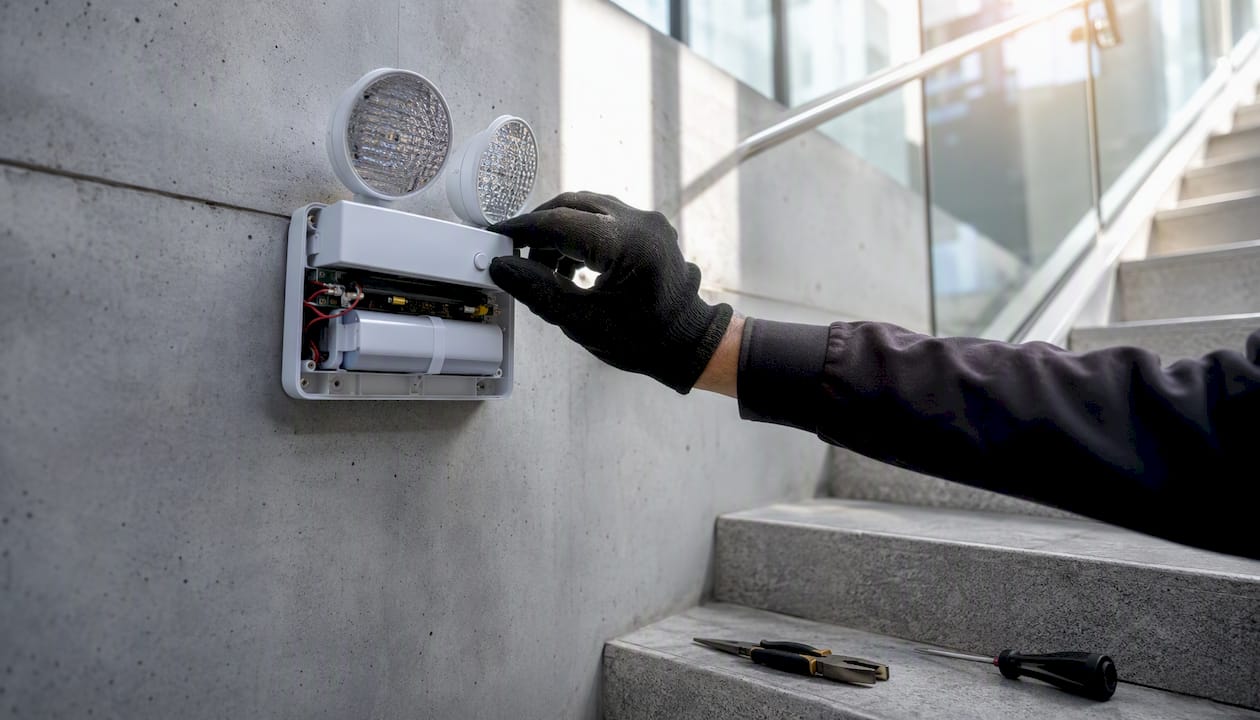
Central battery systems supply power to multiple fittings from a single battery bank, typically housed in a dedicated room or cabinet. They suit larger buildings or those with high fitting counts because battery maintenance is centralised. The risk is that a single battery bank failure can take down an entire zone, so regular discharge testing of the central supply is critical.
Single-point (monitored) systems sit between the two: individual fittings are powered from a dedicated circuit with central monitoring. They offer the installation simplicity of self-contained units with some of the monitoring benefits of a central battery.
Fixture classification and why it matters for replacement
AS/NZS 2293 classifies emergency luminaires from Class A through to Class E, with additional axis ratings (C0, C90, C180) that describe the photometric distribution of the fitting. The classification directly determines the maximum spacing between fittings. A Class A fitting can cover a longer path than a Class D fitting at the same mounting height.
When a fitting is replaced, the replacement must meet or exceed the classification of the original. Substituting a lower-class fitting is one of the most common compliance failures found in NSW commercial buildings. The immediate consequence is that the spacing between the new fitting and its neighbours may now exceed what the lower classification permits, creating a dark zone on the path of travel. Design and installation work should always reference the full AS/NZS 2293 spacing tables rather than rely on rule-of-thumb estimates, because the fitting’s classification drives both the number of fittings required and their layout.
Pro Tip: When ordering replacement fittings, request the photometric data sheet from the supplier and confirm the AS/NZS 2293 classification before purchasing. A fitting that looks identical to the original may carry a lower classification and force you to add extra fittings to maintain compliant spacing.
How often must you test, and what records do you need to keep?
Testing is where most buildings fall short. Having compliant fittings installed is only half the obligation. AS/NZS 2293.2:2019 sets out the inspection and maintenance requirements, and SafeWork NSW expects these to be followed as part of your workplace safety obligations.
Who can perform the tests?
Testing must be carried out by a competent person. In practice, this means a licensed electrician or a certified technician with documented experience in AS/NZS 2293.2 testing. Building managers who conduct their own visual checks between formal inspections are not substituting for the required competent-person tests; they are supplementing them.
What records must you keep?
A compliant logbook entry for each test must include:
- Date of inspection or test
- Location and fitting identification (fitting ID or map reference)
- Type of test conducted (routine inspection, function test, or 90-minute discharge)
- Duration result for discharge tests
- Pass or fail outcome
- Any defects identified
- Corrective action taken and date completed
- Name and licence number of the tester
Records should be retained for a minimum of five years. A digital logbook stored in a cloud-based system is practical for multi-tenancy buildings and strata properties because it gives the building manager, strata committee, and any auditor immediate access to the full test history.
Pro Tip: Keep a separate defect register alongside your logbook. When a fitting fails, log the defect immediately with a photo, then record the remedial action and re-test date as a linked entry. An auditor or insurer reviewing your records after an incident will look for this chain of evidence.
Who is authorised to install or modify emergency lighting in NSW?
Installation and commissioning of emergency lighting systems is electrical work and must be carried out by a licensed electrician. In NSW, this means a person holding a current electrical contractor’s licence or working under the supervision of one, issued by NSW Fair Trading. For complex or large-scale systems, a Level 2 authorised service provider may be involved where the work connects to or affects the metered supply.
What commissioning deliverables should you demand?
When engaging a contractor for a new installation or a significant upgrade, you are entitled to receive a complete commissioning package. Do not accept verbal confirmation that the work is done. The minimum documentation you should require includes:
- Classification and spacing evidence — confirming each fitting’s AS/NZS 2293 classification and that spacing complies with the standard’s tables
What to check on a contractor quote
Before engaging any contractor for emergency lighting installation or commissioning work, confirm the following:
- Current NSW electrical contractor’s licence (verify on the NSW Fair Trading register)
- Demonstrated experience with AS/NZS 2293.1 installations (ask for examples)
- Public liability and professional indemnity insurance
- Commitment to provide commissioning certificate and test log on completion
- Warranty terms on both labour and fittings supplied
A contractor who cannot provide a commissioning certificate or who is unfamiliar with AS/NZS 2293 classification requirements is a compliance risk, not a solution.
A practical compliance checklist you can act on today
Getting from “we think we’re compliant” to “we can prove we’re compliant” requires a structured approach. The following steps work for most small to medium commercial and strata buildings in NSW.
Immediate actions
- Map your building class and applicable standard: — Confirm whether NCC Part E4 (Volume One) or the NSW Housing Provisions apply to your building type.
Remediation workflow
Once you have the audit results, prioritise fittings on primary escape routes first. For each failed or suspect fitting: verify the replacement’s AS/NZS 2293 classification matches or exceeds the original, install by a licensed electrician, re-test the fitting, and update the logbook with the remedial entry and re-test result.
Compliance timeline for a typical small to medium building
| Step | Action | Target window |
|---|---|---|
| 1. Initial audit | Map building, photograph all fittings, review logbook | Week 1–2 |
| 2. Remediation | Replace failed/non-compliant fittings, verify classifications | Week 2–4 |
| 3. Re-test | 6-monthly function test on all fittings post-remediation | Week 4–5 |
| 4. 90-minute discharge | Full annual discharge test on all fittings | Within 12 months of last discharge test |
| 5. Ongoing schedule | 6-monthly function tests; annual discharge tests | Recurring |
For a commercial electrical compliance audit, engaging a licensed electrician to conduct steps 1–3 together is the most efficient path to an auditable record.
Sample logbook fields
A logbook entry for each fitting should capture: date, building address, floor/zone, fitting ID, test type, discharge duration (if applicable), pass/fail, defect description, corrective action, corrective action date, and tester name and licence number. Standardising this across all fittings means any technician or auditor can read the record without needing to interpret shorthand.
What happens if you are not compliant? Enforcement and real risks
Non-compliance with emergency lighting requirements in NSW is not a theoretical risk. Multiple agencies have the authority to inspect, audit, and enforce, and the consequences range from improvement notices to insurance claim denial.
Who enforces and what they look for
Building certifiers check emergency lighting compliance at the construction and occupation certificate stage. Local councils can inspect during routine building audits. SafeWork NSW inspectors may visit following a workplace incident or complaint and will check whether emergency lighting systems are maintained and tested in accordance with AS/NZS 2293. Fire and Rescue NSW may also review emergency systems as part of fire safety audits under the Environmental Planning and Assessment Act.
Each agency looks for the same core evidence: a current logbook, test results within the required intervals, and fittings that are physically intact and operational.
Typical enforcement outcomes
An improvement notice from SafeWork NSW requires you to fix the identified issue within a specified timeframe. Failure to comply can escalate to a rectification order and, ultimately, a penalty. Beyond regulatory penalties, the insurance consequence is often more immediately damaging: if a fire or evacuation incident occurs and your insurer discovers that emergency lighting was not tested or maintained to the required standard, a claim can be denied on the grounds of failure to maintain a safe premises.
A scenario that plays out more often than it should:
A building manager defers the annual 90-minute discharge test for 18 months, assuming the fittings are fine because the charge indicators are green. A building certifier conducting a routine audit requests the logbook. The last discharge test entry is 22 months old. The certifier issues an improvement notice requiring a full discharge test within 14 days and documentary evidence of any failed fittings being replaced. Three fittings fail the belated discharge test, requiring immediate replacement. The total remedial cost, including the licensed electrician’s time, replacement fittings, and re-testing, exceeds what two years of scheduled testing would have cost.
The practical mitigation is straightforward: keep tests current, document repairs the day they are completed, and engage a licensed electrician for commissioning and any hard-wired remedial work. An electrical safety inspection that includes emergency lighting testing gives you a defensible, dated record before any audit arrives.
Common technical gotchas in NSW commercial and strata buildings
Practitioners working across Sydney’s commercial and strata stock encounter the same problems repeatedly. Knowing them in advance lets you check for them proactively rather than discover them during an audit.
Mismatched replacement fittings
The most frequent compliance failure is a maintenance team or facilities manager ordering a replacement fitting based on physical appearance rather than AS/NZS 2293 classification. The new fitting looks right, fits the housing, and the charge indicator glows green. But if its classification is lower than the original, the spacing between it and adjacent fittings may now exceed what the standard permits. The result is a dark zone on the path of travel that only becomes apparent during a lux measurement test.
Batteries past service life in LED fittings
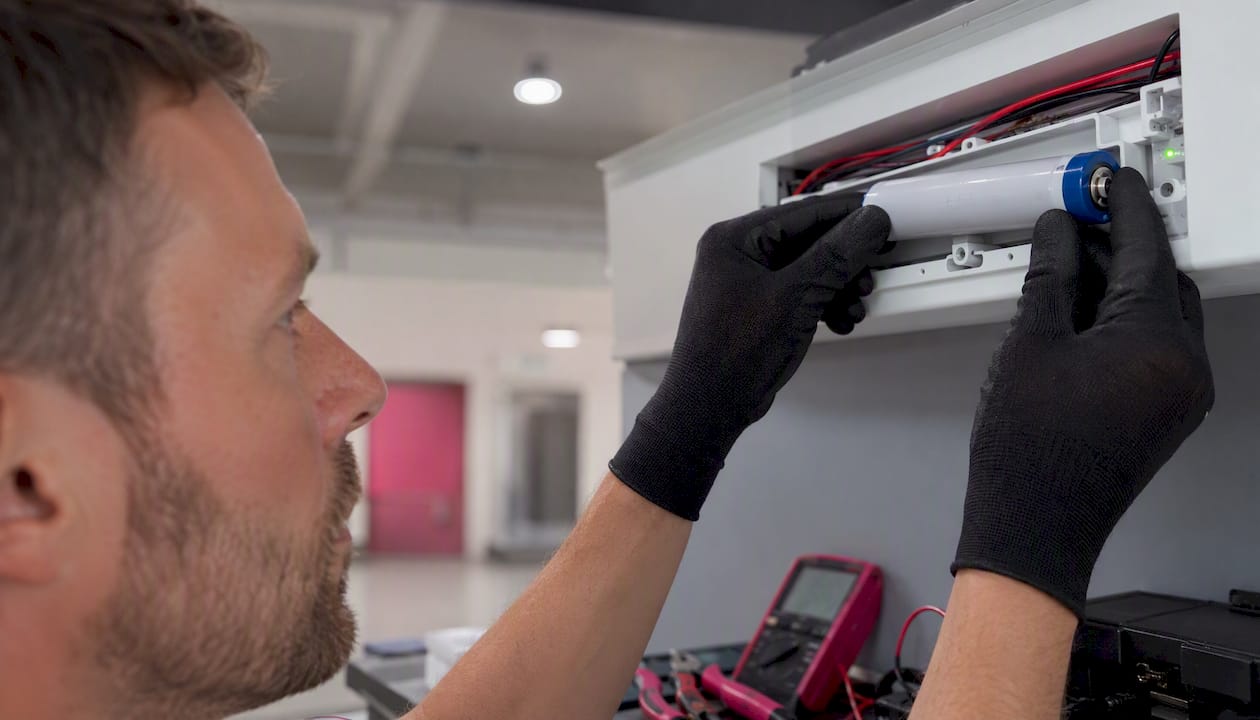
LED emergency fittings last far longer than their fluorescent predecessors, and this creates a false sense of security. The lamp may still be working perfectly after seven years, but the battery inside the fitting has a typical service life of four to five years. Testing guides used in NSW workplaces consistently highlight battery failure as the primary mode of non-compliance in LED fittings. The 90-minute discharge test is the only reliable way to catch a degraded battery before it matters.
Central battery bank failures after maintenance gaps
Buildings with central battery systems are particularly vulnerable when maintenance contracts lapse. A central battery bank that has not been discharge-tested for two or more years can fail silently: the monitoring panel shows no fault, but the battery can no longer sustain the load for 90 minutes. When the mains fails in a real emergency, the system drops out well before the building is evacuated.
Logbook discontinuity after contractor changes
When a building changes its maintenance contractor, the new contractor often starts a fresh logbook without obtaining the previous records. From an audit perspective, a logbook that starts in 2024 with no prior history looks like a building that had no testing before 2024. Always request the full test history from the outgoing contractor and keep it with the current logbook.
Pro Tip: When procuring replacement fittings, ask the supplier for the AS/NZS 2293 classification data sheet before ordering. Keep a register of every fitting’s classification, location, and installation date. When a fitting needs replacing, the register tells you exactly what classification you need to match or exceed, and you can order with confidence.
How does emergency lighting integrate with fire detection and alarm systems?
Emergency lighting and fire detection systems serve the same ultimate purpose: getting people out of a building safely when something goes wrong. In NSW buildings, these systems are often installed and maintained separately, but their interaction is a compliance consideration that building owners and managers need to understand.
Under NCC Part E4, emergency lighting must activate automatically on loss of normal mains supply. In practice, this means the system responds to a power failure, which can be caused by a fire tripping a circuit breaker or a fire alarm panel isolating circuits as part of its response sequence. The emergency lighting system does not need to be directly triggered by the fire alarm panel to meet the NCC requirement; it needs to activate on mains loss, which a fire event typically causes.
However, in more sophisticated building management systems, emergency lighting is often integrated with the building’s fire indicator panel (FIP) so that specific zones can be activated or held on in response to a fire alarm signal. This is particularly relevant in large Class 9 buildings such as hospitals, aged care facilities, and public assembly venues, where staged evacuation means some areas need to remain lit while others are cleared.
The key compliance point for building owners is that integration does not reduce the AS/NZS 2293 performance obligations. Whether the system is triggered by mains loss alone or by a FIP signal, the 0.2 lux, 1-second, 60-second, and 90-minute criteria still apply. Any integration work must be carried out by a licensed electrician familiar with both AS/NZS 2293 and the relevant fire detection standard, AS 1670.1. Commissioning documentation should cover both systems and confirm that the integration does not compromise either standard’s requirements.
For buildings where emergency lighting circuits share switchboard space with fire alarm circuits, a switchboard upgrade may be required to ensure adequate separation and to support the load demands of a central battery system.
Emergency lighting requirements for temporary structures and special events in NSW
Temporary structures and special events present a compliance question that many event organisers and venue managers in NSW underestimate. The short answer is that the NCC and AS/NZS 2293 requirements do not simply disappear because a structure is temporary.
Under the Environmental Planning and Assessment Act 1979 and associated regulations in NSW, temporary structures used for public events, including marquees, stages, grandstands, and temporary buildings, require development consent or an exemption, and the consent conditions typically require compliance with relevant NCC provisions. For a temporary structure used as a public assembly space (Class 9b), emergency lighting is required on the same basis as a permanent building of that class.
The practical challenge is that temporary structures often rely on generator power or temporary electrical supplies, which creates additional complexity for emergency lighting. The system must still activate on loss of the primary supply and sustain 90 minutes of operation. Self-contained battery-backed fittings are the most practical solution for temporary structures because they do not depend on a continuous supply from the generator.
Event organisers should also be aware that WorkCover (now SafeWork NSW) guidance on temporary structures and public events treats emergency egress lighting as a workplace safety obligation for any event where workers are present, which covers virtually every commercial event in NSW.
The practical steps for event compliance are:
- Confirm with the local council or certifier whether the temporary structure requires development consent and what NCC provisions apply
- Specify self-contained AS/NZS 2293-compliant emergency fittings for all required escape routes within the structure
- Conduct a function test of all fittings before the event opens to the public
- Retain a written record of the pre-event test, including the tester’s name and the date
For recurring events at the same venue, a standing testing protocol and a retained logbook covering each event cycle is the most defensible approach.
Key takeaways
Emergency lighting compliance in NSW requires meeting NCC Part E4 triggers, maintaining AS/NZS 2293 performance standards, and keeping a tested, documented logbook that can withstand an audit from SafeWork NSW or a building certifier.
| Point | Details |
|---|---|
| NCC Part E4 triggers | Class 5–9 buildings with storeys over 300 m², rooms over 100 m², and all required exit paths must have emergency lighting. |
| AS/NZS 2293 performance | Systems must deliver 0.2 lux at floor level, provide at least 0.02 lux within 1 second, reach full level in 60 seconds, and run for 90 minutes. |
| Testing schedule | Function test every 6 months; full 90-minute discharge test every 12 months, conducted by a competent licensed electrician. |
| Records and logbooks | Every test must be logged with date, fitting ID, test type, result, defects, corrective action, and tester licence number. |
| Hdlevel2electriciansydney | Hdlevel2electriciansydney conducts AS/NZS 2293.2 testing, commissioning, and remedial work across Sydney, handing over a commissioning certificate and test logbook on completion. |
What the compliance failures we see every week actually tell us
The gap between “installed” and “compliant” is wider than most building owners expect, and it almost always comes down to documentation and testing cadence rather than the fittings themselves.
The buildings that face the most expensive remediation are not the ones that never installed emergency lighting. They are the ones that installed it correctly, then let the testing lapse for two or three years because no one owned the schedule. By the time an audit or an incident forces the issue, batteries have degraded, logbook continuity is broken, and the remedial scope is far larger than a simple re-test would have been.
There is also a persistent misconception that LED fittings are maintenance-free. The lamp may last a decade, but the battery inside that fitting has a service life measured in years, not decades. Skipping the annual 90-minute discharge test on LED fittings is one of the most common ways a building manager unknowingly creates a non-compliant system while believing everything is fine.
The other pattern worth flagging is the replacement fitting problem. Procurement decisions made on price or visual match, without checking the AS/NZS 2293 classification, routinely create dark zones on escape routes that only show up during a lux measurement. The fix is simple: always verify the classification before ordering. The cost of getting it wrong, in additional fittings and re-testing, is always higher than the cost of checking first.
Compliance is not complicated. It is consistent: test on schedule, document every test, replace like-for-like on classification, and engage a licensed electrician for anything that involves the wiring. The building owners who stay out of trouble are the ones who treat emergency lighting as an ongoing maintenance obligation, not a one-time installation task.
Hdlevel2electriciansydney handles your emergency lighting compliance from audit to certificate
Staying compliant with NSW emergency lighting requirements takes more than a working fitting on the wall. It takes a tested system, a current logbook, and a commissioning certificate that holds up under scrutiny. Hdlevel2electriciansydney delivers exactly that for commercial, strata, and residential properties across Sydney.
Our licensed electricians carry out AS/NZS 2293.2 compliance inspections, 6-monthly function tests, and full 90-minute discharge tests, handing over a signed test logbook and remedial evidence photos on the day. When fittings need replacing, we specify and install to the correct AS/NZS 2293 classification, provide as-built drawings, and issue a commissioning certificate. For buildings requiring central battery work or supply upgrades, our team handles the full scope. We are available 24/7 for urgent remedial work after a failed audit or a discovered defect, and we offer free site inspections for Level 2 work.
With over 300 five-star reviews and a track record across Sydney’s commercial and strata sector, Hdlevel2electriciansydney is the team to call when compliance cannot wait. Book your emergency lighting compliance inspection or contact us for a free site assessment today.
Authoritative sources and further reading
The following official documents and practical guides are the primary references for emergency lighting compliance in NSW. Keep copies of the relevant standards alongside your commissioning certificates and test logbooks.
- Part E4 Visibility in an emergency, exit signs and warning systems
- Lighting | SafeWork NSW
- AS/NZS 2293.1:2018 Emergency lighting and exit signs for buildings, Part 1: System design, installation and operation
- Emergency Exit Light Testing Sydney | AS 2293 Compliant
- Emergency & Exit Light Testing Guide for NSW Workplaces
- Part 9.5 Smoke alarms and evacuation lighting
Retain copies of your commissioning certificates, as-built drawings, and full test logbook history. If your building changes maintenance contractors, transfer the complete records to the incoming contractor before the handover is finalised.
Recommended
Powering Your Needs with Expertise
If you’re looking for a reliable, experienced, and prompt electrician, look no further than High Demand Electrical. We cater to all your electrical needs, from routine maintenance to emergency repairs and complete system installations. Our skilled team is committed to providing professional service that ensures your electrical systems run smoothly. Whether it's a small task or a large project, give us a call today. Let us meet all your electrical demands with the quality and reliability you deserve.