Charging Two Electric Cars at Home: What Your Switchboard Needs
Can your switchboard handle charging two electric cars at home? It depends on your existing supply capacity and whether the two chargers can share load intelligently. Many single phase Sydney homes can run two EV chargers safely with the right load management setup, while others genuinely need a switchboard upgrade or a move to three phase power before a second charger is added. The only reliable way to know which situation you are in is a proper maximum demand assessment.
⚡ Quick Answers: Charging Two EVs at Home
- Can one switchboard run two EV chargers? Often yes, but it depends on your existing maximum demand and whether there is enough spare capacity once both chargers, and everything else in the house, are drawing power at once.
- What is load sharing between two chargers? A system that lets two EV chargers communicate and share the available current, so both cars charge without either one tripping the circuit or exceeding your supply capacity.
- Do I need three phase power for two EVs? Not always, but it is common for households wanting to charge two cars quickly at the same time, since three phase gives considerably more usable capacity than single phase.
- What does AS/NZS 3000 require for EV charging circuits? A dedicated final subcircuit with specific minimum cable capacity and dedicated RCD protection, separate from any other socket outlet on the circuit.
- Is adding a second EV charger Level 2 ASP work? Only if it requires upgrading your consumer mains or point of supply. Fitting the charger itself on an existing circuit with spare capacity is standard licensed electrical work.
- Where do I start if I am planning a second charger? With a site assessment that measures your home's actual maximum demand against what two chargers plus your existing appliances will draw together.
1. Why one EV charger is usually easy, but two change the maths
A single home EV charger is a large but manageable addition for most Sydney properties, since modern switchboards and supplies are generally sized with some headroom. Adding a second charger is a different calculation entirely, because you are not just doubling the EV load, you are asking whether your home's total maximum demand, including everything else running at the same time, still fits within what your supply was designed to deliver. This is exactly the kind of assessment covered in our maximum demand explainer, and it is the right starting point before buying a second charger rather than an afterthought.
2. What AS/NZS 3000 requires for EV charging circuits
AS/NZS 3000 sets out specific requirements for EV charging circuits in residential installations under Clause 7.9. For the common Mode 3 and Mode 4 charging setups used by dedicated home EV chargers, the final subcircuit cable must have a minimum current carrying capacity of 32 amps on a single phase supply and must not supply any other socket outlet or point in the wiring. The circuit also needs its own residual current device, specifically a Type B RCD with a maximum rated residual current of 30 milliamps, separate from the general safety switches protecting the rest of your home. Running two chargers means two circuits each meeting this standard, not one circuit shared between both cars.
3. Load sharing and dynamic load management explained
Many modern EV charger installations use load sharing, sometimes called dynamic load management, which lets two chargers communicate electronically and divide the available current between them in real time. Rather than each charger assuming it has the full circuit capacity to itself, the system monitors total demand and automatically reduces each charger's output if both cars are plugged in and charging at the same time, so neither exceeds the supply's real capacity. This is often the most cost effective way to run two chargers off an existing supply, since it avoids the expense of a full upgrade in situations where both cars are not always charging flat out simultaneously.
4. Single phase vs three phase for a two car household
A typical single phase Sydney home has meaningfully less usable capacity than a three phase supply, and running two EV chargers at full speed with no load sharing is often the point where that difference starts to matter. Our single phase to three phase upgrade guide covers what that transition actually involves, and for a two EV household it is worth weighing against load sharing as the two realistic options: upgrade the supply itself, or manage the existing supply more intelligently between two chargers.
5. Switchboard and sub board considerations
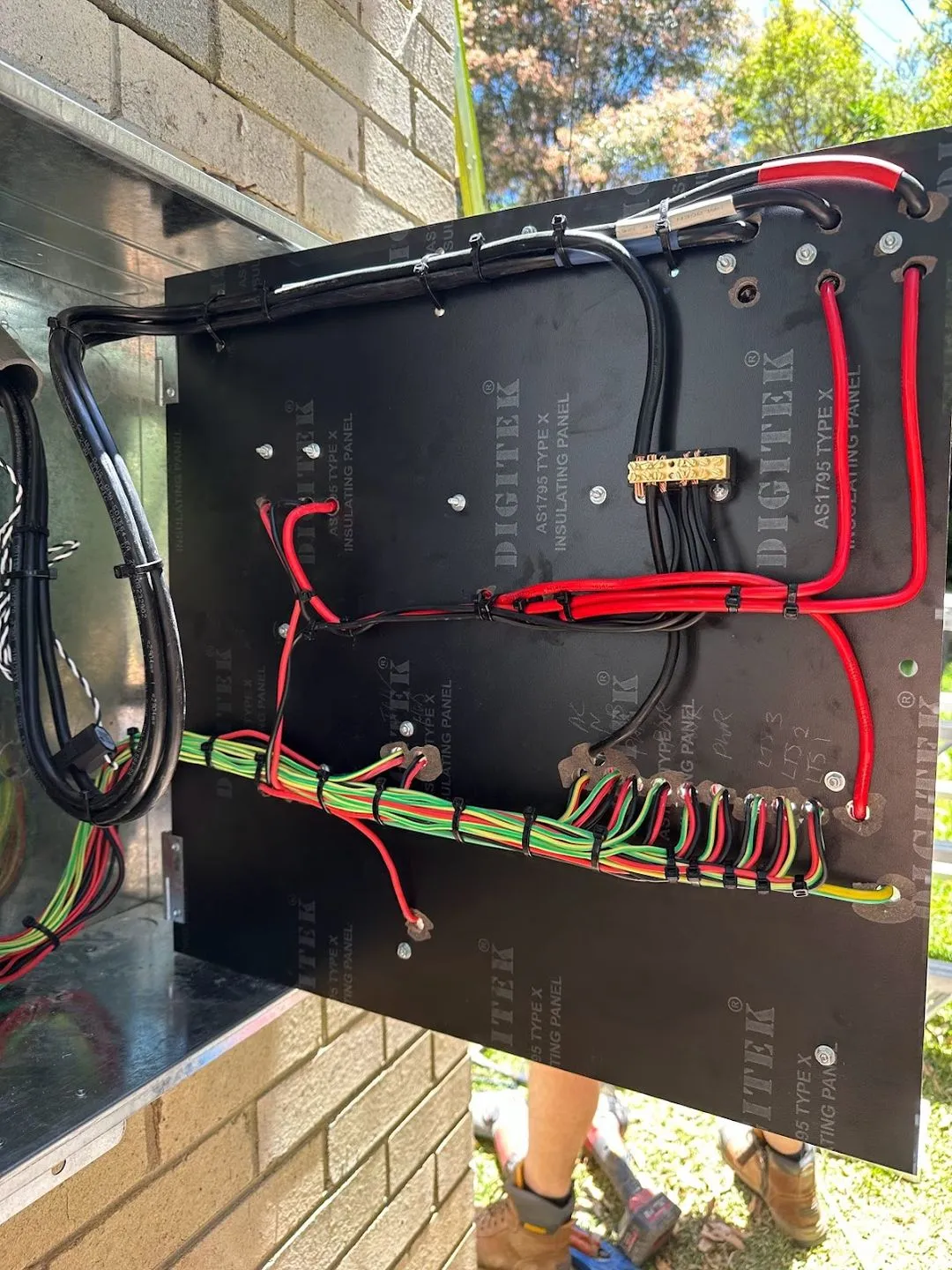
Where a second EV charger is being added some distance from the main switchboard, such as a second car space or a detached garage, a dedicated sub board is often the cleanest solution rather than running a long individual circuit all the way back to the main board. This also makes load sharing easier to wire correctly, since both chargers' control wiring can terminate at the one sub board. Either way, confirming your existing switchboard has the physical space and capacity for two dedicated EV circuits is one of the first things an assessment will check.
6. Off peak scheduling as a practical middle ground
For households not ready for a full supply upgrade, scheduling the two chargers to run at different times, rather than both drawing maximum current simultaneously, is a straightforward way to avoid exceeding capacity without any extra hardware. Most modern EV chargers support scheduled charging through an app, and pairing this with an off peak electricity plan can also reduce the cost of charging two cars rather than just solving the capacity problem.
7. Getting an assessment before you buy a second charger
The most common mistake we see is a household buying a second EV charger and only discovering at installation time that the existing supply cannot comfortably support both running together. A proper site assessment before you purchase, covering your current maximum demand, the condition of your switchboard, and whether load sharing or an upgrade is the better fit for how you actually use both cars, avoids an expensive surprise later.
Why it's sometimes Level 2 ASP work
Fitting a second EV charger onto an existing circuit with genuine spare capacity is standard licensed electrical work. It becomes Level 2 ASP work the moment the assessment shows your consumer mains or point of supply needs upgrading to carry the combined load, since altering that network connected infrastructure sits outside a standard electrician's licence under the NSW Service and Installation Rules. If that is the case for your property, confirming which distributor covers your address with our postcode checker is a useful first step before any application goes in.
How High Demand Electrical helps
High Demand Electrical is a licensed local team, not a call centre, servicing homes and businesses across Sydney's West, South West and Sutherland Shire, and one of Sydney's most trusted Level 2 ASPs across both the Ausgrid and Endeavour Energy networks. For a two EV household, we assess your actual maximum demand, recommend load sharing or a supply upgrade based on real numbers rather than a guess, and handle everything from the power supply upgrade itself through to the EV charger installation, so you are not left coordinating separate contractors for one job.
Charging Two Electric Cars FAQs (Sydney)
Will load sharing slow down my charging time?
It can, since both chargers share the available current rather than each drawing full speed at once, though most households barely notice this if the cars are not both on a tight deadline to finish charging at the same time.
Can I add a second charger to an apartment or strata car space?
Often yes, but strata common property and shared switchboards add extra steps. See our broader guide on assessing switchboard capacity before adding an EV charger for what that assessment covers.
Does a second EV charger affect my smart meter setup?
It can, particularly if you move to an EV specific electricity plan or add load monitoring. See our smart meter upgrades guide for how metering interacts with larger home loads.
Is it cheaper to upgrade to three phase or just use load sharing?
It depends on your household's actual usage pattern and existing supply. A site assessment comparing both options against how you realistically use both cars is the only reliable way to answer this for your specific property.
Do both EV chargers need to be the same brand for load sharing to work?
Not always, but compatibility depends on the specific chargers and load management system chosen, so this is worth confirming as part of your installation quote rather than assuming after both are already purchased.
Planning a second EV charger at home? Get a power supply upgrade quote from High Demand Electrical or call 0402 559 777. Every job starts with a site assessment, since the right setup for two cars depends entirely on your home's real capacity.
Need Help Fast?
1. What are you calculating?
Choose the application — the calculator applies the matching rules from Table C1 or C2 of AS/NZS 3000:2018.
2. Add your loads
3. Results
Show the full working (line by line)
This calculator applies the maximum demand methods in Tables C1 and C2 of AS/NZS 3000:2018 (Appendix C). Appendix C is a guide — the standard permits other assessment methods, and your electricity distributor or the NSW Service & Installation Rules may impose additional requirements. Results are for estimation and education; final maximum demand assessment must be confirmed by a licensed electrician. Ratings entered in watts or kilowatts are converted at 230 V (single-phase) or 400 V (three-phase). Table C1 motors assume pf 0.86 and efficiency 0.95; Table C2 motors assume pf 1 and efficiency 0.95, per the standard's conventions.
Project information
These details appear on your PDF report.
Related Services

Powering Your Needs with Expertise
If you’re looking for a reliable, experienced, and prompt electrician, look no further than High Demand Electrical. We cater to all your electrical needs, from routine maintenance to emergency repairs and complete system installations. Our skilled team is committed to providing professional service that ensures your electrical systems run smoothly. Whether it's a small task or a large project, give us a call today. Let us meet all your electrical demands with the quality and reliability you deserve.

Licensed Level 2 ASP electricians across Sydney. Same-day service and 24/7 emergency response.
Licence 397193C
ABN 87 051 836 527
