
How to assess switchboard capacity before adding an EV charger
A switchboard may be suitable for an EV charger if it has room for a dedicated circuit and enough capacity for the home’s total electrical load. A main switch rated at 63A or higher can be a positive sign for a 7kW charger, but it doesn’t settle the question of whether your switchboard can handle an EV charger. The consumer mains and the power used by other appliances matter too.
It’s understandable to focus first on the switchboard: it’s where the new circuit connects, and a spare slot is easy to spot. But an empty slot alone doesn’t show whether the electrical supply can support EV charging alongside other household loads.
To answer “can my switchboard handle an EV charger?”, the board, circuit protection, consumer mains and other electrical loads all need to be considered. This guide explains what to look for, which signs may point to an upgrade, and why an electrician needs to assess the complete supply, not just space in the switchboard.
Key Takeaways
• Assess the board’s age, RCD protection and available breaker space, but don’t treat a spare slot as proof of capacity.
• A main switch rated at 63A or higher can be a positive sign for a 7kW charger; the home’s overall electrical load still matters.
• Plan for a dedicated EV charging circuit with suitable protective equipment, rather than relying on an existing general-purpose circuit.
• Consider consumer mains capacity alongside other household loads, including appliances or additional EVs used at the same time.
• Allow for future electrical needs when reviewing an upgrade, so the board can accommodate more than the immediate charging requirement.
What is a Main Switch Capacity & Electrical Load Requirements?
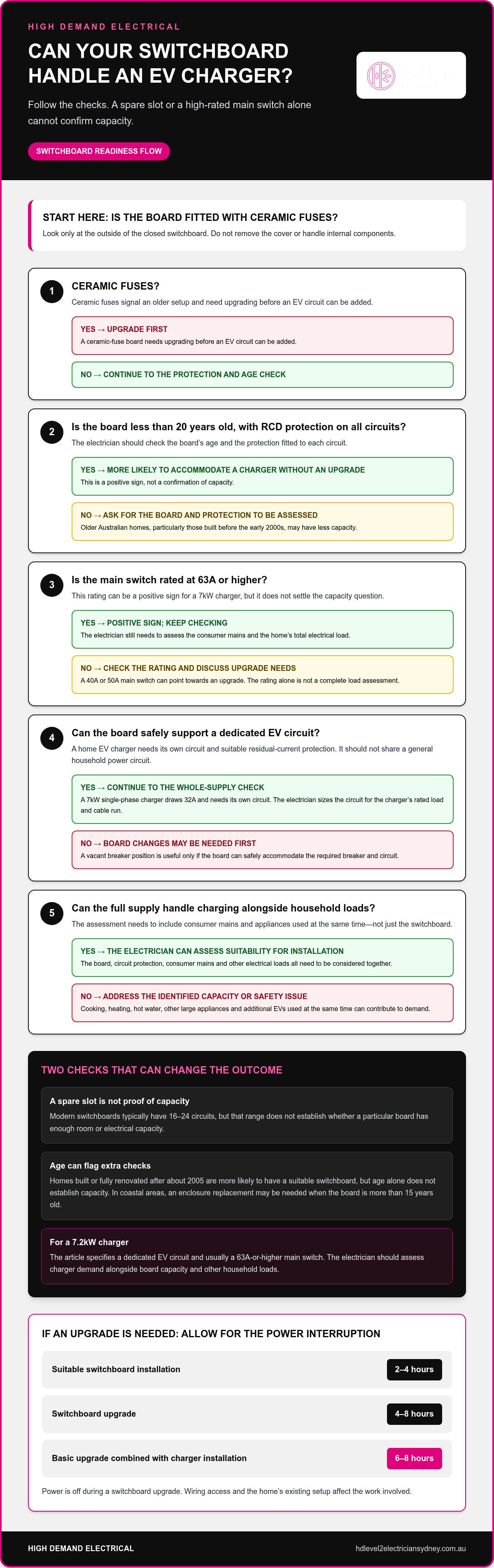
An electrician should inspect the switchboard’s age, main switch rating, safety switches, spare breaker space and household electrical load. A 63A or higher main switch can be a positive sign for a 7kW charger, but it doesn’t prove the whole supply has enough capacity.
•
Check switchboard age and RCD protection
Ask the electrician to assess the board’s age and the protection fitted to each circuit. Switchboards less than 20 years old, with RCD protection on all circuits and a spare slot, are more likely to accommodate an EV charger without an upgrade. Older Australian homes, particularly those built before the early 2000s, may have less capacity. Ceramic-fuse boards, associated with the pre-1990s era, need upgrading before an EV circuit can be added.
•
Assess main switch capacity and household load
Have the electrician read the main switch rating and consider what the home uses at the same time. A 63A or higher rating can indicate potential suitability for a 7kW charger, while a 40A or 50A main switch can point towards an upgrade. The rating alone isn’t a complete load assessment: cooking, heating, hot water and other large electrical appliances all contribute to demand. For example, a home using several high-load appliances during evening charging needs its overall supply assessed.
•
Inspect spare circuit slots and board capacity
Ask the electrician to check both available breaker positions and the board’s capacity to support another circuit. Modern switchboards typically have 16-24 circuits, but that range doesn’t establish whether a particular board has enough room or electrical capacity. A vacant slot is useful only if the board can safely accommodate the required breaker and circuit. Don’t treat a blank space as proof of suitability; the condition and configuration of the existing board matter too.
•
Assess dedicated circuit capacity for an EV charger
Ask the electrician to determine whether the switchboard can supply a dedicated EV charging circuit, rather than sharing an existing household circuit. A 7.2kW charger requires an EV circuit and usually a 63A-or-higher main switch. The electrician should consider the charger’s demand alongside the board’s spare breaker capacity and the home’s other loads. This combined assessment shows whether the current switchboard can support the installation or needs changes first.
Can Your Switchboard Handle an EV Charger?
Use these steps to identify possible upgrade needs and understand what an installation involves. The board’s age, condition and available space all affect the work required.
•
Spot signs of an older switchboard
Check when the home was built or fully renovated, then look at the board’s visible condition without removing its cover. Homes built or fully renovated after about 2005 are more likely to have a suitable switchboard, but age alone doesn’t establish capacity. Ceramic fuses signal an older setup. In coastal areas, allow for possible enclosure replacement when the switchboard is more than 15 years old.
Note the board’s age, fuse type and any visible damage to discuss during an electrical assessment. Don’t open the enclosure or handle internal components. A photo of the closed board can help you describe what you’ve noticed, but it cannot replace an inspection of the wiring and protective equipment.
•
Identify switchboard upgrade triggers
Check whether the board still uses ceramic fuses, then establish whether it can safely accommodate modern circuit breakers. A switchboard with ceramic fuses may need to be upgraded before a home charger can be installed. A switchboard with limited room, older components or wiring that cannot support the new circuit may also need attention before charger installation proceeds.
Include the home’s electricity supply in the assessment, not just the main switchboard. Upgrading the board may not resolve an issue with the consumer mains or another part of the installation. Ask for the proposed work to address the identified capacity or safety issue, rather than assuming a new enclosure will resolve every limitation.
•
Plan the switchboard upgrade and charger installation
Arrange the assessment before scheduling the EV charger installation. A suitable switchboard installation usually takes 2 to 4 hours; a switchboard upgrade typically takes 4 to 8 hours, with power off during that work. A basic upgrade combined with charger installation typically takes 6-8 hours, while wiring access and the home’s existing setup affect the work involved.
Plan for the power interruption and any household equipment that depends on electricity. A switchboard upgrade in Australia can often be completed in one day, depending on wiring and accessibility. For the upgrade scope, use the switchboard upgrade information to understand the relevant work. Coordinate charger installation after the board and supply requirements are addressed.
Does an EV charger need its own circuit?
Yes. A home EV charger needs a dedicated circuit and suitable residual-current protection. The applicable Australian wiring standard is AS/NZS 3000.
•
Plan a dedicated EV charging circuit
Ask the electrician to size a separate circuit for the charger’s rated load and cable run. A 7kW single-phase charger draws 32A, so it needs its own circuit rather than sharing a household power circuit. A typical Australian home power circuit is rated at 20 amps, which isn’t designed for that charging demand.
Include the breaker and protective device in the switchboard plan. A 6 mm² cable and 32A circuit breaker may serve a 7kW charger, though that cable size can be marginal outside basic installations. The cable route, installation conditions and charger specifications affect the final design.
•
Check the supply type and charging speed
Confirm whether the property has single-phase or three-phase power, then match the charger to the supply and vehicle. A three-phase supply can allow charging at 11kW or 22kW if the car accepts that rate. A three-phase charger also needs a three-phase breaker, which takes three times the rail space of a single-phase breaker.
Don’t assume a three-phase charger will charge faster in every home. Charging speed depends on both the vehicle’s onboard charging capability and the available supply. If your property has single-phase power, upgrading to a three-phase supply may be part of the installation plan.
•
Consider load management or a lower-power charger
Ask whether load management or a lower-power charger could reduce demand enough to suit the existing installation. Dynamic load management can adjust charging around other household use, including solar generation or battery operation. Charging at a lower rate also reduces demand compared with a higher-powered option.
These options can help manage peak demand, but they won’t create space for a breaker or fix unsuitable wiring. An electrician still needs to assess the switchboard, circuit protection and supply capacity. Consider which appliances may run while the car is charging before choosing charger settings and load controls.
•
Check applicable installation requirements
Ask the electrician to design the circuit to AS/NZS 3000 and the charger manufacturer’s installation requirements. EV charger installations generally need modern RCBO protection. A dedicated EV circuit should have appropriate protection against electric shock.
Ask which residual-current protection suits the charger. Some chargers include built-in DC leakage protection, allowing Type A RCBO protection; specialised systems may require a Type B RCD, depending on the manufacturer’s specifications. Don’t choose a protective device by appearance alone. Its type must suit the charger and the complete circuit design.
Future-proofing switchboards for additional electrical loads
Allow for the charger’s sustained demand and any electrical loads you may add later. A switchboard needs suitable capacity, protection and space, not just room for one breaker.
•
Assess sustained electrical load and heat
Ask a licensed electrician to assess how the home EV charger’s continuous load affects the switchboard. A typical Level 2 EV charger in Australia can draw up to 32 amps continuously, and a 32-amp charger can draw power for 8 to 10 hours. That sustained demand differs from a brief appliance load, so the board’s operating conditions matter.
Consider heat as well as the breaker rating. A crowded, heat-soaked switchboard may need a circuit rated at twice the nominal load, as specified by some electrical manufacturers. SolarQuotes advises allowing about 20% headroom when designing an EV charging circuit to help prevent nuisance tripping. These are design considerations, not a substitute for assessing the actual board, wiring and installation conditions.
Don’t use a regular Australian power point for continuous, high-load EV charging. It isn’t designed for that use and may overheat. Have the charging circuit designed for the charger’s intended use, rather than relying on a general-purpose outlet or assuming a breaker alone addresses heat risks.
•
Plan for additional electrical loads
List the electrical equipment already in use and the loads you may add. For example, a household planning to install an EV charger, home battery and another high-demand appliance should consider how those loads might overlap. The switchboard and supply need assessment as a complete system, not just for the charger’s immediate demand.
Ask the electrician to consider future circuit protection and physical board space when planning an upgrade. When upgrading a switchboard or adding a sub-board, aim for double the rail space for circuit breakers. This leaves room for additional circuits, rather than filling every available position during the initial work.
Keep existing ceramic fuses in mind when planning for future loads. Older equipment may need attention before a modern circuit can be added, and extra breaker positions alone won’t resolve a capacity limit. In Australia, a licensed electrician must carry out EV charger circuit work and can assess the proposed loads and design the electrical work accordingly.
Consumer mains and maximum demand
A spare switchboard slot doesn’t show whether the consumer mains can supply an EV charger. Assess the complete supply and the household’s combined demand, especially if several major loads may operate at once.
Include the consumer mains in the assessment.
These cables carry electricity from the supply point to the home’s switchboard, so their capacity affects what the board can deliver. The board may have room for another breaker while the incoming supply remains the limiting factor. Ask for the consumer mains, main switch and proposed charger load to be considered together, rather than judging capacity from the board alone.
Map the household’s simultaneous loads.
Maximum demand means the electricity the home may need when several loads operate at once, not simply the total of every appliance’s stated rating. List equipment likely to run during charging, such as an oven, hot water system, heating or air conditioning. Charging an EV while preparing dinner creates a different combined demand from charging when other high-load appliances are off.
Consider the timing and number of vehicles.
Several EVs charging together at 5:00 PM create a synchronised demand that can overload a building’s main switchboard. An older home may have a total power budget of about 40 amps, so a continuous charging load can take a substantial share of available supply. A charger might use half the power available from the street to a home. Charging schedules or load management can help spread demand, but don’t assume they resolve undersized consumer mains.
Identify whether the supply needs more capacity.
An electrician can assess the existing service cables, supply arrangement and planned household loads. Increasing a building’s service-cable capacity from 40 to 63 amps is one example of a possible mains-supply upgrade for EV charging. The right approach depends on the existing installation and the demand expected across the household. If the assessment identifies consumer mains as the constraint, a consumer mains installation may form part of the work.
Plan for more than one charger.
Don’t size the supply for one vehicle if the household expects another EV or additional electrical loads. A single-phase grid connection could only run two EV chargers and nothing else, so simultaneous charging needs careful consideration. Include likely charging patterns and other appliances in the assessment before selecting equipment. This makes the supply decision reflect household use, rather than an empty-house scenario.
High Demand Electrical: Level 2 ASP Electrical Services
High Demand Electrical provides Tesla and home EV charger installation, switchboard upgrades and Level 2 ASP Electrical Services across the Sydney metropolitan area. Turn to the team when an assessment identifies a switchboard, supply or installation issue that needs specialist electrical work.
If the assessment identifies a need to change the supply infrastructure, High Demand Electrical provides private power pole installation. The next step depends on the findings, whether that means preparing the board for a dedicated circuit or addressing a supply constraint affecting the home.
Contact High Demand Electrical to discuss your EV charger installation and the electrical work involved.
Make your next step an installation plan
The most useful outcome is a clear plan for your property, not simply a yes-or-no answer. Use the assessment findings to decide the order of work, the charger setup that suits your household, and whether supply or switchboard changes should happen before installation. That way, you can understand the electrical work required before choosing equipment.
If you’re asking, “Can my switchboard handle an EV charger?”, make the next conversation about the complete installation. Explain your charging needs and any electrical changes you’re planning, such as adding another major appliance. This gives the assessment a practical focus: matching today’s charging requirements with how you expect to use electricity at home.
High Demand Electrical can discuss your project and the electrical work involved. Contact High Demand Electrical about your EV charger assessment to take the next step.
A well-planned installation starts with understanding your home’s needs. With a clearer picture of the work involved, you can decide how to proceed.
Frequently Asked Questions
What Happens if I Don't Get an Electrical Upgrade?
If the existing installation can’t safely support the charger, proceeding without the required electrical work can cause protective devices to trip or equipment to overheat. Charging may also be interrupted when other household loads operate at the same time. For example, repeated interruptions during evening use can make charging unreliable. Don’t bypass a tripping breaker or use an extension lead as a workaround. Have the installation assessed before charging begins.
How can I tell if my Australian switchboard can support an EV charger?
You can spot clues, but a visual check cannot confirm the capacity of the complete supply. Note the switchboard’s age, whether it has ceramic fuses, the main switch rating and any visible damage, without opening the enclosure. Then consider how the charger will operate alongside household equipment. Whether your switchboard can handle an EV charger depends on the board, wiring, consumer mains and expected combined loads, which an electrician needs to assess together.
What electrical capacity and spare circuits does an EV charger need in Australia?
The required capacity depends on the charger’s power rating and whether the home has single-phase or three-phase supply. A 7kW single-phase charger draws 32A and needs a dedicated circuit; the circuit also needs suitable protective equipment. Available breaker space is only one part of the assessment. Cable size and route, existing circuits, the main switch and household demand all affect the electrical design, so a spare slot alone isn’t enough.
When does an Australian switchboard need an upgrade for an EV charger?
An upgrade may be needed if the board can’t safely accept a dedicated circuit, has ceramic fuses, lacks suitable protection or has insufficient capacity for the home’s combined demand. A 40A or 50A main switch can also indicate that an upgrade may be required. The electrician should identify the limiting component before recommending work, because an issue with consumer mains or wiring may need attention as well as the switchboard.
How much does a switchboard upgrade for an EV charger cost in Australia?
The price depends on the specific installation and is given after a quote request. Relevant cost factors include the switchboard’s condition and configuration, the required protective equipment, the charger circuit’s cable route, access to wiring and whether consumer mains work is needed. Combining upgrade work with charger installation can also affect the scope. A site assessment helps define the work, rather than relying on a generic estimate that may not fit the property.
Does installing an EV charger require a licensed electrician or network approval in Australia?
EV charger circuit work must be performed by a licensed electrician. In NSW, electricians must lodge a Certificate of Compliance for Electrical Work (CCEW) through the BCNSW eCert portal for EV charger installation work, a digital lodgement requirement that applies as of July 2026. Network involvement is relevant if the project requires supply or connection changes; the electrician can identify whether that work forms part of the installation.
What safety risks arise from an overloaded or outdated switchboard?
An overloaded or deteriorated installation can overheat, trip protective devices or cause electrical equipment to operate unreliably. A regular power point isn’t designed for continuous, high-load EV charging and may overheat. Heat, burning smells, buzzing or visible damage need prompt attention. Don’t remove the switchboard cover or attempt repairs yourself. Stop using affected equipment and arrange an electrical inspection.
Powering Your Needs with Expertise
If you’re looking for a reliable, experienced, and prompt electrician, look no further than High Demand Electrical. We cater to all your electrical needs, from routine maintenance to emergency repairs and complete system installations. Our skilled team is committed to providing professional service that ensures your electrical systems run smoothly. Whether it's a small task or a large project, give us a call today. Let us meet all your electrical demands with the quality and reliability you deserve.

