
Why Does My Safety Switch Keep Tripping? A Sydney Homeowner’s Guide
What if resetting your safety switch is hiding the fault rather than fixing it? If you’re asking, “why does my safety switch keep tripping”, repeated power cuts are disruptive, but the switch is also signalling that it has detected a problem. A safety switch, also called an RCD, helps protect people from electric shock. A circuit breaker protects wiring from overloads and short circuits. They’re not interchangeable.
A faulty appliance, moisture, damaged wiring, an overloaded circuit or a failing switch could be involved, and the cause isn’t always obvious. This guide explains common triggers, what you can safely observe and when to stop resetting the switch and arrange licensed electrical fault finding in Sydney. It also covers warning signs that need prompt attention.
High Demand Electrical provides fault finding and switchboard repairs across Greater Sydney, with 24/7 emergency support and rapid emergency response, rain, hail, or shine. Call 0402 559 777 for immediate assistance or email chris@highdemandelectrical.com.au. All work complies with AS/NZS 3000, NSW Service and Installation Rules and network operator rules; High Demand Electrical is Ausgrid & Endeavour compliant. The business offers fast, fixed-price quotes, free switchboard inspections and a senior discount of up to 10% on all our local electrical services.
Key Takeaways
• If you’re wondering “why does my safety switch keep tripping”, treat each repeat trip as a warning to investigate, not a reason to keep resetting it.
• A faulty appliance, damaged wiring, moisture or an overloaded circuit may be involved. The trip pattern can offer clues, but it can’t confirm the cause.
• From a safe position, note what happened before the trip and which circuit lost power. Don’t open the switchboard, touch exposed wiring or repeatedly reset a switch that keeps tripping.
• Recurring trips call for qualified fault finding. High Demand Electrical provides safety switch installation, switchboard repairs and fault finding across Greater Sydney.
• High Demand Electrical is a Licensed Level 2 ASP, EC Licence 397193C, ABN 87 051 836 527, with Triple ISO certification and Ausgrid & Endeavour compliance. All work complies with AS/NZS 3000, NSW Service and Installation Rules and network operator rules. The business offers 24/7 emergency support, rapid emergency response, rain, hail, or shine, fast, fixed-price quotes, free switchboard inspections and a senior discount of up to 10% on all our local electrical services. Call 0402 559 777 or email chris@highdemandelectrical.com.au.
Why does a safety switch keep tripping, and what is it protecting?
A sudden loss of power can interrupt work, cooking or simply getting through the day. If you’re asking, “why does my safety switch keep tripping”, the direct answer is that it has detected a condition that needs investigating. A trip is a protective response, not a diagnosis: it doesn’t identify the cause on its own, and repeatedly resetting the switch won’t reveal what’s wrong.
A safety switch monitors a protected electrical circuit and cuts its power when it detects current leaking from the intended path, helping reduce the risk of electric shock. It’s also called a residual-current device, or RCD. The Residual-current device (RCD) overview explains the general purpose of these devices. A trip means the protection has operated, but professional testing is needed to determine why.
What does a safety switch actually do?
A safety switch continually monitors the circuit it protects. If it detects an electrical problem, it interrupts the supply to that circuit. Some lights or power points may lose power while other parts of the property remain on. That interruption helps protect people, but it doesn’t show whether the underlying issue is an appliance, wiring or something else. The trip pattern and electrical testing provide better evidence.
Safety switch or circuit breaker: which one has tripped?
These devices have different jobs. A safety switch is designed to help protect people from electric shock by detecting current leakage. A circuit breaker protects wiring and appliances by cutting power during an overload or short circuit. So, a switchboard trip doesn’t automatically mean the safety switch has a fault. Identifying which device moved can help describe what happened, but it won’t prove the cause.
From a safe position, look at the switchboard labels and note which switch is in a different position from the others. Don’t remove the switchboard cover or touch internal components. Labels and switch designs vary, so if you can’t confidently identify the device, leave it alone and report what you can see to an electrician. An RCBO combines safety-switch and circuit-breaker functions, so the type of device can also affect what a trip means.
One trip is a clue, not a conclusion. Note whether power was lost across the whole home or only part of it, and whether anything had just been switched on. Those observations can help an electrician focus fault finding, but they can’t replace testing. If a device trips again, don’t keep resetting it or attempt a repair inside the switchboard. High Demand Electrical provides safety switch installation, switchboard repairs and fault finding across Greater Sydney. Work complies with AS/NZS 3000, NSW Service and Installation Rules and network operator rules; High Demand Electrical is Ausgrid & Endeavour compliant.
High Demand Electrical is a Licensed Level 2 ASP with EC Licence 397193C and Triple ISO certification: ISO 9001, ISO 45001 and ISO 14001. The business offers 24/7 emergency support, rapid emergency response, rain, hail, or shine, fast, fixed-price quotes, free switchboard inspections and a senior discount of up to 10% on all our local electrical services. For immediate assistance, call 0402 559 777 or email chris@highdemandelectrical.com.au.
Common reasons a safety switch keeps tripping
If you’re still asking, “why does my safety switch keep tripping”, several different problems could be involved. The timing of a trip can offer a useful clue, but it can’t confirm a fault remotely. A single symptom may fit more than one cause, so treat the possibilities below as prompts for safe observation, not a diagnosis.
Could an appliance or circuit issue be triggering it?
A faulty appliance may cause a safety switch to trip if current leaks from its electrical parts. Note what was plugged in or running just before the power went off, including appliances used recently. Don’t open, dismantle or test equipment yourself. A licensed electrician can investigate the circuit; appliance repairs should be handled by an appropriate repairer.
An overloaded circuit is a separate possibility. If several high-demand appliances are running on the same circuit, a circuit breaker may trip to protect the wiring from excessive load. Some switchboard devices combine circuit-breaker and safety-switch functions, so the device that moved matters. An overload alone doesn’t establish that the safety switch has a fault. Note the switch position and what was operating.
Can moisture, damaged wiring or a faulty switch be involved?
Yes. Moisture from rain, a leak or damp conditions may affect electrical equipment or wiring and contribute to a trip. Damaged wiring, including deterioration or accidental damage, is another possibility. Don’t enter a wet area to inspect electrical equipment, touch wiring or remove any switchboard cover. Keep clear and arrange qualified investigation if you suspect water or damage near electrical components.
A worn or faulty safety switch may also be responsible, but it shouldn’t be assumed just because the device trips. A licensed electrician can test the switch and the protected circuit to distinguish a device fault from another electrical problem. Safety switch guidance from a government electrical safety office explains the protective role of these devices and the importance of testing.
Appliance clue
Record which appliance was in use when the trip happened.
Circuit clue
Note which labelled switch moved and which areas lost power.
Moisture or damage clue
Stay clear of the affected area and report what you observed.
Recurring trip
Stop resetting the switch and arrange professional fault finding.
Never remove covers, touch exposed wiring or attempt electrical repairs. High Demand Electrical provides fault finding, switchboard repairs and safety switch installation across Greater Sydney. All work complies with AS/NZS 3000, NSW Service and Installation Rules and network operator rules; the business is Ausgrid & Endeavour compliant. High Demand Electrical is a Licensed Level 2 ASP, EC Licence 397193C, with Triple ISO certification: ISO 9001, ISO 45001 and ISO 14001. It offers 24/7 emergency support, rapid emergency response, rain, hail, or shine, fast, fixed-price quotes, free switchboard inspections and a senior discount of up to 10% on all our local electrical services. For immediate assistance, call 0402 559 777 or email chris@highdemandelectrical.com.au.
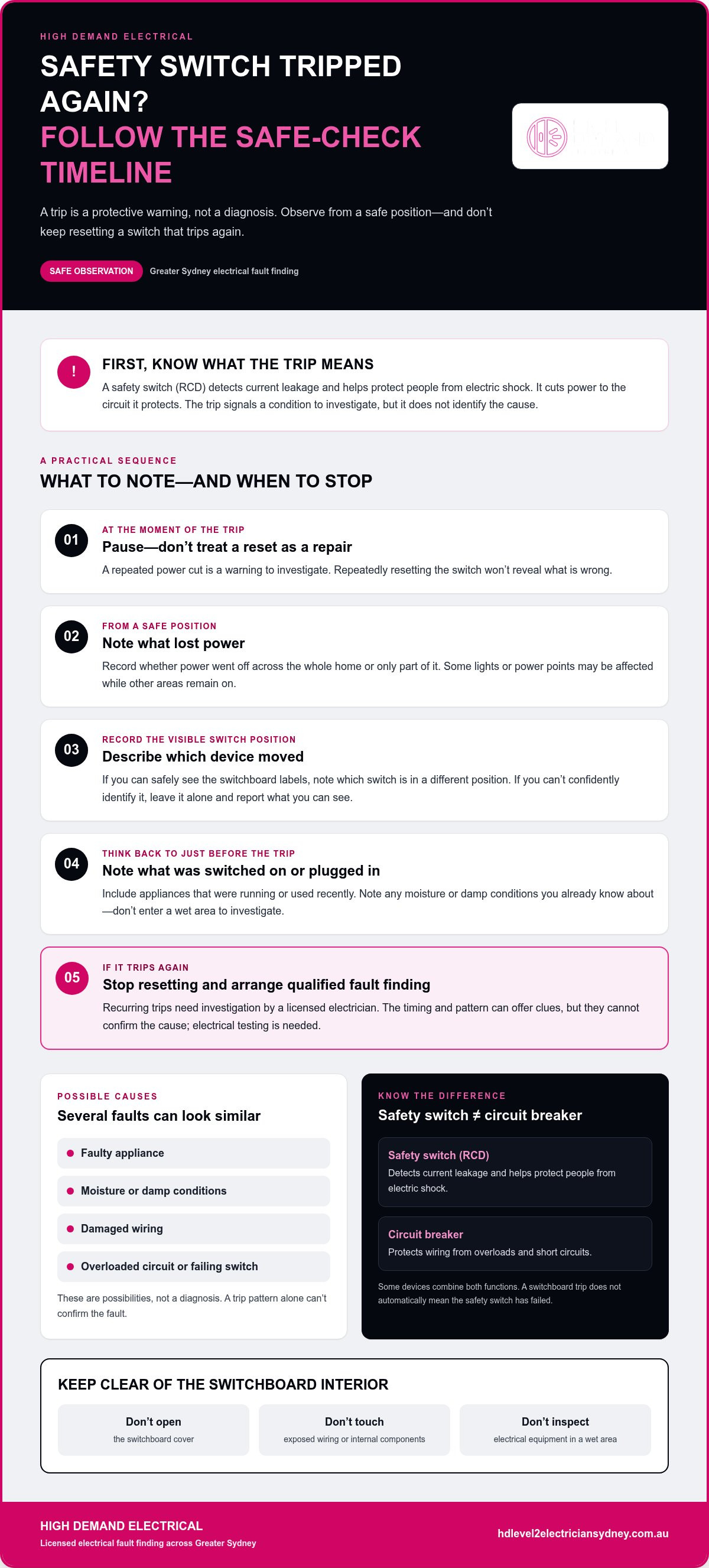
What the tripping pattern can tell you, and what it cannot
The timing and location of a trip can help an electrician narrow down where to investigate. They don’t identify the fault on their own. A safety switch may respond to different problems, and a circuit breaker or combined device may trip for another reason. Use the pattern as a record of what happened, not as a home diagnosis or a reason to keep resetting the switch.
| Observed pattern | Possible explanation, a clue only | Safe next action |
|---|---|---|
| Power trips soon after one appliance is switched on | The appliance or the circuit may be involved, but the timing doesn’t prove the appliance is faulty. | Stop using it if it’s damaged or behaving abnormally. Note its name and what was happening. |
| The trip affects a particular circuit or area | A problem somewhere on that circuit may be contributing, including an appliance or wiring issue. | Record the labelled switch and which lights or power points lost supply. Don’t inspect wiring. |
| The switch trips with no obvious trigger or after a reset | An intermittent electrical fault or a device issue may be involved. The absence of a clear trigger doesn’t rule out a problem. | Note the time, affected circuit and recent conditions. If the trip recurs, arrange qualified fault finding. |
Does it trip when one appliance is switched on?
Close timing may help narrow the investigation, but it isn’t proof that the appliance caused the trip. Record what was switched on, what else was running and which labelled switch moved. If the appliance has visible damage, unusual noise or abnormal operation, stop using it and don’t dismantle it. An electrician can test the electrical circuit; the pattern alone can’t confirm the source.
What if it trips at random or after a reset?
An intermittent trip still deserves attention if it happens again. Make a brief note of the time, what lost power, what was operating and any recent rain or other relevant conditions. Don’t open equipment or the switchboard to investigate. This record can support an electrical safety inspection and professional testing.
If you’re wondering why does my safety switch keep tripping, a pattern can help describe the issue, but testing is needed to identify the actual fault. Keep your notes factual: “the kitchen circuit tripped while the kettle was on” is more useful than assuming the kettle is defective. Note whether the trip happened once or recurred, but don’t deliberately recreate the event or repeatedly reset the switch to gather more information.
For recurring trips in Greater Sydney, High Demand Electrical provides fault finding and switchboard repairs. High Demand Electrical is a Licensed Level 2 ASP with EC Licence 397193C and Triple ISO certification: ISO 9001, ISO 45001 and ISO 14001. It offers 24/7 emergency support, rapid emergency response, rain, hail, or shine, fast, fixed-price quotes, free switchboard inspections and a senior discount of up to 10% on all our local electrical services. Call 0402 559 777 for immediate assistance or email chris@highdemandelectrical.com.au.
What to do when your safety switch trips again
A repeat trip is a reason to pause, not keep restoring power and hope the problem has passed. If you’re wondering why does my safety switch keep tripping, make safe observations from outside the switchboard and pass them to a licensed electrician. Your notes can help, but they don’t replace professional fault finding.
Stop and keep clear.
Don’t open the switchboard, touch exposed wiring or approach electrical equipment if you can see damage or water nearby.
Observe from a safe, dry position.
Note which labelled switch appears to have moved and which parts of the home have lost power. Don’t remove covers to identify a device.
Record what changed.
Write down what was operating before the trip, any appliance you’d just switched on, and relevant conditions such as recent rain or a leak.
Arrange qualified help if it trips again.
Don’t repeatedly reset a switch that keeps tripping or try to diagnose the fault by recreating it.
Which checks can a homeowner safely make?
Keep checks external. If the area is dry and there are no signs of damage, you can use an appliance’s normal controls to switch it off, or unplug it by its plug without touching damaged equipment. Note the affected circuit and what was running. Don’t dismantle an appliance, handle wiring or attempt to test electrical components yourself.
When should you stop resetting it and get help?
Stop and keep clear if you notice a burning smell, unusual heat at the switchboard, visible damage or water near electrical equipment. Don’t touch the switchboard or try to dry, inspect or repair affected components. A trip that recurs also needs investigation, even if the power returns after a reset. Where testing identifies a switchboard fault, a licensed electrician can assess whether a repair or switchboard upgrade is appropriate.
High Demand Electrical provides fault finding and switchboard repairs across Greater Sydney. The company is a Licensed Level 2 ASP, EC Licence 397193C, ABN 87 051 836 527, with Triple ISO certification: ISO 9001, ISO 45001 and ISO 14001. The team offers 24/7 emergency support, rapid emergency response, rain, hail, or shine, fast, fixed-price quotes, free switchboard inspections and a senior discount of up to 10% on all our local electrical services.
For immediate assistance, call 0402 559 777 or email chris@highdemandelectrical.com.au. Contact High Demand Electrical for help with a recurring safety switch trip.
Professional safety-switch fault finding in Sydney
Repeated trips are best dealt with through qualified fault finding, not guesswork. High Demand Electrical provides safety-switch fault finding, switchboard upgrades and repairs, and safety switch installation across Greater Sydney. An electrician can investigate the pattern you’ve recorded and assess the relevant circuit and switchboard, rather than assume the cause from one symptom.
What happens during professional fault finding?
The electrician will ask what happened before the trip, which circuit or areas were affected, and whether the issue has recurred. That history helps direct the investigation. They can then inspect and test relevant electrical equipment to identify what may be causing the interruption. The cause and any suitable repair depend on the assessment findings, so don’t assume a diagnosis, repair outcome, timing or price before inspection.
Don’t open the switchboard or attempt repairs while waiting for help. If you notice burning smells, unusual heat, visible damage or water near electrical equipment, keep clear and explain the hazard when arranging assistance.
High Demand Electrical is a Licensed Level 2 ASP and Level 2 Accredited Service Provider (ASP) - authorised to carry out service line, metering and connection work for Ausgrid, Endeavour Energy and Essential Energy. The business holds EC Licence 397193C and has Triple ISO certification: ISO 9001, ISO 45001 and ISO 14001. It is Ausgrid & Endeavour compliant.
All work complies with AS/NZS 3000, NSW Service and Installation Rules and network operator rules. High Demand Electrical provides fast, fixed-price quotes and free switchboard inspections. A senior discount of up to 10% applies to all our local electrical services.
How to arrange help across Greater Sydney
High Demand Electrical serves Greater Sydney. To explain the issue, have your notes ready: when the trip occurred, which labelled switch appeared to move, what lost power and what was operating at the time. Don’t delay seeking assistance if there are signs of an immediate electrical hazard.
High Demand Electrical offers 24/7 emergency support and rapid emergency response, rain, hail, or shine. For immediate assistance, call 0402 559 777 or email chris@highdemandelectrical.com.au. If a recurring trip needs professional investigation, Contact High Demand Electrical to arrange help.
Take the next step towards a safe resolution
If you’re still asking “why does my safety switch keep tripping”, don’t let repeated interruptions become the new normal. Keep a note of what you observed and arrange qualified fault finding rather than relying on another reset. A clear record gives your electrician a useful starting point, while testing can establish what needs attention.
High Demand Electrical provides fault finding, switchboard repairs and safety switch installation across Greater Sydney. The team includes a Licensed Level 2 ASP, authorised to carry out service line, metering and connection work for Ausgrid, Endeavour Energy and Essential Energy. High Demand Electrical holds EC Licence 397193C and Triple ISO certification: ISO 9001, ISO 45001 and ISO 14001.
Support is available 24/7, with rapid emergency response, rain, hail, or shine. The service includes fast, fixed-price quotes, free switchboard inspections and a senior discount of up to 10% on all our local electrical services. High Demand Electrical has over 300 five-star reviews. For immediate assistance, call 0402 559 777 or email chris@highdemandelectrical.com.au, or contact High Demand Electrical to arrange fault finding.
Frequently Asked Questions
How do I know if my safety switch has tripped?
Compare the switches in the board with their labelled positions, without removing the cover. A switch sitting differently from the others may have tripped, but some boards use combined devices or different indicators. Check which lights or power points have stopped working and note the label beside the switch. If you can’t identify it confidently, don’t operate unfamiliar switches; tell the electrician what you can see.
Why does a safety switch trip when I turn on an appliance?
The appliance or the circuit may be involved, but the timing doesn’t prove either is faulty. For example, a trip just after a heater is switched on could relate to that appliance, another issue on the circuit, or a protective device responding to a different fault. Note what was switched on and which areas lost power. Don’t keep switching the appliance on to test the pattern.
Can a faulty appliance cause a safety switch to keep tripping?
Yes, an appliance with an electrical fault can contribute to repeated trips, but the switch’s response alone can’t confirm that diagnosis. If an appliance has a damaged cord, cracked plug or unusual operation, stop using it and don’t handle damaged parts. Record the appliance and when the trip occurred. A licensed electrician can test the electrical circuit and switchboard; don’t open or modify the appliance yourself.
Can water or moisture make a safety switch trip?
Yes. Moisture from rain, a leak or damp conditions may affect electrical equipment or wiring and contribute to a trip. If water is near a power point, appliance or switchboard, keep clear and don’t touch the equipment, even if it appears switched off. Avoid entering a wet area to investigate. Tell the electrician where you noticed the water and whether the trip happened during or after wet weather.
What should I do if my safety switch keeps tripping?
If you’re asking “why does my safety switch keep tripping”, start by keeping clear of the board and noting what lost power, the switch label and what was operating. Don’t touch exposed wiring or remove covers. If the trip recurs, arrange licensed electrical fault finding in Sydney rather than trying to trace the cause yourself. Burning smells, unusual heat, visible damage or water near electrical equipment are reasons to stay clear and seek urgent help.
Should I keep resetting a safety switch that trips repeatedly?
No. If it trips again, stop resetting it and arrange professional investigation. Repeated resets won’t identify or repair the cause. Note the time and what was happening before the trip, then share those details with the electrician. If there’s water, visible damage, a burning smell or unusual heat, keep away from the switchboard and affected equipment.
Powering Your Needs with Expertise
If you’re looking for a reliable, experienced, and prompt electrician, look no further than High Demand Electrical. We cater to all your electrical needs, from routine maintenance to emergency repairs and complete system installations. Our skilled team is committed to providing professional service that ensures your electrical systems run smoothly. Whether it's a small task or a large project, give us a call today. Let us meet all your electrical demands with the quality and reliability you deserve.

