
Heat Pump vs Electric Hot Water: Which Suits Your Sydney Home?
For most Sydney households, a heat pump is the cheaper hot water system to run. It uses far less electricity than a conventional electric storage tank, but it costs more upfront and needs the right spot and the right electrical supply. A standard electric tank is simpler and cheaper to buy. It only makes sense long term if it runs on a cheap controlled-load tariff or your solar covers most of its load.
This guide compares the two on cost, space, noise, climate and electrical requirements. It also covers what your switchboard and meter have to do with the decision. We are a Level 2 electrical contractor, so we see the electrical side of these swaps every week.
TL;DR
- A heat pump uses 55% to 80% less energy than traditional electric resistance or gas storage systems, so it costs much less to run.
- A standard electric tank is cheaper to buy and install, but dearer to run unless it is paired with solar PV.
- Installed heat pump costs in Australia typically sit between $2,000 and $6,000, before rebates.
- Check your tariff, switchboard capacity and the outdoor unit’s position before you buy.
- Plan ahead. Replacing a system after it fails, often on a long weekend, limits your choices.
Table of Contents
- How each system heats your water
- Why hot water matters on your bill
- Heat pump vs electric hot water at a glance
- Upfront cost and rebates in NSW
- Running costs: where the tariff changes the answer
- Space, tank size and system type
- Noise and neighbours
- Does a heat pump work in cooler weather?
- What about solar thermal?
- The electrical work behind the swap
- Perspective: what we see on the job
- Which one should you choose?
- Before you book an installer
- Get the electrical side done right
- FAQ
- Sources
How each system heats your water
Both systems store hot water in an insulated tank. The difference is where the heat comes from.
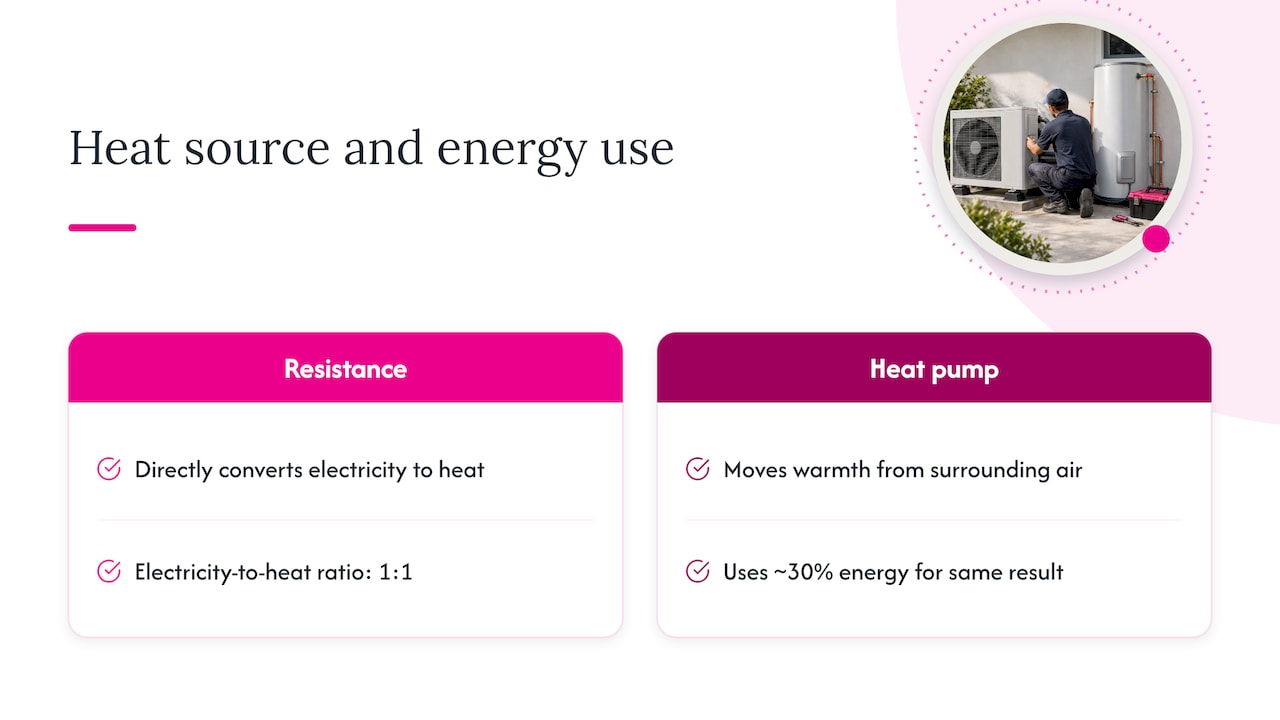
A conventional electric storage system uses a resistance element inside the tank. It turns electricity directly into heat, one unit of electricity for roughly one unit of heat.
A heat pump works like a refrigerator in reverse. According to energy.gov.au, heat pump systems use electricity to move heat from one place to another instead of generating heat directly. They draw warmth from the surrounding air and concentrate it into the water. That is why they can use around 30% of the energy of a conventional electric system for the same result.
The two look similar. The ACT Government’s buyers guide notes that they have comparable electrical and plumbing connections and both deliver a reliable supply of hot water. The ACT guide is written for Canberra, but the technology is the same in Sydney.
Why hot water matters on your bill
Heating water is a large share of what you pay. Energy.gov.au says hot water use is responsible for around 25% of an average household’s energy use. The Clean Energy Regulator adds that electric water heating is the biggest source of greenhouse gases for the average Australian household. A system that uses a fraction of the electricity therefore matters more than most appliance upgrades.
Heat pump vs electric hot water at a glance
| Factor | Heat pump | Standard electric storage |
|---|---|---|
| Upfront cost | Higher. Typically $2,000 to $6,000 installed, depending on model, size and site | Lower to buy and install |
| Running cost | Much lower, using 55% to 80% less energy | Significantly higher unless paired with solar PV |
| Placement | Outdoor unit needed, which means space and noise to think about | Tank only, indoors or outdoors |
| Electrical work | Dedicated circuit, plus a licensed plumber | Often a like-for-like swap |
| Climate | Choose a model rated for your climate zone | Not climate dependent |
| Rebates | STCs and NSW incentives may apply | Generally none |
The running-cost gap is the main reason to choose a heat pump. The upfront gap is the main reason people hesitate.
Upfront cost and rebates in NSW
The NSW Government puts the typical installed cost of a heat pump water heater at $2,000 to $6,000. The spread is wide because the model, the tank size and the site all change the price. A split system with an indoor tank and long pipe runs costs more than a simple integrated unit placed beside the old tank.
Two things can reduce that figure:
- Small-scale Technology Certificates (STCs). The Clean Energy Regulator explains how solar water heaters and air source heat pumps can create certificates under the federal scheme. Your installer usually applies the discount to the quote.
- NSW Government incentives. NSW publishes its current offers on its heat pump water heater page. Amounts and eligibility change, so check that page for the figures before you sign anything.
NSW also states that a heat pump can cut hot water energy use by up to 75%. Where a quote leaves out the rebates, ask the installer to show them as a separate line.
A standard electric system costs less on day one. It then costs more every quarter for the life of the tank. When you compare quotes, compare the total cost over your expected years in the home, not just the invoice.
Running costs: where the tariff changes the answer
Most comparisons stop at “heat pumps use less electricity”. That is true, but what you pay per unit matters too.
Many Sydney homes have an electric storage tank on a separate off-peak or controlled-load circuit. It heats overnight at a lower rate than your general usage. A heat pump usually runs on your general tariff, so part of its saving is offset by the higher unit price. The heat pump often still comes out ahead because it uses so much less energy. But the gap is smaller than it looks if your old tank is on the cheap rate.
Solar changes this again. Energy.gov.au notes that standard electric resistance heaters are significantly more expensive to run unless paired with solar PV. A heat pump with a timer set to run in the middle of the day can use your own panels’ output, which cuts the cost further.
To find your own answer:
- Check your last two bills for the controlled-load line and the general usage rate.
- Note whether your hot water is on a separate meter or circuit.
- Ask each installer to estimate annual running cost for both options, using your tariff.
- Work out the payback from the difference, after rebates.
If your hot water circuit is on a dedicated meter and you are changing how it runs, the metering matters. We explain the options in our guide to a smart meter or an off-peak meter. Our off-peak meter installation page covers the work itself.
Space, tank size and system type
Heat pumps come in two main layouts. The ACT buyers guide explains the difference:
- Integrated systems. The compressor is part of the tank unit. They are often more space-efficient but must be installed outdoors.
- Split systems. The tank can go indoors, with only the heat pump unit outside. This gives more flexibility in tight spaces or where the existing plumbing layout is awkward.
Standard heat pump tank capacities typically run from 150 to 315 litres, according to the same guide. Larger households of five or more people generally need the bigger tanks. That helps avoid relying too much on the backup heating element.
In many Sydney terraces and units there is no obvious spot for an outdoor unit. A narrow side passage might fit one, but airflow and access still matter. If you live in a strata building, check the by-laws and get committee approval before ordering anything.
Noise and neighbours
The outdoor unit has a fan and compressor, and it makes noise. Place it away from bedroom windows, yours and your neighbours’.
The ACT guide notes that legal limits apply at the property boundary. The ACT’s residential noise page lists what to check before installing heating and cooling equipment. Those are ACT rules, so look up the NSW rules and your council’s requirements for your own address before you pick a location. Compare the noise ratings on the models you are considering, and ask your installer to check the position against them.
Does a heat pump work in cooler weather?
Yes, with the right model. The ACT Government says modern heat pumps perform reliably even in colder climates when you choose a model rated for your climate zone. Sydney’s mild winters are much easier on these systems than Canberra’s.
What to check:
- The model’s rating for your climate zone.
- When the electric booster element switches on. The ACT’s heat pump rebate guidance advises checking whether the booster operates only when temperatures drop below -5°C. Heavy reliance on the booster pushes up electricity costs and cancels out the efficiency gain.
Before you buy, research and compare models on the government’s registration database. Energy experts note that most heat pumps get installed in an emergency, which is the worst time to compare.
What about solar thermal?
Solar hot water panels on the roof are an older option. Choosing a heat pump instead can free up roof space for solar PV, which serves the whole household’s electricity use, not just hot water. For most Sydney homes with limited roof area, that is a practical reason to lean towards a heat pump.
The electrical work behind the swap
The appliance is half the job. Installation needs both a licensed plumber and a Level 2 or equivalent electrician. Before the install date, we look at four things.
1. The circuit. The existing hot water circuit may be wired for a resistance element and an off-peak supply. A heat pump may need a different circuit, a different cable size or a different control arrangement. This is where a hot water electrician earns their keep.
2. The switchboard. An old board with ceramic fuses, no RCDs or no spare ways can’t take a new circuit safely. If your board needs attention, see our switchboard upgrades page.
3. Total load. A heat pump draws less than a resistance element, so it rarely causes trouble on its own. But if you are also adding an EV charger, ducted air conditioning or an induction cooktop, the combined demand matters. Our free maximum demand calculator applies the AS/NZS 3000 tables to give you a first estimate. If the total outgrows your supply, a power supply upgrade, including single phase to three phase, may be the next step.
4. Metering. If your hot water is on a controlled-load tariff and you move to a heat pump on the general tariff, the old circuit and meter arrangement may need changing.
The electrical work is simple when you plan it before the old tank fails.
Perspective: what we see on the job
Most heat pump enquiries reach us late. The tank has leaked or the element has failed, the household has no hot water, and everyone wants it fixed today. In that situation people often take a like-for-like swap because it is quick, then regret the running cost a year later.

Our view is simple. If you own your home and plan to stay more than a few years, a heat pump is usually the better long-term choice, provided you have a sensible place for the outdoor unit and your electrical supply is in good order. If you rent out the property, are selling soon, or have no outdoor space, a standard electric system can be the more sensible call. A heat pump is not the right answer for every house, and we would rather tell you that than sell you the wrong job.
What we push for is a check before you commit. A switchboard that is overdue for an upgrade, an old hot water circuit with no RCD protection, or a supply already near its limit will show up on the day of the install, when it is expensive to fix. We look at those at the quote stage, with a free site inspection for Level 2 work.
— Christopher
Which one should you choose?
Choose a heat pump if:
- You plan to stay in the home for several years.
- You have outdoor space away from bedroom windows.
- You have solar PV, or plan to add it.
- Your household is large and uses a lot of hot water.
- Your current tank is on the general tariff, or you can move away from an expensive setup.
Choose a standard electric system if:
- The upfront budget is the main limit and you need hot water now.
- There is no suitable outdoor position, and a split system does not fit your plumbing.
- Your existing tank is on a cheap controlled-load tariff and your use is low.
- You are selling or renting out the property soon.
In between, ask for both quotes with the rebates shown separately. The numbers usually make the decision clear.
Before you book an installer
- Check that the plumber and electrician are licensed for the work. In NSW, a heat pump install involves both trades.
- Ask which model is quoted and look up its rating on the government database.
- Confirm the climate zone rating and the booster behaviour.
- Ask where the outdoor unit will go and what its noise rating is.
- Ask whether the switchboard and circuit need work, and whether it is in the quote.
- Ask how the STC discount appears on the invoice.
Get the electrical side done right
We are a certified Level 2 electrical contractor serving Sydney homes, strata properties and businesses. We handle the circuit, switchboard, metering and supply work that sits behind a hot water swap, and we offer free site inspections for Level 2 work. Our team is available 24/7 if a failed system leaves you without power or hot water. Start with our Level 2 electrician page, or call us about an emergency callout. We offer discounts for seniors, so ask when you book.
FAQ
Is a heat pump better than a normal electric hot water system?
On running cost, yes. Heat pumps use 55% to 80% less energy than traditional electric resistance or gas storage systems. The trade-offs are a higher purchase price and the need for outdoor space. A standard system can still suit a small household on a cheap off-peak tariff.
What are the disadvantages of heat pump hot water?
The main ones are upfront cost, outdoor unit noise and the space the unit needs. Some models also rely on a booster element in cold weather, which raises bills if it runs too often. Choosing a model rated for your climate zone reduces that risk.
How much does a heat pump hot water system cost in NSW?
The NSW Government says installation typically costs $2,000 to $6,000, depending on the model, size and site. Federal STCs and NSW incentives can reduce that. Ask for the rebate shown as its own line on the quote.
Will I need electrical work to install a heat pump?
Usually some. A licensed plumber and a Level 2 or equivalent electrician are both involved. The electrician checks the circuit, the switchboard and the control arrangement, and makes changes where needed.
Sources
- Hot water systems | energy.gov.au
- Electrification | energy.gov.au
- Heat pump water heaters | NSW Climate and Energy Action
- Hot water heat pumps buyers guide | ACT Climate Choices
- Hot water | ACT Climate Choices
- Hot water heat pumps rebates | ACT Climate Choices
- Residential noise | Access Canberra
- Solar water heaters and air source heat pumps | Clean Energy Regulator
Powering Your Needs with Expertise
If you’re looking for a reliable, experienced, and prompt electrician, look no further than High Demand Electrical. We cater to all your electrical needs, from routine maintenance to emergency repairs and complete system installations. Our skilled team is committed to providing professional service that ensures your electrical systems run smoothly. Whether it's a small task or a large project, give us a call today. Let us meet all your electrical demands with the quality and reliability you deserve.

