Electrical safety inspection checklist for Australian properties
Use this ready-to-print electrical safety inspection checklist to confirm a property's switchboard, RCDs, powerpoints, wiring, earthing, and smoke alarms are safe and compliant. The single most important next step: have a licensed electrician perform the functional tests and issue any required report. No checklist replaces that.
Your checklist covers these core areas:
- Switchboard and circuit protection (fuses, circuit breakers, RCDs/safety switches)
- Powerpoints and switches (GPOs, garden and pool outlets)
- Wiring and cabling (visual check for damage, overheating, or DIY alterations)
- Lighting circuits and fixtures
- Earthing and bonding (main earth, water heater earthing)
- Smoke alarms and hard-wired detectors
- Landlord-supplied fixed appliances
Energy Safe Victoria's editable Electrical Safety Check Report is the recommended form to hand to your electrician. Print it, fill in the property details, and ask the electrician to complete the test results and sign off before they leave.
Key takeaways
A licensed electrician must perform all functional tests, issue the signed report, and carry out any remedial work — the checklist is your preparation tool, not a substitute for that professional assessment.
| Point | Details |
|---|---|
| Use the official checklist form | Download Energy Safe Victoria's editable Electrical Safety Check Report and hand it to your electrician at the start of every inspection. |
| Verify the electrician's licence | Check the licence number via TradieVerify or your state regulator before works begin and confirm it matches the signed report. |
| Match frequency to state rules | Victoria mandates a check every two years for rentals; QLD and WA require full RCD coverage; elsewhere, inspect every two to five years based on property age. |
| Prioritise RCDs and the switchboard | A failed RCD or obsolete switchboard with ceramic fuses is an urgent defect requiring same-day or next-day attention. |
| High Demand Electrical | Provides certified Level 2 inspections across Sydney with documented reports, on-the-day remedial quotes, and 24/7 emergency availability. |
Table of Contents
- What does an electrical safety inspection actually check?
- Step-by-step checklist you can hand to a licensed electrician
- Who must carry out the check and how to verify licences
- What are the state-by-state inspection requirements?
- How are electrical checks performed on site?
- What defects are most commonly found, and how urgent are they?
- How should you record and store inspection results?
- How High Demand Electrical conducts safety inspections in Sydney
- Why systematic inspection beats ad-hoc checks every time
- Book a certified inspection with High Demand Electrical
- Sources
What does an electrical safety inspection actually check?
An electrical safety inspection checks these core areas — each one tied to a specific fire or shock risk that a visual walk-around alone cannot rule out.
Switchboard and circuit protection. The electrician checks fuse types (ceramic rewireable fuses are a red flag in older properties), circuit breaker condition, and whether RCDs (residual current devices, also called safety switches) are fitted to the correct circuits. An outdated switchboard with no RCD coverage is one of the most common serious findings in pre-1990s homes.
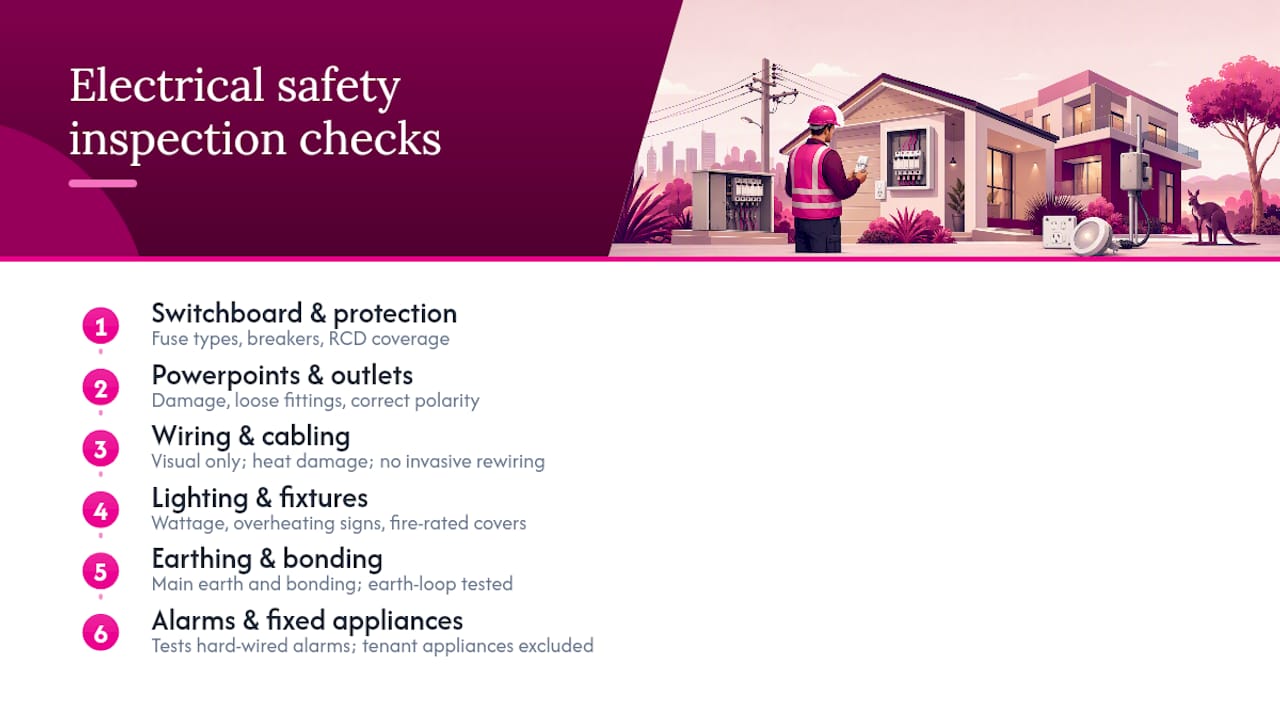
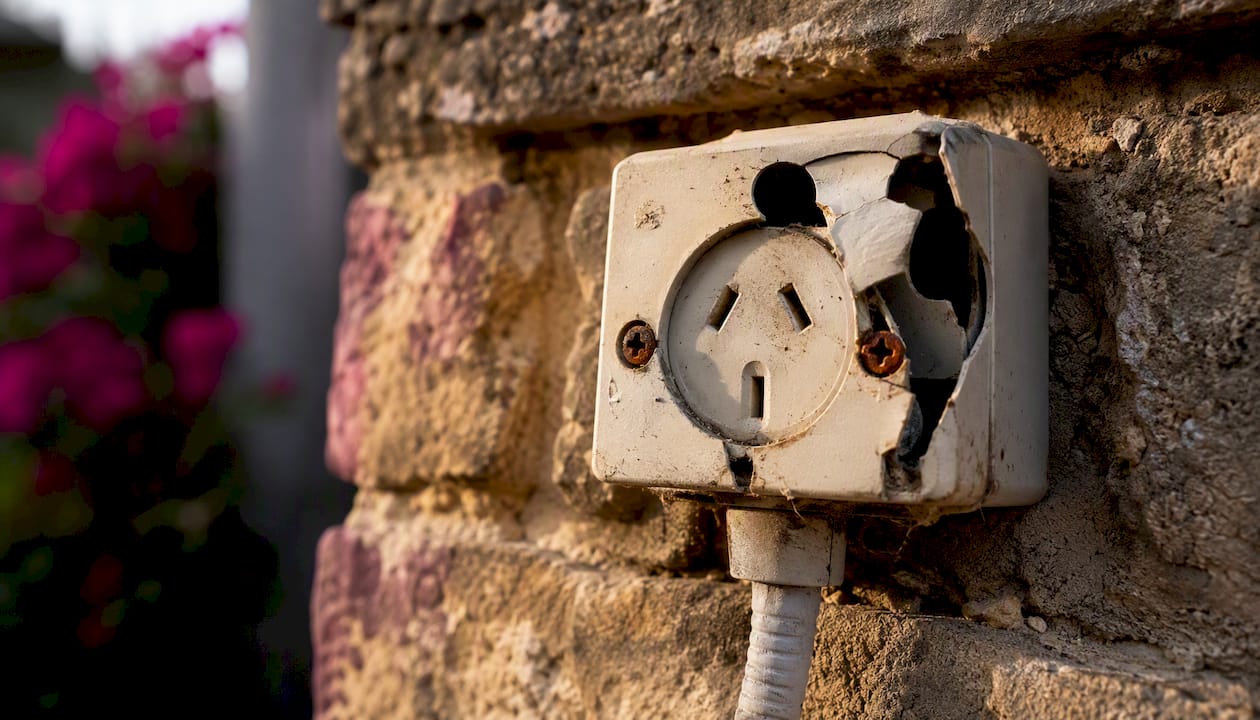
Powerpoints, outlets, and switches. Every general-purpose outlet (GPO) is checked for physical damage, loose fittings, and correct polarity. Outdoor, garden, and pool outlets get extra scrutiny because moisture exposure accelerates deterioration.
Wiring and cabling. This is a visual inspection only — no invasive work unless authorised. The electrician looks for heat-damaged insulation, cabling run through wall cavities without protection, and any DIY alterations that bypass the original installation. Older rubber-insulated wiring (pre-1970s) is noted for condition and risk.
Lighting circuits and fixtures. Checks include correct lamp wattage relative to fitting ratings, signs of overheating at lamp holders, and whether downlights have appropriate fire-rated covers in ceiling spaces.
Earthing and bonding. The main earth connection at the switchboard, plus bonding on the hot water system and any metallic pipework, is verified. A missing or corroded earth is invisible to the eye but detectable with an earth loop tester.
Smoke alarms and hard-wired detectors. The electrician tests hard-wired alarms for function and checks interconnection where required. Landlord-supplied fixed appliances (ovens, cooktops, fixed heaters) are also checked for visible defects and correct installation.
The inspection does not include invasive rewiring, opening wall cavities, or testing appliances the tenant has brought in.
Step-by-step checklist you can hand to a licensed electrician
Use this step-by-step checklist during an inspection or as a handover to your electrician. Number each step, photograph the result, and note any remedial action required before the electrician leaves.
-
Exterior meter and service. Check the meter box for physical damage, moisture ingress, and correct labelling. Note the meter serial number and any visible cable damage from the service head to the meter.
-
Switchboard inspection. Open the board and check for correct circuit labelling, presence of RCDs, fuse types, signs of overheating (scorch marks, discolouration), and adequate cable management. Record the switchboard make, model, and age if visible.
-
RCD functional test. Press the test button on each RCD. It must trip within the required time (typically within 300 ms). Record the RCD label, circuit covered, and test result. A failed trip is an urgent defect.
-
Powerpoints and switches. Test each GPO with a plug-in tester for polarity and earth continuity. Check for cracked faceplates, loose fittings, and discolouration. Note any double-adaptors or piggyback plugs as a risk observation.
-
Lighting circuits. Check all fixed light fittings for correct lamp type and wattage, signs of heat damage, and secure mounting. Test each switch for correct operation.
-
Fixed appliances. Visually inspect ovens, cooktops, fixed heaters, and air conditioning units for damaged cords, loose connections, and correct circuit protection. For air conditioning electrical inspections, a separate specialist check may be warranted.
-
Earthing and bonding. Confirm the main earth conductor is intact and connected at the switchboard. Check bonding conductors on the hot water system and any accessible metallic pipework.
-
Smoke alarms. Test each hard-wired alarm using the test button. Check the installation date (most alarms have a 10-year service life). Note any battery-only alarms in locations that require hard-wired units under state rules.
Pro Tip: Photograph the switchboard label, each RCD test button, and any defects found. Save images in a dated folder named by property address and inspection date — this record speeds up insurer conversations and remedial works authorisation significantly.
Who must carry out the check and how to verify licences
Only a licensed electrician can perform the functional tests and issue certificates. Landlords, property managers, and maintenance staff must not perform live testing, press terminal screws on live circuits, or attempt to rewire RCDs.
For standard safety inspections, a licensed electrician (A-grade or equivalent in your state) is the minimum requirement. Work on the metering system, service lines, or the connection between the property and the network requires a Level 2 authorised service provider. Not every electrician holds this accreditation, so it pays to ask before booking.
Verifying a licence. Use TradieVerify to cross-check an electrician's licence number against state regulator records before works begin. Each state also has its own regulator portal: NSW Fair Trading, the Electrical Safety Office in QLD, and Consumer Protection WA, among others. Ask the electrician for their licence number before they start, and confirm it matches the name on the report they issue.
Landlord and tenant obligations. Landlords are responsible for arranging and paying for mandatory safety checks and any remedial work required to bring the property to a safe standard. Tenants are not responsible for the cost of compliance inspections. Where a defect is found, the landlord must arrange repairs within a timeframe that reflects the urgency of the risk. For rental property electrical inspections, the electrician's signed report is the landlord's primary compliance evidence.
Practical verification steps: ask for the licence number before booking, request the completed Electrical Safety Check Report on the day, and keep a copy of the report and any remedial invoices together in the property file.
What are the state-by-state inspection requirements?
State rules vary more than most property managers realise. Victoria mandates periodic full electrical safety checks for rental properties. Queensland and Western Australia require RCDs on all circuits for rentals, with WA's enforcement tightening from late 2025. NSW does not yet mandate a fixed inspection interval for residential rentals, but the NSW 2025 Draft Service and Installation Rules require contractors to identify hazards, assess risks, and implement controls, referencing AS/NZS 4836 as the guiding standard for safe work on site.
Frequency guidance for all owners. Where no state mandate applies, a full professional inspection every two to five years is reasonable for properties built after 1990. Properties with pre-1980s wiring, ceramic fuses, or no RCDs warrant inspection every two years at most. Between full inspections, press the RCD test button monthly and do a visual room-by-room check every six months, noting any discolouration, burning smells, or flickering lights.
TradieVerify's rental inspection guidance notes that standard checks typically cost $150–$300, with price varying based on switchboard age, number of circuits, travel distance, and whether remedial work is needed on the day.
How are electrical checks performed on site?
Licensed electricians use visual inspection plus a targeted set of functional and instrument tests: RCD trip tests, polarity checks, continuity, and earth loop or insulation resistance tests where required. Each test answers a specific question about the circuit's safety.
- Visual inspection. The electrician looks for physical damage, signs of overheating, non-compliant installations, and any obvious hazards before touching anything live.
- RCD trip test. An RCD tester applies a calibrated fault current to confirm the device trips within the required time. This is the most important routine test for shock protection.
- Polarity check. A plug-in tester or multimeter confirms active and neutral conductors are correctly connected at each outlet. Reversed polarity creates shock risk even when a circuit appears to work normally.
- Earth continuity test. Confirms the earth conductor is intact from the outlet back to the switchboard. A broken earth is invisible in normal use but fatal in a fault condition.
- Insulation resistance test. A megohmmeter applies a high DC voltage to check insulation integrity between conductors. Used on older wiring or where damage is suspected.
- Earth loop impedance test. Measures the total impedance of the fault loop to confirm protective devices will operate fast enough in a fault.
Typical instruments: a dedicated RCD tester, a multimeter or insulation resistance tester (megohmmeter), and an earth loop impedance tester. The report should record the instrument make, model, and calibration date alongside each result.
On-site safety. The NSW 2025 Draft Service and Installation Rules require contractors to conduct a hazard assessment, implement controls, and reference AS/NZS 4836 for safe working near low-voltage installations. In practice, this means the electrician isolates circuits before testing where possible, uses insulated tools and appropriate PPE (insulated gloves, safety glasses), and never works alone on live switchboards without a risk-assessed reason.
Do not press live circuit terminal screws, attempt to rewire an RCD, or open a switchboard yourself. These actions carry a real electrocution risk and are restricted to licensed personnel.
What defects are most commonly found, and how urgent are they?
Defects fall into four urgency categories: urgent (immediate fire or shock risk), high (repair within days), medium (repair within weeks), and low (monitor and schedule). Acting on the right category at the right speed is what separates a managed property from a liability.
| Defect | Urgency | Typical remediation | Ballpark cost (AUD) | Timeframe |
|---|---|---|---|---|
| Exposed live wiring or open junction box | Urgent | Make-safe, re-terminate, cover | $150–$300 | Same day |
| Failed RCD (does not trip on test) | Urgent | RCD replacement | $150–$300 per unit | Same day or next day |
| No RCD coverage on required circuits | High | Add RCDs to switchboard or upgrade board | $150–$300 | Within days |
| Overloaded or obsolete switchboard (ceramic fuses, no earth) | High | Switchboard upgrade | $150–$300 | 1–3 days |
| Loose or damaged powerpoint | Medium | Replace GPO | $150–$300 per outlet | Within weeks |
| Smoke alarm expired or not functioning | Medium | Replace alarm | $150–$300 per alarm | Within weeks |
| Minor labelling deficiencies | Low | Re-label circuits | $150–$300 | Next scheduled visit |
When a serious hazard is found, follow these steps immediately:
- Isolate the affected circuit at the switchboard if it is safe to do so.
- Make safe by ensuring no one can access the hazard (tape off, signage, lock switchboard).
- Report the defect to the property owner or manager in writing, with photos.
- Schedule permanent repair with a licensed electrician. For urgent faults, contact an emergency make-safe service rather than waiting for a standard booking.
For defect rectification following a formal defect notice from a network distributor or regulator, the process is more structured and time-bound. Do not ignore a formal notice.
How should you record and store inspection results?
Keep the electrician's completed Electrical Safety Check Report, all photographs, and remedial invoices together. These are your compliance evidence if a tenancy dispute, insurance claim, or regulator audit arises.
A complete report should capture:
- Inspector's full name and licence number
- Date and property address
- Test instrument make, model, and calibration status
- Circuit-by-circuit test results (pass/fail, measured values where applicable)
- Defects found, urgency category, and recommended actions
- Remedial work completed on the day (with materials used)
- Completion date and inspector's signature
The NSW metering code requires that inspection regimes document testing and recording procedures aligned with AS/NZS 3000, and that evidence of inspections and corrective actions is retained. Victoria requires landlords to keep electrical safety check records for seven years where applicable. Even where no specific retention period is mandated, seven years is a sensible default for rental properties.
For storage, scan the signed report as a PDF immediately after the inspection. Name the file using the format: PropertyAddress_ElectricalCheck_YYYYMMDD.pdf. Keep a second copy in cloud storage (Google Drive, Dropbox, or a property management platform). Physical copies fade; a digital backup does not.
How High Demand Electrical conducts safety inspections in Sydney
High Demand Electrical provides certified Level 2 electricians and NSW-compliant electrical safety inspections with documented reports and remediation options. For Sydney property owners and managers, that means one call covers the inspection, the paperwork, and any follow-up works.
A standard inspection with High Demand Electrical includes:
- Full site risk assessment and hazard identification before works begin
- Complete electrical safety check across switchboard, RCDs, circuits, outlets, earthing, and smoke alarms
- Documented test records on the Electrical Safety Check Report, signed and ready for your property file
- Remedial quote provided on the day for any defects found
- Follow-up works and certification available, including switchboard upgrades, RCD installation, and defect rectification
- Free site inspection for Level 2 work, covering metering, service connections, and network-related issues
High Demand Electrical operates 24/7, rain, hail, or shine. For urgent faults found during an inspection, the team can move directly to emergency make-safe work without a second booking. Over 300 five-star reviews reflect a consistent track record across residential, commercial, and strata properties throughout Sydney.
When you call or submit an online enquiry, expect a prompt response, a confirmed on-site time, and a clear scope of work before anything is touched. The electrician arrives with calibrated test equipment, completes the full checklist, and hands you a signed report before leaving.
Why systematic inspection beats ad-hoc checks every time
The property managers who end up in front of VCAT or dealing with an insurance dispute are rarely the ones who skipped inspections entirely. They are the ones who did informal checks, noted a concern, and did not document it. That gap between "we had a look" and "here is the signed report, the photos, and the remedial invoice" is where liability lives.
Scheduling a formal inspection on a fixed cycle, photographing every finding, and keeping records in a named digital folder takes less than an hour of your time per property per year. The RCD test button takes 30 seconds to press each month. These habits do not just protect tenants — they protect you.
Prioritise the switchboard and RCDs above everything else. An outdated board with ceramic fuses and no safety switches is the single highest-risk configuration still found in Australian rental properties. If your property has one, book a licensed electrician before the next tenancy begins, not after.
Book a certified inspection with High Demand Electrical
Sydney property owners and managers get a documented, compliant inspection and a clear remediation path in a single visit from High Demand Electrical.

High Demand Electrical's certified Level 2 electricians arrive with calibrated test equipment, complete the full electrical safety check, and hand you a signed Electrical Safety Check Report before leaving. No chasing paperwork, no second visit for the quote. Defects found on the day get a remedial price on the spot, and urgent faults can be made safe immediately. Free site inspection applies to all Level 2 work. The team is available 24/7 for both scheduled inspections and emergency callouts across Sydney.
Call Chris on 0402 559 777 or book online to arrange your inspection. For complex switchboard or metering work, ask about Level 2 services and the free site inspection that comes with them.
Sources
Download these official forms and standards to accompany your checklist and keep them in your property file.
- NSW 2025 draft service and installation rules (Energy NSW)
- Rental property trade inspections (TradieVerify)
Recommended
Powering Your Needs with Expertise
If you’re looking for a reliable, experienced, and prompt electrician, look no further than High Demand Electrical. We cater to all your electrical needs, from routine maintenance to emergency repairs and complete system installations. Our skilled team is committed to providing professional service that ensures your electrical systems run smoothly. Whether it's a small task or a large project, give us a call today. Let us meet all your electrical demands with the quality and reliability you deserve.