Property Manager Electrical Checklist: What to Check and When
If you manage a rental, strata or multi-unit property, your minimum electrical check today covers five things: a burning smell anywhere near the switchboard, warm or discoloured power points, breakers that keep tripping, exposed or damaged wiring, and any RCD (safety switch) that fails a test push. Any one of these is a fail. Book a licensed electrician immediately for anything that fails, and photograph every finding with a timestamp before you touch or move anything. That photo record is what protects you and the owner when an insurer or tribunal asks whether the property was properly maintained.
- Smell test at the switchboard and around power outlets
- Touch test on outlets and switch plates for unusual warmth
- Trip history: has any circuit breaker tripped more than once this month?
- Visual check for exposed wiring, scorch marks or loose fittings
- Push-test every RCD/safety switch
Key Takeaways
A defensible electrical checklist combines a fixed inspection cadence, clear escalation rules by risk level, and timestamped photo evidence retained for every finding.
| Point | Details |
|---|---|
| Run three inspection tiers | Monthly visual checks, seasonal audits, and one annual licensed compliance inspection cover every risk level. |
| Escalate by risk, not convenience | Sparks or burning smell mean same-day callout; repeated trips mean 24 to 72 hours; minor wear can wait for routine service. |
| Photograph and timestamp everything | Tag photos with property ID, unit number and date so failed items create an auditable record. |
| Know the Level 2 boundary | Meter, service head and switchboard capacity work legally requires a Level 2 contractor, not a standard electrician. |
| Book licensed inspections through Hdlevel2electriciansydney | The team covers annual compliance inspections, emergency make-safe callouts and Level 2 network work with signed reports. |
Table of Contents
- Property manager electrical checklist for every walkthrough
- How often should you inspect electrical systems?
- When do you need a licensed electrician or Level 2 contractor?
- Keeping records that actually hold up
- Building the checklist into your day-to-day operations
- How should you talk to tenants about electrical inspections and faults?
- What are the legal requirements for electrical safety in rental properties?
- What training helps property managers manage electrical risk?
- What an electrician wishes property managers knew
- Who to call for licensed inspections and Level 2 work
- Sources
Property manager electrical checklist for every walkthrough
Run this list on every routine visit, whether it’s a common-area walk or a unit inspection. Group it by location so nothing gets skipped when you’re moving fast between units.
Common areas and plant rooms
- Switchboard door closes properly, no unusual heat or smell, circuits clearly labelled
- Emergency and exit lighting activates when tested
- External meter box and pole connection show no cracking, rust or exposed cabling
- Any surge protection device shows a healthy indicator light
Individual units
- RCDs/safety switches trip when the test button is pushed
- Power points and switches aren’t warm, discoloured or loose in the wall
- Smoke alarms respond to the test button and aren’t past their battery or unit expiry
- Visible wiring behind appliances or in roof/subfloor access points shows no fraying or DIY splicing
- Hot water system and fixed appliances (ducted air conditioning, ovens, dishwashers) power on without buzzing, tripping or burning odour
External service points
- Private power poles free of vegetation contact and visible corrosion
- Meter box door secure and undamaged
A checklist without evidence is just a memory. Inspectly360’s electrical maintenance framework requires a pass/fail entry and photo evidence on every failed or critical item, which is exactly what regulators and insurers want to see if a claim ever gets contested.
Pro Tip: Tag every photo with the property ID, unit number and date in the filename or caption before you leave the site. Retyping it later from memory is where records fall apart.
How often should you inspect electrical systems?
Property managers who wait for tenants to report a problem are managing risk backwards. A layered inspection cadence catches faults while they’re still cheap to fix.
1. Monthly visual checks
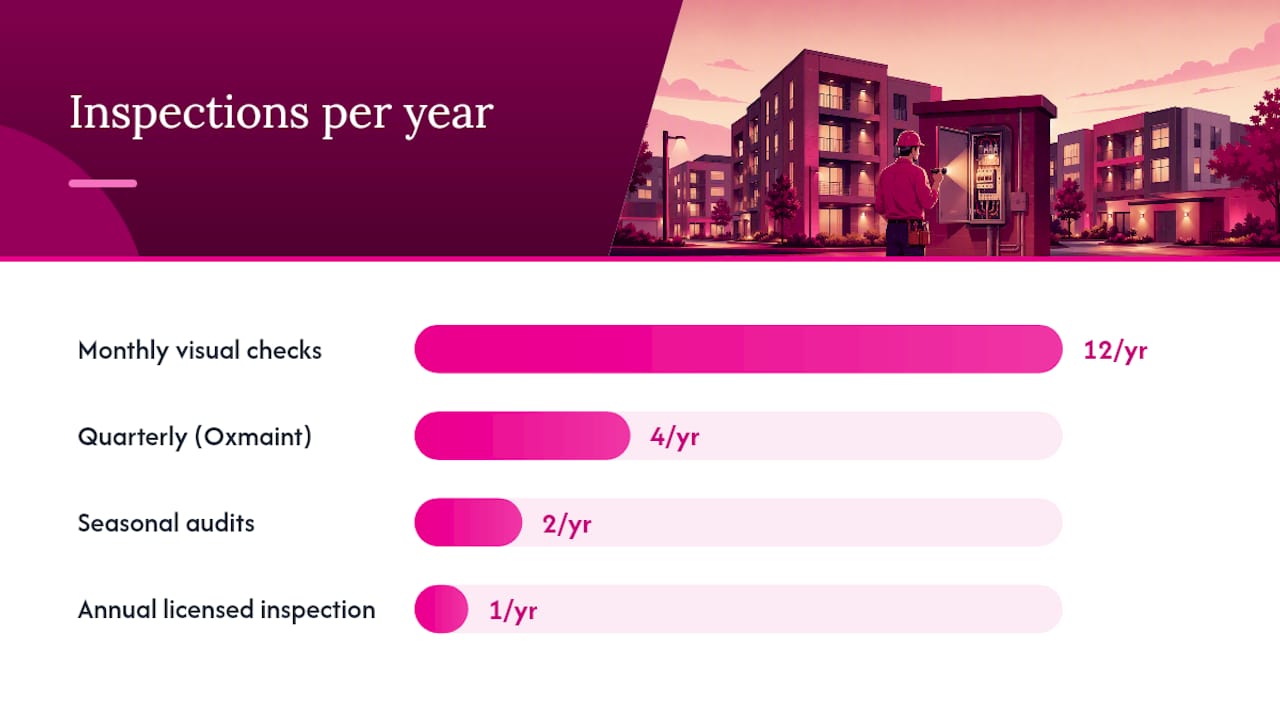
Walk common areas and any accessible switchboards. A fail at this level means: warm outlets, visible burn marks or scorching, a breaker that’s tripped more than once since the last visit, or an RCD that doesn’t trip on test. None of these require a tool, just attention.
2. Seasonal audits (pre-summer, pre-winter)
- Inspect switchboard condition more closely, including connection tightness where visible
- Test emergency and exit lighting under load
- Check for signs of circuit overload before air conditioning or heating season peaks
- Confirm surge protection devices are intact ahead of storm season
- Review fixed appliance condition, particularly hot water systems and ducted units
3. Annual licensed compliance inspection
This is the one job a property manager cannot do themselves. A licensed electrician needs to load-test circuits, inspect the switchboard for compliance, check AFCI protection where required, and issue a formal compliance certificate. Oxmaint recommends exactly this rhythm: quarterly checks paired with an annual licensed inspection, given how often electrical faults sit behind property fire and insurance claims.
Escalation should be built into the timeline, not treated as an exception:
- Immediate: make safe and call an emergency electrician the same day (sparks, burning smell, exposed live wiring)
- Urgent (24 to 72 hours): repeated breaker trips, a failed RCD, warm outlets with no obvious cause
- Routine: schedule with your regular contractor (labelling issues, minor wear, non-critical fittings)
TaskEstate’s preventive maintenance model makes the same point about breaker trips specifically: a single trip is noise, but a pattern of trips on the same circuit is a signal worth escalating before it becomes a fire.
When do you need a licensed electrician or Level 2 contractor?
Some findings are yours to log. Others are not yours to touch. Get this wrong and you’re either creating a liability or wasting a callout fee on something that could’ve waited.
Call immediately (same day, no exceptions) when you see:
- Sparks, smoke or a burning smell from any fitting or switchboard
- Exposed or scorched wiring
- Breakers that trip repeatedly on the same circuit
- Power points or switches that feel warm or show discolouration
The NFPA’s electrical safety checklist lists frequent tripping, tingling sensations from appliances, and warm or discoloured outlets as clear triggers for calling a qualified electrician, not for waiting until the next scheduled visit.
Level 2 accreditation matters for a specific category of work: anything touching the network connection, the service head, the meter, or a switchboard upgrade that affects supply capacity. A standard licensed electrician can’t lawfully do these jobs. Property managers dealing with a power fault that traces back to the meter or pole need a Level 2 contractor specifically, not just any electrician on call.
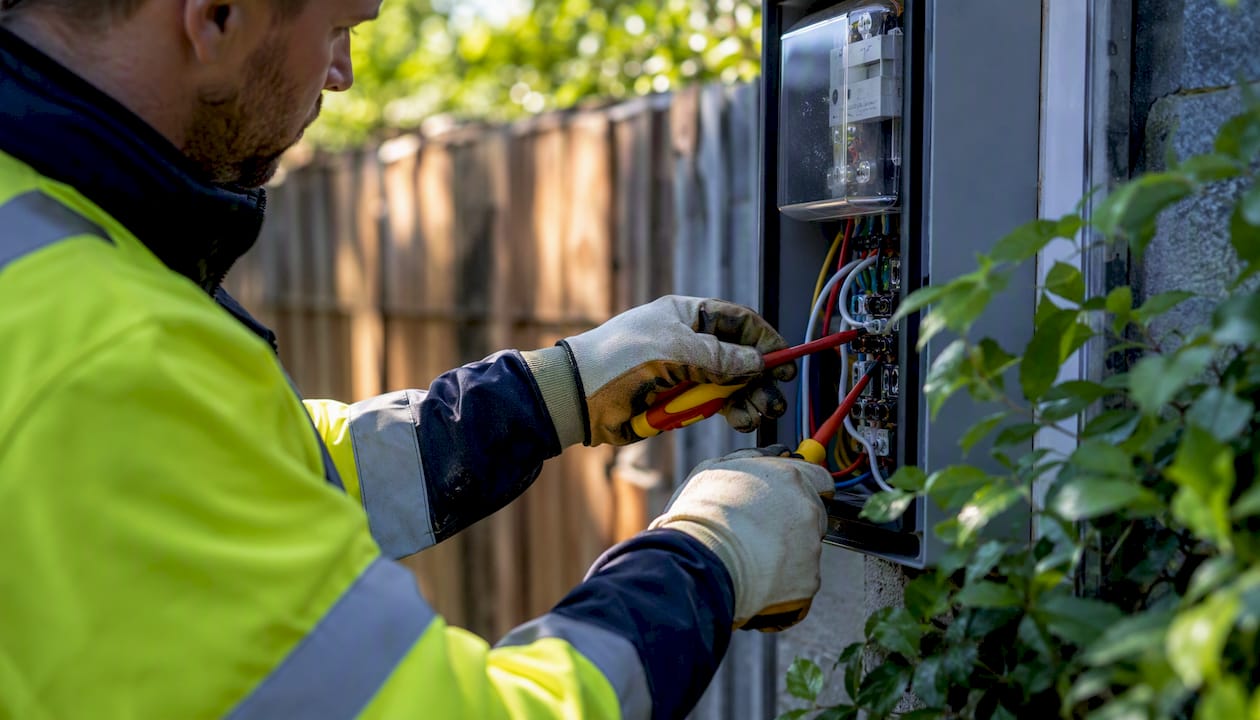
TaskEstate is direct about the boundary here too: property managers should stick to visual safety checks and route anything electrical to a licensed professional, never attempt repairs themselves.
A signed inspection report matters more than most managers realise until they need it. If an insurer asks whether the property was maintained to standard after a fire or an electrocution claim, a dated, signed report from a licensed electrician is your evidence. A verbal assurance from a handyman is not.
Pro Tip: After any emergency make-safe, keep the invoice, the signed report and your own timestamped photos of the fault together in one file. If you’re asked to prove the property was safe six months from now, you’ll want all three in the same place, not scattered across email threads.
Keeping records that actually hold up
An inspection that isn’t documented properly is functionally the same as an inspection that never happened, at least in the eyes of an insurer reviewing a claim. Every check you run should generate the same core record: a timestamped photo, a pass or fail status, the inspector’s name, who owns any corrective action, and proof it was closed out.
- Store timestamped photos against the specific asset ID, not just the property address
- Log pass/fail per item, not a general “all good” note for the whole unit
- Assign a named owner and due date to every corrective action, and don’t close the record until it’s verified fixed
- Keep signed electrician reports as PDFs, filed by property and date, ready to hand to an insurer on request
Inspectly360’s framework treats this as non-negotiable: failed or critical items stay open until corrective action is verified, which is what makes the record auditable rather than just a checklist someone filled in once. Mobile checklists with offline capability are worth the setup time here, because they capture the photo, the timestamp and the inspector’s identity in one action instead of three separate steps that are easy to skip under time pressure.
Pro Tip: Export every completed inspection to PDF and archive it alongside the electrician’s signed report the same day. Insurers move faster on claims when the paperwork is already assembled rather than reconstructed after the fact.
Building the checklist into your day-to-day operations
A checklist only works if it’s actually run, not just written. The workflow is simple: schedule the check, inspect, document with photos, raise a work order for anything that fails, verify the fix, then archive the record.
- Schedule inspections against your existing maintenance calendar, not as a separate task nobody owns
- Inspect using the same fields every time: property ID, location, item, pass/fail/N/A, photo, notes
- Raise a work order with an assigned vendor and due date for every fail
- Verify closure before marking the record complete
- Archive the finished record against the asset, ready for insurance or audit requests
- Train staff on what a “fail” actually looks like, not just how to tick the box
- Build inspection timing into vendor SLAs so contractors know your response windows
- Set a standard tenant notice period for access, and stick to it
Oxmaint’s maintenance scheduling approach bundles electrical checks alongside HVAC and plumbing on the same seasonal calendar, which makes budgeting and expiry tracking far less painful than running electrical on its own timeline.
How should you talk to tenants about electrical inspections and faults?
Tenants react badly to electrical work mostly because they weren’t told what’s happening or why. Fix the communication and most friction disappears.
Give tenants written notice ahead of any scheduled inspection, stating the date, expected duration and which areas need access. For routine checks, the standard access notice period that applies to your state’s tenancy law is the floor, not a courtesy, so check your obligations before you knock. General guidance on rental inspection responsibilities is a useful reference point for what tenants can reasonably expect from both routine and reactive visits.
When a tenant reports a fault themselves, acknowledge it the same day, even if the fix takes longer. Tell them plainly whether it’s urgent (you’re sending someone today) or routine (it’s booked for the next available slot), and give a realistic timeframe rather than a vague “we’ll look into it.”
For anything that triggers an immediate escalation, be direct: tell the tenant to avoid the affected switch, outlet or appliance until the electrician has attended, and confirm in writing once it’s been made safe. This protects the tenant and creates a written record that you acted the moment you were informed.
Keep a simple log of every tenant-reported electrical issue: date reported, description, action taken and closure date. This becomes part of your defensible record if a dispute ever reaches NSW Fair Trading or the NSW Civil and Administrative Tribunal, and it also builds tenant trust that reports get taken seriously rather than filed and forgotten.
What are the legal requirements for electrical safety in rental properties?
Electrical safety obligations for rental and strata properties in NSW sit across a few different frameworks, and property managers are expected to know where each one applies.
Any work on wiring, switchboards, or fixed electrical installations must be carried out by a licensed electrician, full stop. Managers can run visual safety checks, but load testing, circuit certification and switchboard compliance work are legally restricted to licensed professionals, and Level 2 accreditation is required specifically for work on the network connection, service head, meter or supply capacity.
Smoke alarm requirements are a separate compliance layer entirely, with their own testing and replacement obligations that sit alongside, not instead of, general electrical safety duties.
Strata schemes carry an added layer of responsibility for common property electrical infrastructure, including switchboards, common area lighting and shared plant, which typically falls to the owners corporation rather than individual lot owners. Commercial tenancies bring their own compliance layer again, particularly around switchboard certification for fitouts and any changes to supply capacity. Managers overseeing commercial assets should treat switchboard compliance as a distinct checklist item from residential work, since the certification standards and documentation expected by regulators differ.
None of this replaces getting proper legal advice on a specific property’s obligations. What it does mean practically: keep every compliance certificate on file, know which categories of work require Level 2 accreditation specifically, and never treat a visual pass on your own checklist as equivalent to a licensed compliance inspection.
What training helps property managers manage electrical risk?
You don’t need an electrical licence to manage electrical risk well, but a bit of structured knowledge goes a long way toward catching problems before a tenant does.
Most state real estate institutes and industry bodies run short courses on property maintenance compliance that include an electrical safety module, covering what a visual check should catch and where the legal line sits between manager and licensed electrician. These are worth doing even for experienced managers, because the standards shift periodically and a course refreshes what “current” looks like.
Beyond formal courses, the most useful skill is pattern recognition: knowing that a single tripped breaker is noise but three trips on the same circuit in a month is a signal, or that a warm power point is never “probably fine.” This comes from exposure and from talking to the electricians you work with regularly about what they’re seeing on-site.
Fire safety awareness overlaps heavily with electrical risk, since faulty wiring and overloaded circuits sit behind a large share of preventable property fires. Courses covering fire alarm and emergency lighting systems are a sensible companion to electrical safety training, particularly for managers overseeing common areas where emergency lighting compliance is tested less often than it should be.
If your portfolio includes strata or commercial assets, it’s worth having at least one team member complete a course specifically on WHS obligations around electrical safety in shared and commercial spaces, since the duty of care extends further than most managers assume.
What an electrician wishes property managers knew
Most of the faults we get called out for weren’t hidden. They were sitting behind a power point cover or inside a roof space, added by a previous tenant or a well-meaning DIY job nobody flagged. Unlabelled switchboards cost everyone time, us included, when we’re trying to isolate a circuit safely in an emergency. Before we arrive, clear access to the switchboard and affected area, take your own photos, and if anything feels unsafe, switch off the circuit at the board rather than waiting for us to walk in.
Who to call for licensed inspections and Level 2 work
Hdlevel2electriciansydney gives you one number to call instead of juggling separate contractors for routine inspections, urgent faults and Level 2 network work. As a certified Level 2 electrical contractor operating across Sydney, the team handles everything this checklist points to: annual compliance inspections, switchboard upgrades, safety switch installation, and same-day emergency make-safe callouts, all with signed reports and photo evidence you can file straight into your records.

If a routine walkthrough turns up a fail, book a rental property electrical inspection to get a licensed compliance report on file. If something’s sparking, smoking or tripping repeatedly, Hdlevel2electriciansydney’s emergency electrician service is available around the clock, rain, hail or shine. For work on the meter, service head or supply capacity, a free site inspection for Level 2 electrical work means you get transparent pricing before anything’s booked in. Call today to line up your next annual inspection or get an urgent fault looked at before it becomes a bigger problem.
Sources
- Property Electrical Systems Maintenance Checklist: Safety & Compliance
- Electrical preventive maintenance for property managers
- Electrical maintenance checklist for real estate & property management teams
- Electrical safety: checklist (NFPA)
Recommended
Powering Your Needs with Expertise
If you’re looking for a reliable, experienced, and prompt electrician, look no further than High Demand Electrical. We cater to all your electrical needs, from routine maintenance to emergency repairs and complete system installations. Our skilled team is committed to providing professional service that ensures your electrical systems run smoothly. Whether it's a small task or a large project, give us a call today. Let us meet all your electrical demands with the quality and reliability you deserve.