Whole-house surge protector installation in Sydney: what to know
A device label alone can’t tell you whether whole-house surge protection suits your property. Whole house surge protector installation Sydney homeowners consider should start with the switchboard and electricity supply, not simply the product type. A plug-in surge-protecting power board can provide an extra layer for equipment connected to it, while a switchboard-mounted device is intended to protect circuits across the property. Neither replaces a safety switch, which helps protect people from electric shock, or guarantees appliances won’t be damaged.
If you’re concerned about storms, grid fluctuations or sensitive equipment, it’s reasonable to want a clearer picture before deciding. The right approach depends on the existing switchboard, available space, supply arrangement and protection already in place. An assessment should establish these site conditions before any installation is planned.
This guide explains what whole-house surge protection can and can’t do, how it differs from plug-in protection, and what an electrician may need to assess at a Sydney property. It also outlines how switchboard condition and electrical infrastructure can shape the next step, so you can make an informed decision without treating a device label as the whole answer.
Key Takeaways
• Whole house surge protector installation Sydney planning should begin with the property’s switchboard and supply, as site conditions can shape the assessment.
• Compare switchboard-mounted and plug-in protection by where each is installed, what it is intended to protect and its limitations.
• Note any surge concerns, property details and visible switchboard information before arranging an electrical assessment. Leave inspection and work methods to a licensed electrical professional.
• Switchboard condition and available space are useful details to understand when planning the next step for your property.
• For a Sydney electrical project involving switchboard upgrades or repairs, contact HDE on Phone 0402 559 777 or Email chris@highdemandelectrical.com.au.
What whole-house surge protection can do for a Sydney property
A short-lived voltage rise can put electrical equipment under stress, even though it isn’t part of normal power use. A surge protector is designed to limit or manage some of these temporary changes, but its role depends on the device and the electrical system it’s connected to. The idea behind whole house surge protector installation Sydney property owners may consider is to locate protection at a shared supply point, rather than relying only on devices plugged in beside individual appliances.
Whole-house surge protection is a device-based layer at a property’s electrical supply, intended to reduce exposure to certain voltage surges within the limits of its design and installation.
What is a whole-house surge protector?
A whole-house surge protector is generally installed at or near the property’s electrical supply, often at the switchboard. Its position and connection depend on the selected device’s instructions and the property’s electrical arrangement, so the name alone doesn’t establish the exact installation point. The surge protector overview explains the general purpose of these devices and how supply-level protection differs from plug-in options.
A plug-in protector sits between a power point and the equipment connected to it. A supply-level device is intended to act at a shared point in the electrical system, rather than only at one outlet. They can serve different roles, but neither should be assumed to cover every circuit or item of equipment. Check the device documentation for its intended use and stated limits.
What it may protect, and what it can’t promise
Protection scope depends on the device’s specifications, how it’s installed, and the configuration and condition of the property’s electrical system. A device may reduce exposure to some surges within its design limits; it can’t promise that every appliance, circuit or part of the installation will avoid damage. The presence of a protector is not a guarantee against every electrical event.
Think of it as one possible layer, not a complete answer to electrical safety. A surge protector doesn’t repair deteriorated wiring, correct a fault or replace attention to the condition of the switchboard and electrical installation. If equipment has been affected or you’ve noticed signs of an electrical problem, don’t rely on adding a protection device as a substitute for having the underlying issue assessed.
For Sydney properties, the supply arrangement can also be relevant when discussing electrical infrastructure. HDE’s documented work includes switchboard upgrades and repairs, as well as Level 2 network services. Its Level 2 electrician services in Sydney relate to service line, metering and connection work. Considering the supply and switchboard together can help put a property’s electrical setup in context.
Before making a decision, identify what you want to protect and gather any available information about the switchboard or recent electrical work. A site-specific assessment of the existing installation and the device requirements is more useful than choosing a product by label alone.
How surge protection relates to your Sydney switchboard and supply
A proposed device can’t be assessed in isolation. The switchboard’s condition, internal layout and available space all affect what can be considered, as do the existing protective components and the way power reaches the property. A crowded or ageing board may need attention before it can accommodate additional equipment. That’s why whole house surge protector installation Sydney planning should begin with the actual electrical setup, rather than assuming one device or method suits every home.
What an electrician assesses before installation
An assessment considers whether the switchboard is in suitable condition and whether its layout can accommodate the proposed device and its required connections. The electrician also needs to understand the existing components, such as circuit breakers and safety switches, and whether the proposed device is compatible with the board. Manufacturer instructions matter too, as they set out the device’s intended application and installation requirements.
The incoming supply is part of the picture. Service mains are the lines or cables that bring electricity from the network towards a property. Consumer mains carry it from the connection point to the main switchboard. Their configuration, along with the property’s wiring, can affect what needs to be considered during an assessment. The exact device and safe work method are determined for the site, not from a generic diagram.
If the board needs repair or replacement as part of broader electrical work, HDE’s switchboard upgrades and repairs may be relevant. This is distinct from selecting a surge device: the condition and capacity of the existing board need to be understood before proposed work can be evaluated.
Why Sydney network context can matter
Sydney properties may be connected through different electricity distribution networks. Ausgrid, Endeavour Energy and Essential Energy are relevant network entities, but the distributor for a particular address depends on its location. Don’t infer it from a nearby suburb or a general description of the area. A recent electricity bill or the distributor’s address lookup can help identify which network applies to the property.
Network context is especially useful where work may involve the service connection or metering, rather than only equipment within the home. HDE is a Level 2 Accredited Service Provider (ASP), authorised to carry out service line, metering and connection work for Ausgrid, Endeavour Energy and Essential Energy. This accreditation covers network work involving those areas.
A sound installation assessment starts with the property’s actual supply, switchboard and existing electrical components. Keep the address, any known switchboard history and the distributor name together when discussing a project. For help with a Sydney switchboard upgrade or repair, contact HDE on Phone 0402 559 777 or Email chris@highdemandelectrical.com.au.
Whole-house surge protector vs plug-in protection: compare their roles
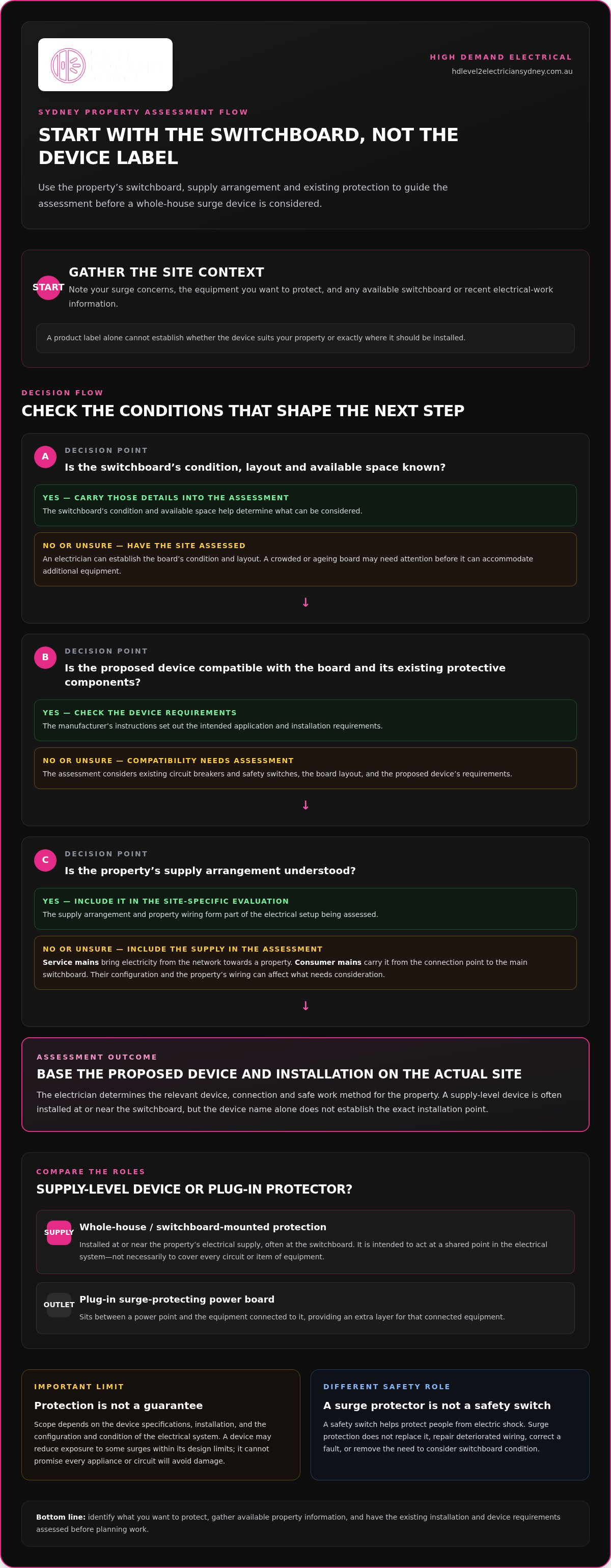
These options work at different points in an electrical system. A supply-level device is intended to address surges at a shared point, while a plug-in protector is used at an individual power point. Neither should be treated as a guaranteed shield for every appliance or circuit. The right comparison starts with what each product is designed to do and the limits stated by its manufacturer.
How the two protection approaches differ
A whole-house device is connected to the property’s electrical supply, commonly at the switchboard, but its exact position depends on the specific product and installation requirements. A plug-in unit sits between a power point and connected equipment. Its intended protection applies at that point of use and depends on the device’s specifications, condition and correct use.
| Comparison | Whole-house device | Plug-in device |
|---|---|---|
| Typical location | At the electrical supply or switchboard, as specified for the product. | Between a power point and the equipment connected to it. |
| Intended role | Provides a supply-level layer for the property’s electrical system, within the device’s stated scope. | Provides a point-of-use layer for connected equipment, within its stated scope. |
| Key limitation | Coverage depends on product specifications, installation and the property’s electrical setup. | Doesn’t automatically cover equipment connected elsewhere or establish protection across the property. |
The table shows why the two approaches aren’t automatic substitutes. A plug-in unit relates to the equipment connected through it; a switchboard device is installed at a different point and has its own defined scope. In either case, the product label isn’t enough to establish what protection a particular property or item will receive. Check the product documentation for its intended use and stated limitations.
When a layered approach needs closer assessment
If a property has sensitive equipment in several rooms or across multiple circuits, it may be useful to review the overall protection needs rather than focus on one outlet. A layered approach can involve devices at different points, but adding products does not automatically create compatible or complete protection. The electrical system, selected devices and their manufacturer instructions all matter.
For example, a plug-in protector beside a computer only describes that point-of-use arrangement; it says nothing by itself about equipment elsewhere in the home. Likewise, a supply-level device should not be assumed to provide identical protection to every connected item. An electrician can assess how the property’s electrical system and proposed devices relate, without presuming a particular configuration or outcome. That’s the practical starting point for whole house surge protector installation Sydney discussions.
If your comparison raises questions about the condition or capacity of your switchboard, HDE can discuss a related switchboard project. Contact High Demand Electrical to discuss the electrical work you’re planning.
What to expect during a whole-house surge protector installation assessment
A useful assessment follows a clear sequence: explain what prompted the enquiry, review the existing electrical setup, consider the requirements of any proposed device, then discuss suitable next steps. The assessment is specific to the property. It doesn’t mean a particular product or installation method will suit every switchboard.
Before the site assessment
A few practical notes can help make the discussion more focused. Record which equipment was affected, what happened and when, and any changes to the property’s electrical supply or switchboard that you know about. If there have been repeated symptoms, note whether they affected one item or several. Don’t open the switchboard or handle electrical equipment to gather this information.
Identify where the switchboard is and make sure the electrician can access it. If you have documents relating to previous switchboard work or supply changes, have them available. These details can help explain the property’s history, but the electrician will still need to assess the installation directly.
During and after the assessment
The licensed electrical professional reviews the switchboard’s condition and arrangement, relevant existing components and the property’s supply. If a device is being considered, its manufacturer’s instructions and compatibility with the installation are part of the discussion. The professional determines the safe work method for the site, then explains whether related electrical work may be needed and what the next steps involve.
Broader checks may be relevant if the concern points to the general condition of the electrical installation, not only surge protection. HDE’s electrical safety inspection service relates to assessing electrical safety conditions. Any reference to AS/NZS 3000 or SIRNSW should be considered in relation to the proposed work and applicable requirements. A general description alone does not establish compliance.
For work involving service lines, metering or connections, HDE is a Level 2 Accredited Service Provider (ASP), authorised to carry out service line, metering and connection work for Ausgrid, Endeavour Energy and Essential Energy. HDE’s Sydney Level 2 electrician service covers this infrastructure work. HDE also holds Electrical Contractor Licence EC Licence 397193C.
For a whole house surge protector installation Sydney enquiry, keep your notes and property details ready and describe the concern plainly. An assessment can establish which parts of the electrical setup need consideration before any work is planned. For related Sydney electrical work, discuss your project with HDE.
Planning a Sydney surge-protection project: safe next steps
A clear initial enquiry helps focus the discussion on the property and the electrical work involved. Gather a few details before getting in touch, but don’t try to diagnose the cause of a surge or inspect wiring yourself. Any assessment or proposed work needs to take account of the property’s actual setup.
What to include in an initial enquiry
Share your suburb, property type and the concern you’re investigating. For example, note whether equipment was affected after a particular event, which items were involved and whether you’ve noticed any other electrical symptoms. Describe what happened in plain terms rather than assuming the cause.
Property
suburb and whether it’s a house, unit or business premises.
Concern
what happened, when it occurred and which equipment was affected.
Switchboard
its location, any known issues and relevant upgrade or repair history.
Supply changes
any known recent changes to the property’s electrical connection or supply.
These notes are a starting point, not a substitute for a site assessment. The next steps depend on the property’s needs and the electrical work involved. Don’t remove switchboard covers or handle electrical components to collect information. If you have records of previous work, make them available for discussion.
HDE’s documented Sydney electrical credentials
High Demand Electrical provides switchboard upgrades and repairs in Sydney. These services may be relevant if the board’s condition or capacity needs attention as part of a broader electrical project. Keep this work distinct from selecting a surge protector, so it’s clear what the electrical project involves.
HDE holds Electrical Contractor Licence EC Licence 397193C and is a Level 2 Accredited Service Provider (ASP), authorised to carry out service line, metering and connection work for Ausgrid, Endeavour Energy and Essential Energy. Its triple ISO certification comprises ISO 9001, ISO 45001 and ISO 14001. These credentials relate to HDE’s electrical and network work.
For a whole house surge protector installation Sydney project, keep the enquiry focused on your concern, property and any known switchboard or supply details. HDE can discuss switchboard upgrades and repairs and related electrical work in Sydney. Contact High Demand Electrical on Phone 0402 559 777 or Email chris@highdemandelectrical.com.au, or contact High Demand Electrical about your Sydney electrical project.
Take the next step with a clear project brief
A useful next step is to turn your concern into a straightforward project brief: note what happened, which equipment was affected and what you know about the property’s switchboard or supply. That gives the discussion a practical starting point without assuming the cause or deciding in advance which device is suitable. For whole house surge protector installation Sydney planning, an assessment of the property’s electrical setup should guide any proposed work.
High Demand Electrical’s credentials include Electrical Contractor Licence EC Licence 397193C, Level 2 Accredited Service Provider (ASP), authorised to carry out service line, metering and connection work for Ausgrid, Endeavour Energy and Essential Energy, and triple ISO certification to ISO 9001, ISO 45001 and ISO 14001.
To discuss a Sydney switchboard upgrade or repair, or related electrical work, contact High Demand Electrical. Call Phone 0402 559 777 or email Email chris@highdemandelectrical.com.au.
Powering Your Needs with Expertise
If you’re looking for a reliable, experienced, and prompt electrician, look no further than High Demand Electrical. We cater to all your electrical needs, from routine maintenance to emergency repairs and complete system installations. Our skilled team is committed to providing professional service that ensures your electrical systems run smoothly. Whether it's a small task or a large project, give us a call today. Let us meet all your electrical demands with the quality and reliability you deserve.