Underground Electrical Conduit Costs in Sydney
What if your Sydney property needs an underground power route that crosses a driveway or runs beneath a landscaped area? The cost of underground electrical conduit installation depends on the route length, ground conditions, access and the work needed to protect and reinstate the surface. A clear run is different from a route through difficult ground or an existing driveway.
It’s reasonable to want a clear picture of the work before excavation begins, especially when trenching and surface repairs affect the project. This guide explains what drives the cost of underground electrical conduit installation in Sydney and what to consider when planning underground power work.
You’ll learn how driveway crossings affect the scope, how trenching and conduit fit into an installation, and why route planning matters. These details help you understand the work involved and what information is needed for a suitable quote.
Key Takeaways
• See how trench length, ground conditions, access and surface reinstatement can affect the scope of an underground power project.
• Understand why Perth quotes may involve route planning and authority coordination when cabling crosses verges, public land or property boundaries.
• Learn which site conditions can make Gold Coast installations, including driveway crossings, more complex.
• Compare underground and overhead power by considering site constraints, ground works and the protection each route requires.
• Find out what to consider around driveway-crossing depth and protection, and when Level 2 ASP electrical services may be relevant.
Trenching and conduit installation
Trenching, conduit, cable installation and surface reinstatement all shape the work. Route length, ground conditions and site access affect the excavation required.
Trenching and excavation costs
Excavation involves opening the route, managing spoil and preparing a stable base for the conduit. Longer runs require more trenching, materials, labour and coordination. Rocky ground, restricted machinery access or existing paving can add work. A useful quote sets out whether spoil removal, bedding and surface reinstatement are included.
Trenching depth and conduit requirements
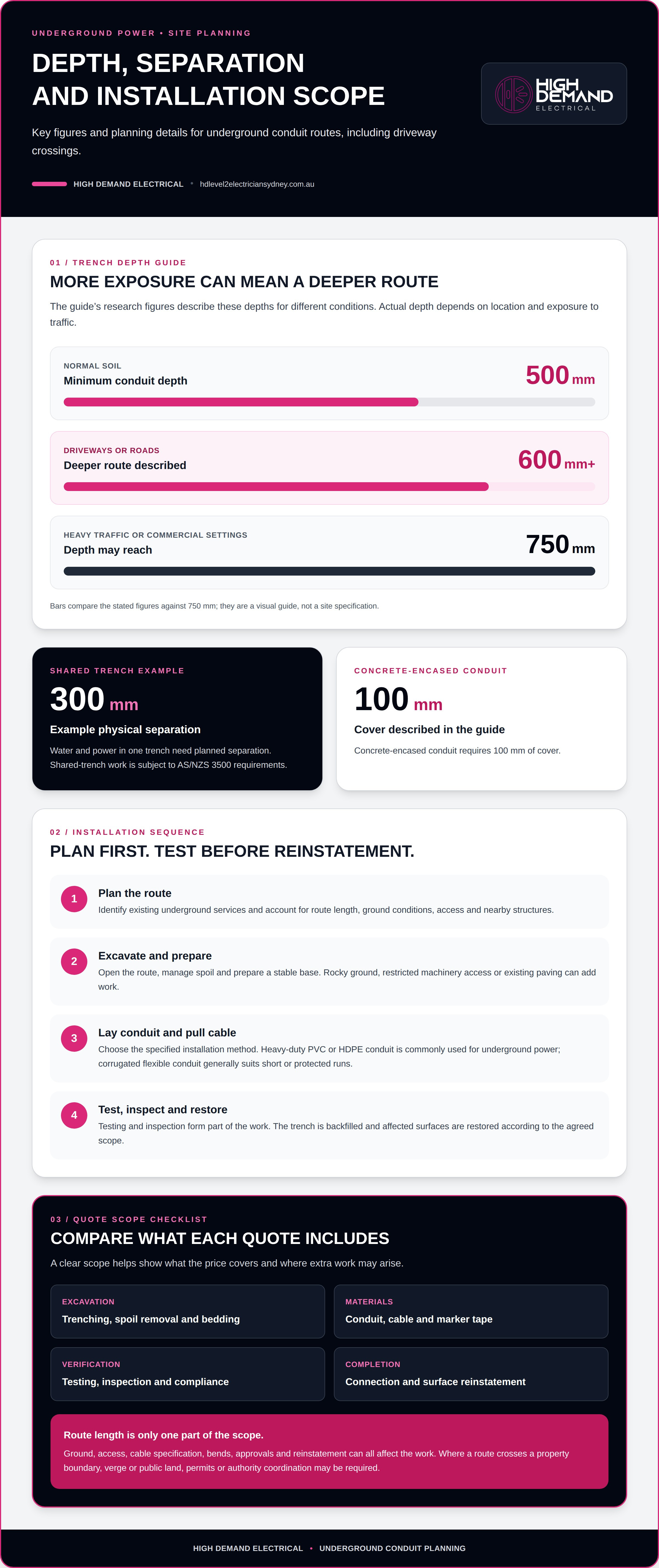
Depth depends on the location and exposure to traffic. The research figures describe 500 mm as a minimum for conduit in normal soil, and 600 mm or deeper beneath driveways or roads. Heavily trafficked or commercial settings may require depths up to 750 mm. Heavy-duty PVC or HDPE conduit is commonly used for underground power.
Before excavation, the installer plans the route and identifies existing underground services. The trench is excavated to suit the site, then the conduit is laid and cable is pulled through. Direct-buried cable and conduit installations have different protection requirements, so the specified method matters. Corrugated flexible conduit is generally suited to short or protected runs, rather than long underground installations.
Water and power sharing a trench need planned separation. A 300 mm gap is an example of physical separation, while shared-trench work is subject to AS/NZS 3500 requirements. The route design must account for both services and their protection, rather than simply placing them side by side. This planning can affect trench width, excavation and coordination.
Compare the scope of each quote, not just its trenching description. It should state whether conduit, cable, bedding, marker tape, testing, compliance, connection and reinstatement are included. These details clarify what the price covers and where extra work may arise. Longer routes require more materials and installation time.
After cable installation, testing and inspection form part of the work. Underground electrical work in Australia is performed by licensed electricians and inspected or certified for compliance. The trench is then backfilled, and affected surfaces are restored according to the agreed scope. For supply routes serving a building, underground service mains installation involves this connection between the supply and the property.
Concrete-encased conduit requires 100mm of cover. Longer underground power runs require more trenching, conduit, cable, labour and coordination. Installation also includes testing and inspection.
Residential underground cable installation costs in Perth
For residential properties in Sydney, underground cable costs depend on the route and work required at the site. A direct run through accessible ground differs from one crossing paving, a property boundary or public land. The price depends on the route, ground, cable specification, access and reinstatement, and is provided after a quote request. These factors shape the excavation, materials and surface work.
Route length is only one part of the estimate. Cable type and the supply it needs to support affect the materials required. Ground conditions influence excavation, while narrow access can limit machinery and change how spoil is moved. A route that bends around existing structures may also need more cable than a straight line on a plan.
In Sydney, cabling that crosses a property boundary, verge or public land may require permits or coordination with the relevant authority. This can add planning before excavation starts. The proposed route also needs to account for existing underground services and the work area. Where public land is involved, the project scope should identify approvals, site coordination and surface reinstatement.
Sydney estimates should reflect the specific property, rather than rely on a broad per-metre comparison. Access, distance, ground and reinstatement can change the scope from one site to another. Underground work involving supply connections, consumer mains or metering may also require a different scope from a cable run within a property. The quote should define the installation and connection work included.
Weather can affect excavation timing and site management, particularly when wet ground changes access or soil handling. For a fault in an existing buried cable, the installer identifies the affected section and assesses whether repairs require excavation or cable replacement. The fault location, cable condition and nearby structures influence the repair scope. Keeping route information with property records can help locate the installation later.
For a new Sydney installation, a useful quote separates cable and conduit from trenching, spoil handling, approvals and reinstatement. It should also identify testing and connection work, so the scope is clear before excavation begins. Where the project involves a property's supply, consumer mains installation may be relevant. If you’re planning a route or addressing a cable issue, discuss the underground cable work with High Demand Electrical.
There is no single average per-metre cost because the estimate depends on the route, ground conditions, cable specification, access and reinstatement. Pricing is provided after a quote request.
The total cost varies with the property’s route, ground conditions, cable requirements, access and reinstatement, as well as any approvals or connection work. A quote based on the specific scope is needed to determine the cost.
Typical underground conduit installation costs on the Gold Coast
For Sydney properties, underground conduit costs depend on the route, ground, access and surface work. A local assessment is more useful than applying figures from another region.
Residential underground service costs
Underground power can supply a home, shed or granny flat, but the project scope varies. The cost of underground electrical conduit installation in Sydney depends on the distance, excavation, cable requirements and any driveway or paved-area work. A private power pole is generally less expensive to install than an underground system, but the site layout and supply requirements determine which option suits the property.
Sydney overhead installations can also involve a private pole or consumer mains upgrades. Their scope differs from underground work, which includes excavation and reinstatement. Compare the work required for each route, rather than treating overhead and underground connections as identical jobs.
Installation cost factors
Distance affects how much trenching, conduit, cable and labour an installation requires. Rocky ground, restricted access and existing concrete can add excavation or restoration work. A driveway crossing may require cutting or boring, followed by repairs to the affected surface.
Incorrect burial can damage existing services, compromise cable protection or leave the installation non-compliant. Electrical installation and connection should be handled by a licensed professional. For an accurate Sydney quote, provide the property location, proposed route, supply point, surface types and any access constraints. The installer can define the work scope around those details.
Per-metre and total installation costs
There is no single per-metre rate that describes every Sydney project. A rate alone cannot account for ground conditions, access, cable requirements, driveway crossings or reinstatement. The cost of underground electrical conduit installation is assessed against these project factors, and a quote sets out the relevant scope and charges.
Likewise, the total for a home depends on whether the route is straightforward or involves difficult excavation and surface repairs. A useful quote identifies trenching, spoil removal, conduit, cable, testing, connection and reinstatement. This shows what the estimate includes, rather than relying on a broad figure that may not suit the property.
For a clearer estimate, share the proposed route and note driveways, paving and access limitations. That information helps define the installation and any related supply work. Discuss your Sydney underground electrical project.
Underground versus overhead power
Underground and overhead connections solve different site problems. The right option depends on the property layout, access and supply requirements.
Underground power keeps cables out of sight and avoids exposed overhead wiring across a yard. It can suit a property where overhead clearance or pole placement creates constraints. However, excavation, conduit, cable protection and surface reinstatement add work. Underground installation in Australia is usually more expensive than overhead because it requires ground works, materials and site-specific planning.
Overhead power avoids trenching, but may require suitable pole placement and clearances. In Sydney, an overhead connection can involve a private pole or consumer mains upgrades, depending on the existing supply and property. Overhead Service Mains Installation addresses the above-ground connection route. Private power poles are generally less expensive to install than underground electrical systems, though the site and required work still shape the comparison.
For a shed or granny flat, the professional plans a supply route from the property’s electrical connection to the outbuilding. Underground runs of 50-100 metres are common for homes and sheds. Wiring to sheds, garages and outbuildings needs suitable protection, with the installation planned for the route and site conditions. The selected route, distance, ground conditions and any driveway crossing affect the work involved. An overhead route instead depends on its pole arrangement and the path of the wiring.
Underground installation involves more than placing conduit in a trench. The electrician plans and excavates the route, lays conduit, pulls through cable, then splices and terminates connections where required. Testing and inspection follow installation. The work must follow applicable Australian standards, including AS/NZS 3000, and the completed supply must be connected correctly. Each stage matters: a poorly planned route can complicate access, protection and future repairs.
Some projects also require a planned disconnection and reconnection of the electrical supply. This is relevant when existing service connections or consumer mains need alteration as part of the installation. The work sequence should account for the supply connection, cable installation, testing and reconnection, rather than treating trenching as a separate job. Site access and the existing installation influence the sequence.
Compare both options against the same requirements: route distance, supply needs, site access, surface impact, pole placement and connection work. Underground power may suit a site where visible wiring is unsuitable, while overhead service may avoid excavation. The price depends on the job and is provided after a quote request, with the route, access, ground conditions and required connection work shaping the scope.
Depth and protection for driveway crossings
Burial depth depends on the installation method and whether the route crosses trafficable ground. A driveway crossing needs particular attention to depth or protective construction.
Burial depth in normal soil
For conduit in normal soil, the supplied Australian reference states a minimum burial depth of 500 mm under AS/NZS 3000:2018. A typical residential underground power trench is described as 600 mm deep. These figures distinguish a stated minimum from a typical trench depth; the required design still depends on the installation and location.
Choosing depth and meeting minimums
A licensed electrician considers whether the route is beneath a driveway, road or other trafficable area, as well as the cable installation method. Driveway crossings may call for added depth or protective measures, depending on the installation and site. Depth is assessed alongside protection, site conditions and the relevant installation requirements, rather than chosen from a single general figure.
Driveway work can involve saw cutting, boring, demolition or surface reinstatement. The required steps depend on the existing driveway and the route beneath it. Where the specified depth cannot be achieved, the stated alternative is steel or concrete protection. The installer plans the crossing so the cable route and protection suit the site before excavation begins.
Garden lighting uses a different depth range when it operates at extra-low voltage of 50 V or less. The supplied figure is 300-500 mm. That range applies to the stated garden-lighting example, not automatically to a residential power supply or driveway crossing. Correctly identifying the type of installation is essential when assessing minimum burial depths.
Direct-buried cable is also distinct from cable installed in conduit. The supplied Australian reference gives 600 mm as the minimum depth for directly buried electrical conduit, while normal-soil conduit is listed at 500 mm. The installation method therefore matters. A professional assesses the cable and conduit arrangement, ground use and traffic exposure before selecting the trench depth.
Before underground power installation, the route and existing network services need consideration. The supply connection, switchboard location and driveway position help define where the cable runs. Inspection and testing form part of compliant electrical work, but the crossing’s depth and protection must be addressed in the installation design. For a driveway route, request an assessment of your underground power requirements.
High Demand Electrical
High Demand Electrical can help you assess underground power requirements alongside the property’s electrical supply and infrastructure. Its Level 2 ASP Electrical Services are relevant when work involves supply connections, while Switchboard Upgrades may address related switchboard requirements. The right scope depends on the installation, route and existing electrical setup.
If you’re weighing underground and overhead options or planning a connection for your property, outline the route, driveway crossings and intended supply point. This gives the electrical work a clear starting point and helps identify the relevant requirements.
Contact High Demand Electrical to discuss your project.
Plan your next electrical project
Before committing to a route, consider how the connection will serve the property over time. A new outbuilding, supply change or planned electrical upgrade can affect the work required now and later. Understanding the cost of underground electrical conduit installation helps frame the project, but a site-specific scope turns those considerations into a practical plan.
High Demand Electrical provides Level 2 ASP Electrical Services, Switchboard Upgrades and Private Power Pole Installation. These services can help address related supply and infrastructure needs where they fit your project. Share the proposed route, the connection point and any driveway or access constraints to start a focused discussion about the electrical work involved.
Discuss your electrical project with High Demand Electrical and take the next step with a clearer plan.
Frequently Asked Questions
When might you need underground power?
Underground power may suit a property where overhead wiring is impractical, exposed or visually unsuitable. It can also provide a supply route to a detached shed or granny flat when the connection needs to cross the property. The choice depends on the site layout, existing supply and route constraints. A new building, changed property use or overhead service issue can prompt an assessment of underground options.
What are the risks of DIY conduit burial, and when should a professional handle it?
DIY burial risks damaging existing services, selecting unsuitable protection or leaving electrical work non-compliant. Excavation can also expose hazards that aren’t visible at the surface. A licensed electrician should plan and carry out cable installation, connection and testing. For example, a trench passing near water pipes or a driveway needs careful route planning. Leave electrical work and service connections to a qualified professional.
Frequently Asked Questions?
This FAQ addresses common decisions about underground electrical projects, from choosing a supply route to understanding the installation scope. Start with the question closest to your property: a new connection, a cable fault or a driveway crossing may involve different work. For a useful project discussion, note the property type, where power is needed and any known constraints along the proposed route.
How deep should electrical conduit be buried in Australia?
Depth depends on the cable method and the surface above it. The provided Australian figures distinguish conduit in normal soil, listed at a 500 mm minimum, from direct-buried cable, listed at 600 mm minimum. For underground service mains, the stated minimum is 600 mm under AS/NZS 3000. Driveways and other trafficable areas need a design that accounts for additional depth or protection.
How much does underground cabling cost in Perth?
There isn’t one fixed Sydney price for every underground cable route. The estimate depends on distance, cable requirements, soil, access, crossings and surface restoration. A route through a clear garden differs from one beneath a paved entrance or across a boundary. To compare quotes, look for a defined scope covering the electrical work and reinstatement, rather than relying only on a per-metre figure.
How do trenching depth, soil type and surface reinstatement affect conduit installation costs?
Deeper or more protected routes require different excavation and installation work. Rocky ground can slow trenching, while soft or wet ground may affect how the excavation is managed. Cutting concrete, boring beneath a driveway or restoring paving also adds work beyond laying conduit. For example, a lawn route may need less surface repair than a trench through a brick path.
How do costs compare between customer-prepared trenching with electrician installation and a full contractor service?
The difference depends on which tasks the electrical contractor includes and who manages excavation, spoil removal and surface repairs. Customer-prepared trenching may reduce the contractor’s excavation scope, but the trench still needs to meet the electrician’s installation requirements. A full-service scope places excavation and electrical work within one coordinated job. Compare inclusions, responsibility for reinstatement, and any testing or connection work.
What electrical conduit types and sizes are required for underground installations in Australia?
Heavy-duty PVC and HDPE are commonly used for underground power. The required conduit size depends on the cable arrangement and installation design, so one diameter cannot be assumed for every job. An electrician specifies conduit suited to the cable and route, including bends and entry points. Avoid choosing conduit by appearance alone: an unsuitable fit can complicate cable installation and protection.
Need Help Fast?
Powering Your Needs with Expertise
If you’re looking for a reliable, experienced, and prompt electrician, look no further than High Demand Electrical. We cater to all your electrical needs, from routine maintenance to emergency repairs and complete system installations. Our skilled team is committed to providing professional service that ensures your electrical systems run smoothly. Whether it's a small task or a large project, give us a call today. Let us meet all your electrical demands with the quality and reliability you deserve.

Licensed Level 2 ASP electricians across Sydney. Same-day service and 24/7 emergency response.
Licence 397193C
ABN 87 051 836 527