Do You Need to Disconnect Power Before Demolition in Sydney?
Do you need to disconnect the power before a demolition or major rebuild in Sydney? Yes. Before any demolition, strip out or knockdown starts, the property has to be fully disconnected from the Ausgrid or Endeavour Energy network, and only an accredited Level 2 ASP can do that work. Book it before you lock in the demolition date, because the network has to give formal permission for each job and the paperwork has to be in order first.
⚡ Quick Answers: Disconnecting Power Before Demolition
- Can demolition start with the power still connected? No. Live service cables and mains inside a building being pulled down are a serious electrocution and fire risk for the crew and machinery on site.
- Who is allowed to disconnect the supply? Only an accredited Level 2 ASP authorised by the local network. A general electrician or the demolition contractor cannot do it.
- Permanent or temporary disconnection? A full knockdown usually needs a permanent disconnection and removal of the service. A renovation that keeps the building often needs a temporary disconnection with power restored later.
- What paperwork does the network need? A written request from the property owner, written agreement from the occupier if that is someone else, and the network's own permission for that specific job.
- What happens to the meter and service cable? The ASP removes them and returns network owned equipment to the distributor along with a Notification of Service Work form.
- How do builders get power back for construction? Through a temporary builder's supply, then a new permanent connection once the new home is ready.
1. Why the supply has to be dead before the first wall comes down
Every Sydney home is fed by a service cable, either overhead from a street pole or underground from a pit or pillar, running to a point of attachment or meter position on the house. During demolition, that cable is one of the first things an excavator or a falling wall can hit. If it is still live, the crew is working next to a conductor that can kill on contact, and a damaged cable can also start a fire inside the rubble.
Switching off the main switch at the switchboard is not enough. The main switch only isolates the wiring inside the home. The service cable, the service fuse and the meter terminals on the network side stay live until the supply is disconnected at the network end, which is the part only an ASP can touch.
2. Permanent disconnection versus temporary disconnection
The right type depends on what is happening to the building, and getting it wrong at the start causes delays later.
- Permanent disconnection suits a full knockdown rebuild or a property being cleared. The overhead or underground service, the network owned meter and any load control equipment are removed, and the supply is abolished at that address until a new connection is applied for.
- Temporary disconnection suits a major renovation, an extension or a strip out where the building stays standing. The supply is isolated at the network side so work can proceed safely, then restored once the risky stage is finished.
If you are not sure which one your project needs, the deciding question is simple: will the existing service cable and meter position still exist when the job is finished? If not, plan for a permanent disconnection. Our guide to permanent power disconnection covers that path in more detail, and supply abolishment in NSW explains what abolishing a supply means for the address.
3. The paperwork the network asks for
Under the Service and Installation Rules of NSW (clause 1.16.3), only accredited and authorised service providers can permanently disconnect and remove overhead and underground services and network owned meters. The ASP has to consult the distributor for each proposed job and get formal permission before proceeding.
To get that permission, the ASP forwards three things to Ausgrid or Endeavour Energy:
- A written request from the property owner.
- Written agreement from the occupier, if the occupier is not the owner. On a tenanted property headed for demolition, this is the step builders most often forget to chase.
- Written agreement from the electricity retailer, where the customer is on a non franchise contract and the retailer is not the distributor.
Missing any one of these holds the job up, so collect them when the demolition contract is signed rather than the week before the excavator arrives. Not sure which network covers the site? You can check your network area in seconds with our postcode checker, since Ausgrid and Endeavour Energy each run their own approval process.
4. What happens on the day
Once permission is granted, the disconnection itself is usually straightforward. The ASP isolates the supply at the network side, confirms the installation is dead by testing, and removes the service equipment covered by the job. After the work, the rules require the ASP to return the recovered overhead or underground service (unless the distributor agrees otherwise), any recovered network owned metering or load control equipment, and a completed Notification of Service Work form.
Smart meters add one more step. Many Sydney homes now have a meter owned by the retailer's metering provider rather than the network. The rules allow a Metering Coordinator, or someone authorised by the Metering Provider, to remove those meters, and removal has to follow AEMO's procedures. Telling the ASP early whether the site has a smart meter avoids a second visit.
5. Private poles, rear lane supplies and shared services
Older Sydney blocks often have something unusual feeding them: a private power pole in the front yard, a rear lane overhead service, or a supply shared with the semi next door. Each of these changes the scope.
- A private power pole that will not be reused needs its own removal plan, and one that will be reused needs an inspection before the new home connects to it. Our sister site covers the knockdown rebuild power sequence for pole fed homes step by step.
- A shared service or point of attachment means the neighbour's supply may run through or across your building. That has to be identified and rerouted before demolition, or the neighbour loses power when your wall comes down.
- An underground service needs the cable route confirmed before any excavation near the boundary.
6. Getting power back for the build
Once the old building is gone, the site still needs power for tools, lighting and site sheds. That is a separate job from the disconnection. Most builders use a temporary builder's supply, connected through a compliant temporary switchboard, and construction and demolition sites are covered by their own standard, AS/NZS 3012. Our guides to temporary power for a building site and moving from builder's supply to a permanent connection walk through both stages.
The new permanent connection needs its own application to the network. Lodging it early, alongside the disconnection, keeps the two from colliding at the end of the build. Our guide to new electrical connections in NSW explains how to avoid reapplying.
7. A simple booking order for builders
This is the order we recommend on knockdown rebuilds, so nothing waits on anything else:
- Confirm the network for the address and whether the site has a private pole, a shared service or a smart meter.
- Collect the owner's written request and the occupier's written agreement when the demolition contract is signed.
- Book the ASP to apply for the disconnection and, at the same time, apply for the temporary builder's supply.
- Set the demolition date only after the network has given permission for the disconnection.
- Lodge the application for the new permanent connection while the frame goes up, not at handover.
8. When the granny flat stays and the front house goes
Some of our Sydney demolition jobs are part demolitions: the front house comes down, but a granny flat or rear studio stays standing. The catch is that the granny flat is usually fed by a sub main from the front house switchboard, and often has its own smart meter mounted on that same board. Demolish the front house without planning for it, and the excavator can rip the sub main straight out of the granny flat wall.
On these jobs we cut the sub main close to the granny flat, cap it and make it safe so it cannot be dragged out during demolition, remove the granny flat meter from the front board and store it securely for reinstatement, and lodge the meter paperwork with the network. We photograph the capped points so the owner can hand proof to the builder. Reconnecting the granny flat is a separate job once the new meter position is known.
A question owners ask on these jobs is whether they are paying twice, once for the demolition contractor and once for us. They are not. A demolition contractor can strip wiring inside a building that is already dead, but making it dead at the network side is Level 2 ASP work that the demolisher is not allowed to do.
Suburb Case Study: Permanent disconnection before a knockdown rebuild, Cabramatta NSW 2166
A vacant Endeavour Energy home disconnected and documented ahead of demolition, then reconnected later for the new build.
Problem: The owner was preparing a vacant house for a knockdown rebuild and needed the supply permanently removed before the demolition contractor could start. A rooftop solar system had already been disconnected years earlier, which we confirmed during the enquiry. The demolition date depended on the owner's complying development certificate, so the disconnection could not be locked in until that approval came through in mid July.
Work Completed: Once the approval landed, we booked the disconnection around it. On the day we isolated the supply, removed the service fuse, disconnected the service conductors and capped and secured them at the point of attachment, then photographed the final meter readings. The same afternoon we issued the Certificate of Compliance for Electrical Work, lodged the Notification of Service Work with Endeavour Energy, and passed the final readings to the retailer so the account could be closed and the site abolished. Because the meter was accessible from outside, the owner did not need to be home, and we were on site for under two hours.
Result: The demolition contractor received a site that was dead at the network side, with paperwork to prove it. A few months later the same owner came back to us for the new connection: a two storey home on three phase with an attached granny flat on single phase, each with its own meter, fed from a new private pole.
Three things this job shows: book the disconnection around the CDC approval rather than the demolisher's preferred date, ask for photographed final meter readings so the retailer can close the account, and start talking about the new connection while the old one is still being removed.
Why it's Level 2 ASP work
Disconnecting an installation at the network connection point, removing a service cable and removing network owned meters is authorised work under the NSW accreditation scheme. A standard licensed electrician can isolate circuits inside a home but cannot work on the network side of the service fuse. Using a Level 2 electrician in Sydney means the same team handles the network application, the disconnection on site and the paperwork the distributor needs afterwards.
How High Demand Electrical helps
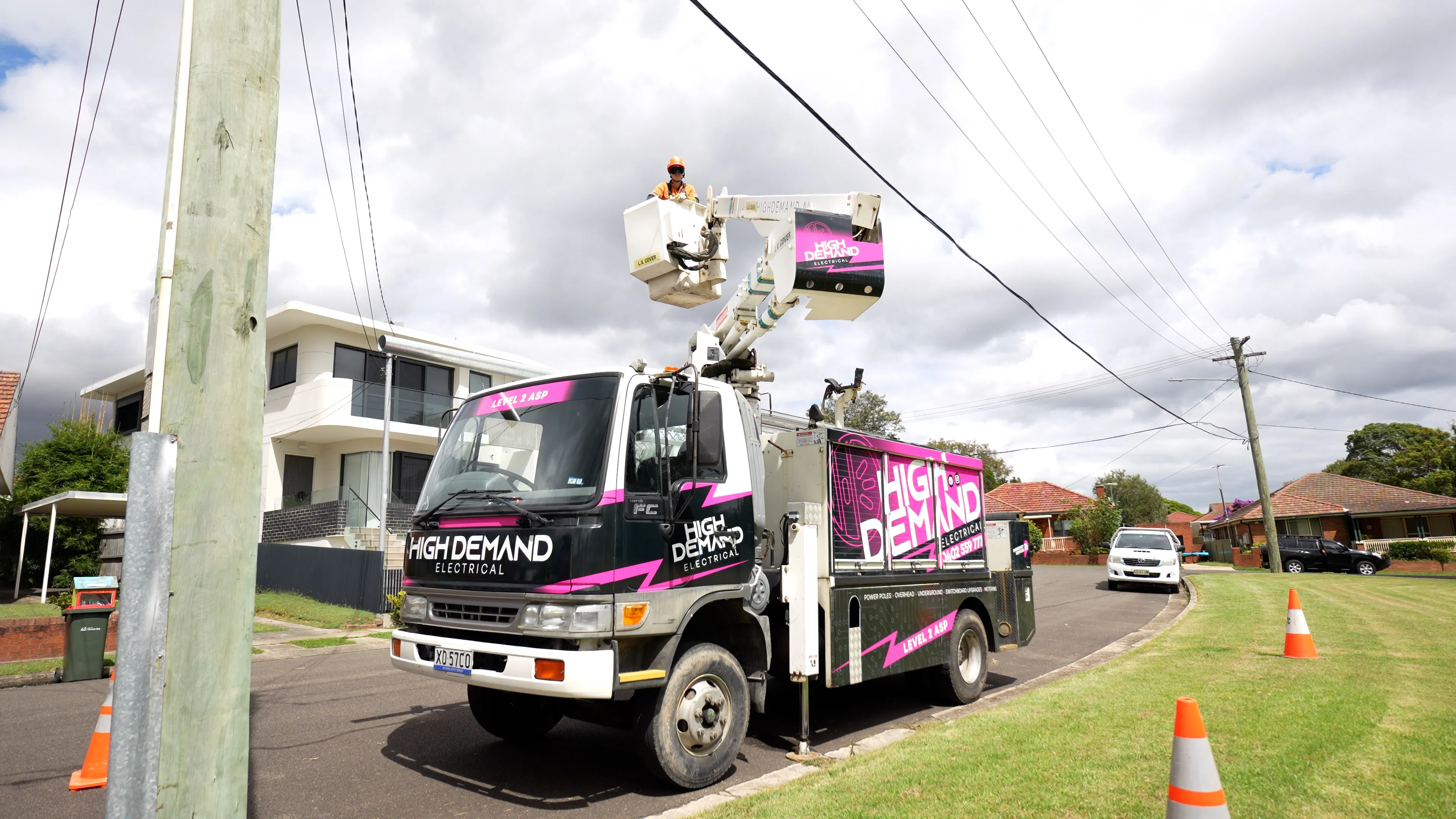
High Demand Electrical is one of Sydney's most trusted Level 2 ASPs for builders and demolition contractors. We check the network, the service type and the meter before quoting, chase the written consents with you, and line up the disconnect and reconnect work, the temporary builder's supply and the new connection application so your demolition date holds. Where the site has a private pole or an old overhead service, we cover overhead service mains and underground service mains for the new home as well. We are a licensed local team, not a call centre, servicing homes and businesses across Sydney's West, South West and Sutherland Shire.
Disconnection Before Demolition FAQs (Sydney)
Can my demolition contractor disconnect the power themselves?
No. Disconnecting the supply at the network side is authorised work for an accredited Level 2 ASP only. A demolition contractor or general electrician cannot disconnect the service or remove the meter.
What if the property is tenanted?
The network needs written agreement from the occupier as well as a written request from the owner. Collect the tenant's agreement early, because the disconnection cannot go ahead without it.
Do I need a new connection after a knockdown?
Yes, if the supply was permanently disconnected. The new home needs its own connection application to the network. Lodge it during construction so it does not hold up handover. See our power supply upgrades page for what that involves.
Doesn't the demolition company already cut the power?
Not at the network side. A demolition contractor can strip wiring inside a building once it is dead, but disconnecting the supply from Ausgrid or Endeavour Energy is Level 2 ASP work, so you are not paying for the same job twice.
What happens to an old private power pole on the site?
It is either removed with the old service or inspected and reused for the new connection. The decision depends on its condition and where the new home's point of attachment will be.
Planning a demolition or knockdown rebuild? Get a Disconnection Quote from High Demand Electrical or call 0402 559 777. Every job needs a site assessment before scope or pricing can be confirmed.
For official guidance on electrical safety on construction sites, see SafeWork NSW. In an emergency involving fallen or damaged lines, call Ausgrid on 13 13 88, Endeavour Energy on 131 003, or 000 if anyone is in danger.
Need Help Fast?
Related Services
Powering Your Needs with Expertise
If you’re looking for a reliable, experienced, and prompt electrician, look no further than High Demand Electrical. We cater to all your electrical needs, from routine maintenance to emergency repairs and complete system installations. Our skilled team is committed to providing professional service that ensures your electrical systems run smoothly. Whether it's a small task or a large project, give us a call today. Let us meet all your electrical demands with the quality and reliability you deserve.

Licensed Level 2 ASP electricians across Sydney. Same-day service and 24/7 emergency response.
Licence 397193C
ABN 87 051 836 527
