Strata Electrical Compliance in NSW: What Owners Corporations Must Do
In a NSW strata scheme, the owners corporation is responsible for keeping the electrical systems on common property safe, tested and repaired. That covers the main switchboard, the cables that feed more than one lot, and the lighting and power in shared areas. Every piece of wiring work must be done by, or under the supervision of, a licensed electrician, and each job must be backed by a Certificate of Compliance for Electrical Work (CCEW). A Level 2 electrician who works on strata schemes can handle the inspection, the repair and the paperwork in one visit, which is how we run these jobs at High Demand Electrical.
This guide is for strata committee members, strata managers, property managers and lot owners who need to know what is theirs, what is the scheme’s, and what to do when a fault or defect turns up.
TL;DR
- The owners corporation maintains and repairs common property. Lot owners repair what sits inside their own lot, and the dividing line for wiring is how many lots a cable serves.
- All electrical wiring work in NSW needs a licensed electrician, and unlicensed work carries fines of $22,000 for an individual or $110,000 for a company.
- Each job needs a CCEW lodged through the Building Commission NSW eCert portal within 7 days of the test. Handwritten and PDF forms have not been accepted since 1 July 2026.
- Regular testing of safety switches (RCDs), switchboards and common area lighting is how a scheme shows it is managing risk and catches defects early.
- Emergency work, switchboard upgrades and defect rectification are all Level 2 territory when the network connection is involved.
Table of Contents
- Who is responsible: the owners corporation or the lot owner?
- Who can do the work
- The Certificate of Compliance for Electrical Work (CCEW)
- The standard the work must meet
- What to inspect and how often
- Handling defects, quotes and records
- When a strata building needs a Level 2 electrician
- How we approach strata electrical compliance
- Book a Level 2 electrician for your scheme
- FAQ
- Sources
Who is responsible: the owners corporation or the lot owner?
The NSW Government’s strata repairs guidance says the owners corporation maintains and repairs common property, while owners repair their own property. Electrical systems follow the same split, but the boundary is not always where people expect.
A practical way to read it:
| Item | Usually responsible |
|---|---|
| Main switchboard and meter room | Owners corporation |
| Submains running to each lot | Owners corporation |
| Common area lighting, emergency lighting and exit lights | Owners corporation |
| Common area power points, garage and car park power | Owners corporation |
| Cable serving more than one lot, even inside a lot’s wall | Owners corporation |
| Wiring, power points and the sub-board serving a single lot | Lot owner |
| Appliances, fittings and lighting inside a lot | Lot owner |
The test that settles most disputes is how many lots a cable serves. If it serves one lot, it belongs to that lot. If it serves several, it is common property, even when it runs through the wall of a unit. The exact status of any item also depends on the scheme’s registered plan and by-laws, so a committee that is unsure should check those documents before authorising work.
The obligation to maintain sits within the Strata Schemes Management Act 2015. Building-services guidance from engineers working with strata schemes describes the main switchboard, submains, house lighting and emergency lighting as common property that the owners corporation must maintain, repair and replace.
Safety switches on common property
A common point of confusion is the RCD, or safety switch, which cuts power quickly when it detects a leak of current. The NSW Government’s electrical safety in the home page says that where a safety switch is on common property, such as a power room or garage, tenants should ask the landlord or property manager to arrange a test. Owners should ask the strata manager or owners corporation to include it in the scheme’s regular safety checks. In other words, if the switch is in a shared room, the test is the scheme’s job, not the tenant’s.
Who can do the work
In NSW, you must hold an electrical licence or certificate before doing any electrical wiring work, regardless of cost and whether the building is residential, commercial or industrial. The NSW Government licensing page states that unlicensed electrical work breaches the Home Building Act 1989, with fines of $22,000 for an individual and $110,000 for a company.
For a committee, the practical consequence is simple. A volunteer owner, a handyman or a general maintenance contractor cannot touch wiring on common property, however small the job looks. Licensing also affects insurance and liability if something goes wrong.
Why Level 2 matters for strata buildings
A Level 2 electrician is an accredited service provider (ASP) authorised to work on the connection between the electricity network and the building: service mains, metering, and supply upgrades. Most strata buildings sooner or later need something at that level: a switchboard replacement, a larger supply for new EV chargers, a change to metering, or a defect notice from the network. Our Level 2 team at High Demand Electrical is accredited and available for this work across Sydney, including defect notice rectification and metering services.
The Certificate of Compliance for Electrical Work (CCEW)
A CCEW is the document that proves electrical work was tested and meets the rules. The NSW Government’s compliance requirements page explains that electricians submit it to Building Commission NSW to show the work complies with the Gas and Electricity (Consumer Safety) Regulation 2018, the relevant Australian Standards and the Gas and Electricity (Consumer Safety) Act 2017. It can also help with warranty claims.
What triggers a CCEW
A CCEW is needed whenever electrical equipment is installed, repaired, added or altered. According to the NSW Government’s CCEW submission guidance, that includes like-for-like replacement of items such as water heaters, ovens, stove tops and electrical accessories. The electrician must first run a safety and compliance test that verifies earthing continuity, insulation resistance, polarity and circuit connections.
For a strata scheme, that means a CCEW should exist for work such as:
- a new or replaced common area switchboard
- replaced light fittings, sensors or emergency lighting circuits
- new circuits for EV charging in a shared car park
- repairs after a fault or outage in the common areas
- rectification of a defect found during inspection
The 7-day rule and the eCert portal
The qualified person who conducts the test must lodge the CCEW on the Building Commission NSW eCert portal no later than 7 days after finishing the test. The NSW Government states that failing to supply a CCEW can bring on-the-spot fines of up to $1,000 per occasion, while failing to meet the technical standards can carry penalties of up to $550,000.

Since 1 July 2026, handwritten and PDF CCEW forms are no longer accepted. Everything goes through eCert. If a contractor offers you a paper certificate for work done this year, it is not the right document.
Getting your copy
NSW Fair Trading explains that customers can receive a copy by email when the electrician adds their address at lodgement, or can download it from the portal. For a scheme, give the electrician the strata manager’s or secretary’s email so the certificate lands in the scheme’s records. We explain what the certificate shows in more detail in our guide to the electrical compliance certificate in NSW, and what it does and does not prove in this breakdown of compliance certificates in Sydney.
The standard the work must meet
Electrical installations in NSW must meet AS/NZS 3000, the Wiring Rules. The NSW Government standards page confirms the 2018 edition has been mandatory under NSW legislation since 1 January 2019. Among its changes: RCDs on all domestic and residential final sub-circuits, isolator requirements for water heaters, air conditioners and heat pumps, and guidance for EV charging.
In an older building, this is where compliance gaps show up. A switchboard from the 1970s or 80s may have ceramic fuses, no RCD protection and no room for extra circuits. Upgrading the board brings it into line, and our switchboard upgrade service covers that work. If you want the rules in plain terms, our guide to AS/NZS 3000 walks through them.
What to inspect and how often
NSW law does not hand strata committees one fixed electrical checklist, so schemes build a routine from the legal duty to maintain common property and from industry practice. Published strata maintenance checklists give a useful guide:
- A common property inspection guide from a strata services firm suggests checking main switchboards for overheating, corrosion or water ingress, push-button testing RCDs quarterly, checking common area lighting timers and sensors, and having a licensed electrician inspect annually.
- A strata insurer’s maintenance checklist recommends six-monthly RCD testing and inspection of common wiring and switchboards, plus an annual full electrical inspection for larger schemes that can include load testing and thermal imaging.
A sensible schedule for most schemes:
- Every three to six months: push-button test of every RCD on common property, and a walk-through of lighting in stairwells, car parks and lobbies.
- Annually: a licensed electrician inspects the main switchboard, submains, common area circuits and emergency lighting, and records findings.
- After any fault, storm damage or outage: inspect before power is restored to the affected circuits.
- Before major works: check switchboard capacity, particularly before adding EV chargers, air conditioning or lift upgrades.
Our electrical maintenance service includes standard maintenance checks and RCD or safety switch testing, and our electrical safety inspection gives the committee a clear picture of what needs attention. If you want to see what a check covers, the electrical safety inspection checklist lists the items.
Fire safety is separate
Fire safety inspections and annual fire safety certification are a separate obligation handled by a licensed fire services provider. Emergency and exit lighting overlaps with both electrical and fire safety, so confirm with your strata manager who is coordinating each.
Handling defects, quotes and records
When an inspection finds a defect, the committee needs to act and document it. A few rules from the NSW Government’s repairs and maintenance guidance matter here:
- Schemes must obtain at least two independent quotes for work valued at $30,000 or more.
- For emergency repairs to common property that address a serious and imminent threat to residents’ health or safety, written notice of levies must give at least 14 days to pay.
The Strata Schemes Management Regulation 2016 also limits who may be delegated certain functions, including arranging fire safety inspections and entering contracts for maintenance of common property: only a strata committee member or the strata managing agent. Contracts for electrical maintenance should be signed by someone with that authority.
A simple compliance file
Keep one folder, digital or paper, for each building with:
- every CCEW, with the date and the work it covers
- inspection reports and the actions taken
- RCD test logs with date, location and result
- quotes, invoices and committee approvals
- any defect notice from the network, and proof it was rectified
When a new strata manager takes over, or an insurer or buyer asks questions, that file answers them.
Worked example
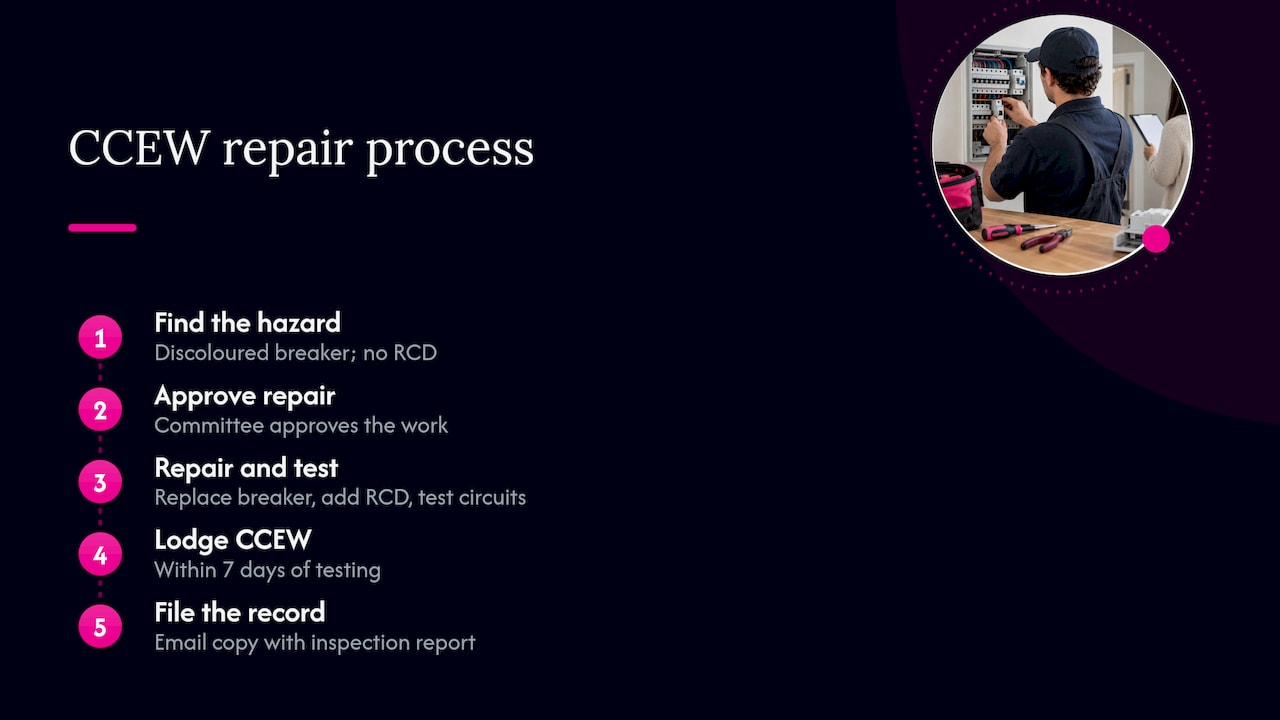
A 24-lot Sydney building has a main switchboard in the garage. During the annual inspection, the electrician finds discolouring on one circuit breaker and no RCD on the common area lighting circuit. The committee approves the repair, a licensed electrician replaces the breaker and adds RCD protection, tests the circuits, and lodges the CCEW within 7 days. The secretary receives the copy by email and files it with the inspection report. The scheme now has a dated record showing the hazard was found and fixed. If the same finding were ignored and a fault followed, the committee would have a much harder conversation with its insurer.
When a strata building needs a Level 2 electrician
Not every electrical job needs one, but these do, because they involve the connection to the network:
- Single phase to three phase upgrades, when demand outgrows the supply, for example from lifts, pumps, heavy air conditioning or EV charging. See our power supply upgrades.
- Consumer mains and service mains work, whether overhead or underground.
- Metering changes, including new meters for additional loads.
- Defect notices from the network provider that must be rectified before supply is restored or the notice is cleared.
- Private power poles and complex site connections in larger or semi-rural strata sites.
For urgent faults in the common areas, such as a total outage or a burning smell from the switchboard, our emergency electrician service is available 24/7. Our guide for managers, Strata Electrician Sydney: What Building Managers Need to Know, covers the day-to-day side.
How we approach strata electrical compliance
Most strata electrical problems we hear about started as small items nobody owned. A tripped RCD in the garage, a flickering stairwell light, a switchboard that has been “fine for years”. The scheme’s duty to maintain does not wait for a fault, and neither should the committee.
Our view is that compliance is easiest when one qualified team does the inspection, the repair and the certificate. As a Level 2 contractor we can work on the network connection as well as the building’s wiring, so a switchboard upgrade or a three phase supply change does not need to be split between providers. We offer free site inspections for Level 2 work, so a committee can see the scope before it votes. We are triple ISO certified, and our emergency line is staffed 24/7 with a 10-minute callback guarantee.
For committees, our advice is simple: book the annual inspection, keep every CCEW in one file, and treat any defect as a job to close out, not a note to revisit.
Christopher
Book a Level 2 electrician for your scheme
High Demand Electrical is a certified Level 2 electrical contractor serving residential, commercial and strata properties across Sydney. We carry out switchboard and power supply upgrades, metering, safety inspections, defect rectification, EV charger installation and emergency repairs, and our work is backed by more than 300 five-star reviews. Seniors can ask about our discounts.

To arrange an inspection or discuss an upgrade for your building, start with our Level 2 electrician page or contact us through High Demand Electrical. We service the inner suburbs and beyond, as listed on our service areas page.
FAQ
Is the owners corporation or the lot owner responsible for electrical repairs?
The owners corporation repairs common property, and lot owners repair their own lots. For wiring, the deciding factor is how many lots a cable serves: a cable serving more than one lot is common property, while wiring, power points and the sub-board serving a single lot belong to the lot owner. Check the scheme’s by-laws and registered plan for borderline items.
Who can issue a CCEW in NSW?
Only the licensed electrician who did the work and ran the safety and compliance test can lodge it. They submit it through the Building Commission NSW eCert portal within 7 days of completing the test. You cannot create or sign one yourself.
Do I get a paper copy of the compliance certificate?
Paper and PDF forms stopped being accepted on 1 July 2026, so certificates are lodged online. Ask the electrician to add your email at lodgement and the portal sends you a copy, or you can download it from the portal.
How often should a strata scheme test its safety switches?
NSW law does not set one interval for common property, but published strata checklists suggest push-button tests every three to six months and a full licensed inspection each year. Safety switches on common property are the scheme’s responsibility to include in its regular checks.
What happens if unlicensed electrical work is done in a building?
It breaches the Home Building Act 1989, with fines of $22,000 for an individual or $110,000 for a company. It also leaves the scheme without a valid CCEW for the work.
Sources
- Strata repairs and maintenance | NSW Government
- Electrical safety in the home | NSW Government
- Electrical work | NSW Government
- Electrical compliance requirements | NSW Government
- When to submit a Certificate of Compliance for Electrical Work | NSW Government
- Electrical standards, rules and notes | NSW Government
- Electrical safety requirements and consumer rights | NSW Government
- Strata Schemes Management Regulation 2016 | NSW Legislation
- Building Services for Strata: Owner’s Corporation Guide
- Strata Maintenance Checklist
- CHU strata maintenance checklist
Recommended
Need Help Fast?
Powering Your Needs with Expertise
If you’re looking for a reliable, experienced, and prompt electrician, look no further than High Demand Electrical. We cater to all your electrical needs, from routine maintenance to emergency repairs and complete system installations. Our skilled team is committed to providing professional service that ensures your electrical systems run smoothly. Whether it's a small task or a large project, give us a call today. Let us meet all your electrical demands with the quality and reliability you deserve.

Licensed Level 2 ASP electricians across Sydney. Same-day service and 24/7 emergency response.
Licence 397193C
ABN 87 051 836 527
