Protecting Electronics from Power Surges in Sydney: The 2026 Homeowner’s Guide
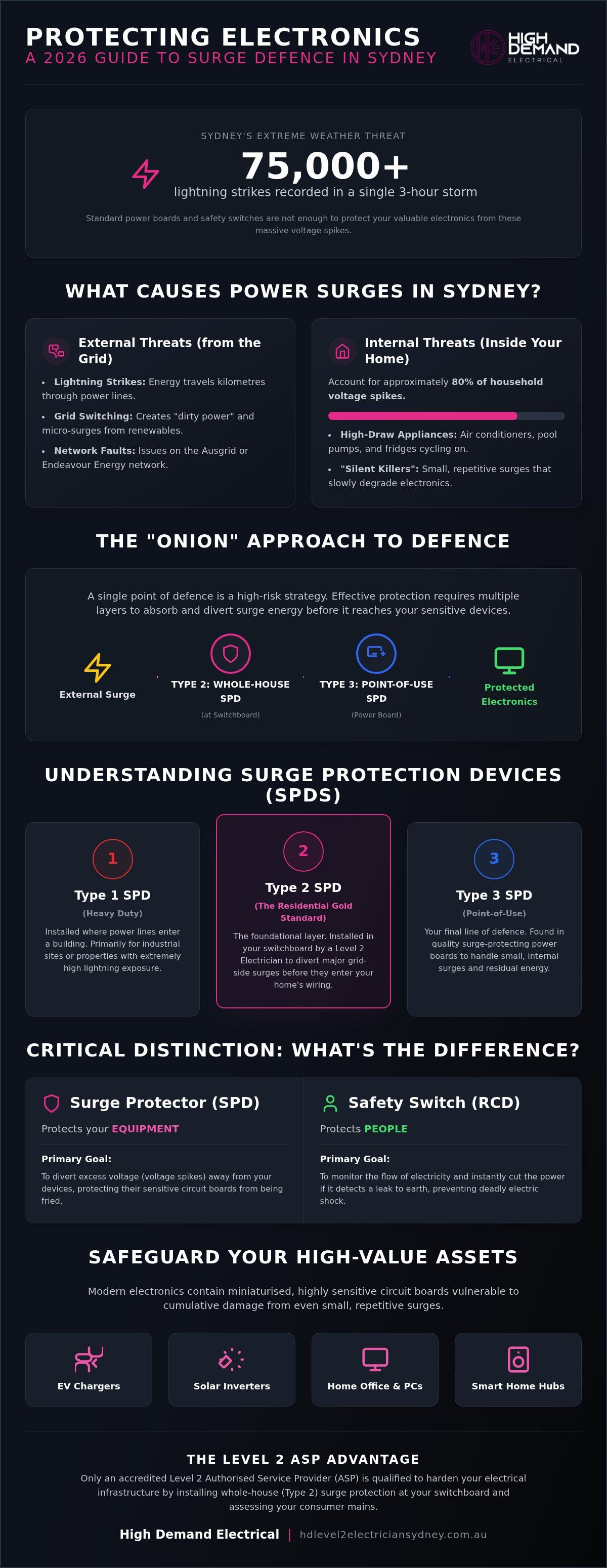
Did you know that Sydney's sky can unleash over 75,000 lightning strikes in a single three-hour window, as we saw during the extreme storm events of early 2024? For many homeowners, the sound of thunder triggers an immediate sense of anxiety about the safety of their expensive technology. You're right to be concerned; a standard power board or a basic safety switch simply can't stop a massive voltage spike from damaging your most valuable assets. When it comes to protecting electronics from power surges in Sydney, the stakes have never been higher for households running high-draw equipment like Tesla EV chargers and sophisticated home office setups.
This 2026 guide provides the professional clarity you need to safeguard your home against the volatile nature of the NSW grid. You'll discover how a layered protection strategy, starting at your switchboard and consumer mains, offers a level of security that DIY plug-in strips cannot match. We will explain the vital distinction between safety switches and surge protection devices, while detailing how a Level 2 ASP can harden your electrical infrastructure to ensure your high-value electronics remain operational regardless of what the weather brings.
Key Takeaways
• Understand why Sydney’s volatile grid and severe storm activity require a multi-layered defence strategy to protect your sensitive technology.
• Learn the critical difference between point-of-use strips and professional whole-house solutions for protecting electronics from power surges in Sydney.
• Discover the specialised protection requirements for high-value, high-draw assets such as Tesla home EV chargers and solar inverters.
• Identify why an accredited Level 2 ASP is essential for hardening your electrical infrastructure through switchboard and consumer mains upgrades.
• Gain the confidence to build a customised surge protection plan that addresses the specific environmental risks and technical needs of your local property.
What Causes Power Surges in Sydney and Why Are They Increasing?
A power surge is a transient voltage spike that exceeds the standard Australian 230V supply. While many homeowners associate surges with catastrophic lightning strikes, most spikes are smaller, frequent events that exceed the tolerance of sensitive equipment. Understanding what a surge protector is and how it functions as a gateway for your home's power is the first step toward securing your property. These voltage fluctuations can originate from the street or from within your own four walls.
Sydney's electrical landscape is evolving rapidly. As the grid transitions toward high-density renewable energy sources, the frequency of grid switching increases. This process often results in "dirty power" or micro-surges as the network balances fluctuating supply levels. However, internal factors remain a massive threat; high-draw assets like ducted air conditioning systems, pool pumps, and large refrigeration units cause approximately 80% of household voltage spikes. Every time these motors cycle on, they send a small surge back through the internal wiring, slowly degrading the delicate components of your other connected devices.
The Sydney Storm Factor
Geographic location significantly influences your specific risk profile. Western Sydney often experiences intense electrical storms driven by inland heat convection, while the Northern Beaches face unique challenges from coastal lightning activity that can impact overhead lines. A strike on the Ausgrid or Endeavour Energy network several kilometres away doesn't need a direct hit to cause damage; the energy can travel through your consumer mains and enter your switchboard with ease. Within Sydney’s electrical grid, transient voltage is defined as a temporary, high-energy pressure wave that lasts less than a millisecond but carries enough force to bypass standard safety switches and incinerate circuit boards.
Modern Electronics: High Sensitivity in 2026
Protecting electronics from power surges in Sydney is a more complex task today than it was in previous decades. Your 2026 smart home hub, gaming PC, or OLED television contains miniaturised Printed Circuit Boards (PCBs) that are far more sensitive than the robust components found in 1990s appliances. These modern devices are susceptible to the cumulative damage effect. This is a process where small, repetitive surges don't cause an immediate "pop" but instead create microscopic fractures in the silicon. These "silent killers" gradually shorten the lifespan of your technology, leading to mysterious hardware failures and data corruption that standard warranties often won't cover.
Layered Surge Protection: Point-of-Use vs. Whole-House
Effective protection relies on the "Onion" approach. This strategy organises your defences in tiers, ensuring that if one layer is overwhelmed, the next is ready to intercept the remaining energy. Relying on a single retail power board is a high-risk strategy. These point-of-use protectors are useful for fine-tuning the power reaching your TV, but they lack the capacity to divert massive energy surges originating from the street. A basic $20 power strip from a hardware store won't stop a lightning-induced spike or a major grid fluctuation; it's designed to catch minor internal ripples, not the high-energy transients common in New South Wales.
Whole-house Surge Protection Devices (SPDs) are the foundation of a secure electrical system. Installed directly at your switchboard, these devices act as a primary shield. They handle the heavy lifting required for protecting electronics from power surges in Sydney, especially during the peak of the summer storm season. For maximum compliance and safety, these installations should align with the Australian Standard for lightning protection (AS/NZS 1768:2007). This standard provides the technical framework for diverting high-voltage transients safely to the earth before they reach your internal circuits.
Type 1, 2, and 3 SPDs Explained
Understanding technical classifications helps you choose the right level of security. Type 1 SPDs are heavy-duty units typically reserved for industrial sites or properties with high lightning exposure. Type 2 SPDs are the residential gold standard. We install these in your switchboard to divert grid-side surges before they enter your internal wiring. Finally, Type 3 SPDs are your point-of-use strips. They provide the final "polish" by catching any residual voltage that bypasses the Type 2 protector. Using all three types in a coordinated manner is the only way to achieve 100% peace of mind.
Why "Safety Switches" Aren't Surge Protectors
A common misconception among Sydney homeowners is that a modern safety switch provides surge protection. This is dangerously incorrect. A safety switch, or Residual Current Device (RCD), is designed to protect people by cutting power when it detects a leakage to earth. It does nothing to stop a high-voltage spike from frying your computer's motherboard. SPDs and RCDs perform entirely different roles. While an RCD saves lives, an SPD saves your equipment. Integrating both into a comprehensive switchboard upgrade ensures your home meets modern safety and protection benchmarks. If you're unsure about your current level of coverage, consulting an accredited Level 2 ASP can clarify your home's specific vulnerabilities.
Protecting High-Value Assets: EV Chargers and Solar Inverters
Sydney homes in 2026 are no longer just residential spaces; they are sophisticated power hubs housing tens of thousands of dollars in sensitive technology. While previous decades focused on protecting a single desktop computer, the modern priority has shifted toward permanently connected infrastructure. You cannot simply unplug a Tesla Wall Connector or a multi-kilowatt solar inverter when a storm rolls across the harbour. This permanent connection creates a direct path for voltage spikes, making the task of protecting electronics from power surges in Sydney a critical financial safeguard. Without professional mitigation, a single millisecond event can compromise the battery management systems of your vehicle or the delicate semiconductors in your renewable energy setup.
Insurance companies are increasingly specific about "reasonable protection" clauses. If a major surge event destroys your home's smart infrastructure, and an investigation reveals that no switchboard-level surge protection was present, your claim could be at risk. This financial exposure extends to your smart home hubs, integrated security cameras, and automated lighting systems. These components are often interconnected; a surge entering through one device can quickly migrate through your data and power lines, creating a domino effect of hardware failure that is both expensive and time-consuming to rectify.
EV Charger Surge Mitigation
Electric vehicle charging stations are uniquely vulnerable due to their high-draw nature and direct link to your car's internal electronics. A surge doesn't just threaten the charger itself; it can travel through the charging cable and damage the vehicle’s battery management system, which is a catastrophic failure for any EV owner. When we perform an EV charger installation in Sydney, we prioritise the integration of specialised surge protection. This is particularly vital for high-speed 3-phase chargers, which require robust, multi-pole surge devices to ensure that a fault on any single phase doesn't bypass your defences and reach your car.
Solar and Battery Storage Safety
Your solar array is effectively a large lightning collector sitting on your roof. While direct strikes are rare, the electromagnetic field from a nearby strike can induce massive voltages into the DC wiring of your panels. This energy travels straight to the inverter, which is the most expensive and sensitive part of your solar investment. Protecting electronics from power surges in Sydney must include a focus on both the AC and DC sides of your inverter. Furthermore, if you have a home battery storage system, it requires dedicated protection to ensure that grid-side faults don't turn your backup power solution into an expensive casualty of a network surge.
The Level 2 ASP Advantage: Infrastructure-Level Protection
While a standard electrician can install internal wiring, they are legally restricted from working on the connection between your home and the street. Only an accredited Level 2 ASP is authorised to handle the high-risk infrastructure where your property meets the Ausgrid or Endeavour Energy network. This distinction is vital for protecting electronics from power surges in Sydney. True surge mitigation requires hardening the entry point of your power supply, ensuring that massive voltage transients are intercepted before they ever reach your internal circuit breakers. If your protection strategy stops at the power point, you are leaving your most expensive assets exposed to grid-level faults.
The effectiveness of any surge protection device depends entirely on the quality of your home's earthing system. When a surge occurs, the SPD must divert thousands of amps of current away from your electronics and into the ground. If your earthing electrode is corroded or your internal wiring is outdated, that energy has nowhere to go but through your appliances. We often find that older Sydney properties have inadequate earthing that renders even the most expensive surge protectors useless. Professional infrastructure hardening ensures your system has a high-capacity path to earth, providing the technical reassurance that your hardware will survive a direct network disturbance.
Switchboard Modernisation
Modernising your switchboard is the most effective way to build a foundation for surge safety. Our process follows a strict protocol to ensure maximum reliability. Step 1 involves assessing the current capacity and age of your switchboard to identify existing vulnerabilities. Step 2 is the installation of DIN-rail mounted surge arrestors, which provide a robust primary defence against external spikes. Step 3 is verifying the main earth connection. This is the most critical part of surge protection; we ensure the connection meets current statutory requirements, providing a low-resistance path that is essential for the rapid diversion of surge currents.
Consumer Mains and Metering Upgrades
Undersized or degraded consumer mains act as a bottleneck during a surge event, increasing the risk of fire and equipment damage. As a Level 2 ASP, we specialise in upgrading these "power arteries" to handle the demands of modern 2026 households. This infrastructure work often coincides with a smart meter upgrade, where we integrate modern protection standards directly into your metering enclosure. If you own a private power pole, maintaining this asset is equally critical; a neutral failure on a private pole can cause a catastrophic overvoltage event that bypasses all internal safety switches. To secure your home's infrastructure against these high-stakes risks, contact High Demand Electrical for a comprehensive system audit.
Building Your Surge Defence Plan with High Demand Electrical
Securing your property against voltage transients requires more than just buying a few surge strips. A comprehensive professional audit is the essential first step. At High Demand Electrical, we don't believe in a one-size-fits-all approach. Your risk profile changes depending on your specific Sydney location. For instance, homes in bushy areas like the Northern Beaches or the Hills District face higher risks from lightning strikes on overhead lines and falling branches. Residents in high-density city centres are more susceptible to micro-surges caused by heavy grid switching and industrial-scale power demands. Protecting electronics from power surges in Sydney effectively means customising your defence to match your local environment.
Our systematic process ensures no vulnerability is overlooked. We begin with a full infrastructure assessment, examining your point of attachment, consumer mains, and switchboard condition. Once we identify the gaps, we implement high-capacity surge arrestors and verify your earthing system's integrity. Finally, we provide official certification, ensuring your home meets the latest safety standards. This methodical approach transforms your electrical system from a liability into a hardened asset, providing the technical depth required to withstand the most volatile grid conditions.
Surge protection devices are essentially sacrificial components. They absorb the energy that would otherwise destroy your technology, but this means they can wear out over time. It's vital to have your systems checked after major weather events. A device that intercepted a massive spike during last summer's storm season might not have the capacity to handle the next one. Regular maintenance ensures your primary defences remain active and ready to perform when they're needed most.
Our Sydney-Wide Specialist Services
High Demand Electrical brings a specialised skill set to every project. We are accredited Level 2 ASP technicians with deep expertise in high-risk infrastructure, including private power poles and overhead line maintenance. Our team understands the specific nuances of the Ausgrid and Endeavour Energy networks, ensuring every installation is compliant with the current NSW Service and Installation Rules. We act as both your technical guide and your rapid responder, positioning ourselves as the dependable local safeguard for your home's power supply.
Get a Professional Assessment Today
Sydney's weather is notoriously unpredictable. Don't wait for the next "East Coast Low" or severe summer thunderstorm to find out if your current defences are sufficient. A single neglected neutral connection or an outdated switchboard can lead to thousands of dollars in hardware losses. Booking a comprehensive switchboard and mains audit allows us to identify and rectify these issues before they escalate into an emergency. Take the proactive step to secure your high-value technology and EV charging infrastructure now. Protect your Sydney home with High Demand Electrical and gain the peace of mind that comes with professional infrastructure hardening.
Securing Your Sydney Home for the 2026 Storm Season
Sydney's electrical landscape is more demanding than ever. Ensuring your property is resilient against volatile grid events isn't just about convenience; it's about safeguarding your most significant investments. By implementing a layered defence that begins at the consumer mains and extends to your sensitive point-of-use equipment, you move beyond reactive anxiety and into a state of professional readiness. Hardening your infrastructure through switchboard modernisation and verified earthing is the only reliable way to achieve this level of security.
Protecting electronics from power surges in Sydney requires specialised technical knowledge that only a qualified specialist can provide. As accredited Level 2 ASP specialists and expert Tesla charger installers, we provide the infrastructure upgrades necessary to keep your technology operational during extreme weather. We serve all Sydney Metropolitan areas, delivering the rapid response and technical depth required to secure your home's future. You don't have to wait for the next major grid fault to find out if your system is vulnerable.
Secure your home from power surges with a Sydney Level 2 ASP expert
Don't leave your high-value assets to chance when the next storm rolls in. Take control of your home's safety and ensure your family's technology remains protected today.
Frequently Asked Questions
Does a safety switch (RCD) protect my electronics from power surges?
No, a safety switch isn't a surge protector. Its primary role is to monitor the balance of electricity and disconnect power if it detects a leakage to earth. This protects you from electrocution, but it doesn't stop a voltage spike from entering your circuits. You must install a dedicated Surge Protection Device (SPD) to shield your equipment from the high-voltage transients that a safety switch simply isn't designed to handle.
How often should I replace my whole-house surge protector?
You should plan to replace your protector every three to five years. These devices use internal components that wear out as they divert spikes away from your electronics. If your area experiences a severe storm or a major grid disturbance, you should have the unit inspected immediately. Most modern protectors have a status indicator; if the light changes colour, the unit has sacrificed itself to save your gear and requires immediate replacement.
Will a surge protector stop a direct lightning strike on my Sydney home?
A residential surge protector isn't built to survive a direct hit. The sheer volume of energy in a direct strike is too high for any standard household device to manage. However, direct hits are exceptionally rare. Most damage comes from surges that occur when lightning strikes nearby infrastructure or power lines. High-quality Type 2 protectors are designed to divert this conducted energy safely to earth, protecting your home's sensitive technology.
Why do I need a Level 2 ASP for surge protection upgrades?
You need a Level 2 ASP because only these specialists are authorised to work on the connection between your home and the network. While a standard electrician can work on your internal wiring, they cannot modify your consumer mains or point of attachment. Hardening these entry points is the most effective method for protecting electronics from power surges in Sydney, as it stops the energy before it ever reaches your switchboard.
Are surge protection power boards actually effective?
These boards offer a limited, final layer of protection for your appliances. They're useful for catching minor internal fluctuations or residual voltage that might bypass your main switchboard. However, they don't have the capacity to stop a massive external surge from the grid. You should always use them as a secondary defence in a layered system that includes a whole-house surge protector installed by a qualified professional at your main switchboard.
What should I do if my electronics have already been damaged by a surge?
Safety is your first priority. Don't attempt to use any device that smells of burning or shows visible damage. Disconnect the power at the switchboard and contact a licensed specialist to inspect your home's wiring for hidden faults. If your household appliances have been affected, you can learn more about specialised white goods repair services. Once your system is cleared, you should focus on infrastructure hardening. If a surge has already caused damage, it's a clear sign that your current protection isn't sufficient for Sydney's volatile electrical environment.
Most policies cover surge damage, but you should check for specific "reasonable care" requirements. Insurers often expect homeowners to have taken preventative measures to protect their property. If your high-value assets like EV chargers aren't protected by a professional switchboard-level device, you might find that your claim is harder to process. Having a certified installation on record provides the technical proof that you've prioritised your home's electrical safety.
How much does it cost to install whole-house surge protection in Sydney?
The cost of installing whole-house surge protection varies based on the age and condition of your switchboard. Modern boards are generally simpler to upgrade, while older properties might require a full switchboard modernisation or earthing repairs to ensure the protection works correctly. Because every home has different requirements for protecting electronics from power surges in Sydney, we recommend a professional audit to assess your infrastructure and provide an accurate scope of work.
Powering Your Needs with Expertise
If you’re looking for a reliable, experienced, and prompt electrician, look no further than High Demand Electrical. We cater to all your electrical needs, from routine maintenance to emergency repairs and complete system installations. Our skilled team is committed to providing professional service that ensures your electrical systems run smoothly. Whether it's a small task or a large project, give us a call today. Let us meet all your electrical demands with the quality and reliability you deserve.