Proactive electrical maintenance: inspection timing and costs
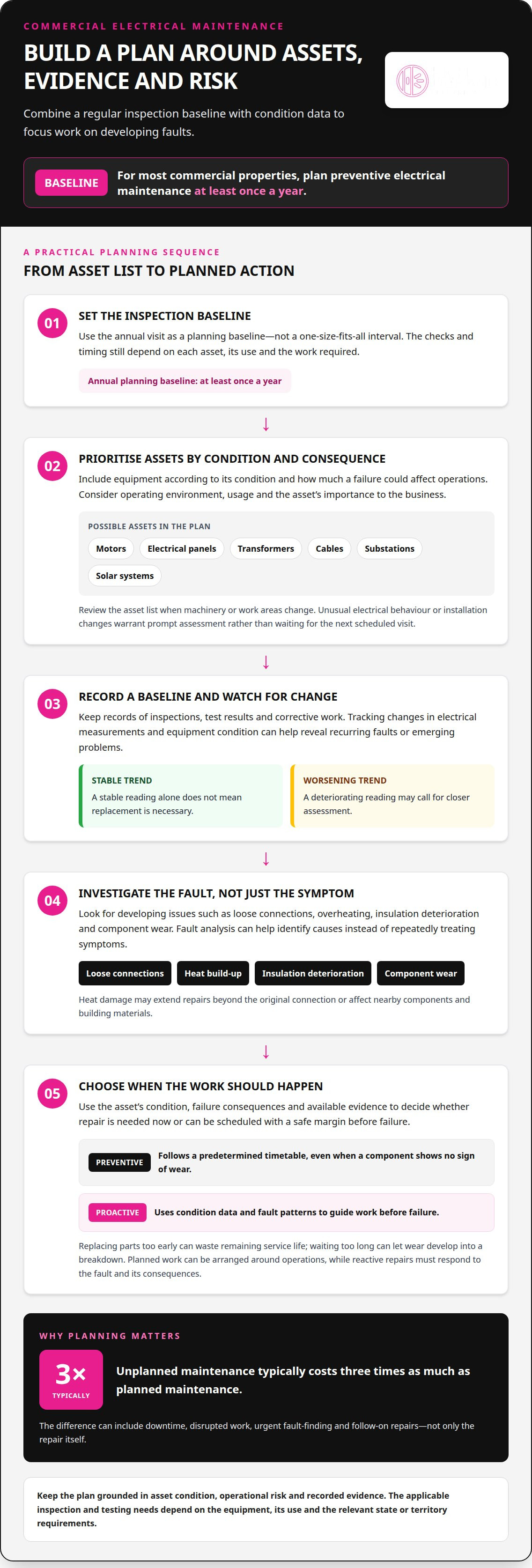
For most commercial properties, plan preventive electrical maintenance at least once a year. A proactive electrical maintenance to avoid defects plan can also use equipment data to time work around emerging faults, rather than relying only on a fixed calendar. Set the inspection plan according to the condition and importance of each electrical asset.
It’s reasonable to want a clear schedule and fewer unexpected repair bills. Preventive and proactive maintenance are different: preventive maintenance follows a set timetable, while proactive maintenance uses condition data and fault patterns to guide decisions.
This article explains how often to plan inspections, what trend tracking and fault analysis can reveal, and how maintenance agreements can help make spending more predictable. It also shows how to balance scheduled checks with data-led repairs, so maintenance focuses on the risks that matter most to your operation.
Key Takeaways
• Most commercial properties should schedule preventive electrical maintenance at least once per year, with the plan shaped by asset condition and operational risk.
• Fixed-schedule maintenance and data-led maintenance serve different purposes; combining them can help balance routine care with timely repairs.
• Tracking changes in electrical measurements and investigating fault causes can help focus maintenance on emerging problems, rather than repeatedly treating symptoms.
• Maintenance agreements can help organise planned work and spending, while repair decisions depend on asset condition, criticality and available performance data.
• Level 2 ASP services and switchboard upgrades are relevant when electrical infrastructure needs specialist attention or improvement.
What is Proactive (Predictive) Maintenance?
Reactive maintenance starts after equipment fails, leaving repairs to compete with operational demands. A machine that stops unexpectedly can interrupt production, delay services and require urgent fault-finding. Unplanned maintenance typically costs three times as much as planned maintenance. That difference reflects more than the repair itself: downtime can disrupt work, while a fault may affect connected equipment or damage nearby building materials.
Proactive maintenance uses equipment condition and operating data to schedule work before failure. Preventive maintenance follows a predetermined schedule, even when a component shows no sign of wear. An inspection might identify a loose connection or heat build-up; follow-up analysis can help determine whether repair is needed now or can be scheduled. This approach to proactive electrical maintenance to avoid defects aims to address developing faults while allowing a safe margin before failure.
Replacing parts too early can waste their remaining service life and increase maintenance spending. Waiting too long can allow wear to progress into a breakdown, potentially extending repairs beyond the original component. The decision depends on the asset’s condition, the consequences of failure and the available evidence. For example, a worsening temperature trend may warrant closer assessment, while a stable reading alone doesn’t mean replacement is necessary.
Electrical faults can develop through loose connections, overheating, insulation deterioration and component wear. Heat damage to insulation can mean repairs extend beyond the original connection, and deterioration may affect nearby components or building materials. Preventive maintenance can help identify small faults before they become major failures. LED upgrades can also reduce energy consumption and maintenance frequency in commercial buildings, but decisions should account for the existing lighting system and operating needs.
Hidden costs can include lost output, disrupted staff schedules, urgent fault-finding and follow-on repairs. A business with a machine essential to a production line may face a wider interruption when that machine fails. Planned work can be arranged around operations, while reactive repairs must respond to the fault and its consequences. In Sydney, faults affecting service infrastructure may require a different scope from equipment within a building; Level 2 electrical services in Sydney cover work involving that infrastructure. Assessment and trend records help distinguish routine wear from a developing defect.
Regular electrical inspections and preventive maintenance can help identify potential issues before they cause downtime or equipment failure. However, preventive maintenance can also add costs if parts are replaced while they still have useful life remaining.
Proactive maintenance uses available data to schedule repairs near a predicted failure, while leaving a safe margin to prevent downtime. The aim is to improve asset efficiency and effectiveness and reduce unexpected failures.
How often should you get an electrical maintenance inspection?
Most commercial properties should plan preventive electrical maintenance at least once a year. Use this as a planning baseline, then adjust inspection timing to the equipment’s condition, operating environment and importance to business operations. A heavily used motor, for example, may need closer monitoring than equipment with a stable operating history. Changes to the installation or unusual electrical behaviour also warrant prompt assessment rather than waiting for the next annual visit.
Australian electrical safety requirements depend on the work and the relevant state or territory. AS/NZS 3760 concerns in-service inspection and testing of electrical equipment, but the applicable checks and intervals depend on the equipment and its use. A fixed annual maintenance visit shouldn’t be treated as a substitute for identifying the specific inspection and testing needs of each asset. In Sydney, keeping records of inspections, test results and corrective work helps track recurring faults and support consistent maintenance planning.
Who can inspect and maintain electrical equipment? The appropriate qualification depends on the work and the state or territory where it takes place. Electrical installation or repair work should be performed by a person holding the relevant licence or authorisation for that jurisdiction. The distinction matters: a routine visual check of equipment isn’t the same as testing or repairing electrical infrastructure. For example, work involving supply infrastructure may need a specialist with the applicable Level 2 ASP authorisation.
How much does preventive electrical maintenance cost in Australia? The cost depends on the job and is provided after a quote request. Factors include the number and type of assets, their condition, access, and the scope of inspection or testing. A plan covering a switchboard and several machines will differ from one focused on a single asset. Set the scope around operational risk to allocate maintenance spending efficiently and avoid unnecessary checks.
A practical plan can cover motors, electrical panels, transformers, cables, substations and solar systems. Include equipment according to its condition and the effect its failure could have on operations. For example, a transformer supplying essential production equipment may warrant priority over a non-critical asset. Review the asset list when machinery or work areas change to keep inspections relevant and help extend equipment life.
Neglected maintenance can allow overheating, insulation deterioration or worn components to progress to equipment failure. A fault may create a fire or injury risk, damage surrounding building materials, or stop a machine or connected process. Checks should consider both the asset’s condition and the consequences of failure. If an inspection identifies a concern, record the finding and arrange appropriate follow-up repairs rather than leaving it unresolved.
For an inspection plan that accounts for electrical infrastructure and business operations, discuss your maintenance requirements.
Baseline data, trend tracking and fault analysis
Warning signs include rising temperatures, unusual vibration, changing electrical measurements, loose connections and deteriorating insulation. Comparing condition data over time can help distinguish a developing fault from normal operating variation.
Establishing Baselines and Tracking Trends
A baseline records an asset’s normal operating condition, giving later measurements a point of comparison. Temperature, current and vibration readings can reveal changes a single inspection may miss. For example, a gradual rise in a motor’s operating temperature can prompt closer assessment before the machine fails. Historical operating data can also help estimate a component’s average service life and inform maintenance timing for critical assets.
Consistent records make those comparisons useful. Data management brings inspection findings, operating measurements and repair histories together, helping staff review an asset’s condition rather than isolated readings. Cloud-based dashboards can display monitoring data in real time, helping maintenance teams track changes across equipment. Businesses can use the information to refine schedules and update thresholds as operating conditions change. A new production load, for instance, may alter normal current readings and make an older baseline less representative.
Using Data to Identify Defects
Fault analysis interprets changes in condition to identify likely defects and guide maintenance decisions. Overheating, unusual vibration or shifts in electrical measurements can indicate deterioration; an inspection can then assess possible causes, such as loose connections or insulation failure. Data alone doesn’t diagnose every fault. It helps direct attention to equipment and conditions needing closer technical assessment.
System analysis adds operational context. It considers how an asset failure could affect availability and production capacity, and can help identify bottlenecks. If one critical asset limits an entire process, its condition may deserve more attention than equipment whose failure has little operational effect. This prioritisation directs maintenance resources towards risks that matter to reliability, rather than treating every asset as equally urgent.
Root cause analysis investigates why a fault occurred, so teams can address the cause instead of repeatedly treating symptoms. If a connection repeatedly overheats, fault history and operating data can inform a closer investigation of the recurring issue. Record the finding, corrective work and later readings together. This helps show whether the problem has stopped recurring or still needs attention.
Staff need enough training to interpret trends and escalate abnormal readings. A dashboard alert, for example, should prompt staff to follow the site’s reporting process, not dismiss a change as routine. A data-driven maintenance strategy combines accurate records, staff observations and technical analysis. It can help schedule work according to asset condition, reduce reliance on reactive maintenance and lower the chance that a developing fault becomes an emergency.
Maintenance agreements, warranties and predictable spending
A proactive electrical maintenance program starts by identifying critical assets, recording their condition and setting planned checks. It then uses inspection findings and equipment data to schedule work, investigate emerging faults and review whether the plan remains appropriate. This gives maintenance decisions a clear basis instead of relying solely on failures or calendar intervals.
A maintenance agreement can document which electrical systems are covered, scheduled work, reporting arrangements and how follow-up repairs are handled. A clear scope helps a business plan maintenance around operations and distinguish routine inspections from additional corrective work. For example, an agreement might define checks for selected switchboards while recording separately any repairs identified during inspection. The terms should explain what work is included and how additional work is assessed.
Predictive maintenance uses equipment performance data to schedule work before a fault interrupts operations. Algorithms can identify trends in temperature, vibration, electrical measurements and pressure. This information can indicate when a component may need attention, rather than treating every asset as if it faces the same failure risk. A business can begin with a small group of critical assets, then expand monitoring as it proves useful for maintenance planning.
Predictions are only as useful as the measurements and interpretation behind them. A temperature change may signal deterioration, but operating conditions and earlier readings provide context. Historical data can help estimate a component’s average life, while inspection findings help determine whether the trend reflects a genuine fault. These estimates support decisions but can’t establish the exact failure date. Keep records of readings, assessment outcomes and completed repairs together.
Use different strategies for different components. Scheduled preventive repairs suit lower-cost components and consumables with finite lives, where waiting for failure may cause avoidable disruption. For major components, condition data can better support proactive repair decisions. This balance helps avoid replacing parts with useful life remaining while reducing exposure to unplanned failures. Let the asset’s condition and the consequences of losing it guide the timing.
Warranty terms also matter. They define what the manufacturer covers and any conditions attached to a claim; a maintenance agreement doesn’t automatically extend warranty coverage. Keep inspection reports, fault records and repair details organised so the business can provide relevant maintenance history if a claim arises. The warranty and agreement serve different purposes: one sets product coverage, while the other structures planned maintenance and follow-up.
To manage spending, review planned tasks, asset condition and completed work together. If monitoring shows stable performance, reassess the maintenance plan; if readings worsen, earlier action may prevent a more disruptive failure. This evidence-led review keeps spending connected to equipment needs and helps limit repeated reactive repairs across business operations.
Definitions of preventive and proactive maintenance
Preventive maintenance is work carried out on a predetermined schedule, even when equipment shows no sign of wear. Proactive maintenance uses available condition and operating information to anticipate problems and decide when intervention is appropriate. Reactive repairs begin only after a fault occurs. These approaches differ in timing and evidence, but a sound electrical maintenance plan can combine them.
Consider a commercial lighting system. A preventive plan might schedule checks or component replacement according to an established timetable. This can reduce reliance on breakdowns, but replacing a part early may discard useful service life. A proactive approach considers condition information before deciding whether to replace a component now or later. LED upgrades can reduce energy consumption and maintenance frequency in commercial buildings.
Reactive repairs are necessary once a fault has occurred, but they offer little warning before an interruption. A failed light fitting, for example, needs repair after it stops working. If it is in an essential work area, the fault may disrupt operations until addressed. Planned maintenance helps identify issues earlier, while reactive work remains necessary when prevention has not avoided failure.
Predictive maintenance is a specific, data-led form of proactive maintenance. It uses equipment performance information to identify changing conditions and schedule work near a predicted failure, with a safe margin to avoid downtime. A rising temperature reading, for instance, could prompt assessment before a component fails. The prediction informs a decision; it doesn’t guarantee the exact failure date.
Different assets call for different methods. Scheduled preventive tasks can suit consumables or lower-cost parts with finite lives. Major components may warrant condition-based decisions when reliable performance data is available. For example, a business could replace a routine consumable on schedule while assessing a major switchboard component according to inspection findings. This avoids treating every asset as if it wears at the same rate.
A practical program begins by identifying important equipment and the consequences of its failure. It then assigns suitable scheduled checks, records condition findings and defines how staff report unusual behaviour. The team can review results and adjust tasks as operating conditions change. A production area that adds machinery, for example, may need a review of maintenance priorities because electrical load and operational risks have changed.
The key distinction is simple: preventive maintenance follows a timetable; proactive maintenance responds to evidence and risk; reactive repair follows failure. Combining them helps balance early intervention against unnecessary replacement. For electrical systems, maintenance records also show what was inspected, what was found and what corrective work followed. They support informed decisions but don’t replace assessment of a defect or required repair.
To discuss a maintenance approach suited to your electrical installation, contact the team about your requirements.
High Demand Electrical
High Demand Electrical is a practical next step when inspection findings point to electrical infrastructure or equipment that needs specialist attention. Its Level 2 ASP Electrical Services can address infrastructure-related work, while switchboard upgrades, private power pole installation, and Tesla and home EV charger installation support specific electrical project needs. These services can be relevant when a maintenance review identifies concerns involving supply infrastructure, switchboard capacity, a power pole, or EV charging requirements.
Clear inspection findings help define the issue and the work required, so the next step can match the electrical problem rather than treating every fault alike. For work involving these areas, contact High Demand Electrical to discuss your requirements.
Turn inspection findings into a clear next step
A practical plan for proactive electrical maintenance to avoid defects should lead to a clear decision: monitor the issue, schedule corrective work or address an immediate risk. Link the inspection finding to the affected asset and required work. This makes it easier to brief the appropriate electrical specialist and avoid treating an infrastructure concern as an equipment fault.
Where the work involves electricity supply infrastructure, a switchboard upgrade or a private power pole, High Demand Electrical offers relevant services. Its Level 2 ASP Electrical Services address infrastructure-related electrical work, while switchboard upgrades and private power pole installation cover specific upgrade and installation needs. The right scope depends on what the inspection identifies.
Take the next step with the details you have, such as the affected equipment and the inspection finding. Contact High Demand Electrical to discuss the electrical work required. A clear decision now can help you move forward with confidence.
Frequently Asked Questions
Is preventive maintenance worth the cost for small businesses?
Proactive maintenance can be worthwhile when a fault could interrupt essential work or damage equipment. A small café, for example, might prioritise electrical assets that support refrigeration over equipment with little effect on daily service. Compare the maintenance scope with the likely operational impact of failure, and focus planned attention on the assets that matter most. This helps a business make a reasoned spending decision without assuming every item needs the same level of maintenance.
What is proactive electrical maintenance and how does it prevent defects?
Proactive electrical maintenance to avoid defects uses equipment condition and operating information to guide action before a fault develops into a failure. Repeated unusual readings, for example, can prompt a closer technical assessment and corrective work. It can also help identify recurring issues for investigation rather than treating each fault as an isolated event. Maintenance records give the business a practical basis for deciding what needs attention and documenting the response.
How often should electrical equipment and installations be inspected and tested in Australia?
Most commercial properties should schedule preventive electrical maintenance at least once per year, then tailor further checks to asset condition, use and operating environment. AS/NZS 3760 covers in-service inspection and testing of electrical equipment; the relevant interval depends on the equipment and how it’s used. An installation change, unusual behaviour or a new operational demand can also prompt an earlier assessment. The required inspection scope can differ between portable equipment and fixed electrical installations.
Need Help Fast?
Powering Your Needs with Expertise
If you’re looking for a reliable, experienced, and prompt electrician, look no further than High Demand Electrical. We cater to all your electrical needs, from routine maintenance to emergency repairs and complete system installations. Our skilled team is committed to providing professional service that ensures your electrical systems run smoothly. Whether it's a small task or a large project, give us a call today. Let us meet all your electrical demands with the quality and reliability you deserve.

Licensed Level 2 ASP electricians across Sydney. Same-day service and 24/7 emergency response.
Licence 397193C
ABN 87 051 836 527
