Outlet sparks when plugging in: is it dangerous?
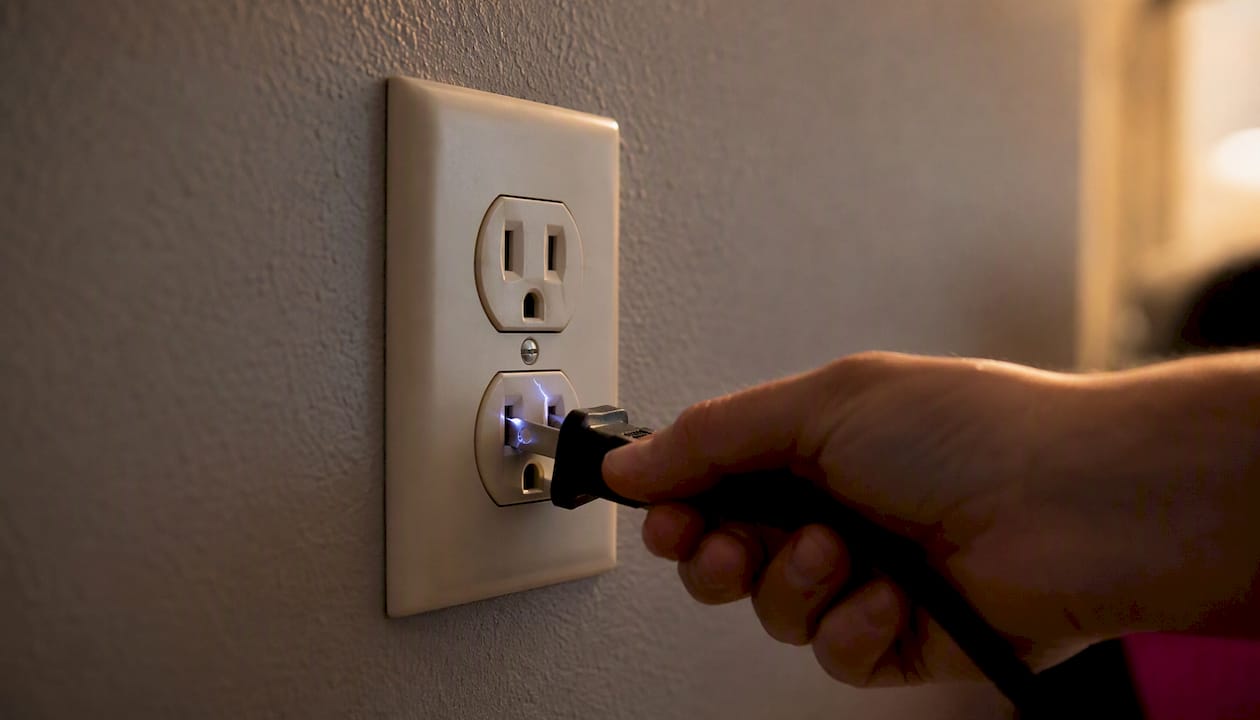
A quick, silent blue flash the instant a plug meets a socket is almost always harmless. It's a micro-arc caused by inrush current, and it's common with anything that has a power brick, motor, or capacitor. But a spark that lingers, crackles, glows yellow or orange, or comes with a burning smell is a different story entirely. That's a dangerous arc, and it needs attention now, not next week.
Here's your immediate action plan:
- Do: If the outlet is cool and the plug comes out easily, unplug the device and stop using that socket.
- Don't: Never poke, sniff too closely, or remove the faceplate on a socket that's warm, smoking, or scorched.
- Call an electrician immediately if: you see repeated sparks, smell burning plastic, notice scorch marks, or the circuit breaker has tripped. High Demand Electrical runs 24/7 emergency callouts for exactly this scenario, and a properly fitted RCD or AFCI should catch a genuinely hazardous arc before it becomes a fire.
Key Takeaways
A brief blue flash when plugging in is a harmless micro-arc, but sustained, yellow, hot, or smelly sparks signal a dangerous arc that needs a licensed electrician immediately.
| Point | Details |
|---|---|
| Know the difference | A quick silent blue flash is normal; yellow sparks, crackling, or heat mean stop using the outlet. |
| Never inspect live outlets | Unplug if cool and safe, or switch off the breaker if the faceplate is warm or smoking. |
| Watch for repeat patterns | Sparks that happen every time you plug in, or trip the breaker, are not a coincidence. |
| Keep records for the electrician | Note the appliance, location, and take photos of any scorch marks before calling. |
| Book High Demand Electrical for anything unresolved | Our Level 2 electricians offer free site inspections and 24/7 emergency callouts across Sydney. |
Table of Contents
- What causes outlet sparks when plugging in?
- Is a sparking outlet always a sign of danger?
- What should you do immediately after seeing a spark?
- When should you call a qualified electrician?
- How does an electrician diagnose and fix a sparking outlet?
- How can you prevent outlets from sparking?
- What does a practising electrician actually think about outlet sparks?
- How High Demand Electrical handles sparking outlets and electrical faults
- Frequently Asked Questions
- Sources
What causes outlet sparks when plugging in?
Most plug-in sparks trace back to one of a handful of causes, and only some of them are worth losing sleep over.
- Normal inrush current (micro-arc): Motors, chargers, and anything with a capacitor draw a brief surge of current the instant contact is made, producing a tiny, silent blue flash that's gone before you've blinked.
- Worn receptacle contacts: The metal contacts inside an outlet lose spring tension with age and thousands of insertions, letting the plug blades arc slightly instead of sliding into a firm connection.
- Loose terminal screws or backstabbed wiring: Wires pushed into the spring-clip "backstab" holes on cheap outlets, or screws that have simply worked loose over years of vibration, create a weak point where current has to jump a small gap.
- Damaged plug or cord: Bent, corroded, or partially broken prongs on the plug itself can cause sparking that has nothing to do with the wall outlet.
- Overloaded circuit or power-hungry device: Appliances drawing more current than the circuit or outlet is rated for stress the connection every time they're switched on.
- Moisture or corrosion: Outlets near kitchens, bathrooms, laundries, or exterior walls can develop a thin film of corrosion that increases resistance and encourages arcing.
- Damaged or degraded insulation: Cracked or brittle wire insulation inside the wall can let conductors touch briefly, a condition called parallel arcing that worn contacts and loose connections make progressively worse over time.
Pro Tip: Before you call anyone, pull the plug and look at the prongs under good light. Discolouration, pitting, or a slightly bent blade points to the device or cord, not the wall. A faint plasticky smell right at the socket, without heat or visible marks, is worth noting but doesn't always mean an emergency. Never push a screwdriver or your finger into a live outlet to "check" anything inside it.
Is a sparking outlet always a sign of danger?
Not always, and learning to tell the two apart is the single most useful skill in this article. A normal micro-arc lasts a fraction of a second, looks pale blue or white, makes no sound you'd notice, and leaves the outlet exactly as cool as it was before. A dangerous arc behaves differently on every count: it can persist for a moment or repeat with each plug attempt, glow yellow or orange, crackle or sizzle, and leave the faceplate noticeably warm.
Watch for these warning signs and treat any of them as reason to stop using the outlet immediately:
- Sparks that continue after the plug is fully seated
- Yellow, orange, or reddish sparks rather than a quick blue flash
- Crackling or sizzling sounds from the wall
- A burning or melting-plastic smell near the socket
- Visible scorch marks or discolouration on the faceplate
- A faceplate that feels warm or hot to the touch
- The circuit breaker tripping when you plug something in
| Trait | Normal micro-arc | Dangerous arc |
|---|---|---|
| Duration | Instant, under a second | Sustained or repeating |
| Colour | Pale blue or white | Yellow, orange, or reddish |
| Sound | Silent | Crackling, sizzling, or popping |
| Heat | Faceplate stays cool | Faceplate feels warm or hot |
| Action required | None, monitor over time | Stop use, call an electrician |
If you're genuinely unsure which category you're looking at, treat it as hazardous. Electricians make this call based on energy and duration, not gut feeling, and a device like an AFCI breaker exists precisely because that judgement call matters. Underestimating a dangerous arc is how house fires start; overestimating a harmless one just costs you a phone call.
What should you do immediately after seeing a spark?
Work through this order, and stop as soon as you reach a step that matches your situation.
- Assess before you touch anything. Look at the outlet from a safe distance. Is it cool, dry, and undamaged, or warm, smoking, or scorched?
- If it's cool and undamaged, unplug the device by gripping the plug itself, not the cord, and stop using that socket until it's checked.
- If the faceplate is warm, smoky, or discoloured, don't touch the plug or the outlet at all. Go straight to your switchboard and switch off the circuit breaker that feeds it.
- If you can't identify the right breaker, or the whole board looks suspect, switch off the main isolator and treat the property as needing a professional make-safe.
- Never remove a faceplate or reach inside a live outlet to inspect wiring yourself. There's no visual check worth the risk of contacting an energised conductor.
- Call for help. A licensed electrician for anything short of an active fire; call emergency services immediately if you see flames, thick smoke, or the smell of burning insulation spreading through the property.
Pro Tip: If a plug or faceplate is genuinely hot, the safest fix is switching off the breaker before anyone handles it, not pulling the plug by hand. That's a job for a qualified electrician with the right test equipment, and it's exactly the kind of call High Demand Electrical's emergency team takes around the clock.
When should you call a qualified electrician?
Some sparks call for an emergency callout tonight. Others just need a booking in the diary. Knowing which is which saves you money and unnecessary stress.
Call immediately for:
- Sparks that repeat every time you plug in, not just once
- Any burning smell, scorch marks, or visible melting
- A breaker that trips the moment you plug something in
- A faceplate that's warm or hot to touch
- Sparks from more than one outlet on the same circuit
Book a scheduled inspection for:
- A single faint blue flash with no smell, heat, or damage
- An old outlet you'd like checked as a precaution
- A property you're about to rent out or sell
An emergency callout typically starts with isolating the affected circuit, confirming the fault isn't live elsewhere in the switchboard, and applying a temporary make-safe if the outlet needs to stay disconnected until parts arrive. Timeframes and cost depend on how accessible the wiring is and whether the fault sits at the outlet or further upstream.
Before the electrician arrives, have this ready:
- Which appliance was plugged in when it sparked
- The room and approximate location of the outlet
- Whether the breaker tripped, and which one
- Photos of any scorch marks or damage, taken from a safe distance
How does an electrician diagnose and fix a sparking outlet?
A licensed electrician doesn't guess. They run through a structured sequence of checks designed to isolate exactly where the fault sits, then fix that specific point rather than replacing everything in sight.
The process usually starts with a visual inspection of the outlet, plug, and visible cabling, followed by a tightness check on every terminal screw. From there, insulation resistance testing reveals whether current is leaking where it shouldn't, and earth fault loop impedance testing confirms the protective earth path is doing its job. Thermal imaging can spot a hot connection before it's visibly damaged, and continuity and polarity checks confirm the wiring is correctly connected end to end. Where an AFCI or AF/DD device is fitted, they'll verify it's tripping correctly, since repeated arc-fault trips usually point to a real fault rather than a nuisance.
| Test | What it finds | Typical fix |
|---|---|---|
| Visual inspection | Scorching, corrosion, physical damage | Replace damaged outlet or plug |
| Terminal tightness check | Loose screws or failed backstab connections | Reterminate under screw, not spring clip |
| Insulation resistance test | Degraded insulation causing leakage | Replace damaged cable section |
| Earth fault loop impedance | Weak or broken earth path | Repair earthing, upgrade if needed |
| Thermal imaging | Hot spots at connections before failure | Reterminate or replace connection |
| AFCI/AF-DD verification | Genuine arc faults vs nuisance trips | Fit or replace arc-fault protection |
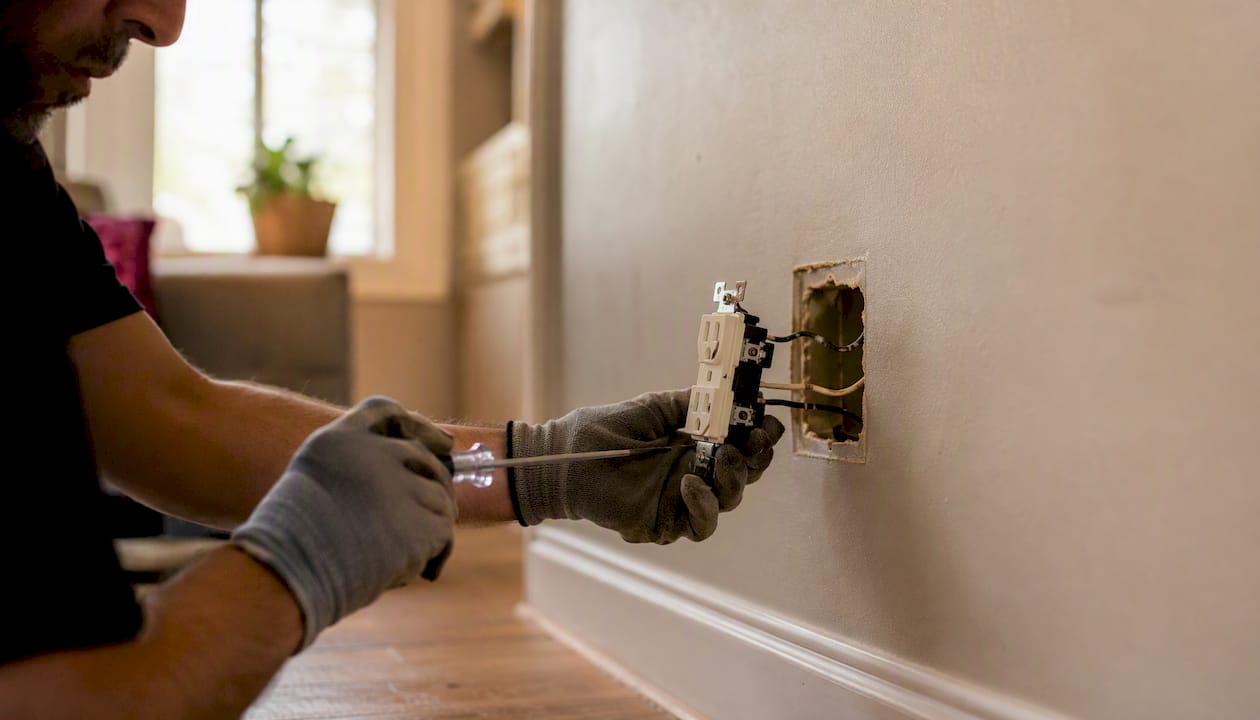
Most sparking outlets are fixed by replacing a worn receptacle, retermination under a proper screw connection instead of a backstab clip, or swapping out a damaged section of cable or plug. If the fault traces back further, to the switchboard itself, that becomes Level 2 scope, particularly where metering or the network connection is involved, and only an accredited Level 2 ASP can legally carry out that work. It's a distinction worth knowing before you call around, since not every licensed electrician holds that authorisation. You can read more about when to hire a Level 2 electrician for fault work that goes deeper than the outlet itself.
How can you prevent outlets from sparking?
Prevention here isn't complicated, but it does need to happen on a schedule rather than only after something goes wrong.
- Replace outlets that show wear, discolouration, or looseness in the plug fit, rather than waiting for them to fail outright.
- Have terminal screws checked and tightened during any electrical inspection, since vibration and thermal cycling loosen them over years.
- Avoid backstabbed connections where possible. A screw terminal holds far more reliably over time.
- Don't run high-load appliances permanently off an extension cord. Get a proper outlet installed instead.
- Keep outlets dry, especially in kitchens, bathrooms, laundries, and anywhere near an exterior wall.
- Inspect cords and plugs on your own appliances periodically for cracked insulation or bent prongs.
- Use certified surge protectors on sensitive electronics, particularly in areas prone to voltage fluctuation.
A general inspection every few years is a reasonable rhythm for most homes, and it's worth bringing forward after storms, flooding, or any renovation that disturbed the wiring. Older homes, particularly anything still running on aluminium wiring, benefit from more frequent checks since aluminium expands and contracts differently to copper and loosens connections faster.
Pro Tip: If you've got several high-inrush devices, think fridges, power tools, air conditioners, on one circuit, a certified surge-protection strip is cheap insurance. If you're seeing sparking across multiple outlets or your switchboard still has old fuses instead of breakers, a switchboard upgrade is usually the better long-term investment over patching individual outlets one at a time.
What does a practising electrician actually think about outlet sparks?
Most calls we get about sparking outlets turn out to be exactly what they sound like: a harmless micro-arc that startled someone the first time they noticed it. That's normal, and it's a reasonable thing to notice, not panic about. What changes the calculation is repetition, heat, smell, or damage. Any one of those on its own is enough to justify stopping use of that outlet and getting it looked at.
A licensed electrician can usually make a suspect outlet safe within minutes of arriving, isolate the circuit, confirm whether the fault is at the outlet or further upstream, and give you a clear answer rather than a guess. Stop using the outlet in the meantime, and if you can, snap a photo of any scorch marks or damage before you call. It gives the electrician a head start and saves you repeating the description twice.
How High Demand Electrical handles sparking outlets and electrical faults
High Demand Electrical is the practical alternative to waiting on a callback from a general handyman or guessing at a fix yourself. Where a DIY approach means poking around a live outlet with no test equipment and no way to confirm the fault is actually gone, a Level 2 electrician arrives with insulation testers, thermal cameras, and the legal authority to work on the network connection if that's where the problem sits.

High Demand Electrical's team runs emergency electrical callouts around the clock across Sydney, covering everything from a single sparking outlet to a full switchboard fault. Booking a job for Level 2 work comes with a free site inspection, so you get a clear picture of what's wrong and what it'll cost before anything's decided. If your outlet is showing any of the warning signs covered above, from repeated sparking to a warm faceplate, book an emergency electrical make-safe rather than waiting to see if it happens again.
Frequently Asked Questions
Is a sparking outlet always an emergency?
No. A single, instant blue flash when you plug in a device with a motor or capacitor is a normal micro-arc — it's not a fault. It becomes an emergency when the spark repeats, lasts longer than a blink, smells like burning, leaves the faceplate warm, or trips your circuit breaker. If any of those apply, stop using the outlet and call an electrician the same day.
Does a sparking outlet mean I need a switchboard upgrade?
Not necessarily. Most sparking outlets are caused by a worn receptacle, a loose connection behind the outlet, or a damaged appliance plug — not a problem with the switchboard itself. However, if the fault traces back to the board, or if repeated outlet faults suggest an overloaded circuit, that's when a switchboard assessment becomes the right next step. Your electrician will tell you which it is after inspecting the fault.
Can I reset the circuit breaker myself after a sparking outlet?
Only if the outlet is completely cool, the spark was a one-off, and the appliance you were plugging in is clearly the cause (bent plug, cracked cord). If the breaker trips again when you reset it, or if the outlet is warm, scorched, or smells of burning, don't try again — leave the breaker off and call an electrician. Resetting into a live fault can cause the fault to progress.
What should I have ready before calling an electrician about a sparking outlet?
Have the following to hand: which appliance was plugged in when it sparked, which room the outlet is in, whether the circuit breaker tripped and which one, and any photos of scorch marks or damage you can safely take from a distance. This lets the electrician arrive with the right parts and gives a head start on diagnosis.
Sources
- Socket sparking when plugging in | Elec-Mate
- Outlet sparks when plugging in? | DC Electric
- Outlet sparking: what's normal vs a dangerous arc | Tried & True Electric
- About sparking outlet — find out more | Econnex
Recommended
Powering Your Needs with Expertise
If you’re looking for a reliable, experienced, and prompt electrician, look no further than High Demand Electrical. We cater to all your electrical needs, from routine maintenance to emergency repairs and complete system installations. Our skilled team is committed to providing professional service that ensures your electrical systems run smoothly. Whether it's a small task or a large project, give us a call today. Let us meet all your electrical demands with the quality and reliability you deserve.