What are the AS/NZS 3000 switchboard requirements in NSW?
AS/NZS 3000 (the Wiring Rules) is the mandatory standard governing switchboard installations across Australia, and it sets the clearances, protection, and labelling rules every NSW installation must meet. Switchboards rated at 125 A per phase or higher, or subject to a fault potential of 10 kA or more, must also comply with AS/NZS 61439, which means the manufacturer has to provide verification documentation before you can sign off the job.
The clearance rules are simple to check and easy to get wrong:
- minimum clear space in front of the switchboard when the doors are open
- clear space when the doors are closed, for safe operation and maintenance access
- Larger boards with high current rating or substantial length need additional egress paths and room sizing
One trigger catches out more homeowners than any other: installing an EV charger, adding a second kitchen, or fitting battery storage often pushes total demand past what an older board was ever built to carry, forcing an upgrade regardless of how well the existing switchboard has performed.
Key Takeaways
Meeting AS/NZS 3000 switchboard requirements in NSW means satisfying clearance, protection, earthing, and verification rules together, not treating any one of them as sufficient on its own.
| Point | Details |
|---|---|
| Standards apply in layers | AS/NZS 3000 governs the whole installation; AS/NZS 61439 kicks in above 125 A per phase or 10 kA fault potential. |
| Clearances are measurable | Keep 600 mm clear with doors open and 1.0 m clear with doors closed, always measured from the board face. |
| Verification is non-negotiable | Request manufacturer test reports, design verification, and as-built drawings before signing off any new board. |
| Upgrades follow clear triggers | EV chargers, battery storage, nuisance tripping, and network-driven metering changes all justify a switchboard review. |
| Local support matters | Hdlevel2electriciansydney offers free site inspections and Level 2 verification support for switchboard compliance across Sydney. |
Table of Contents
- Which standards apply and when: AS/NZS 3000 vs AS/NZS 61439
- Clearances, location and switchroom requirements under AS/NZS 3000
- Construction, labelling and protective devices required by AS/NZS 3000
- Verification, documentation and what contractors must obtain before sign-off
- When to plan a switchboard upgrade: common triggers and timing
- Practical compliance checklist for homeowners and contractors
- Detailed earthing and bonding requirements specific to switchboards
- Testing procedures and commissioning requirements post-installation
- Maintenance and periodic inspection obligations for switchboards
- What actually gets missed on inspection day
- How High Demand Electrical handles switchboard compliance in Sydney
- Frequently asked questions
- Sources
Which standards apply and when: AS/NZS 3000 vs AS/NZS 61439
Every electrical installation in NSW, from a two bedroom unit to a multi tenancy commercial fitout, sits under AS/NZS 3000:2018. It is the baseline. It covers wiring methods, protection, and the fundamental safety rules that apply whether you are running a single circuit or building a full distribution board.
Where things get more technical is the switchboard assembly itself. Clause 2.10.3.2 requires any switchboard rated at 125 A per phase or greater, or exposed to a fault potential of 10 kA or more, to comply with the AS/NZS 61439 series. That standard governs how the assembly itself is designed, built, and verified, separate from the wiring rules that sit around it.
A few practical points worth knowing:
- Small domestic switchboards below those thresholds are generally exempt from full AS/NZS 61439 verification, though good manufacturers still test to it
- Always check both the current rating and the fault level before assuming an exemption applies, because either one can trigger the requirement on its own
- The 2026 edition of AS/NZS 61439.1 introduces group rated current provisions, extended DC assembly guidance, and revised temperature rise verification, all directly relevant if your new board will host solar inverters, battery inverters, or EV charging circuits
If your renovation or upgrade touches any of those DC-heavy loads, ask your contractor whether the board’s verification covers the newer thermal and DC rules.
Clearances, location and switchroom requirements under AS/NZS 3000
The 600 mm and 1.0 m rules aren’t arbitrary numbers. They exist so an electrician can safely isolate a circuit, pull a meter, or work inside the board without being pinned against a wall or a hot water unit.
- Measure from the switchboard face, not the wall behind it. The 600 mm applies with doors swung fully open; the 1.0 m applies to the standing clearance in front when doors are shut.
- Larger assemblies need more than clearance. Boards with large current rating or length typically require two separate exit paths from the switchroom, plus a room sized to allow safe evacuation if something goes wrong mid-job.
- Mounting height matters. Operating handles and indicators generally sit within easy reach, and ventilation openings need to stay clear of insulation, storage, or built-in furniture that traps heat.
- IP rating follows location. An outdoor board in a Sydney coastal suburb needs a higher ingress protection rating than one tucked inside a garage, given salt air and driving rain.
Pro Tip: In strata blocks, don’t assume the switchboard cupboard someone built around your meter box meets clearance rules just because it looks tidy. Measure it. A stylish enclosure that blocks 1.0 m of standing room is a compliance headache waiting to surface at your next inspection.
Construction, labelling and protective devices required by AS/NZS 3000
Inspectors and network operators check the same handful of things on almost every switchboard, and they’re consistent whether you’re in Parramatta or Bondi.
- RCD protection is required across most final sub-circuits in residential and small commercial installations, arranged so a single fault doesn’t take out every circuit in the house at once
- Earthing and the multiple earthed neutral (MEN) system need continuity right through the board, tying the neutral, earth bar, and consumer’s earthing conductor together correctly
- Labelling has to show circuit identification, the fault-current rating of the assembly, and danger warnings where live parts are exposed
- Enclosure and barrier requirements keep live parts inaccessible to anyone without a tool, which is why a missing or cracked cover plate is an automatic fail on most inspections
Grouping breakers logically, lighting circuits together, power circuits together, isn’t just tidy work. It’s what lets an inspector or the next electrician trace a fault in minutes instead of an hour.
Verification, documentation and what contractors must obtain before sign-off
Don’t accept a new or upgraded switchboard without paperwork to back it. For assemblies caught by AS/NZS 61439, the manufacturer needs to supply verification through one of three recognised methods, testing, calculation, or comparison to an already-tested design, and Annex D sets out which attributes each method covers.
What you should be asking your contractor for:
- Manufacturer test reports or design verification documents
- Confirmation the installed board matches the verified design, not a field-modified version
- Short-circuit rating confirmation appropriate to the fault level at that point on the network
- IP rating confirmation matching the installation environment
- As-built drawings showing the final circuit layout
Older assemblies verified under the previous AS/NZS 3439 standard generally remain acceptable if unmodified, but any structural change, extra ways added, busbar altered, usually forces re-verification. Keep every document. If a contractor can’t produce them, that’s worth pausing on before you pay the final invoice.
When to plan a switchboard upgrade: common triggers and timing
Most upgrade decisions come down to three questions: has demand grown, is the board misbehaving, or has the network changed something upstream.
- Increased demand from EV charging, a new kitchen, or battery storage often exceeds what an older board’s rating was designed for, even if every individual circuit still works fine on its own.
- Behavioural red flags matter more than people think: repeated nuisance tripping, zero spare ways left for future circuits, or protective gear that predates modern RCD requirements all point toward a board that’s reached its limit.
- Network-driven changes, a metering upgrade, a supply capacity change from your distributor, or a fault level reassessment, can force an upgrade even when nothing on your side has changed at all.
A typical path runs from site inspection, to quoting and verification document review, to installation, then final testing and sign-off, usually completed within one to two visits depending on supply authority involvement.
Practical compliance checklist for homeowners and contractors
Before any switchboard work starts, confirm the supply rating, book a site inspection, and request verification documents if the job falls under AS/NZS 61439 thresholds. On site, an electrician checks clearances, RCD arrangement, labelling, earthing continuity, and IP rating against the installation environment.
| Stage | What to check or request |
|---|---|
| Before work | Site inspection, supply rating confirmed, verification documents requested |
| During install | Clearances, RCD protection, labelling, earthing continuity, IP rating |
| After completion | Design verification, test certificates, as-built drawings, commissioning records |
| Who to engage | Level 2 electrician for supply-side or metering work; licensed electrician for internal board work |
Pro Tip: Keep every commissioning record in one folder, digital or paper. When you sell the property or lodge a development application for renovation work, a complete document trail saves weeks compared to chasing a contractor for paperwork after the fact.
Anything involving supply authority connections, metering changes, or private power poles calls for a Level 2 electrician specifically, since standard licensed electricians aren’t authorised for that scope of work.
Detailed earthing and bonding requirements specific to switchboards
Earthing inside a switchboard isn’t a single wire, it’s a system. The main earthing conductor from the consumer’s earth electrode terminates at the main earth bar inside the board, and every metallic enclosure, chassis, and cable gland within that board bonds back to it.
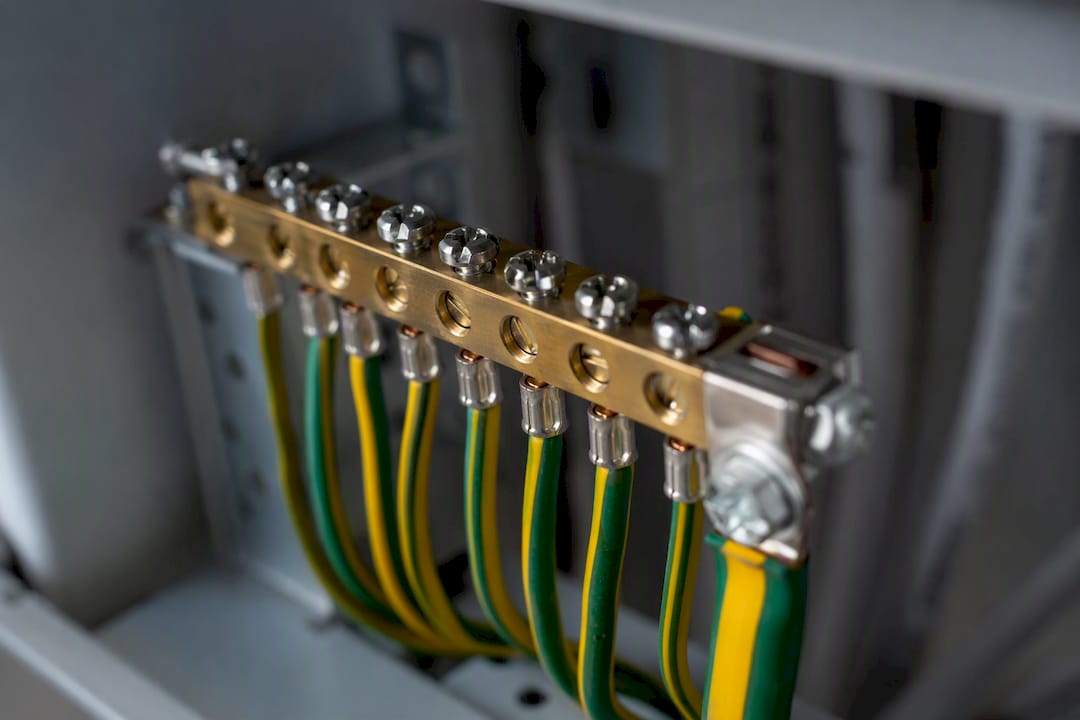
Under the MEN system used throughout NSW, the neutral bar and earth bar are linked at one point only, usually at the main switchboard. That link should never be duplicated further downstream, since a second neutral-earth connection can create dangerous parallel current paths and mask a genuine fault.
Bonding extends beyond the board itself. Metal water pipes, gas pipes where required, and structural steel within reach of the installation typically need equipotential bonding back to the main earth bar, reducing the risk of a voltage difference building up between surfaces someone could touch simultaneously.
For sub-boards feeding a granny flat, garage, or detached studio, the earthing arrangement depends on whether that sub-board is fed by a single circuit from the main board (where the earth simply extends) or treated as a separate installation. Getting this distinction wrong is one of the more common defects turned up during safety inspections, particularly in older Sydney properties that have had additions bolted on over decades without the earthing system being reassessed as a whole.
Any switchboard servicing a swimming pool, spa, or outdoor area also triggers additional bonding requirements for metal fittings and structures within the relevant zone, given the elevated shock risk around water.
Testing procedures and commissioning requirements post-installation
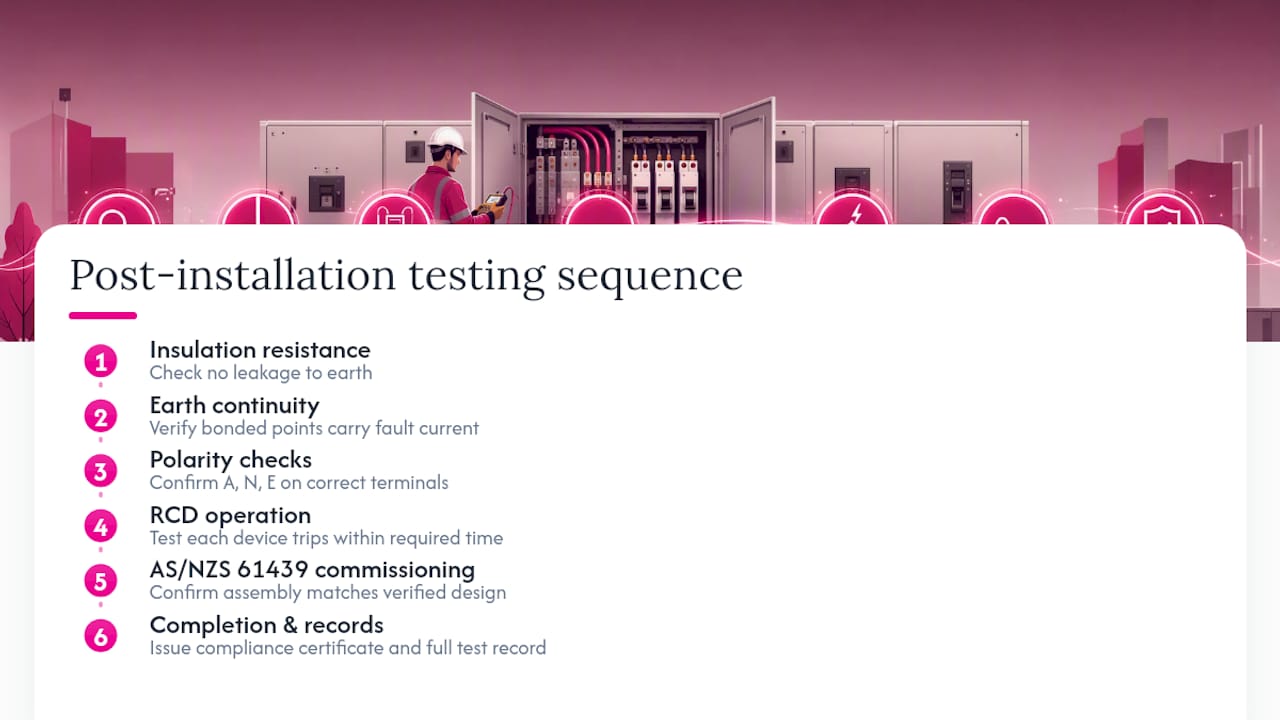
A switchboard isn’t compliant just because it looks right. AS/NZS 3000 expects a defined sequence of tests before anyone calls the job finished.
Insulation resistance testing comes first, confirming there’s no unintended leakage path between live conductors and earth. Earth continuity testing follows, verifying every bonded point actually carries a fault current back to the source rather than relying on a loose connection that happens to look fine.
Polarity checks confirm active, neutral, and earth conductors land on the correct terminals throughout the board, a step that catches wiring errors before they become live hazards. RCD operation gets tested individually, confirming each device trips within the required time when a test current is applied, not just that it clicks when you press the test button.
For boards under AS/NZS 61439, commissioning also includes confirming the installed assembly matches the verified design on paper, checking nothing was substituted or modified on site that would invalidate the manufacturer’s verification.
Once testing is complete, the electrician issues a certificate of compliance, and for larger commercial or strata jobs, a full test and commissioning record showing every measured value against the expected range. Keep that certificate. It’s the document a network operator, insurer, or future buyer’s building inspector will ask for first, and reconstructing it after the fact if it’s lost is far harder than filing it away on the day.
Maintenance and periodic inspection obligations for switchboards
AS/NZS 3000 doesn’t stop mattering once the certificate is issued. Switchboards degrade, contacts loosen, thermal cycling stresses connections, and dust or moisture ingress creeps in over years, particularly in coastal NSW suburbs or older strata buildings with ventilation issues.
There’s no single blanket inspection interval that applies to every switchboard in NSW. Commercial and strata common-property boards typically follow a periodic inspection schedule set by the building’s fire safety or maintenance plan, often annually, while residential boards are commonly checked whenever other electrical work is carried out, or every few years as a standalone health check.
RCDs specifically benefit from more frequent attention. Testing the trip function periodically, beyond just the manufacturer’s test button, confirms the device still responds within its rated time as it ages. A safety switch that hasn’t tripped correctly in years isn’t necessarily faulty, but you won’t know until it’s tested.
Thermal imaging during a periodic inspection catches problems before they become failures: a loose lug or degrading connection shows up as a hot spot well before it causes visible damage or a fire. It’s one of the more valuable, and underused, checks available for older boards carrying higher loads than they were originally designed for.
If your switchboard has never had a documented inspection since installation, and it’s more than a decade old, that’s a reasonable prompt to book one, particularly before adding new load like an EV charger or battery system.
What actually gets missed on inspection day
Most switchboard failures in NSW aren’t caused by exotic wiring faults. They come from small, boring oversights: a cupboard built too close to the board, a sub-board earthed incorrectly during a renovation, or a decade-old RCD that’s never actually been load tested since the day it was installed.
The gap between what people assume “meeting AS/NZS 3000” means and what an inspector actually checks is wider than most homeowners expect. A board can look immaculate, correctly labelled, tidy wiring, and still fail on a 600 mm clearance measurement because someone installed a shelf unit in the wrong spot years after the original electrician signed off. Compliance isn’t a one-time event; it’s a state the installation has to maintain.
The other pattern worth flagging: people upgrade the visible things, a new EV charger, a shiny battery inverter, without anyone checking whether the board feeding them was ever verified for that load in the first place. Adding modern DC-heavy equipment to a board never assessed against those characteristics is where a lot of avoidable rework originates.
How High Demand Electrical handles switchboard compliance in Sydney
Hdlevel2electriciansydney is the direct alternative to guessing whether your switchboard actually meets AS/NZS 3000, a Level 2 contractor who can assess supply, metering, and verification documentation in one visit rather than sending you between a sparky and the network operator separately.

High Demand Electrical’s Level 2 team handles switchboard upgrades, metering changes, and supply capacity increases directly, including the manufacturer liaison and verification paperwork that AS/NZS 61439 assemblies require. Every free site inspection covers the clearances, earthing, and labelling checks this guide has walked through, so you get a clear answer on what’s compliant and what isn’t before any work is quoted. The team is available 24/7 for urgent faults and works across residential, commercial, and strata properties throughout Sydney, with more than 300 five-star reviews backing that track record.
If your board is nearing capacity, showing its age, or you’re planning an EV charger or battery install, book a free site inspection through the Level 2 electrician Sydney page, or arrange a switchboard upgrade consultation to get the verification documentation sorted before it becomes a problem at settlement or your next inspection.
Frequently asked questions
Do all NSW switchboards need to comply with AS/NZS 61439? No. Only switchboards rated at 125 A per phase or greater, or exposed to a fault potential of 10 kA or more, are required to comply with the AS/NZS 61439 series. Smaller domestic boards generally sit outside that threshold, though quality manufacturers often test to it anyway.
What clearance does AS/NZS 3000 require in front of a switchboard? The standard commonly requires 600 mm of clear space when the switchboard doors are open and 1.0 m when they’re closed, measured from the front face of the board, with larger provisions for switchboards over 800 A or longer than 3 m.
Does adding an EV charger always require a switchboard upgrade? Not always, but it’s one of the most common triggers. If the existing board lacks spare capacity or spare ways, or the supply rating can’t handle the added load, an upgrade becomes necessary before the charger can be connected safely.
What documents should I ask my contractor for after switchboard work? Request the design verification documents, manufacturer test reports where AS/NZS 61439 applies, a test and commissioning record, and as-built drawings showing the final circuit layout. Keep these together for insurance, resale, or future inspections.
How often should a switchboard be inspected under AS/NZS 3000? There’s no single universal interval. Commercial and strata boards typically follow a periodic maintenance schedule, often annually, while residential boards are commonly checked during other electrical work or every few years, with more frequent RCD testing recommended as boards age.
Sources
- NSW Government — Electrical standards, rules and notes
- Western Australian Government — AS/NZS 3000:2018 amendment 2 (announcement)
Recommended
Powering Your Needs with Expertise
If you’re looking for a reliable, experienced, and prompt electrician, look no further than High Demand Electrical. We cater to all your electrical needs, from routine maintenance to emergency repairs and complete system installations. Our skilled team is committed to providing professional service that ensures your electrical systems run smoothly. Whether it's a small task or a large project, give us a call today. Let us meet all your electrical demands with the quality and reliability you deserve.