NSW Energy Savings Scheme: your 2026 guide to discounts
The NSW Energy Savings Scheme (ESS) delivers upfront discounts on eligible energy-efficient upgrades by having Accredited Certificate Providers (ACPs) create and sell certificates on your behalf. You never apply to the government directly. Your immediate next steps:
- Check the Accepted Products List in the TESSA registry to confirm your chosen product qualifies.
- Find an installer who partners with an ACP or is one themselves.
- Request a written quote that itemises the ESS discount and confirms certificate registration.
- Use energy.nsw.gov.au as your authoritative source for scheme rules and updates.
Key takeaways
The NSW Energy Savings Scheme delivers upfront discounts through Accredited Certificate Providers, and checking the Accepted Products List in TESSA before purchase is the single most important step to protect your entitlement under the July 2026 Rule.
| Point | Details |
|---|---|
| Check TESSA before buying | Confirm your specific product model is on the Accepted Products List before signing any quote. |
| ACP channel is mandatory | You cannot apply for ESS discounts directly; an Accredited Certificate Provider must create and register your certificates. |
| Discount appears on invoice | The ESS discount reduces your installation invoice at the time of the job, not as a later government payment. |
| Combine programs carefully | Home Energy Saver offers discounts and zero-interest loans up to $15,000; apply for the discount first, then assess the loan. |
| High Demand Electrical | Certified Level 2 ASP electricians in Sydney offering free site inspections and ESS-relevant electrical services for homes and businesses. |
Table of Contents
- What is the NSW Energy Savings Scheme and how does it fit NSW energy policy?
- Who can access ESS incentives?
- Which upgrades typically qualify under the ESS?
- How the ESS actually delivers your discount
- How to check eligibility and secure your ESS discount
- What changed with the July 2026 ESS Rule?
- How the ESS interacts with other NSW and federal programs
- What to ask your installer before you hire
- Typical timelines and what you will pay out of pocket
- Why working with an accredited Level 2 electrician matters for ESS projects
- High Demand Electrical: ESS-ready electrical services for Sydney homes and businesses
- Sources
What is the NSW Energy Savings Scheme and how does it fit NSW energy policy?
The ESS is a market-based certificate scheme established under the NSW Electricity Supply Act 1995. Its core purpose is to deliver cost-effective energy savings for households and businesses by providing financial incentives to install energy-efficient equipment. The scheme has been running since 2009, and the current ESS Rule came into effect on 1 July 2026, with the scheme legislated to continue to 2050.
Between 2009 and 2023, the ESS supported projects estimated to deliver 57,000 GWh of lifetime energy savings and reduced greenhouse gas emissions by around 27 Mt CO₂ equivalent as of December 2023. Those figures give you a sense of the scheme's reach.
The ESS sits alongside the Peak Demand Reduction Scheme (PDRS) under the broader Energy Security Safeguard framework. The distinction matters in practice:
The ESS targets overall energy consumption reductions across NSW households and businesses, while the PDRS focuses specifically on reducing electricity demand during peak periods. Both schemes use the same certificate mechanism and are administered under the Energy Security Safeguard, but they generate different certificate types and apply to different eligible activities.
Understanding which scheme applies to your upgrade determines which certificates are created and how the discount is calculated. Some upgrades, such as battery connections to a Virtual Power Plant (VPP), can generate certificates under both schemes.
Who can access ESS incentives?
Eligibility is broader than most people expect, but there are genuine conditions to satisfy before you can access a discount.
- Owner-occupiers in NSW are the most straightforward participants. If you own and live in the property, you can engage an ACP-partnered installer for eligible upgrades.
- Small business owners can access incentives for commercial-grade equipment such as efficient refrigeration, motors, and lighting.
- Landlords can access incentives, but typically need tenant permission or must meet specific conditions depending on the upgrade type. Strata and apartment owners face additional approval requirements from owners corporations.
- Renters may access some incentives in limited circumstances, usually where the landlord consents or where the upgrade is portable. Check directly with an ACP for your specific situation.
All eligible activities must occur at a NSW property, and the equipment installed must appear on the Accepted Products List in TESSA. Some programs layered on top of the ESS, such as Home Energy Saver, carry additional eligibility criteria including income thresholds or concession card requirements.
Pro Tip: If you own a strata property, check whether your owners corporation approval is needed before engaging an installer. A BASIX certificate or occupation certificate may also be relevant for larger renovation projects that include energy upgrades.
Which upgrades typically qualify under the ESS?
The IPART-administered eligible upgrades list covers a wider range of products than most people realise. Common qualifying categories include:
- Reverse-cycle air conditioners (replacing older, less efficient units)
- Heat pump hot water systems (replacing electric resistance or gas storage units)
- LED lighting (residential and commercial)
- Pool pumps (variable speed models replacing single-speed units)
- Draught-proofing and efficient showerheads
- High-efficiency motors and pumps for small businesses
- Efficient refrigeration for commercial small business use
- Battery storage connected to a VPP
For air conditioner upgrades, the incentive value depends on the star rating and capacity of the new unit. Heat pump hot water systems tend to generate strong certificate values because of the significant energy reduction compared to electric resistance systems. Battery and VPP connections generate Peak Reduction Certificates under the PDRS rather than Energy Savings Certificates under the ESS.
Not every model within a qualifying category is eligible. Technical rules, minimum efficiency ratings, and in some cases minimum warranty periods are all specified in the Accepted Products List. A heat pump water heater that a retailer markets as “efficient” may still fall short of the scheme’s technical threshold.
Pro Tip: Always search the specific brand and model number on the Accepted Products List in TESSA before signing a quote. A product that qualified six months ago may have been removed after a Rule update.
How the ESS actually delivers your discount
The financial benefit does not arrive as a government rebate cheque. It flows through a certificate mechanism, and understanding that flow helps you verify you are getting what you are entitled to.
Here is how the process works in practice:
- Step 1: An ACP-accredited installer completes your eligible upgrade at your NSW property.
- Step 2: The ACP calculates the number of Energy Savings Certificates (ESCs) or Peak Reduction Certificates (PRCs) the activity generates, based on the activity definition and product specifications.
- Step 3: The ACP registers those certificates in the Registry of Certificates within the TESSA system, which is publicly searchable.
- Step 4: The ACP sells the certificates to obligated participants (typically electricity retailers required to surrender certificates each year).
- Step 5: The revenue from that certificate sale is passed back to you as an upfront discount on your installation invoice.
Accredited Certificate Providers are the approved businesses authorised to perform this process. You cannot create certificates yourself or apply to the government for an ESS payment. The ACP channel is mandatory. IPART administers the scheme and publishes the ESS Rule and all activity definitions. TESSA is the public registry where certificates are registered and where the Accepted Products List is maintained.
The discount typically appears as a line item on your installation invoice at the time of installation, not weeks later. If an installer tells you the rebate will arrive separately from the government, that is a red flag.
How to check eligibility and secure your ESS discount
Follow these steps in order before committing to any purchase.
- Identify your intended upgrade and search the specific product model on the Accepted Products List in TESSA. Confirm it is listed and check the eligibility conditions.
- Find an installer who is an ACP or partners with one. The public ACP list is available through IPART’s registry. Not every licensed electrician or plumber is an ACP.
- Request a written quote that clearly itemises the ESS discount as a separate line, states the number of certificates to be created, and identifies which scheme (ESS or PDRS) applies.
- Confirm the ACP will register certificates in TESSA and ask for written confirmation of certificate registration once the job is complete. This is your proof the discount was legitimately applied.
- Proceed with installation and receive the discount directly on your invoice. The ACP handles certificate creation and sale after completion.
- Keep all records: the signed quote, the itemised invoice showing the discount, and the certificate registration confirmation. These matter for warranty claims and any future audit queries.
Ask every installer upfront which program or programs they will claim under. Some jobs may attract both ESS and PDRS certificates, or may be eligible for Home Energy Saver discounts on top. You want that breakdown in writing before work begins.
What changed with the July 2026 ESS Rule?
The ESS Rule is updated regularly, and the version that came into effect on 1 July 2026 introduced changes that directly affect what qualifies and how incentives are calculated. Before you buy, check the current Rule version on energy.nsw.gov.au.
Key areas affected by recent rule changes include:
- Multi-split and large air conditioner eligibility: Activity definitions and eligible capacity ranges were revised. A unit that qualified under the previous Rule may no longer qualify.
- Commercial heat pump water heaters: Eligibility conditions and activity definitions were updated for commercial-scale systems.
- Liquid chilling package lifetimes: Lifetime assumptions used to calculate certificate numbers were adjusted, affecting the incentive value for commercial refrigeration and cooling.
- Air conditioner co-payments: Some air conditioner activities now require a minimum customer co-payment, meaning the discount does not cover the full installation cost.
The practical consequence is straightforward: a model on the Accepted Products List today may be removed after the next Rule update, and an activity that generated a certain certificate value last year may generate a different value now. Check the Accepted Products List in TESSA and confirm the current Rule version with your installer before signing anything.
How the ESS interacts with other NSW and federal programs
Several programs can work alongside the ESS, but the combination rules are specific and worth understanding before you commit to an upgrade.
| Program | Type | Who it’s for | Combinable with ESS? |
|---|---|---|---|
| ESS (Energy Savings Scheme) | Certificate discount via ACP | Households and businesses in NSW | Base scheme |
| PDRS (Peak Demand Reduction Scheme) | Certificate discount via ACP | Households and businesses in NSW | Yes, for eligible activities |
| Home Energy Saver | Discounts and zero-interest loans up to $15,000 | Eligible NSW households (income/concession criteria) | Generally yes, for different costs |
| Australian Cheaper Home Batteries Program | Federal battery discount | Australian households | Yes, with VPP incentives where rules allow |
The Home Energy Saver programme is funded by the NSW Government with $557 million to provide targeted discounts and zero-interest loans. If you are eligible for both a discount and a loan, apply for the discount first so you can accurately determine the loan amount needed for the remainder of the cost.
For batteries, the situation changed when the Australian Government’s Cheaper Home Batteries Program launched. NSW suspended its battery installation discount at that point, but increased incentives for connecting batteries to a VPP. Those VPP incentives can be combined with the federal program where the rules allow. Ask your installer to confirm which programs apply to each component of the job and to provide a written breakdown on the quote.
What to ask your installer before you hire
Accredited installers and ACPs carry specific obligations: they must verify product eligibility, create and register certificates in TESSA, pass on the discount, and maintain documentation for audit purposes. Not every installer meets these obligations equally well.
Ask these questions before engaging anyone:
- Are you an Accredited Certificate Provider, or do you work with one? Can you show me your ACP registration?
- Can you show me recent TESSA certificate registrations for similar jobs?
- Will the ESS discount appear as a line item on my invoice?
- Which scheme or schemes will you claim under for this job (ESS, PDRS, Home Energy Saver, federal battery program)?
- What documentation will you provide after installation to confirm certificate registration?
- What are the warranty terms for the equipment, and does the product meet the minimum warranty required under the Accepted Products List?
Red flags to watch for: an installer who cannot confirm their ACP status, who gives vague answers about certificate registration, or who presents the discount as a “government rebate” arriving separately after installation. A legitimate ACP-managed job delivers the discount on the invoice, with certificate registration in TESSA as the verifiable proof.
For strata or apartment upgrades, owners corporation approval may be required before work begins. A practical guide to granny flat and property approvals in NSW can help you understand the broader approvals context for property-based upgrades.
Typical timelines and what you will pay out of pocket
Setting realistic expectations upfront avoids frustration later.
- Quote to installation: Lead times vary by equipment type. Heat pump water heaters and high-efficiency air conditioners can have supply lead times of one to four weeks depending on the model and installer availability.
- Certificate creation: ACPs create and register certificates in TESSA at or shortly after job completion. This is not a weeks-long government approval process.
- When you see the discount: The discount appears on your installation invoice at the time of the job, not as a later reimbursement.
- Customer co-payments: Some activities require a minimum customer contribution. Air conditioner upgrades under the 2026 Rule, for example, may carry a co-payment. Your quote should state this clearly.
- Home Energy Saver loans: If the remaining cost after discounts is still significant, a zero-interest loan of up to $15,000 through Home Energy Saver may cover the gap. Apply for the discount first, then assess the loan amount needed.
Always request a written invoice breakdown that separates the equipment cost, installation labour, the ESS or PDRS discount, and any co-payment. That breakdown protects you if questions arise later about what was claimed and what was passed on.
Why working with an accredited Level 2 electrician matters for ESS projects
Many ESS-eligible upgrades look straightforward on paper but carry real electrical complexity underneath. Connecting a battery to a VPP requires metering work and network approval. Installing a high-capacity reverse-cycle air conditioner in an older home often means a switchboard upgrade to handle the additional load safely. Heat pump hot water systems frequently need an off-peak meter reconfigured to capture the tariff benefit that makes the economics work.
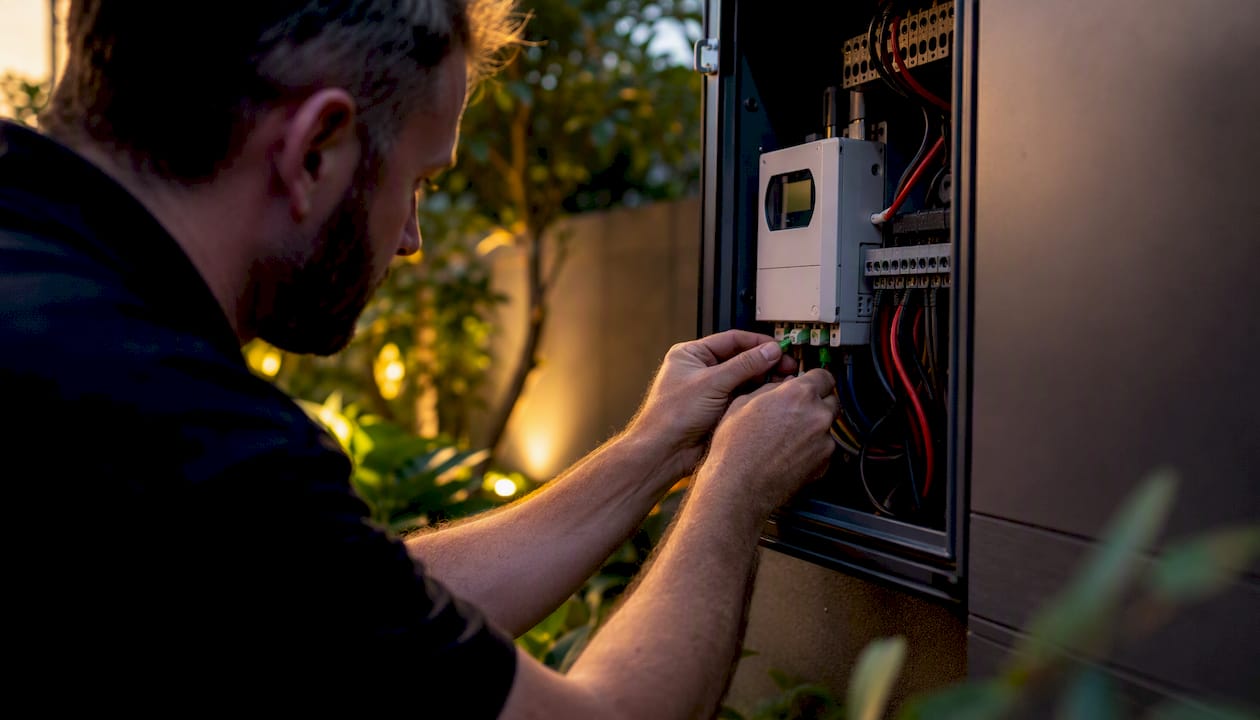
A certified Level 2 ASP electrician manages the network connection work, metering changes, and compliance documentation that a standard electrician cannot touch. When certificates and discounts are involved, that documentation trail matters. An ACP can only register a certificate for work that was completed correctly and to code. If the electrical installation has defects, the certificate process stalls and so does your discount. Getting the right accredited professional from the start avoids that outcome entirely.
There are also jobs where the electrical side of an ESS upgrade reveals a separate problem. A switchboard that isn’t rated for a new heat pump or EV charger load is a common discovery on older Sydney homes built before the 1990s. Catching this at the quote stage — rather than after the equipment is already on-site — is part of what a thorough Level 2 site inspection is for.
High Demand Electrical: ESS-ready electrical services for Sydney homes and businesses
Sydney households and businesses chasing ESS discounts need more than a quote. They need an electrician who understands the certificate process, manages the compliance paperwork, and completes the electrical work to the standard an ACP requires.
High Demand Electrical is a certified Level 2 ASP electrical contractor serving residential, strata, and commercial clients across Sydney, holding licence 397193C with over 300 five-star Google reviews and 24/7 availability. Services directly relevant to ESS projects include:
- Switchboard and power supply upgrades — required when a new heat pump, EV charger, or ducted air conditioner exceeds the capacity of your existing board
- Off-peak meter installation and reconfiguration — essential for heat pump hot water systems to access controlled-load tariffs that make the economics work
- Smart meter upgrades — needed for time-of-use tariffs and VPP battery connections that attract PDRS certificates
- EV charger installation — dedicated circuit and supply work for home and commercial charging infrastructure
- Solar and battery connections — metering and network approval for systems connecting to the Ausgrid or Endeavour Energy grid
- Commercial electrical fitouts — for small businesses upgrading lighting, refrigeration, or motors under ESS commercial activity definitions
Every Level 2 job starts with a free site inspection, so you get a clear picture of what your project actually needs — including any switchboard or metering work the ESS upgrade will trigger — before you commit to anything. That written scope is also what an ACP needs to confirm the electrical side of the job will be done to code.
Contact High Demand Electrical to book a free Level 2 site inspection for your ESS project across Sydney.
Sources
Use these pages to verify eligibility, check products, and confirm certificate registration.
Powering Your Needs with Expertise
If you’re looking for a reliable, experienced, and prompt electrician, look no further than High Demand Electrical. We cater to all your electrical needs, from routine maintenance to emergency repairs and complete system installations. Our skilled team is committed to providing professional service that ensures your electrical systems run smoothly. Whether it's a small task or a large project, give us a call today. Let us meet all your electrical demands with the quality and reliability you deserve.