Free Site Inspection: Sydney Lighting Automation with Level 2 Installer
A professionally installed lighting automation system suits most Sydney homes and businesses, but it needs a licensed electrician to scope, wire and commission it correctly. Done well, you get remote control, scheduling and real energy savings. Done without proper compliance, you risk failed inspections and voided warranties. The sensible first step is a site inspection with a licensed Sydney installer who can quote on both the technology and the compliance work.
TL;DR:
- Lighting automation systems in Sydney require licensed electricians for proper wiring, commissioning, and compliance with NSW laws to prevent failed inspections and warranty voids.
- Common systems like DALI-2, C-Bus, Dynalite, and RAPIX suit different project scales, with hardware choices influenced by project size, complexity, and future upgrade paths.
- Proper installation and commissioning, including calibration and documentation, are critical for energy savings and certification, making licensed professionals and detailed scope essential.
- Project costs and timelines vary based on fixture count, zones, sensors, and integration, with a site inspection offering the most accurate scope and price estimate before commitment.
- Licensed electrician involvement and thorough commissioning procedures outweigh technology brand choices in ensuring system performance and compliance.
Table of Contents
- What lighting automation actually does for your property
- Which lighting control systems are common in Sydney projects?
- Compliance, licensing and safety rules you need to check in NSW
- How do you choose the right lighting automation installer in Sydney?
- What’s the typical installation process, timeline and cost in Sydney?
- Why Sydney credentials matter when you’re choosing an installer
- Our take: compliance and installer selection matter more than the gadget
- Ready to book a free site inspection for your lighting project?
- FAQ
- Sources
What lighting automation actually does for your property
Lighting automation turns a bank of switches into a system you can control from your phone, a wall keypad or voice commands. For homeowners, that means dimming the living room from the couch or setting porch lights to switch on at dusk. For business owners, it means lighting that matches occupancy and trading hours without someone flicking switches at 6:00 AM.
The practical gains come from a few core features working together:
- Remote and app control: adjust lighting from a phone, tablet, keypad or voice assistant from anywhere.
- Scheduling and scenes: set “morning”, “evening” or “closed” lighting scenes that trigger automatically.
- Occupancy and daylight sensors: lights dim or switch off when spaces are empty or naturally bright, cutting running costs.
- Integration with shades, HVAC and security: lighting responds to the same triggers as blinds, air conditioning and alarm systems for a more comfortable, efficient building.
Most Sydney households notice the convenience first and the lower power bills second.
Which lighting control systems are common in Sydney projects?
You’ll come across a handful of system types once you start getting quotes, and each suits a different scale of project. DALI-2 is the current standard for fixture-level control: every luminaire has its own address, so it can report status and be dimmed or scheduled individually. That granularity makes it easier to produce the commissioning evidence that certifiers want for NCC Section J compliance on commercial fit-outs.
C-Bus and Dynalite are integrated building and home control platforms that handle lighting alongside other circuits, popular in luxury homes and larger strata buildings. RAPIX is a DALI-based platform built for scalable commercial networks, with zone controllers and eHubs that integrate DALI lines, sensors and reporting across a whole site, according to the RAPIX design guide.
- Small residential retrofits usually suit wireless or hybrid DALI setups with minimal rewiring.
- Luxury new builds often use C-Bus or Dynalite for whole-home integration.
- Strata and commercial buildings tend towards DALI-2 or RAPIX for zone control and compliance reporting.
A Sydney warehouse project, the Light Horse Logistics Hub, combined wired DALI with wireless controllers and daylight harvesting sensors, a hybrid approach that kept cabling costs down while still meeting sustainability targets.
Pro Tip: Ask your installer which system gives you an upgrade path, since swapping platforms later usually means re-commissioning the whole site.
Compliance, licensing and safety rules you need to check in NSW
Lighting automation projects touch mains wiring, so they fall squarely under NSW electrical licensing law. All electrical wiring work, including installing automated lighting control systems, must be carried out by a licensed electrician or supervised certificate holder. Unlicensed DIY wiring is not permitted, and licences require formal qualifications plus at least 12 months of wiring experience under AS/NZS 3000:2018.
AS/NZS 3000 sets the wiring rules every installation must follow. AS/NZS 1680 sets minimum maintained illuminance levels for workplace lighting, a standard the National Construction Code references directly. Commercial fit-outs in Sydney generally need to demonstrate AS/NZS 1680 compliance, and where NCC Section J applies, certifiers increasingly expect as-built device schedules and commissioning evidence, including calibrated daylight sensors and addressed device lists, to support energy efficiency sign-off.
This is why commissioning matters as much as installation. A system that’s wired but never properly commissioned won’t deliver the energy savings it’s rated for, and the documentation gap can hold up occupation certificates on commercial jobs. Skipping licensed installation or proper commissioning is one of the more expensive mistakes we see, because defect rectification and re-commissioning cost more than doing it right the first time.

How do you choose the right lighting automation installer in Sydney?
Quotes for the same project can vary widely, so it pays to compare on substance rather than price alone.
- Confirm the licence and accreditation. You need a current NSW electrical licence, and for network, metering or consumer mains work, a Level 2 Authorised Service Provider (ASP) qualification.
- Ask what commissioning includes. Get specifics on sensor calibration, scene programming and testing, not just “we’ll set it up”.
- Request as-built documentation. You want a device schedule and wiring diagrams handed over at the end, not promised later.
- Check insurance and warranty terms. Confirm what’s covered on hardware versus labour, and for how long.
- Read the quote breakdown. Hardware, programming, commissioning and switchboard or Level 2 work should each be itemised, not bundled into one lump figure.
Red flags include vague scopes, no mention of commissioning, and anyone willing to skip licensing paperwork to save time.
What’s the typical installation process, timeline and cost in Sydney?
Most projects follow the same sequence: site inspection, design and specification, procurement, installation, commissioning, then documentation handover. The inspection stage is where an installer confirms your switchboard capacity, existing wiring and whether any Level 2 work is needed before automation gear goes in.
Timelines vary by scale. A small residential retrofit, say a few rooms with wireless keypads and sensors, typically runs from a few days to a couple of weeks. A luxury new build with full C-Bus or Dynalite integration usually spans several weeks to a few months, often running alongside the broader electrical fit-out. Commercial projects are project-dependent, shaped by the number of zones, fixture count and whether Section J documentation is required.
- Fixture and DALI address count drives hardware and programming costs directly.
- Programming and commissioning time scales with the number of scenes, sensors and zones.
- Switchboard or Level 2 work adds cost when consumer mains or metering upgrades are needed.
- Integration with shades, HVAC or security adds coordination time but improves the overall result.
Pro Tip: Get your switchboard assessed during the site inspection, since an undersized or ageing board is the most common reason a lighting automation quote blows out.
Why Sydney credentials matter when you’re choosing an installer
We operate as a certified Level 2 electrical contractor across Sydney, with accredited Level 2 Authorised Service Provider status and 24/7 response for urgent faults. We offer free site inspections for Level 2 work, which gives you a genuine scope and cost picture before committing to a lighting automation project. We’ve built up more than 300 five-star reviews across residential and commercial jobs in Sydney.
That Level 2 capability matters for lighting automation specifically because many projects touch metering or consumer mains, work that an ordinary electrical licence can’t legally cover. Having that accreditation in-house means fewer handoffs between trades, faster fault response if something trips during commissioning, and documented, as-built evidence you can hand to a certifier or hold onto for warranty purposes.
Our take: compliance and installer selection matter more than the gadget
The lighting automation conversation online tends to fixate on which app or hub looks slickest, when the decision that actually affects your outcome is who commissions the system and whether they document it properly. A DALI-2 setup commissioned badly delivers worse results than a simpler C-Bus system commissioned well.
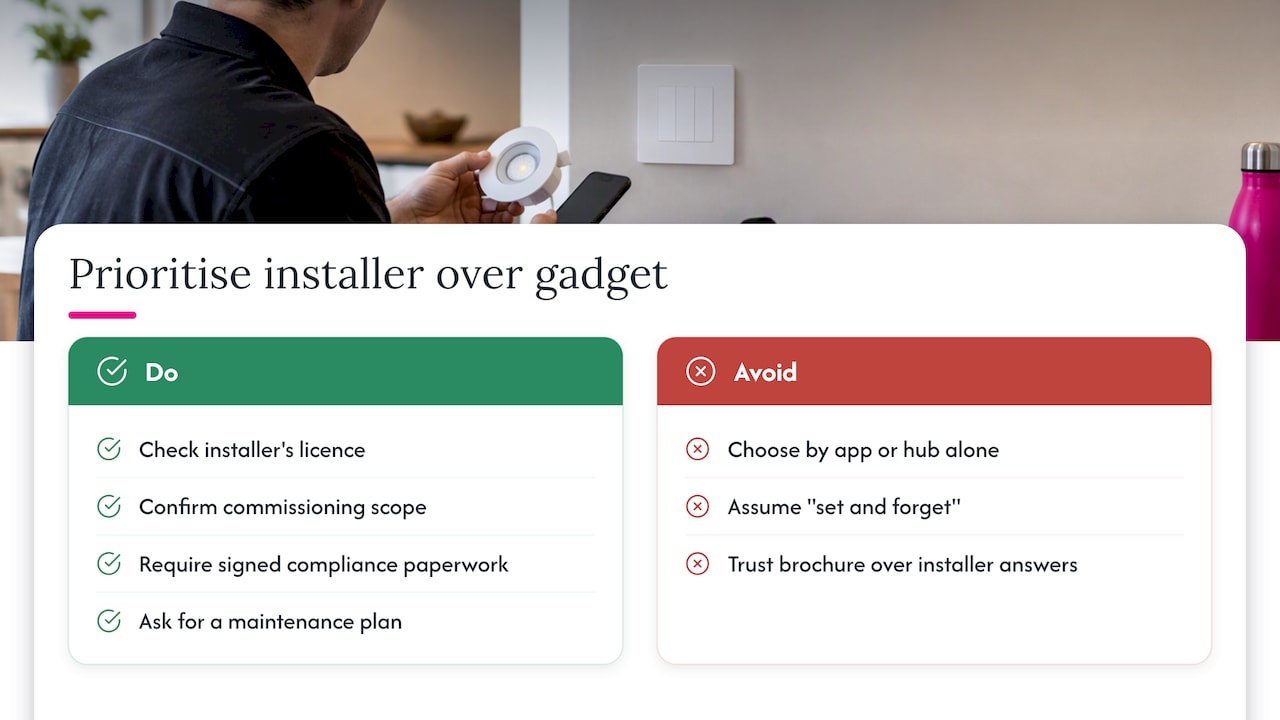
The “set and forget” pitch is the part of the conventional advice that falls short. Sensors drift, schedules need retuning as seasons or trading hours change, and energy savings claims only hold up if someone revisits the calibration. A system with no maintenance plan is a system that quietly stops earning its keep within a year or two.
If you’re prioritising one thing before you call anyone, prioritise the licence and the commissioning scope, not the brand of controller. Ask who signs the compliance paperwork and what happens if the sensors need recalibrating in twelve months. That answer tells you more about the installer than any product brochure will.
— Christopher
Ready to book a free site inspection for your lighting project?
Whatever stage you’re at, from a single-room retrofit to a full commercial fit-out, we can scope it properly before you commit to anything. Our lighting design and installation service covers the full process: design, procurement, installation and commissioning, with as-built documentation handed over at the end.
If your project involves metering, consumer mains or a switchboard that’s due for an upgrade, our Level 2 electrician team handles that work directly, and our switchboard upgrades service covers the groundwork many automation projects need first. We’re a certified Level 2 contractor with 24/7 availability and over 300 five-star reviews across Sydney.
The free site inspection for Level 2 work is the easiest way to get a real scope and cost before you decide anything. Book your inspection and we’ll walk your property with you.
FAQ
Do I need a licensed electrician for lighting automation in NSW?
Yes. All electrical wiring work in New South Wales, including installing automated lighting control systems, must be carried out by a licensed electrician or supervised certificate holder. DIY wiring work is not legally permitted, regardless of how simple the system looks.
Are smart bulbs enough, or do I need a wired system?
Plug-in smart bulbs can handle basic scheduling in a single room, but they don’t give you whole-property scenes, occupancy-based savings or the commissioning documentation commercial and strata buildings often need. For anything beyond a room or two, a wired or hybrid system installed by a licensed electrician delivers more reliable results.
How long does commissioning take?
Commissioning time depends on the number of zones, sensors and scenes being programmed, so it varies project to project. A small residential job might be commissioned in a single visit, while a commercial fit-out with daylight harvesting and multiple zones takes longer to calibrate and document properly.
What does a lighting automation project typically cost?
Costs depend on fixture and DALI address count, programming and commissioning time, and whether switchboard or Level 2 work is needed, so there’s no single figure that fits every property. We offer free site inspections for Level 2 work, which is the most reliable way to get an accurate quote for your specific project.
Does High Demand Electrical offer free site inspections for lighting automation projects?
Yes, we provide free site inspections for Level 2 work, which covers much of the scoping needed before a lighting automation project begins. You can book an inspection to get a clear picture of compliance requirements and costs before committing.
Sources
- Electrical work | NSW Government
- AS 1680 lux levels for Australian workplaces
- DALI‑2 & commercial lighting compliance (DUKE Lighting)
- RAPIX design guide (Automated)
- DALI case study: Light Horse Logistics Hub, Sydney (Lumen Resources)
Recommended
Powering Your Needs with Expertise
If you’re looking for a reliable, experienced, and prompt electrician, look no further than High Demand Electrical. We cater to all your electrical needs, from routine maintenance to emergency repairs and complete system installations. Our skilled team is committed to providing professional service that ensures your electrical systems run smoothly. Whether it's a small task or a large project, give us a call today. Let us meet all your electrical demands with the quality and reliability you deserve.