How to plan a strata switchboard upgrade in Sydney for safe access
A strata switchboard upgrade in Sydney is more than a board replacement: it needs to account for the building’s electrical condition, protection requirements and safe access for everyone affected. Ageing equipment, limited capacity or plans to add electrical loads can all prompt a closer assessment. In a shared building, the work also needs careful coordination across apartments and any commercial spaces.
It makes sense to want a strata switchboard upgrade in Sydney completed safely, with disruption planned rather than left to chance. This guide explains signs that an upgrade may be needed, how RCD or RCBO protection fits into the planning, and what to consider when arranging access and work across a strata property.
You’ll learn how to plan the project around the main switchboard, individual circuits and building users, including the information an electrical professional needs to scope the work. The aim is a practical path from identifying the need to organising a safe, coordinated upgrade.
Key Takeaways
• Ageing equipment, limited capacity and plans for new electrical loads can signal that a strata switchboard needs assessment.
• Plan access to electrical rooms and individual lots early so the work can be coordinated with residents and commercial occupants.
• Consider how RCD or RCBO protection will be addressed across the circuits as part of the upgrade scope.
• For non-emergency work valued at $30,000 or more, NSW legislation requires owners corporations to obtain at least two independent quotes.
• Building-wide upgrades need a clear scope that accounts for the main switchboard, supply capacity and the needs of shared areas.
Why Do You Need Switchboard Upgrades in Sydney?
Start with a documented assessment of the switchboard, incoming supply and building distribution. In Sydney strata properties, ageing equipment, limited capacity or planned electrical loads can make it worth reviewing upgrade options.
Assess the property and compare upgrade options
Arrange an electrical assessment covering the main board, consumer mains and the loads each area requires. A residential property may need a replacement board, while a high-rise or commercial site may need its shared distribution reviewed alongside apartment circuits. If solar is planned, discuss a solar-ready design; for larger loads, assess whether three-phase supply suits the building. Avoid selecting equipment before the existing capacity and intended loads are understood.
Compare quotes by scope.
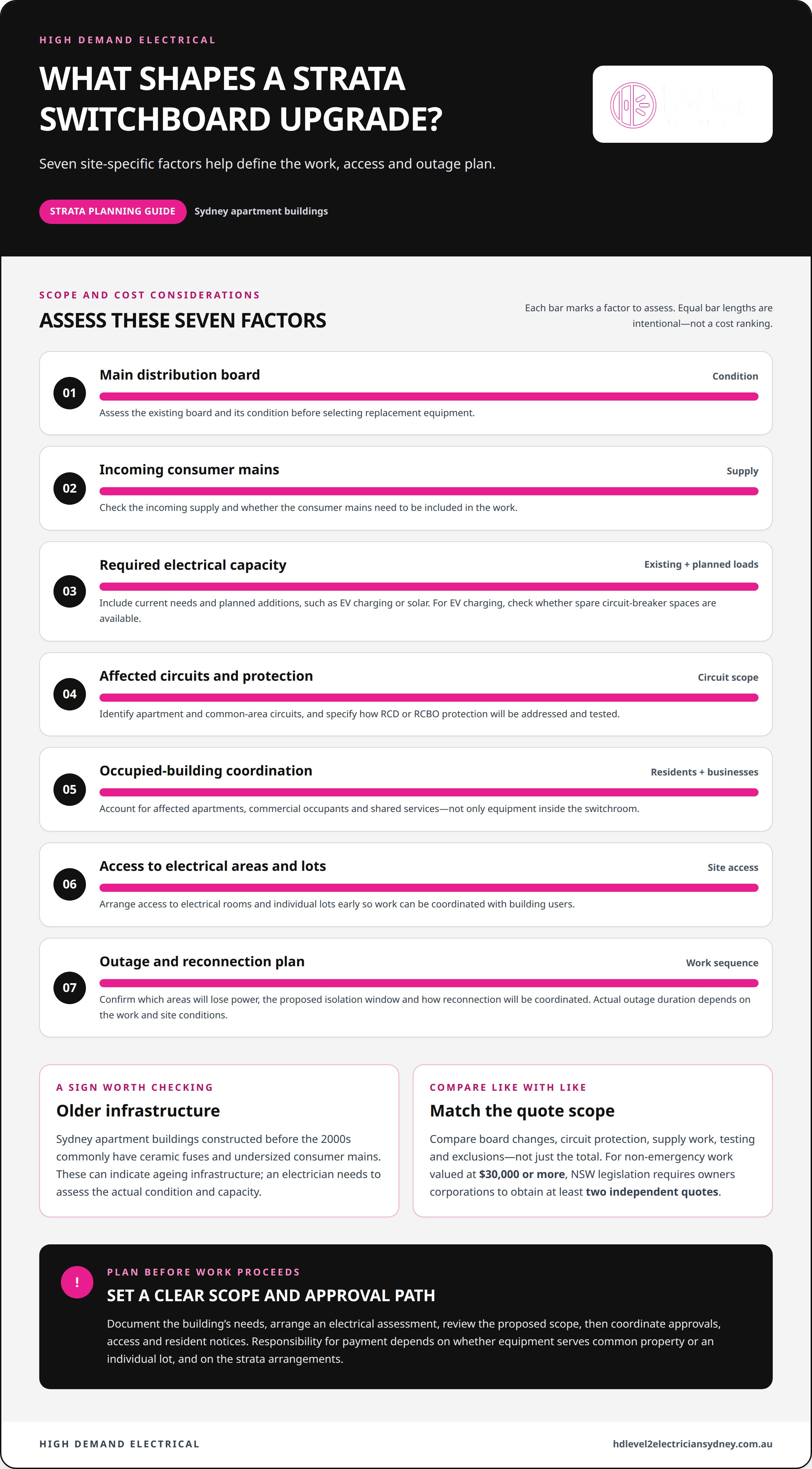
Ask for the same work to be described in each quote, including board changes, circuit protection, supply work, testing and exclusions. Compare what each scope covers, not just the total. In NSW, owners corporations must obtain at least two independent quotes for non-emergency work valued at $30,000 or more, according to NSW legislation.
Set responsibility and approvals.
Responsibility for payment depends on whether the affected equipment serves common property or an individual lot, and on the strata arrangements. The owners corporation should consider the work’s scope, funding and approval pathway; committee involvement and a formal owners corporation decision may be needed. Confirm the applicable process before authorising non-emergency work.
Plan resident communication.
Ask for the proposed isolation window and affected areas once the electrical scope is clear. Send residents and commercial occupants a notice explaining the planned interruption, access arrangements and any preparation needed, such as keeping essential equipment accessible. The actual outage duration depends on the work and site conditions, so avoid promising a fixed time before the scope is assessed.
Select modern switchboard protection
Include protection requirements in the upgrade scope, rather than treating the enclosure as the whole project. Modern switchboards can include residual current devices (RCDs) and circuit breakers. Ask how the proposed setup addresses the circuits being upgraded and how protection will be tested. For example, a shared building with apartment and common-area circuits needs a clear distribution plan that identifies which circuits will receive new protection.
Check NSW electrical safety requirements
Have the proposed switchboard alterations assessed against applicable NSW electrical safety rules and relevant Australian Standards, including AS/NZS 3000 where applicable. Where the work involves supply connection, disconnection or service equipment, particular work may require an appropriately accredited Level 2 electrician. Clarify these requirements in the project scope before work proceeds. For a change from single-phase to three-phase supply, include the three-phase upgrade requirements in the assessment.
Main switchboard upgrades for apartment buildings
Plan a building-wide upgrade around the main distribution board, incoming supply and services residents rely on. In Sydney apartment buildings, the replacement scope and outage plan need to reflect the site’s electrical condition.
•
Identify signs an upgrade may be needed
Arrange an assessment of the main board and incoming consumer mains, especially in older apartment buildings. Sydney buildings constructed before the 2000s commonly have ceramic fuses and undersized consumer mains. These features can indicate ageing infrastructure, but the electrician must assess the actual condition and capacity before recommending replacement. Include planned loads, such as a larger EV charging installation, in that assessment.
For EV charging, ask whether the main board has spare circuit-breaker spaces. If it doesn’t, the proposed charging load may require a main switchboard upgrade. This gives the owners corporation a clear reason to assess the building-wide supply before approving a project that relies on additional electrical capacity.
•
Consider factors that affect upgrade costs
Ask for a scope that explains the work behind the quote. Key factors include the condition of the main distribution board, incoming consumer mains, required capacity, affected circuits and the complexity of coordinating work in an occupied building. Access to electrical areas and the outage plan can also shape the work. Compare quotes against the same scope, including what each covers and excludes.
The steps for arranging an upgrade are straightforward: document the building’s needs, arrange an electrical assessment, review the proposed scope, then coordinate approvals, access and resident notices. Include planned changes, such as EV charging, so the assessment considers future loads alongside existing services. Clear project information helps the electrician define the work and explain the quote.
•
Plan a whole-building switchboard replacement
Ask the electrician to specify whether replacement includes both the main distribution board and incoming consumer mains. A whole-building project needs to account for affected apartments and shared services, not just equipment inside the switchroom. The proposed scope should identify which building areas will lose power and how reconnection will be coordinated after replacement.
A full switchboard replacement in an occupied Sydney apartment building is typically completed within a single working day. That timeframe makes careful preparation essential, but it doesn’t replace a site-specific outage plan. Identify affected lifts, common-area lighting and other essential building services before setting the interruption window.
• Coordinate the outage with the building’s strata manager and communicate the confirmed plan to residents and commercial occupants. Notices should state the affected areas, expected interruption window and any preparation residents need to make. Avoid setting expectations before the electrician has assessed the scope. For support planning a building-wide replacement, arrange an assessment for your strata building.
Access to electrical rooms and individual lots
Map access before work starts, from the building’s electrical room to any apartments that require entry. A clear access plan helps coordinate inspections, isolations and reconnection.
Identify every work area.
Ask the electrician to list the electrical rooms, distribution boards and individual lots involved. In a high-rise apartment building, the main switchroom may serve several floors, while separate equipment serves particular apartments. Confirm locations against building records and arrange a site walk-through if access routes aren’t obvious.
Arrange access to shared electrical rooms.
Nominate the strata manager, building manager or another authorised keyholder to meet the electrical team. Confirm how they’ll enter the building, reach the switchroom and keep the route clear. A locked plant room or obstructed corridor can delay inspections and disrupt the planned sequence of work.
List apartments needing entry.
Ask the electrician to identify which lots require access, and why. For example, work on an apartment distribution board may require entry there, while a main-board replacement may involve shared areas only. Use the confirmed scope to organise resident appointments, explain access arrangements and avoid unnecessary entry.
Coordinate access with occupants.
Have the strata manager explain the agreed appointment process to residents and commercial tenants. Include how entry will be arranged, which areas are affected and who will provide access. If an occupant won’t be present, resolve the arrangement through the building’s usual access procedures before the work date.
Separate electrical access from parking and deliveries.
Identify the loading areas, service lifts and corridors electricians need to reach the equipment. For example, replacing a board may require a clear route between a loading area and the switchroom. Coordinate deliveries and building activity around those routes, so equipment can be moved without blocking resident access.
Confirm the isolation sequence.
Ask the electrician to explain which areas will lose supply and when access is needed. Note any affected building services, apartment circuits or EV charging equipment. Share the sequence with residents and relevant site staff, then keep the work area accessible throughout isolation, inspection and reconnection.
Keep a single access contact available.
Give residents and the electrical team one named building contact for access changes on the workday. That person can direct the team to the right room, relay a tenant’s access issue and update building staff if the sequence changes. Record agreed arrangements with the work schedule.
RCD/RCBO protection
Make protection part of the switchboard scope, not an afterthought. The electrician should identify how RCD or RCBO protection will cover each circuit and how testing will be coordinated with residents.
Map the circuits before selecting protection.
Ask for the proposed arrangement to show which circuits serve apartments, common areas and equipment such as EV charging. This circuit map helps the electrician plan protection across the building and identify affected areas. The upgrade scope should include RCD or RCBO protection across every circuit.
Clarify the equipment in the proposal.
RCDs provide residual current protection, while circuit breakers address circuit overcurrent. An RCBO combines both functions in one device. Ask the electrician to identify the proposed device for each circuit, so the owners corporation can understand how apartment and shared-area circuits are covered.
Consider how a fault could affect occupants.
An RCD safety switch is designed to disconnect power when it detects a current leakage fault. This rapid response helps reduce the risk of serious electric shock and fire. In a strata building, ask how protection will be arranged for circuits serving shared lighting, individual apartments and electrical equipment.
Discuss circuit separation and disruption.
Protection arrangements affect how circuits are grouped and isolated during testing or later maintenance. Ask the electrician to explain which areas could lose power if a protective device operates. For example, separating apartment circuits from common-area lighting can make the effect of a fault and the scope of any interruption clearer.
Plan testing around building access.
The electrician needs to test the installed protection and confirm the affected circuits operate as intended. Coordinate access to electrical rooms and any apartments requiring entry. Give residents advance notice of testing that could interrupt supply, and align the work sequence with building staff.
Include test outcomes in the handover.
Ask for a clear record of the circuits covered and the protection installed. This gives the strata manager a useful reference for future electrical inspections, maintenance or changes to building loads. Keep the information with the building’s electrical records, rather than relying on labels alone.
Resolve gaps in the existing arrangement.
If the electrician identifies circuits without the planned protection, include the required work in the upgrade scope. Details of safety switch installation can clarify how that work fits into a broader switchboard project. Confirm the final scope before scheduling interruptions.
Commercial and strata switchboard upgrades
Plan commercial and strata upgrades around supply capacity, shared loads and the building’s operating needs. A clear scope connects the electrical work with how the site is actually used.
Map the building’s existing supply and demand.
Ask for the assessment to separate apartment loads from commercial tenancies and common areas. A retail tenancy, shared ventilation and corridor lighting can place different demands on a building’s distribution. Include current equipment and planned additions so the proposed capacity reflects actual use, not assumptions.
Record proposed EV charging alongside lifts, lighting and other common-area loads. These requirements can affect the supply capacity needed for a commercial or strata site. Give the electrician details of the building’s planned changes before the scope is prepared, so the assessment can consider the combined demand.
Define the upgrade’s boundaries.
Ask the project scope to identify which switchboards, circuits and supply equipment are included. For example, a common-area board may serve building services, while tenancy boards distribute power to separate commercial spaces. Clear boundaries help the owners corporation understand what affects shared infrastructure and what relates to individual areas.
Keep proposed capacity changes tied to identified loads. An upgrade planned for EV charging should account for the charging installation and common-area requirements together, rather than treating each as a separate addition. This gives the project team a practical basis for planning the building’s electrical distribution.
Include NSW compliance in the work scope.
Switchboard alterations in NSW must comply with applicable electrical safety rules and relevant Australian Standards, including AS/NZS 3000 where applicable. Ask the electrician to state how these requirements apply to the proposed work. This keeps compliance connected to the actual alteration, rather than relying on a general statement about standards.
For supply connection, disconnection or service equipment work, particular tasks may require an appropriately accredited Level 2 electrician in NSW. Identify these tasks during scoping, especially where the project changes incoming supply. That distinction helps the owners corporation plan the right work sequence and responsibilities.
Coordinate the project across commercial operations.
Identify which tenancies and shared services depend on the affected board. A café, office or shop may rely on electrical equipment during operating hours, while residents rely on common-area services. Use the project scope to establish affected areas and communicate the planned interruption before work begins.
Keep the scope, load requirements and access arrangements together for the strata manager and commercial occupants. If supply capacity needs to increase for EV charging or shared loads, make that requirement explicit in the proposed work. This helps prevent the final design from overlooking an important building use.
Move from assessment to a defined scope.
Bring the building’s load information, planned changes and affected areas into one project brief. Ask the electrical professional to assess the switchboard and supply against those requirements, then explain the proposed work and compliance considerations. For a commercial or strata project, request a switchboard upgrade assessment to establish the next planning step.
High Demand Electrical: Switchboard Upgrades
High Demand Electrical helps strata managers and owners corporations plan switchboard upgrades for apartment and commercial buildings across Sydney. Turn to the team when an ageing board, limited capacity or planned EV charging prompts a building assessment. The work can be scoped around the main switchboard, affected circuits and the building’s access and outage requirements.
Where a project involves supply connection, disconnection or service equipment, Level 2 ASP Electrical Services may also be relevant. High Demand Electrical also provides Tesla and home EV charger installation, helping connect charging plans with the building’s electrical capacity assessment.
Contact High Demand Electrical to discuss a switchboard upgrade for your strata property.
Set up the next stage of your building’s electrical planning
Before approving a strata switchboard upgrade in Sydney, give the owners corporation a clear project brief: the building’s priorities, planned electrical changes and decisions still to be made. Keep the approved scope and supporting records together, so future committees can understand what the project addressed and plan later changes with that context.
High Demand Electrical offers Switchboard Upgrades and Level 2 ASP Electrical Services for projects involving switchboard or supply infrastructure. Where a private power pole also forms part of the property’s electrical infrastructure needs, its Private Power Pole Installation service may be relevant to the broader planning discussion.
A well-defined next step is to bring the building’s scope and priorities together for professional review. Contact High Demand Electrical to discuss your strata switchboard project, and move forward with a clear plan for your property.
Frequently Asked Questions
Does every apartment need to lose power?
No. The outage depends on which switchboard and circuits the work affects. A project focused on shared equipment may interrupt common-area services, while work involving apartment distribution boards can affect individual lots. Ask for the planned isolation areas to be mapped before work begins. For example, residents in unaffected sections may retain supply, but the electrician’s scope and switching sequence determine the actual impact.
How much notice should residents receive?
Give residents notice as soon as the work scope and likely outage arrangements are clear. Include the work date, affected areas, expected interruption window, access requirements and a strata contact for queries. If the plan changes, communicate the update promptly through the building’s usual notice channels. Give occupants enough time to plan around affected services, such as work equipment or electrically powered building facilities.
What Happens on the Day of the Upgrade?
The electrical team follows the agreed scope and isolation sequence, completes the switchboard work, then tests affected circuits before restoring supply. The building contact can coordinate room access and relay updates to residents or commercial tenants. Keep the switchroom route clear and provide agreed apartment access. After testing, the strata manager should retain the project handover information with the building’s electrical records.
What does a strata switchboard upgrade involve in Sydney?
A strata switchboard upgrade in Sydney may involve replacing a main distribution board, addressing incoming consumer mains and updating circuit protection. The scope depends on the existing equipment, building supply and planned electrical loads. For example, a project supporting new EV charging may need an assessment of the main board’s capacity and available circuit spaces. Clearly define work affecting shared and individual areas for the owners corporation.
Does a strata switchboard upgrade require an ASP electrician or a licensed electrical contractor?
The required expertise depends on the work. In NSW, particular supply connection, disconnection or service equipment work may require an appropriately accredited Level 2 electrician. A switchboard project involving those tasks needs its network-related work identified in the scope. The electrician’s role should match the work being undertaken, especially where the project changes incoming supply rather than only replacing equipment within the building.
How long does a strata switchboard upgrade take, and will power be interrupted?
A full switchboard replacement in an occupied Sydney apartment building is typically completed within a single working day. Power interruptions are expected where circuits must be isolated, but the affected areas depend on the switchboard and isolation plan. The project schedule should distinguish the work period from each supply interruption. Ask the electrical team to explain which services may be unavailable and when supply is expected to return.
What are the signs a strata building switchboard needs upgrading?
Ageing equipment, ceramic fuses, undersized consumer mains or a lack of spare circuit-breaker spaces can prompt an assessment. Sydney apartment buildings built before the 2000s commonly have ceramic fuses and undersized consumer mains. A proposed EV charging installation can also expose capacity constraints if the main board has no spare breaker spaces. An electrician’s assessment establishes whether replacement or another scope of work is appropriate.
What are the risks of delaying a switchboard upgrade in an older Sydney strata building?
Delaying an assessment can leave ageing equipment or limited supply capacity unaddressed as building needs change. For example, a board without spare circuit-breaker spaces may constrain plans for a larger EV charging installation. Older equipment may also lack the protection included in a modern switchboard. An electrical assessment helps the owners corporation understand the building’s condition and prioritise work before committing to new electrical loads.
Need Help Fast?
Powering Your Needs with Expertise
If you’re looking for a reliable, experienced, and prompt electrician, look no further than High Demand Electrical. We cater to all your electrical needs, from routine maintenance to emergency repairs and complete system installations. Our skilled team is committed to providing professional service that ensures your electrical systems run smoothly. Whether it's a small task or a large project, give us a call today. Let us meet all your electrical demands with the quality and reliability you deserve.

Licensed Level 2 ASP electricians across Sydney. Same-day service and 24/7 emergency response.
Licence 397193C
ABN 87 051 836 527