How to choose an electrician safely in NSW
Hire a licensed, insured electrician who is authorised for your specific class of work, then verify their licence on the Verify NSW public register before you book. In NSW, an electrical licence is mandatory for all wiring work, and NSW Fair Trading enforces penalties for non-compliant installations. High Demand Electrical publishes this guide to help you get that verification right the first time.
Before you call anyone, run through this checklist:
- Licence number and legal trading name — ask for both upfront; no legitimate electrician hesitates.
- State register verification — search Verify NSW or Service NSW to confirm the licence is active and covers the right category of work.
- Public liability insurance — request the certificate with its expiry date before work starts.
- Written, itemised quote — scope, materials, labour, permit fees, and warranty terms in writing.
- Certificate of Compliance for Electrical Work (CCEW) — confirm the contractor will lodge and hand over this certificate on completion; it is your legal proof the installation meets Australian standards.
- ABN or ACN — cross-check it against the quote and the register entry.
Key takeaways
Verify the licence category and insurance before you book, confirm the CCEW in writing, and match the contractor's accreditation to the specific class of work — those three steps eliminate the majority of risk when choosing an electrician.
| Point | Details |
|---|---|
| Verify the licence first | Search Verify NSW or Service NSW with the licence number and confirm the category covers your job. |
| Confirm insurance in writing | Request the public liability certificate with its expiry date before work starts, not after. |
| Get itemised written quotes | Compare at least two quotes on scope, materials, permit fees, and warranty terms, not price alone. |
| Require a CCEW on completion | Do not pay the final invoice until the Certificate of Compliance for Electrical Work is handed over. |
| Know when to call Level 2 | Metering, pole, and supply-head work requires a Level 2 contractor; High Demand Electrical holds that accreditation in Sydney. |
Table of Contents
- What should you check before booking an electrician?
- Which type of electrician do you actually need?
- How does electrical licensing work in Australia, and how do you verify it?
- Why do insurance and compliance certificates protect you?
- How do you get quotes that actually compare like for like?
- What questions should you ask, and what are the red flags?
- What does the typical process look like, and how long will it take?
- When should you call an emergency electrician or a Level 2 contractor?
- What most homeowners get wrong when choosing an electrician
- Sydney homeowners: certified Level 2 electrical services from High Demand Electrical
- Authoritative registers and government pages for licence checks
- Sources
What should you check before booking an electrician?
Five minutes of verification before you book can save you months of headaches. Here is what to do on first contact.
- Ask for the electrician's licence number, legal trading name, and ABN/ACN. Write them down.
- Run the licence number through Verify NSW or use the Service NSW tradesperson check tool, which walks you through the search step by step.
- Confirm the licence category matches your job — a general electrical licence does not cover Level 2 network work.
- Ask whether the job requires a CCEW or council permits, and whether those costs are included in the quote.
- Request proof of public liability insurance — not a verbal assurance, the actual certificate.
- Get at least two written quotes before committing.
Pro Tip: Prefer contractors who offer to send their insurance certificate and licence details by email before you sign anything. Those who do it without being asked are usually the ones who also lodge the CCEW without being reminded.
Which type of electrician do you actually need?
Matching the right trade category to your job is one of the most overlooked steps in finding a good electrician. Hire the wrong category and the work may not be legally compliant, regardless of how skilled the individual is.
General residential electrician handles the work most homeowners picture: new powerpoints, lighting circuits, ceiling fans, safety switches, and fault-finding inside the home. This is the right call for the majority of day-to-day jobs.
Level 2 electrician holds additional accreditation to work on the network side of the meter. That includes metering changes, service head connections, private power pole installation or replacement, new supply connections from the street, and supply isolation. Level 2 accreditation is a separate credential from a general electrical licence, and not every licensed electrician holds it.
Specialists cover specific technology categories. Solar array installers must hold Clean Energy Council (CEC) accreditation. EV charger installers need to demonstrate competency with the specific equipment and, in many cases, hold additional manufacturer or standards-body endorsements.
A quick guide to which category fits common jobs:
- Replacing a powerpoint or adding a circuit → general residential electrician
- Switchboard upgrade with a new meter → Level 2 electrician
- Installing a home EV charger → accredited EV installer (often also Level 2 for supply work)
- Adding rooftop solar → CEC-accredited solar installer
- Storm damage to the service head or private pole → Level 2 emergency contractor
Pro Tip: Ask the quoting contractor directly: "Will you issue a CCEW for this job, and will you organise any required permits?" If they hesitate or say permits aren't needed for a job that clearly involves network connections, that is a strong signal they are not the right category for the work.
How does electrical licensing work in Australia, and how do you verify it?
In NSW, electrical wiring work requires a current electrical licence regardless of the job's cost or scale. The licence must cover the correct category for the work being performed. Other states maintain equivalent registers, and the same verification logic applies wherever you are.
Step-by-step verification for NSW:
- Ask the electrician for their licence number and legal trading name.
- Go to Verify NSW or use the Service NSW check tool and enter the name, licence number, or ABN/ACN.
- Confirm the licence status is active (not suspended or cancelled).
- Check the licence category — it must cover the class of work you need.
- Note the licence start and end dates.
- Screenshot or print the result and keep it with your quote documents.
A note on interstate contractors: Australia's mutual recognition framework allows licensed tradespeople from other states to work in NSW, but you should still verify their registration is current and that their home-state licence category covers your job. Never rely on a photo of a licence card or a business card as proof. Photos can be faked; the public register cannot.
What to record:
- Licence number and category
- Register screenshot with the date of your search
- ABN/ACN matched to the quote
- Insurance certificate with expiry date
Why do insurance and compliance certificates protect you?
These documents are not bureaucratic formalities. They are the legal layer between you and significant financial risk.
Public liability insurance covers damage to your property or a third party's property that occurs during the job. If an electrician causes a fire or damages your switchboard and they carry no public liability cover, you may be left pursuing an individual with limited assets. For residential work, a minimum of $5 million in public liability cover is standard practice in NSW, though many reputable contractors carry $10 million or more.
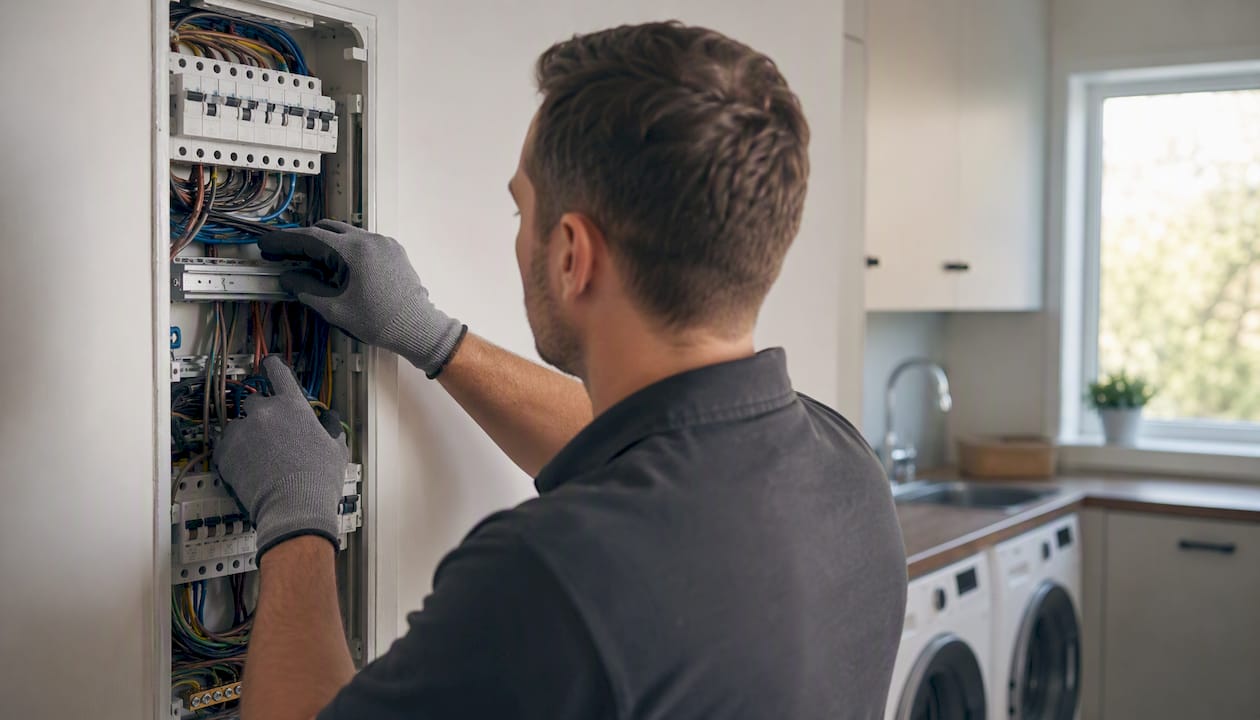
Workers' compensation confirms that anyone working on your property under that contractor's business is covered for workplace injuries. Without it, an injured worker could potentially pursue a claim against you as the property owner.
Certificate of Compliance for Electrical Work (CCEW) is the document that matters most on completion. NSW government guidance confirms that electricians must submit certificates proving compliance and that safety inspections have taken place. The CCEW is your legal assurance that the wiring work meets Australian standards. It also matters for your home insurance: if an electrical fault later causes damage and you cannot produce a CCEW for recent wiring work, your insurer may dispute the claim.
What to request:
- Insurance certificate (public liability and workers' comp) with expiry dates, before work starts.
- CCEW on completion, before you pay the final invoice.
- Itemised invoice matching the original written quote.
You can also review the electrical safety inspection checklist for NSW to understand what a compliant inspection covers before you engage a contractor.
How do you get quotes that actually compare like for like?
The cheapest quote is rarely the best one. An unusually low price often signals that the contractor plans to skip permits, use lower-grade materials, or avoid lodging the CCEW — all of which create long-term safety and insurance risk. NSW Fair Trading guidance recommends getting more than one written quote and not paying without a written contract.
To get quotes that are genuinely comparable, give every contractor the same written brief. Include the specific work, the location in the home, any known constraints (e.g. older wiring, concrete walls), and whether you need permits organised.
An itemised quote should specify:
- Labour hours and hourly rate (or a fixed-price total)
- Materials, including brands or grades where relevant
- Permit and inspection fees
- CCEW lodgement (confirm it is included, not optional)
- Warranty terms and duration
- Payment milestones — avoid contractors who demand more than a small deposit upfront
Compare quotes on scope and warranty, not price alone. A quote that excludes permit fees or CCEW lodgement is not cheaper; it is incomplete.
Pro Tip: For defined, scoped work, always ask for a fixed-price quote. Then ask: "If variations arise, are they charged at an hourly rate or a fixed variation price?" That one question tells you a lot about how the contractor manages cost blowouts.
What questions should you ask, and what are the red flags?
Asking the right questions on first contact takes two minutes and filters out most unreliable operators before they set foot in your home.
Questions to ask every electrician:
- What is your licence number and legal trading name?
- Do you hold current public liability insurance, and can you send me the certificate?
- Will you provide a written, itemised quote?
- Will you issue and lodge a CCEW on completion?
- Do you subcontract any of this work? If so, who carries the warranty?
- Can you provide references or photos of recent similar jobs?
Red flags to walk away from:
- Cash-only payment with no receipt or written contract
- Reluctance to provide a licence number or insurance certificate
- Vague warranty terms ("we'll sort it out if something goes wrong")
- Pressure to pay a large deposit before work begins
- Prices that seem too low for the stated scope of work
- Any suggestion that permits or CCEW lodgement are unnecessary for regulated wiring work
That last point deserves emphasis. An electrician who suggests skipping the CCEW or avoiding permit requirements is not saving you time or money. They are exposing you to safety risk, insurance voidance, and potential liability for non-compliant work. Walk away.
What does the typical process look like, and how long will it take?
Knowing what to expect at each stage helps you plan and avoids day-of surprises.
Typical stages:
- Inquiry and scoping — you describe the job; the contractor may do a site visit before quoting.
- Written quote — received within 1–3 business days for most residential jobs.
- Booking and deposit — minor jobs often require no deposit; larger jobs may require 10–20% upfront.
- On-site work and testing — the electrician completes the installation and tests circuits before leaving.
- CCEW issuance and final invoice — the CCEW is lodged and handed to you; final payment is due.
Rough timelines by job type:
- Minor jobs (powerpoint, lighting, safety switch): 1–4 hours
- Medium jobs (partial rewire, switchboard upgrade): 1–3 days
- Major or Level 2 jobs (new service connection, private pole, metering): several days to a few weeks, depending on network operator scheduling and parts availability
Permit or network operator approvals can add lead time to Level 2 work. Ask the contractor upfront whether they will manage those communications, and get a realistic timeline in writing. For electrical repairs that are urgent but not emergencies, a staged approach — a temporary make-safe followed by full rectification — is sometimes the most practical path.
On completion, you should receive:
- The CCEW
- An itemised invoice matching the original quote
- Written warranty terms
When should you call an emergency electrician or a Level 2 contractor?
Some situations cannot wait for a standard booking. Knowing when to escalate, and to whom, keeps your household safe.
Call an emergency electrician immediately if you notice:
- Exposed or sparking live conductors anywhere in the home
- A burning smell or smoke from an outlet, switchboard, or ceiling cavity
- Persistent power faults affecting safety-critical circuits (medical equipment, heating in winter)
- A sparking or humming switchboard
- Major storm damage to internal wiring or the service head
For power fault diagnosis and urgent make-safe work, a 24/7 emergency electrician is the right first call. Do not attempt to investigate live faults yourself. Electrical Safety QLD's guidance is unambiguous: homeowners should not attempt their own electrical work and must engage licensed tradespeople.
Call a Level 2 contractor specifically when the job involves:
- A new service connection from the street
- Supply isolation at the pole or service head
- Private power pole installation, replacement, or repair
- Metering changes or smart meter upgrades
- Defect notices from the network operator
Pro Tip: For storm or network incidents, turn off the main switch at the switchboard if it is safe to do so, then call a Level 2 emergency contractor. A Level 2 contractor can liaise directly with the network operator — a general electrician cannot, which means delays if you call the wrong trade first.
What most homeowners get wrong when choosing an electrician
The standard advice — get three quotes, check the licence, ask for a warranty — is correct but incomplete. Most homeowners follow those steps and still end up with problems, because they focus on the wrong variable.
The real risk is not hiring an unlicensed electrician. Most homeowners now know to check the register. The risk is hiring a licensed electrician who is not authorised for the specific category of work, or who is licensed but has let their insurance lapse, or who issues a CCEW but does not actually lodge it with the relevant authority. All three scenarios leave you legally exposed even though the contractor appeared compliant on the surface.
The second thing most guides understate is the CCEW's role in your home insurance. Insurers increasingly scrutinise electrical work when assessing fire-related claims. A missing or fraudulent CCEW for recent wiring work is grounds for a disputed claim. That document is not a receipt; it is a safety record tied to your property.
The third gap is around Level 2 work. Many homeowners do not know the category exists until a general electrician tells them mid-job that they cannot complete the work. Identifying whether your job touches the network side of the meter before you start quoting saves time, money, and the frustration of a half-finished job.
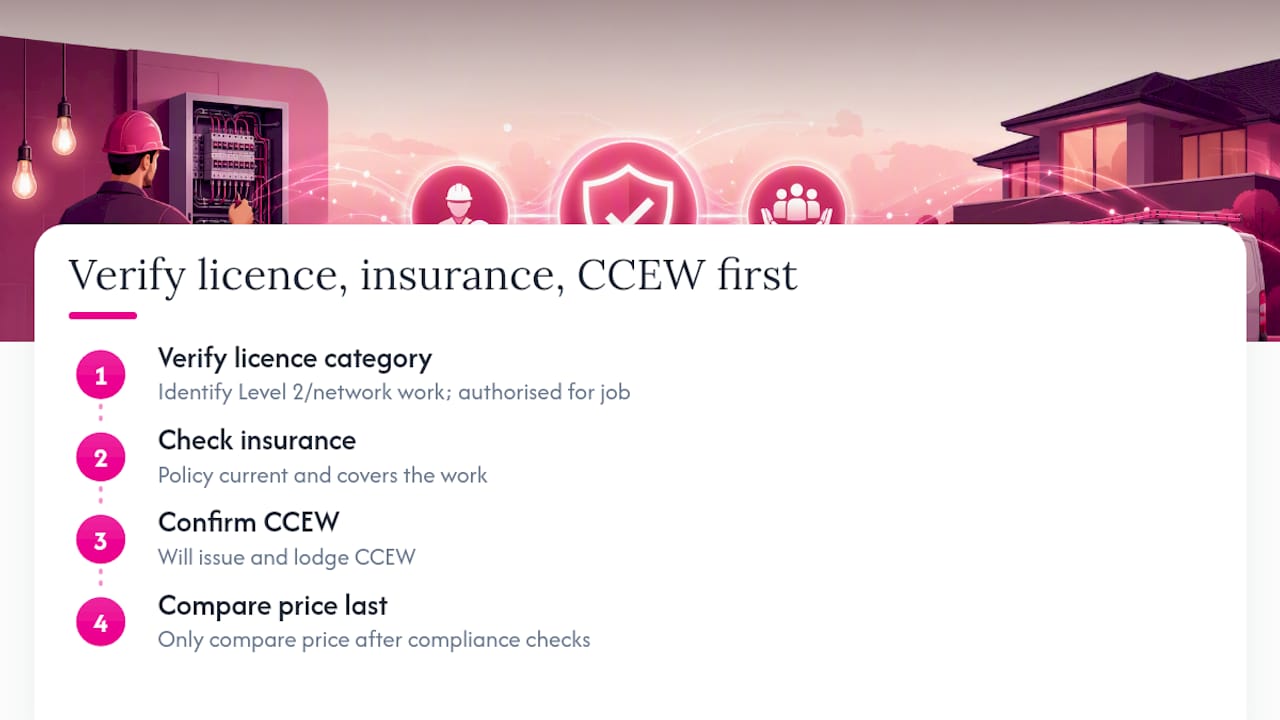
Verify the licence category first. Then the insurance. Then the CCEW commitment. Price comes last.
Sydney homeowners: certified Level 2 electrical services from High Demand Electrical
When the job goes beyond a standard residential scope, you need a contractor who holds the right accreditation, carries the right insurance, and handles the paperwork without being chased.
High Demand Electrical is a certified Level 2 electrician in Sydney, available 24/7 for emergency callouts, switchboard upgrades, new service connections, metering changes, and storm damage make-safe work. Every job comes with documented CCEW issuance, public liability cover, and licensed technicians who manage network operator communications directly. Free site inspections are available for Level 2 work, so you know exactly what is involved before any commitment. Over 300 five-star reviews reflect a consistent record of compliant, on-time work across Sydney.
Services homeowners commonly need from a Level 2 contractor:
- Switchboard upgrades and safety switch installation
- New service connections and metering changes
- Storm damage make-safe and defect rectification
- Emergency electrical callouts and power restoration
Request a free site inspection or book an emergency make-safe by contacting High Demand Electrical directly.
Authoritative registers and government pages for licence checks
For NSW homeowners, the two primary sources are:
- Verify NSW — search by name, licence number, or ABN/ACN; shows active, suspended, and cancelled licences and the licence category.
- Service NSW tradesperson check — step-by-step tool with guidance on what details you need to run a search.
These are the legal source of truth for NSW licence status. Always use them rather than relying on a contractor's own documents.
Other state registers:
- QLD: Electrical Safety QLD licence search — verify licence status and categories for electricians working in Queensland.
- VIC: Energy Safe Victoria public register — searchable register for licensed electricians in Victoria.
- WA: Commerce WA licence search — covers licensed electricians and gasfitters in Western Australia.
- SA: CBS SA public register — South Australia's searchable trade licence register.
- ACT: Access Canberra electricians register — construction and electrical licence verification for the ACT.
- TAS: CBOS Tasmania licensed occupations search — find licensed tradespeople including electricians in Tasmania.
Saving your search results: after running any register search, take a screenshot or print the results page. Record the date of the search, the licence number, and the category shown. This documentation makes any future warranty dispute or insurance claim significantly easier to resolve.
Sources
- Verify licence - the place to look up and verify NSW licence and registration information
- Check a builder or tradesperson licence | Service NSW
- Electricians - Compliance and regulation | NSW Government
- Electricalsafety
Recommended
Powering Your Needs with Expertise
If you’re looking for a reliable, experienced, and prompt electrician, look no further than High Demand Electrical. We cater to all your electrical needs, from routine maintenance to emergency repairs and complete system installations. Our skilled team is committed to providing professional service that ensures your electrical systems run smoothly. Whether it's a small task or a large project, give us a call today. Let us meet all your electrical demands with the quality and reliability you deserve.