Guide to getting buy-in for electrical upgrades
What if agreement comes more easily when an upgrade is explained in plain language rather than made to sound more urgent? Getting buy-in for a necessary electrical upgrade can be difficult when one decision-maker hears technical terms and another sees an optional expense. It’s reasonable to want clear evidence of the need, the work involved and any disruption before making a decision.
Some recommendations address a specific safety or capacity issue; others are planned improvements. Understanding the difference helps everyone weigh the options calmly. This guide shows you how to explain the recommendation, compare the options actually presented and discuss urgency and scope without pressure or jargon. You’ll also learn how to agree on a documented next step with a qualified electrical professional, so the decision is based on clear information and a shared understanding of what happens next.
Key Takeaways
• For getting buy-in for a necessary electrical upgrade, separate an assessed safety or capacity need from an optional improvement.
• Explain the recommendation by outlining the finding, its practical effect, the proposed action and any unanswered questions.
• Compare only the options raised in the assessment, noting what each addresses and what information is still needed to decide.
• Use a short meeting agenda to help decision-makers discuss the evidence, their concerns and a practical next step.
• For relevant network and connection work, understand when an Accredited Service Provider is involved. High Demand Electrical serves Sydney-wide, including the Inner West, Sydney’s West, South West and the Sutherland Shire.
Is an electrical upgrade a necessity or a preference?
Raising a technical recommendation can be awkward, especially if the work may disrupt a home or business or affect a shared budget. One person may focus on a reported fault, while another wants to know whether the proposed upgrade is essential or simply an opportunity to install newer equipment. Start by separating what was observed, what was assessed and what work is recommended.
A necessary upgrade is supported by an assessed condition, a demonstrated capacity need or a documented requirement that applies to the proposed work. A preference may still be worthwhile, but it should be described as an improvement rather than presented as essential. That distinction gives everyone a fair basis for deciding.
For a broad overview of hazards and preventative measures, the electrical safety principles can provide useful background. They don’t determine what work a particular installation needs.
To see an example of the questions to consider before a panel upgrade, watch this video:
A warning sign is a reason to investigate, not proof that a particular upgrade is required. For example, a circuit that trips or lights that flicker are observations to record and explain. On their own, they don’t establish the cause or the scope of work. A professional finding connects an observation to an assessed condition and explains why a specific action is recommended.
Evidence shows why work is needed; preference describes a choice for newer equipment or an improvement beyond that need. Keeping these categories separate is central to getting buy-in for a necessary electrical upgrade without relying on pressure.
What evidence makes an upgrade recommendation easier to assess?
Before starting the conversation, gather the written recommendation, inspection findings and any relevant notices. Note which equipment is affected, what condition was observed and what practical effect it may have. A switchboard is the panel that houses electrical circuits and protective devices. Consumer mains are the conductors that supply electricity to the installation. Use these terms only when they relate to the assessed work.
Mark each point as confirmed or unresolved. If a cause, scope or requirement still needs technical assessment, say so plainly. This helps decision-makers focus on what the evidence supports instead of treating an assumption as a diagnosis.
How can you discuss safety concerns without creating alarm?
Describe the observation and who identified it, then explain its known practical effect. Keep an immediate concern distinct from a planned improvement or a longer-term capacity need. Avoid words such as “dangerous” or “urgent” unless the assessment or a documented notice supports them. Don’t declare a legal obligation or deadline without verifying its basis.
Where the recommendation involves service line, metering or connection work, a Level 2 electrician in Sydney can assess the relevant network work. High Demand Electrical is a Level 2 Accredited Service Provider (ASP) - authorised to carry out service line, metering and connection work for Ausgrid, Endeavour Energy and Essential Energy.
How to explain an electrical upgrade recommendation in plain English
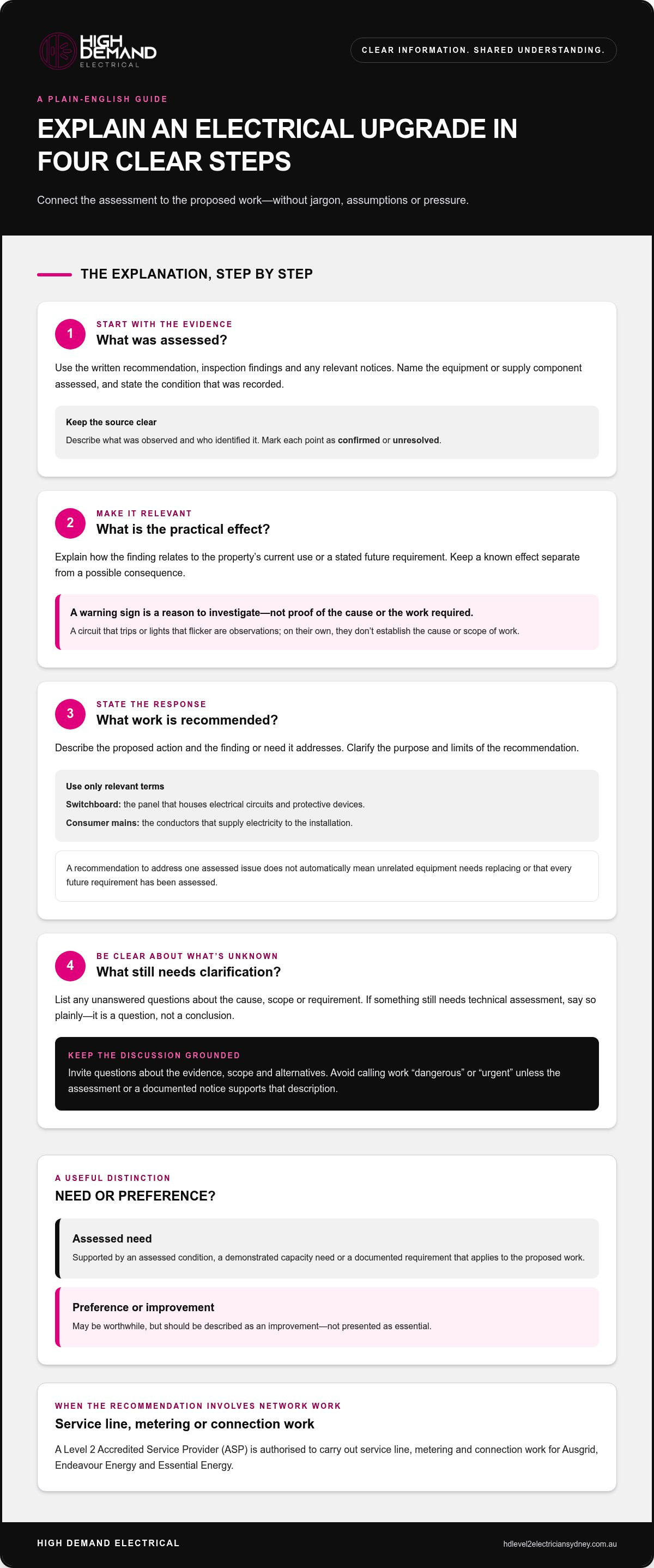
A useful explanation doesn’t start with a list of parts or technical terms. It connects the assessment to what the property needs, states the recommended action and identifies what remains unclear. This gives another decision-maker something concrete to consider without implying that every possible consequence will happen.
Use this sequence to organise the discussion:
Finding
What equipment or supply component was assessed, and what condition was recorded?
Practical effect
How does that finding affect the property’s current use or a stated future requirement?
Recommended action
What work has been proposed, and which finding or need does it address?
Unresolved questions
What still needs assessment or clarification before the decision is made?
Keep each step distinct. A finding describes evidence, the practical effect explains why it matters, and the recommendation sets out a response. Don’t present a possible consequence as certain unless the assessment supports that conclusion. This makes getting buy-in for a necessary electrical upgrade a constructive discussion rather than a debate over jargon.
What should an upgrade explanation include?
Name the component identified in the written assessment and explain its relevance to the property. For example, if an assessment identifies a supply-capacity issue, explain how it relates to the household’s existing use or a stated plan to add electrical demand. A power supply upgrade may be relevant when the recommendation specifically concerns supply capacity.
Clarify the recommendation’s purpose and limits. It may address the assessed issue, but that doesn’t automatically mean unrelated equipment needs replacing or that every future requirement has been assessed. If the scope or cause is unclear, record it as a question, not a conclusion.
How can you make technical findings understandable?
Use the written assessment as your source rather than relying on memory. Define only the terms that matter to the recommendation: a switchboard is the panel that contains circuits and protective devices; consumer mains are the conductors supplying electricity to the property. Leave out technical detail that doesn’t help explain the finding, its effect or the proposed work.
Invite questions about the evidence, scope and alternatives. A useful summary might be: “The assessment identified [finding] affecting [equipment or supply]. The stated effect is [practical impact], so the recommendation is [action]. It addresses [scope], while [question] still needs clarification.” Adapt the wording for a household or small business, and leave out any unsupported claim.
For context, OSHA electrical safety standards are US guidance, not Australian requirements. They shouldn’t be used to establish what rules apply to work in Sydney. Keep the explanation grounded in the local assessment and applicable Australian requirements.
Compare electrical upgrade options without overstating the case
Comparing scopes is useful only when each option comes from the assessment. Don’t invent a repair, staged approach or smaller alternative to make a recommendation sound more flexible. If the assessment sets out one scope, explain what it addresses and what questions remain. If it gives several options, compare them against the same evidence.
Keep timing language precise too. Separate an action identified as urgent in the assessment from planned work and optional improvements, but don’t assign deadlines unless they’re documented. The suitable scope depends on the property’s site conditions and the technical requirements for the work. A comparison should help decision-makers understand the choices, not suggest that a less extensive option is safe or suitable without evidence.
How do you compare a targeted upgrade with broader work?
Start with the finding each proposed scope is intended to address. A targeted scope may relate to a specific assessed component; broader work may address additional findings in the assessment. Neither description proves that one is sufficient or preferable. Record what falls outside each option and whether further technical assessment is needed to make a sound comparison.
Where consumer mains are part of the assessment, keep the discussion focused on the identified supply components and work boundary. A finding about one part doesn’t establish the condition of the whole electrical installation.
Use a like-for-like table. Populate it only with options presented in the assessment, and mark a cell “to clarify” if the supporting information isn’t available.
| Finding addressed | Scope | Unresolved risk | Information needed to decide |
|---|---|---|---|
| Record the finding linked to this option. | Note the work included and its boundary. | State what remains unassessed or uncertain. | List the evidence or explanation still required. |
| Record the finding linked to this option. | Note any additional work specified. | Identify what this scope doesn’t establish. | Record any outstanding technical questions. |
Which questions help decision-makers weigh the options?
Ask questions that test the evidence and clarify what each scope means, rather than pressing for a preferred answer:
• Which specific finding supports this option?
• What evidence informs the recommended scope?
• Which equipment or supply components are included, and what sits outside the work boundary?
• What disruption should we plan for, and what details have yet to be assessed?
Write down agreed priorities alongside unanswered questions. This gives everyone a record to return to without turning uncertainty into a claim that the work is either unnecessary or compulsory. If consumer mains are specifically in scope, the consumer mains installation information can help clarify the component being discussed.
Standards need the right context too. The US National Electrical Code (NEC) requirements are not Australian requirements, so they shouldn’t be used to decide what applies to a Sydney project. Base the comparison on the assessment and relevant Australian technical requirements. An evidence-led approach supports getting buy-in for a necessary electrical upgrade without exaggerating the case.
A practical plan for getting agreement on electrical work
A useful meeting gives each decision-maker the same information and space to raise practical concerns. Choose a time when people can focus, and have the written assessment, any options already presented and relevant notices available. Include anyone responsible for the property, budget or day-to-day operations.
Keep the discussion focused with a short agenda:
What was found
Summarise the documented assessment and the equipment or supply component involved.
Why it matters
Explain the practical effect identified without adding assumptions.
Available choices
Review only the scopes raised in the assessment and note what remains unclear.
Next action
Decide what information is needed, who will follow up and when to revisit open questions.
Agreement doesn’t have to mean resolving every detail in one conversation. The group can decide to proceed or identify the specific evidence or explanation needed before making a decision. This keeps getting buy-in for a necessary electrical upgrade grounded in shared information rather than pressure or recollection.
How can you respond to concerns about disruption or timing?
Acknowledge the concern first. Ask which practical issue matters most, such as access to the property, household routines or the effect on business operations. Then return to the documented need and the scope under discussion. Keep disruption separate from whether the work is needed, and don’t promise a schedule or outcome that hasn’t been established for the project.
If the assessment can’t answer a concern, record it as an open question and identify who can provide the relevant project information. This shows the concern has been heard without making unsupported assurances or treating an unanswered detail as a technical finding.
What belongs in a shared decision record?
After the meeting, write a brief record and share it with the decision-makers. Include the source of the assessment, the issue discussed, the selected scope or open decision, and the reason for that status. Note follow-up responsibilities and any information still needed, so everyone knows what they’ve agreed to do and what remains undecided.
Keep the assessment, relevant notices, written options and meeting notes together. This provides a reference if people revisit the discussion or new information changes the decision. Label assumptions as questions requiring follow-up rather than recording them as agreed facts.
Once the concerns and next steps are documented, you can discuss the electrical upgrade with High Demand Electrical.
Turn agreement into a safe, properly scoped Sydney electrical upgrade
Once everyone understands the recommendation and agrees on the next step, turn that decision into a clear work scope. The assessment should guide what is included, which components are affected and what questions still need resolving. A switchboard upgrade, consumer mains work or a power supply upgrade may address different findings, so do not treat these scopes as interchangeable.
Electrical work in NSW may involve requirements such as the NSW Service and Installation Rules (SIRNSW) or AS/NZS 3000, depending on the work. Assess their applicability against the particular project rather than assuming it from a general recommendation. A qualified electrical professional can explain how relevant requirements affect the scope and whether the work involves the electrical installation or the network connection.
When does an upgrade involve Level 2 ASP work?
Some assessed work involving a service line, metering or connection may require an Accredited Service Provider (ASP). The relevant network operator depends on the property’s location, so do not infer it from the suburb alone. Not every electrical upgrade requires an ASP; the assessment and work involved determine whether network-related services are relevant.
High Demand Electrical is a Level 2 Accredited Service Provider (ASP) - authorised to carry out service line, metering and connection work for Ausgrid, Endeavour Energy and Essential Energy. Where the recommendation involves this work, High Demand Electrical’s Level 2 electrician services in Sydney are a relevant next step.
What should you have ready for the next discussion?
Have the property location, written findings, relevant notices and agreed questions ready. Include the decision-makers’ notes on the selected scope, unresolved points and practical concerns such as access or disruption. This gives the discussion a clear starting point and keeps the proposed work connected to the assessed need.
High Demand Electrical serves Sydney-wide, including the Inner West, Sydney’s West, South West and the Sutherland Shire. Relevant services include switchboard upgrades and repairs, consumer mains installation and single-phase to three-phase power upgrades. HDE holds EC Licence 397193C and triple ISO certification: ISO 9001 (Quality Management), ISO 45001 (Health and Safety) and ISO 14001 (Environmental Management).
Use your agreed record to explain what has been found, what work is being considered and what still needs clarification. That keeps getting buy-in for a necessary electrical upgrade focused on a documented scope rather than a broad or assumed need. If the assessment points to service line, metering or connection work, include those details in the next conversation.
Discuss your electrical upgrade with High Demand Electrical. Phone 0402 559 777 or email chris@highdemandelectrical.com.au.
Make the next decision with confidence
Agreement doesn’t mean having every answer straight away. It means knowing what decision is ready to make, what information remains outstanding and who will follow up. Keep the written scope and open questions together so the next conversation can move the project forward without turning uncertainty into pressure.
A shared record gives an electrical professional a clear starting point: the property, the assessed concern and the decision-makers’ priorities. From there, the work can be discussed in terms of a defined scope and practical next steps. This helps getting buy-in for a necessary electrical upgrade lead to a considered decision rather than a rushed yes or an indefinite delay.
High Demand Electrical holds EC Licence 397193C and ABN 87 051 836 527, and is a Level 2 Accredited Service Provider (ASP) - authorised to carry out service line, metering and connection work for Ausgrid, Endeavour Energy and Essential Energy. Its triple ISO certification covers ISO 9001 (Quality Management), ISO 45001 (Health and Safety) and ISO 14001 (Environmental Management).
When you’re ready to clarify the next step, discuss your electrical upgrade with High Demand Electrical. Phone 0402 559 777 or email chris@highdemandelectrical.com.au.
Frequently Asked Questions
How do I explain to someone why an electrical upgrade is necessary?
Explain the specific finding and connect it to the property’s actual use or a documented plan. For example, if the recommendation relates to capacity for proposed electrical equipment, distinguish that future need from a fault or safety concern. Avoid presenting possibilities as certainties. If the assessment doesn’t explain why the selected work is needed, make that the next point to clarify together before agreeing to a scope.
What evidence should I gather before discussing an electrical upgrade?
Bring the written assessment, any relevant defect or network notice, and correspondence that describes the recommendation. Note when the issue was observed and which part of the installation the document identifies. If the work relates to a planned change, such as adding an EV charger, have that requirement clear too. These details help the electrical professional relate the recommendation to the property rather than general assumptions.
Can electrical upgrade options be compared before deciding on the scope?
Yes, if the assessment or professional discussion presents more than one option. Compare each against the same criteria: the finding it addresses, work included, what remains outside the scope and what information is still needed. Don’t create a smaller or staged option that hasn’t been assessed, or assume it’s suitable simply because it involves less work. Ask for clarification where the evidence doesn’t support a fair comparison.
What should I do if another decision-maker disagrees with the recommendation?
Pause the decision and identify the specific concern, such as the reason for the work, its scope or its impact on property use. Record the question and seek a plain-language explanation tied to the assessment. If the disagreement centres on evidence or technical uncertainty, have that point addressed before treating it as settled. A shared written record can help everyone review the same information and agree on a clear follow-up.
Do flickering lights or tripped breakers always mean an electrical upgrade is needed?
No. These symptoms can warrant investigation, but they don’t establish the cause or prove that an upgrade is required. Record when the flickering or tripping occurs, which area or circuit is affected and whether the pattern changes. Don’t open equipment or attempt electrical work yourself. Give these observations to a qualified electrical professional so they can be considered alongside an inspection and the property’s electrical requirements.
When might an electrical upgrade involve service line, metering or connection work?
An upgrade may involve this work if the assessed scope includes the service line, electricity metering or connection between the property and the network. The relevant network operator depends on the property’s location. Not every upgrade involves an ASP.
What information should I have ready to discuss an electrical upgrade in Sydney?
Have the property’s Sydney address, written findings, relevant notices and any questions agreed by the decision-makers ready. Note the equipment or supply component identified and the work being considered, such as a switchboard or consumer mains upgrade. High Demand Electrical serves Sydney-wide. To discuss the next step, call 0402 559 777 or email chris@highdemandelectrical.com.au, including the assessment details where relevant.
Powering Your Needs with Expertise
If you’re looking for a reliable, experienced, and prompt electrician, look no further than High Demand Electrical. We cater to all your electrical needs, from routine maintenance to emergency repairs and complete system installations. Our skilled team is committed to providing professional service that ensures your electrical systems run smoothly. Whether it's a small task or a large project, give us a call today. Let us meet all your electrical demands with the quality and reliability you deserve.