Exposed Electrical Wires: What to Do and Who to Call in NSW
If you can see bare copper, frayed insulation or loose cables, treat the wires as live. Do not touch them, keep people and pets away, and call a licensed electrician. If there is smoke, flame or someone has been shocked, call Triple Zero (000) first. For exposed wiring in a Sydney home, business or strata building, our Level 2 electricians are available 24/7 through our emergency electrician service, and we guarantee a callback within 10 minutes.
This guide covers what to do in the first few minutes, what not to do, why exposed wiring is a legal matter as well as a safety one in NSW, and how a proper repair is done and verified.
TL;DR
- Never touch exposed wires, and never tape or push them back yourself. You cannot tell by looking whether a conductor is live.
- Smoke, flame, sparks, a burning smell or a shock injury: leave the building and call 000.
- In NSW, a licence or certificate is required for any electrical wiring work, including repairs, regardless of cost or property type.
- A proper fix ends with inspection and testing before the circuit goes back into use, not just a neat visual finish.
- We offer free site inspections for Level 2 work, 24/7 emergency response and discounts for seniors.
Table of Contents
- Why exposed wires are dangerous
- What to do right now
- Where exposed wiring shows up in Sydney properties
- Why you cannot fix it yourself in NSW
- What a Level 2 electrician does about exposed wiring
- A note on wire colours
- Emergency or can it wait?
- Who this matters for most
- When exposed wiring points to a bigger upgrade
- Perspective
- Get it made safe today
- FAQ
- Sources
Why exposed wires are dangerous
A wire is insulated so that the current inside it stays inside it. Once the insulation is missing, cracked or burnt, the conductor can touch you, a metal fitting, a damp surface, or another conductor. Each of those has a different outcome:
- Shock. The NSW Government warns that live parts can be exposed in old wiring, especially at power outlet and light-switch connections, and that touching them can be fatal.
- Fire. Damaged or deteriorated insulation raises fire risk. The same NSW Government page reports that 40% of house fires in NSW each year are caused by electrical faults and electrical appliances.
- Short circuits and arcing. Bare conductors that touch each other, or touch an earthed metal surface, can spark and overheat well before anything trips.
The danger is also not always obvious. A wire that is dead this minute may be connected to a circuit that gets switched on by someone else, by a timer, or by the power coming back after an outage. That is why the rule is the same for everyone: do not touch it.
What to do right now
Work through these in order. Each step is short, and the first two are the ones that prevent injuries.
- Keep everyone away. Move children, pets and visitors out of the room or at least a couple of metres back. Close the door if the wires are in a room you can safely leave.
- Look for the danger signs. If you see smoke, flame, sparking, a hot or melted fitting, or smell burning plastic, leave the building and call 000. Do not wait to see if it settles.
- Switch off at the switchboard only if you can do it safely. If the switchboard is dry, cool, undamaged and easy to reach, turning off the circuit or the main switch reduces the risk. If the switchboard is wet, hot, sparking or visibly damaged, do not approach it. If water is involved, read our guide on what to do when there is water in your switchboard before anything else.
- Do not touch, tape, push back or cover the wires. Electrical tape and wire nuts are not a repair. A taped joint inside a wall or ceiling is hidden, which is the situation that causes trouble later.
- Do not use the affected outlet, switch or light. Unplug nothing from an outlet with exposed conductors. Leave the circuit off.
- Call a licensed electrician. Tell them where the wires are, whether they are in a wall, ceiling, roof space, outdoors or at the switchboard, whether anything has tripped, and whether there has been water, a pest or a recent renovation.
If you are a tenant, tell your property manager or landlord at the same time. If you are a property manager, an exposed conductor in a common area or tenancy is a duty-of-care issue as well as an electrical one, and a documented, same-day response protects everyone.
Where exposed wiring shows up in Sydney properties
Knowing where it tends to appear helps you describe the problem accurately on the phone and spot it before it becomes an emergency.
- Outlets and light switches in older homes. Cloth or rubber-insulated cabling in pre-1970s houses can become brittle. When a faceplate is removed or cracked, bare conductors may sit right behind it.
- Missing junction box covers. Ceiling and wall junction boxes left open after renovations or earlier trade work leave connections uncovered.
- Roof spaces. Rodents, heat and age damage cables, and insulation batts can hide the problem. Roof-space wiring is a common place for unnoticed deterioration.
- Outdoors. Garden lights, pool and shed supplies, meter boxes and overhead connections suffer from sun, rain and impact. Damaged outdoor cabling is more dangerous in wet conditions.
- Switchboards. Old ceramic fuse boards, missing blanking plates and loose, scorched or overheated connections can all leave live parts reachable. Our guides on what causes switchboard fires and switchboard fire safety in NSW explain the warning signs.
- After DIY work. Unfinished jobs, cables left hanging after an appliance or fitting was removed, and cut-off ends with no termination are a frequent source of live exposed conductors.
Why you cannot fix it yourself in NSW
It is tempting to treat a bit of loose wire as a ten-minute job. The law and the risk both say otherwise.
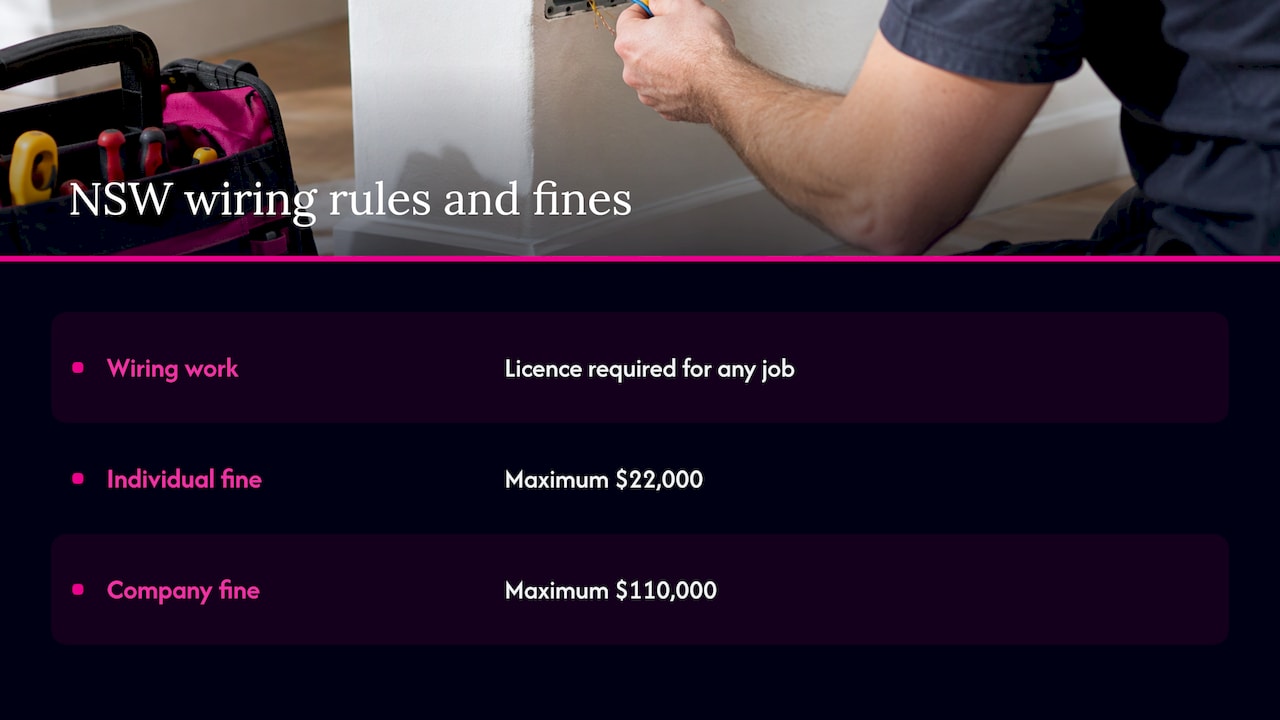
The NSW Government’s electrical licensing page states that a licence or certificate is required before any electrical wiring work, including installation, repair, alteration, removal or addition, regardless of the job’s cost or property type. That covers a single outlet in a rental unit and a whole shopfront.
The same page says unlicensed electrical wiring work breaches the Home Building Act 1989 and can attract maximum fines of $22,000 for an individual or $110,000 for a company.
There is a practical side too. A repair that looks fine can fail later, in a fault or over time. Insurers, buyers and building managers also expect electrical work to be done and certified by a licensed person. Our guide to DIY electrical dangers in Australia explains where the line sits for homeowners.
So the safe response is a short one: make the area safe, keep people away, and hand the work to a licensed professional.
What a Level 2 electrician does about exposed wiring
In NSW, a Level 2 electrician is an accredited service provider authorised to do work on the electricity network connection side as well as inside the property: service mains, metering, connections and power supply upgrades. For most exposed-wire jobs inside a house, a licensed electrician is what the law requires. A Level 2 provider is the right call when the problem touches the supply itself, for example a damaged overhead or underground service, a faulty consumer mains cable, a private power pole, the meter position or a defect notice from the network.
Our team works as a certified Level 2 contractor, and we handle both. In practice the job moves through four stages.
1. Make safe
The first priority is removing the risk. That can mean isolating the circuit, or terminating and securing exposed conductors and marking off the area. Queensland’s workplace Code of Practice, for example, describes leaving unfinished electrical work safe by terminating and securing exposed conductors, marking off the work area, warning affected people and preventing the circuit being re-energised by accident. If you need this done urgently, see our emergency make safe service.
2. Find the cause
Exposed wiring is rarely the whole story. It is a symptom of age, water, pests, overheating, a previous bad repair or an overloaded circuit. Finding the cause is what stops the same fault returning next month. If the wiring has deteriorated across the house, one repair will not be enough and a wider electrical safety inspection is the sensible next step. Older properties benefit most; our older homes inspection checklist shows what is looked at.
3. Repair or replace
The fix depends on what is damaged. A single damaged cable run, a missing cover, a failed connection, a deteriorated switchboard or a damaged service cable each call for a different repair. We cover electrical repairs and switchboard upgrades for homes, strata buildings and commercial sites across Sydney, and defect notice rectification when a network or inspection notice has been issued.
4. Test before it goes back into service
This is the stage people do not see. The Wiring Rules, AS/NZS 3000:2018, are the Australian and New Zealand standard for electrical installations. Standards Australia’s preview of the standard says alterations and repairs must be inspected and tested before being put into service. A neat-looking repair is not the same as a verified one. For a closer look at what a thorough check includes, this overview of what a home electrical safety inspection covers shows why testing matters before repaired equipment is used again.
A note on wire colours
People often ask whether the colour of an exposed wire tells them what it is. It can help a licensed electrician, but it is not a safety test for you. The Wiring Rules reserve green or green/yellow insulation or sleeving for earthing and bonding conductors, and live conductors must not use those colours in Australian installation wiring. Older installations, repairs and imported equipment, however, do not always follow the rules, and faded or burnt insulation hides the original colour. Never assume a wire is safe because of its colour. Treat every exposed conductor as live.
Emergency or can it wait?
Use this as a guide when deciding how fast to act.
| Situation | What to do |
|---|---|
| Smoke, flame, burning smell or sparking | Leave the building, call 000 |
| Someone has had a shock | Call 000, do not touch them until the power is off |
| Exposed wires and water present (leak, storm, flooding) | Keep clear, do not enter standing water, call an emergency electrician |
| Exposed wires at a switchboard that is hot, scorched or wet | Do not approach it, call an emergency electrician |
| Bare conductors behind a cracked or missing faceplate or cover | Switch off the circuit if it is safe to do so, keep people away, call a licensed electrician the same day |
| Hanging cable after a renovation, appliance removal or earlier DIY | Leave the circuit off, keep clear, book a licensed electrician promptly |
If you are not sure which row you are in, treat it as the more urgent one.
Who this matters for most
Homeowners and seniors
Older wiring is the common cause. If you live in an older house and have noticed warm outlets, flickering lights, crackling sounds or discoloured faceplates, those are warning signs worth a call. We offer discounts for seniors, so the cost of getting a licensed electrician in should not be the reason a hazard is left in place.

Property managers and strata
Exposed wiring in a tenancy, car park, plant room or common area needs a fast response and a record of what was done. We work with residential, commercial and strata properties across Sydney, and defect rectification, inspections and make-safe work are part of what we do. Our electrical safety inspection checklist is a useful starting point for scheduling regular reviews of your portfolio.
Businesses and contractors
In a shop, office or industrial unit, exposed conductors after a fitout, a failed cable or an unfinished job create both a safety and a compliance problem. We carry out electrical fitouts and upgrades for commercial sites, including power supply upgrades and single phase to three phase conversions where the existing supply cannot carry the load.
When exposed wiring points to a bigger upgrade
Sometimes the real answer is not a patch. Repeated faults can mean the installation has reached its limit.
- An old switchboard. Ceramic fuses, no safety switch and crowded, overheating connections are a sign to replace rather than repair. See our guide to old switchboard replacement in Sydney.
- No safety switch. A safety switch (RCD) cuts the power quickly when current leaks, for example through a person. Our safety switch installation guide covers what protection a home should have, and we offer RCD testing under our electrical maintenance service.
- A supply that is too small. Adding an EV charger, air conditioning, a workshop or a pool to a single-phase supply can overload it. A single phase to three phase upgrade is often the proper fix. Our power supply upgrades page explains the service.
Perspective
The most common mistake we see described by people who call about exposed wires is wanting to “just tape it up” for now. That instinct is understandable, but a temporary fix hides the problem rather than removing it, and the person who is next to touch that wire may not be you.
Our view is simple. The first job is to make the area safe. The second is to find out why the wiring got there. The third is to repair it properly and test it before it goes back into use. That order is why we hold Level 2 accreditation, why we are available 24/7, and why we offer free site inspections for Level 2 work so you know what is involved before work begins.
If you have exposed wires and you are not sure how serious they are, call us. We guarantee a callback within 10 minutes.
Christopher
Get it made safe today
If you have exposed wires in a Sydney home, business or strata property, High Demand Electrical is a certified Level 2 electrical contractor with 24/7 emergency support, triple ISO certification and over 300 five-star reviews. We carry out emergency callouts, repairs, switchboard and power supply upgrades, and defect rectification, and we offer free site inspections for Level 2 work and discounts for seniors.

Call our emergency electricians now, or start from our home page to see everything we cover.
FAQ
What should I do with exposed electrical wires?
Do not touch them, and keep people and pets away. If it is safe to reach a dry switchboard, turn off the affected circuit or the main switch, then call a licensed electrician. If there is smoke, flame or a shock injury, leave and call 000 instead.
Is exposed wiring in a house dangerous even if the power seems off?
Yes. You cannot tell by looking whether a conductor is live, and a circuit can be switched back on by someone else or by power returning. Treat every exposed wire as live until a licensed electrician has made it safe.
Can I fix exposed wires myself if I use electrical tape?
No. In NSW a licence or certificate is required for any electrical wiring work, including repairs, and unlicensed work can attract fines of up to $22,000 for an individual. Tape also hides the problem without fixing it, so the hazard stays.
What happens if a wire is exposed and nothing is done?
The conductor can cause a shock to anyone who touches it, and it can arc or overheat and start a fire, especially inside walls and roof spaces where you cannot see it. Damage tends to worsen over time, so acting early is safer and usually simpler.
Who should I call in Sydney for exposed wiring?
Call a licensed electrician, and a Level 2 electrician when the problem involves the supply, meter or service cables. We are available 24/7 across Sydney, and our emergency electrician page has the details.
Sources
- Electrical safety in the home | NSW Government
- Electrical work | NSW Government
- Preview: AS/NZS 3000:2018 | Standards Australia Store
- Managing electrical risks in the workplace Code of Practice 2021 | WorkSafe Queensland
Recommended
Need Help Fast?
Powering Your Needs with Expertise
If you’re looking for a reliable, experienced, and prompt electrician, look no further than High Demand Electrical. We cater to all your electrical needs, from routine maintenance to emergency repairs and complete system installations. Our skilled team is committed to providing professional service that ensures your electrical systems run smoothly. Whether it's a small task or a large project, give us a call today. Let us meet all your electrical demands with the quality and reliability you deserve.

Licensed Level 2 ASP electricians across Sydney. Same-day service and 24/7 emergency response.
Licence 397193C
ABN 87 051 836 527