Emergency Electrical Repair in Sydney: What to Do and Who to Call
When something electrical fails in a Sydney home or business, you need two things quickly: a safe situation and the right licensed person on the way. If anyone is hurt or in danger, call 000. For everything else, switch off what you safely can, keep clear of the fault and call a 24/7 licensed electrician. We are High Demand Electrical, a certified Level 2 electrical contractor, and our emergency team answers around the clock with a 10-minute callback guarantee.
This guide covers what counts as an emergency, what to do in the first few minutes, why the repair itself must be left to a licensed electrician, and the paperwork you should receive afterwards.
TL;DR
- Life at risk, fire or someone shocked: call 000 first. Fallen powerlines are treated as live, so stay well back and report them to the electricity network.
- While you wait, switch off and unplug appliances, stay away from the fault and do not attempt your own repair.
- In NSW, electrical wiring work must be done by or under the supervision of a licensed electrician, and you should get a Compliance Certificate for it.
- Level 2 work covers the service side of your property: mains, metering, switchboards and supply upgrades such as single phase to three phase.
- Our emergency line is staffed 24/7 by accredited Level 2 ASP electricians, with a 10-minute callback guarantee.
Table of Contents
- What counts as an electrical emergency
- The first five minutes
- Why the repair is not a DIY job
- When the emergency needs a Level 2 electrician
- How to check the electrician you call
- Paperwork after the repair
- Storm season and repeat faults
- When the emergency exposes a bigger problem: three-phase and supply upgrades
- What we do when you call
- Our perspective
- FAQ
- Sources
What counts as an electrical emergency
An emergency is any fault where people, property or the supply to a building is at risk right now. In practice, that means:
- Sparking, smoking or hot switchboards, powerpoints or plugs. These point to arcing or overheating inside the installation.
- A burning or fishy smell near a switchboard, outlet or appliance.
- A tripping switchboard that will not reset, or a safety switch that trips repeatedly.
- Total loss of power when your neighbours still have theirs. That suggests a fault on your side of the meter.
- Water in contact with electrical equipment, common after a storm or a burst pipe.
- Tingles or shocks from taps, appliances or metal fittings.
- Damaged service lines or a leaning or broken private power pole on your property.
A flickering light or a single dead powerpoint is urgent but usually not an emergency. Even so, a fault that is “only” intermittent is still a fault in the wiring, and it should be inspected promptly rather than lived with.
The first five minutes
What you do before the electrician arrives matters. Follow this order.
1. Protect people first
If anyone has received a shock, NSW Fair Trading advises switching off the electricity if possible, never touching the person bare-handed or with a wet or metal object, calling an ambulance or doctor and starting resuscitation if needed. If there is fire or any threat to life, call 000.
2. Treat fallen powerlines as live
Energy Safe Victoria’s emergency guidance says to report fallen powerlines to the electricity supply company and police, treat them as live and stay more than 8 to 10 metres away. The same sensible distance applies in Sydney. Your network operator’s emergency number is printed on your electricity bill.
3. Switch off and unplug
If the fault is a blackout or a surge risk, the same guidance recommends turning off and unplugging appliances so a returning supply does not damage them. Do this only where you can reach the switch or plug dry and safely. Do not go near a switchboard that is sparking, smoking or wet.
4. Keep a torch and charged phone handy
A torch, a charged phone and a battery radio are the basics Energy Safe Victoria lists for outage preparedness. They let you move around safely and talk to your electrician while you wait.
5. Call a licensed electrician
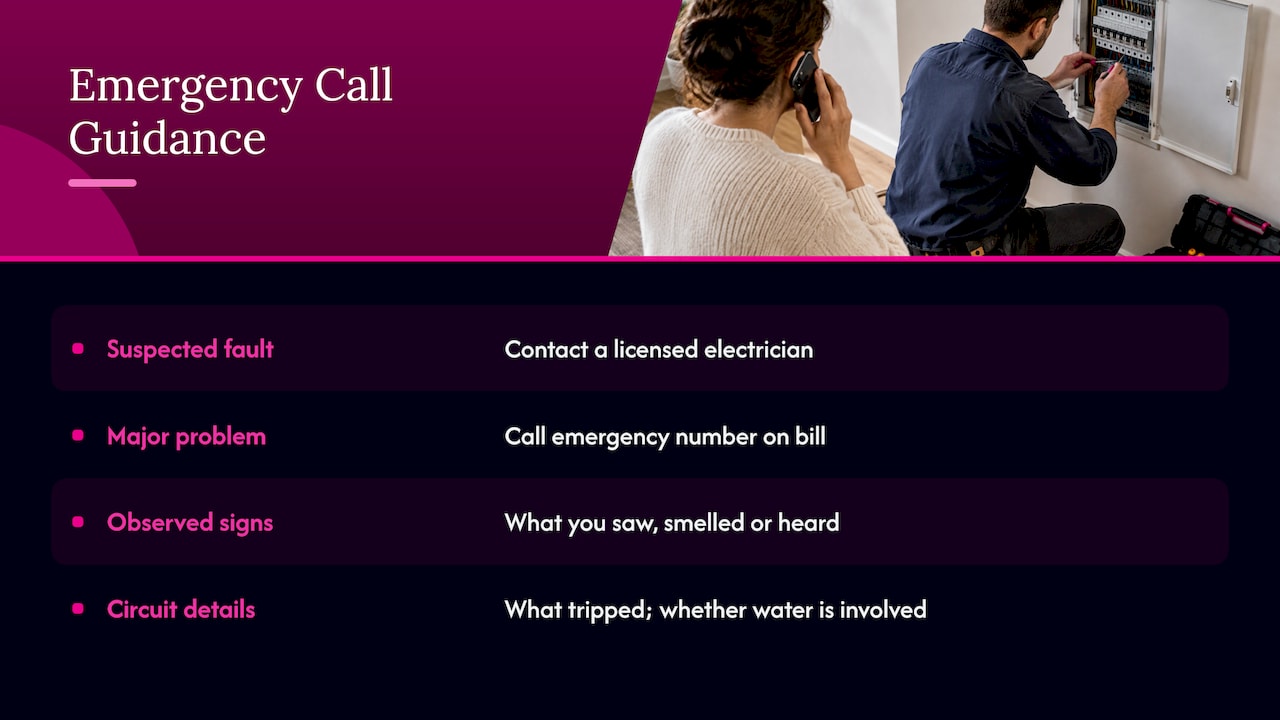
For a suspected fault in your installation, NSW Fair Trading says to contact a licensed electrician. For a major problem it says to call the emergency number on your electricity bill so the installation can be made safe. Then give your electrician the facts: what you saw, smelled or heard, what tripped, and whether any water is involved.
Our emergency page has the details for 24/7 emergency electrician callouts. If the cause is a blackout across the street, our power outage checklist helps you tell a network outage from a fault in your own wiring.
Why the repair is not a DIY job
In NSW, electrical wiring work must be done by or under the supervision of a licensed electrician, and the tested work must comply with the Gas and Electricity (Consumer Safety) Regulation 2018 and the relevant Australian Standards, including AS/NZS 3000, the national wiring rules.
Network operators say the same. Ausgrid’s home maintenance guidance says householders who are not qualified electricians should not wire a home, install or move powerpoints, lights or switches, install ceiling fans, or do electrical maintenance other than changing a light globe.
There is a practical reason as well as a legal one. A fault that trips a safety switch has a cause somewhere in the circuit. A licensed electrician finds that cause with test instruments, repairs it and tests the result. Resetting a breaker and hoping is how a small fault becomes a fire.
Renters have a clear path: NSW Fair Trading says tenants should report electrical problems to the landlord or managing agent immediately, and landlords must keep installations and fittings in safe working order. Property managers can act fast by sending a licensed electrician; our guide to landlord electrical safety in NSW explains the testing and certificates involved.
When the emergency needs a Level 2 electrician
Most household faults sit inside the property: a failed circuit, a damaged powerpoint, a burnt-out switchboard component. A licensed electrician handles those. A Level 2 electrician is an Accredited Service Provider (ASP) authorised to do the connection work between the network and your main switchboard. The NSW Government’s Service and Installation Rules describe Level 2 accreditation as covering contestable customer connection work between the point of common coupling (where your installation meets the network), the connection points and the main switchboard.
In emergency terms, you want a Level 2 ASP when the fault involves:
- Service lines or consumer mains, such as an overhead line pulled down by a branch or an underground cable damaged by digging.
- A private power pole that has been damaged or has failed.
- The meter or metering equipment.
- A main switchboard that is burnt, flooded or cannot be made safe.
- A defect notice issued by the network or an inspector that must be rectified before supply is restored.
We hold that accreditation, so one team can make the installation safe, repair the fault and deal with the connection side. See our Level 2 electrician services for metering and defect notice rectification, and our guide on what a Level 2 electrician is.
How to check the electrician you call
Under pressure it is tempting to take the first answer. Thirty seconds of checking is worth it. The NSW Government says you can ask to see an electrician’s contractor licence, check it online or call NSW Fair Trading on 13 32 20.
Ask three things:
- Is the licence current, and is the contractor accredited for the work? For anything on the service side of the meter, the accreditation level must match the job.
- Will you receive a Compliance Certificate? The electrician must provide one showing the work has been tested and is safe.
- Who will actually attend? Fully accredited electricians should be the ones doing the work, not an unlicensed helper.
Our own guide to choosing an electrician safely in NSW goes through these points in more detail.
Paperwork after the repair
A repair is not finished until the paperwork is. In NSW the key document is the Certificate of Compliance for Electrical Work (CCEW). Building Commission NSW says it shows the work was tested and complies with the regulations and relevant Australian Standards, and it can assist customers with warranty matters.
Two timing rules are worth knowing. The CCEW must be submitted as soon as practical and no later than seven days after the electrical test. From 1 July 2026, CCEWs must be lodged through the BCNSW eCert system rather than as handwritten or PDF forms. You do not lodge it yourself: your electrician does, and you should receive a copy.
For property managers and strata committees, that copy is part of your compliance file. For homeowners, it is the record you will want when you sell, claim insurance or call on a warranty. Our guides explain what an electrical compliance certificate proves and how the CCEW process works in Sydney.
Storm season and repeat faults
Sydney storms are a common cause of emergency callouts: water in switchboards, lightning-induced surges, and trees dragging down service lines. If you have lost power after a storm, keep away from any wet electrical equipment and treat downed lines as live. Our guides to electrical hazards during Sydney storms and common storm damage problems and fixes explain what to look for and how we repair it.
If the same circuit keeps tripping, do not treat the emergency as a one-off. A safety switch (RCD) test or maintenance check confirms your protection is working, and a worn or overloaded board may be due for a switchboard upgrade.
When the emergency exposes a bigger problem: three-phase and supply upgrades
Some emergencies are really capacity problems. A home with a new EV charger, ducted air conditioning and a workshop on one phase can overload its supply. A business that adds three-phase equipment can find the existing connection will not carry it.
The NSW Government’s Rules explain that a single phase to three phase upgrade may be needed when planned demand or three-phase equipment exceeds the existing supply. In NSW you apply to the distributor and wait for written approval before committing to the work, and you engage an ASP accredited for the connection work. NSW Climate and Energy Action adds that the provider’s accreditation level must match the work, and that ASPs coordinate with the distributor and may arrange approvals, inspections and planned outages.
A typical upgrade can involve site assessment and design, altered service lines and customer mains, switchboard and meter changes, and an outage while the work is connected. The final checks include polarity, phase rotation where applicable, insulation resistance, earthing integrity and the required compliance certificate.
If an emergency has made you realise your supply is stretched, our power supply upgrades page covers single phase to three phase work, and our smart home readiness guide explains how loads add up.
What we do when you call
Our emergency response is built around speed and safety. When you ring, our team is available 24/7, rain, hail or shine, and we back it with a 10-minute callback guarantee. Our emergency electricians are fully accredited Level 2 ASP electricians, so the person who makes your installation safe is qualified for the repair, the switchboard and the supply side.
We work across residential, commercial and strata properties in Sydney, and our repairs cover power restoration, fault finding, surge protection and defect rectification. If a repair leads to bigger Level 2 work, we offer free site inspections for Level 2 work, and we offer discounts for seniors.
For non-urgent repairs, see our electrical repairs service. For an emergency, go straight to the emergency electrician page.

We also serve local areas such as Earlwood, Leumeah and Austral with dedicated emergency pages, and cover fault repairs in Castle Hill.
Our perspective
Most emergency callouts we attend start small: a warm powerpoint, a switch that crackles, a board that trips on wet days. People wait because the lights are still on. Our advice is to act at the first sign, because the cost and the danger both grow with delay.
The second thing we would tell any owner or property manager is to choose an electrician who can finish the whole job. An emergency often reveals an ageing switchboard, a stretched supply or a defect notice. When one accredited Level 2 team can make it safe, fix the cause, handle the connection side and issue the compliance paperwork, you avoid a string of separate visits.
That is why we run a 24/7 line staffed by accredited Level 2 ASP electricians, why we guarantee a 10-minute callback, and why we offer free site inspections for Level 2 work. You should know what is wrong and what is needed before you commit.
Christopher
FAQ
Who do I call first in an electrical emergency?
Call 000 if there is a fire, a shock injury or any danger to life. For a fault in your installation, call a licensed electrician. For a major problem or fallen powerlines, NSW Fair Trading and Energy Safe Victoria both point to the emergency number on your electricity bill.
Can I fix a tripping switchboard myself?
No. In NSW, wiring work must be done by or under the supervision of a licensed electrician, and network guidance says homeowners should limit themselves to changing a light globe. A switchboard that keeps tripping has a cause that needs testing and repair by a licensed electrician.
What paperwork should I get after emergency electrical repair?
You should receive a Compliance Certificate for Electrical Work (CCEW) showing the work was tested and is safe. Your electrician must lodge it within seven days of testing, and from 1 July 2026 it is lodged through BCNSW eCert. Keep your copy for insurance, warranty and property records.
Do you offer discounts for seniors?
Yes, we offer special discounts for seniors on our electrical services. Call us to confirm how they apply to your job. Our free site inspection for Level 2 work also lets you understand the scope before you decide.
Sources
- Electrical emergencies, Energy Safe Victoria
- Electrical safety requirements and consumer rights, NSW Government
- Electrical compliance requirements, NSW Government
- DIY and home maintenance, Ausgrid
- New South Wales Standard Electricity Service and Installation Rules, June 2025
- Installing or altering electricity supply to your property, NSW Climate and Energy Action
Recommended
Need Help Fast?
Powering Your Needs with Expertise
If you’re looking for a reliable, experienced, and prompt electrician, look no further than High Demand Electrical. We cater to all your electrical needs, from routine maintenance to emergency repairs and complete system installations. Our skilled team is committed to providing professional service that ensures your electrical systems run smoothly. Whether it's a small task or a large project, give us a call today. Let us meet all your electrical demands with the quality and reliability you deserve.

Licensed Level 2 ASP electricians across Sydney. Same-day service and 24/7 emergency response.
Licence 397193C
ABN 87 051 836 527