Electrical Defect Notice Risks and Repairs in Sydney
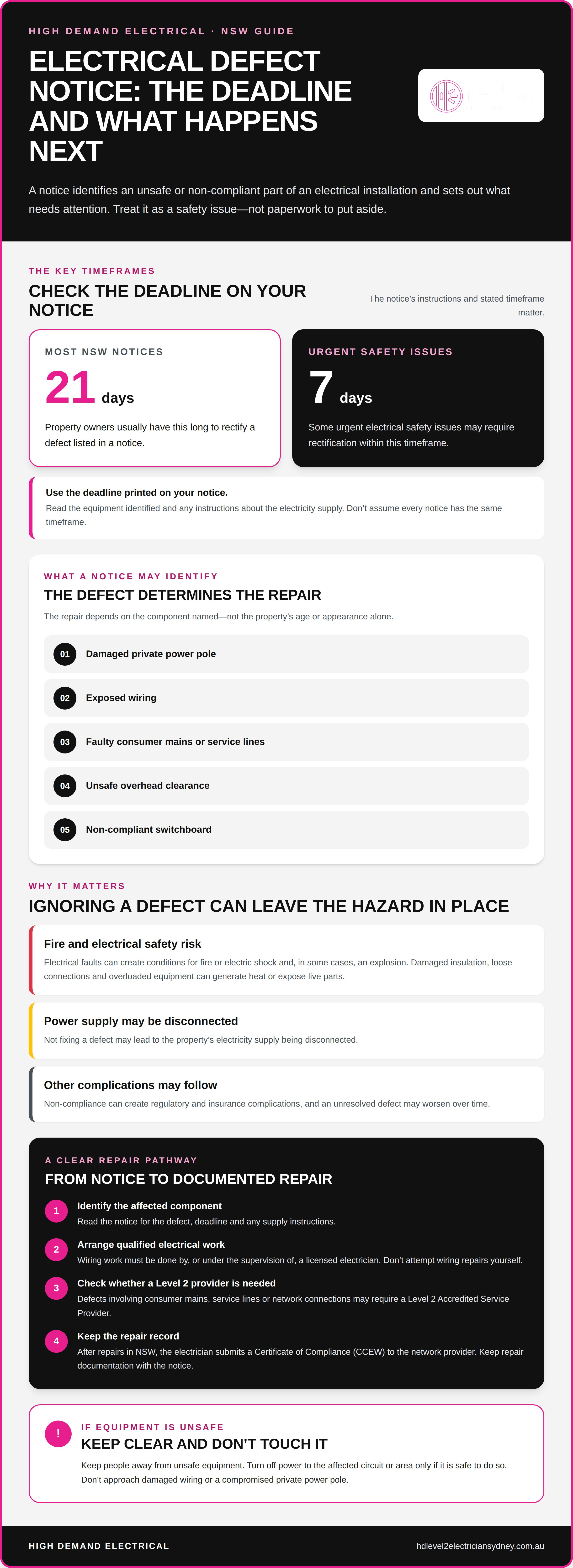
An electrical defect notice in NSW usually gives property owners 21 days to fix the listed issue. The consequences of not fixing an electrical defect can include power disconnection and an increased risk of fire, so treat the notice as a safety issue, not paperwork to put aside.
An electrical defect notice can raise immediate questions: what does it mean, and what needs fixing? This guide explains the consequences of not fixing an electrical defect, the risks of ignoring a notice and the repairs that may be needed for a Sydney property.
From damaged private power poles and exposed wiring to faulty consumer mains or a non-compliant switchboard, the required work depends on the defect identified. You’ll also learn when a Level 2 Accredited Service Provider is relevant and what to do next to move towards a safe, compliant repair.
Key Takeaways
• In NSW, property owners usually have 21 days to rectify a defect listed in a notice. Treat the deadline as a priority to reduce safety and supply risks.
• Damaged private power poles, exposed wiring and faulty consumer mains are examples of issues that may need attention.
• Ignoring a notice can increase the risk of fire and may lead to the property's power supply being disconnected.
• Non-compliance can also create regulatory and insurance complications, while unresolved defects may worsen over time.
• Repairs involving service lines, consumer mains or other network equipment may require a Level 2 Accredited Service Provider, with the repair approach guided by the defect listed.
What Is an Electrical Defect Notice?
An electrical defect notice identifies an unsafe or non-compliant part of a property’s electrical installation and sets out what needs attention. In NSW, an electricity network provider such as Ausgrid or Endeavour Energy may issue a notice after an inspection, supply upgrade or meter replacement. The defect listed, not the property’s age or appearance alone, determines the repair needed.
For most NSW notices, property owners usually have 21 days to resolve the defect. Read the notice promptly and note its deadline, the equipment identified and any instructions about the electricity supply. Ignoring it can increase fire risk and may lead to disconnection of the property’s power. These consequences of not fixing an electrical defect can affect household routines and leave the underlying hazard in place.
A notice may identify a damaged private power pole, exposed wiring, faulty consumer mains, unsafe overhead clearance or a non-compliant switchboard. Storm damage, building work, a supply upgrade or meter replacement can also reveal a defect. For example, a storm-damaged service line needs assessment before its safety can be established.
Use the notice to identify the affected component, arrange the appropriate repair and resolve the defect within the stated timeframe. Property owners are typically responsible for repairs. If you’re a tenant, send the notice to your landlord promptly so the work can be organised before the deadline. Don’t attempt wiring repairs yourself. The NSW Government states that wiring work must be done by, or under the supervision of, a licensed electrician.
The required expertise depends on the location of the fault. A defect affecting consumer mains, service lines or the connection to the network may need a Level 2 Accredited Service Provider. A Level 2 electrician in Sydney can address defects involving electrical infrastructure and mains. The notice’s description helps determine the repair scope; it shouldn’t be treated as a general instruction to replace unrelated equipment.
After the defect has been resolved, keep the repair documentation with the notice and arrange regular electrical maintenance checks. Inspections can help identify deterioration before it becomes a listed defect, particularly after storm damage or renovation work. For a rental property, sending any new notice to the landlord without delay helps keep the repair process moving within the required timeframe.
Electrical safety hazards, including fires and explosions
For NSW homes, electrical wiring work must be done by, or under the supervision of, a licensed electrician, according to the NSW Government. An electrician should assess the defect and complete repairs safely. This applies whether the issue involves wiring inside the home or equipment connected to its supply. Don’t touch exposed conductors or attempt a repair yourself.
Electrical faults can create conditions for fire, electric shock or, in some cases, an explosion. Damaged insulation, loose connections and overloaded equipment can generate heat or expose live parts. A defect notice may identify a serious hazard, and urgent electrical safety issues may require rectification within 7 days. The timeframe on the notice matters: follow its instructions and arrange qualified repair work promptly.
Australia’s AS/NZS 3000:2018 Wiring Rules standard covers safe electrical installations. AS/NZS 3820:2020 sets essential safety requirements for electrical equipment. These standards are relevant to installation safety, but they don’t replace an assessment of the specific defect. For example, a damaged cable and a fault in a switchboard require different checks and repair methods.
If a notice identifies unsafe equipment, keep people away and stop using it. Turn off power to the affected circuit or area only if it’s safe to do so. Don’t approach damaged wiring or a compromised private power pole. In Victoria, a distribution network operator can disconnect electricity immediately when a defect poses imminent danger. That is a Victoria-specific rule, not a Sydney notice timeframe.
Prevention starts with having electrical installations inspected by a licensed electrician. An inspection can identify deterioration, damage or unsafe equipment before it develops into a more serious hazard. Older homes may need more frequent attention. After storm damage, renovation work or changes to electrical equipment, arrange an inspection if there are signs of damage or a new safety concern.
Victoria’s Electricity Safety Act 1998 governs electrical defect notices there. After prescribed electrical work in Victoria, a licensed electrician issues a Certificate of Electrical Safety to certify compliance with applicable standards and regulations. NSW has a separate process: after defect repairs, the electrician submits a Certificate of Compliance (CCEW) to the network provider. Keep relevant repair records with the notice.
If an electrical hazard needs professional attention, request help with electrical safety concerns.
Potential fines for non-compliance
Non-compliance can carry regulatory consequences, but the rules depend on the state and the property’s electricity network. In Victoria, continued failure to address a defect notice may lead to fines under electrical safety legislation. The available facts do not establish a fine amount for Sydney, so Victorian penalties shouldn’t be presented as NSW penalties. For a Sydney property, focus on the notice, its deadline and the network requirements that apply.
Do electrical defect rules and repair timeframes vary between Australian states and territories? Yes. In NSW, property owners usually have 21 days to rectify a defect in a notice, while Victoria has its own electrical safety framework and processes. The state, defect and distributor requirements affect the applicable steps, so a Victorian timeframe or penalty shouldn’t be assumed to apply in Sydney.
In NSW, network compliance is relevant when a defect affects the property’s connection to electricity supply. The Electricity Supply Act 1995 No 94, Ausgrid List of Network Standards and Endeavour Energy Network Standards are among the requirements relevant to defect notices. A notice involving exposed cabling, consumer mains or a damaged service connection needs attention within the timeframe stated. If the issue remains unresolved, the network provider may disconnect the property’s supply.
That can disrupt a home or business, but disconnection is also a safety measure where electrical equipment presents a risk. For a serious defect involving the connection between a property and the network, repair work may require an accredited Level 2 service provider authorised for that equipment. The right repair depends on the component identified, not simply on whether the property needs a replacement switchboard or cable.
Commercial properties may have compliance obligations beyond the immediate defect notice. The Building Code of Australia and Essential Safety Measures regulations may apply to commercial property compliance. For example, a defect affecting equipment that supports a building’s essential safety measures may need coordinated attention. The building’s use and the equipment affected determine the work required. Ignoring the notice leaves both the safety issue and the compliance concern unresolved.
Record the notice date, deadline, defect description and network provider. Arrange repairs with a suitably qualified provider, then keep the completion documents with the notice. This creates a clear record of how the issue was addressed. A repair booking is not proof of resolution: the defect itself must be rectified.
If a notice identifies a mains or network-side defect, contact the electrical team about the required repair.
Electrical fire and electric shock risks
A defect can create a fire risk if damaged wiring overheats or an electrical connection becomes unsafe. Exposed live parts can also cause electric shock, particularly near metal fittings or damp areas. For example, damaged cable insulation may expose conductors that someone could touch. The hazard depends on the fault’s location and condition, so avoid the affected equipment until it has been assessed.
Electric shock can occur when someone touches a live part and electricity passes through their body. A faulty consumer switchboard, exposed wiring or damaged appliance lead can create a contact hazard. Don’t handle the equipment or try to cover exposed conductors. Keep people away, especially children, and arrange an assessment by a licensed electrician.
Fire hazards can develop inside walls, switchboards or connection points, where damage may not be visible. A burning smell, scorch marks or unusually warm equipment needs prompt attention, although these signs alone don’t identify the fault. Stop using the affected circuit or equipment, and don’t remove covers to investigate.
A damaged overhead service cable or private power pole can put people at risk outside the home as well as inside it. Keep clear of the equipment and the area beneath it. Don’t approach fallen or sagging cables, even if the power appears to be off. Network-connected defects may need an accredited service provider authorised to work on that equipment.
If a defect notice identifies a dangerous circuit, switch off power to that area only if you can do so safely. Don’t enter a space if doing so would bring you close to exposed wiring or damaged equipment. Follow any isolation instructions in the notice, and keep affected equipment out of use until repairs are complete.
Electrical upgrades and renovations can reveal pre-existing faults. Replacing a switchboard, for example, may expose damaged wiring or a problem with the supply connection. Have the newly visible issue assessed properly. Covering it or reconnecting equipment without resolving the fault can leave the hazard in place.
In NSW, the NSW Government states that wiring work must be done by, or under the supervision of, a licensed electrician. This applies to repairs as well as full electrical upgrades. An assessment can establish whether the defect involves internal wiring, consumer mains or overhead supply equipment, and identify the appropriate repair.
After work, keep the repair documentation with the defect notice. If the same circuit shows scorch marks, unusual heat or exposed wiring again, stop using it and arrange another assessment. Repeated signs can indicate the original fault remains or a separate issue has developed.
Repairs to electrical installations and mains
Repairs should address the defect described in the notice. A damaged service line, faulty consumer mains, unsafe overhead clearance, private power pole or non-compliant switchboard each requires a different assessment. Replacing equipment without identifying the underlying fault may leave the original hazard unresolved. Use the notice description to focus the inspection on the affected part of the installation.
Who is allowed to repair electrical defects in Australia, and what licence is required? The NSW Government states that electrical wiring work must be done by, or under the supervision of, a licensed electrician. In NSW, most defect rectification work is authorised for a Level 2 Accredited Service Provider, particularly where the defect involves electrical infrastructure or network equipment.
The distinction matters. A fault within a property’s wiring may need a licensed electrician, while a defect involving consumer mains, service cables or the connection to the network may require a Level 2 Accredited Service Provider authorised for that equipment. For example, exposed cabling inside a building and a damaged overhead service line are not the same repair. The notice and the location of the fault guide the required expertise.
Repairs may involve replacing damaged service equipment, rectifying consumer mains, addressing overhead clearance, repairing or replacing a private power pole, or upgrading an unsafe switchboard. Further assessment may be needed to determine whether an older installation’s defect is isolated or affects connected equipment. The work depends on the inspection findings. Address the listed defect rather than assuming every older component needs replacement.
After the work, the electrician submits a Certificate of Compliance (CCEW) to the network provider in NSW. Keep it with the defect notice as a record of the rectification. The network provider may need this information to process the repaired defect and supply connection. The completed work and its supporting documents help show how the issue was addressed.
How much does it cost to repair common electrical defects in Australia? The price depends on the defect and is provided after a quote request. The type of equipment, access, parts required and extent of damage all affect the repair scope. A switchboard issue, damaged service line and private power pole defect involve different work, so one flat figure would not describe them accurately.
For a notice involving mains, switchboard or service equipment, arrange an assessment that follows the defect details and applicable network requirements. Defect notice rectification addresses the listed issue, while request a repair assessment to plan the next step.
High Demand Electrical
High Demand Electrical helps Sydney property owners address electrical infrastructure concerns through Level 2 ASP Electrical Services. If a defect notice identifies consumer mains, a private power pole or a network connection, its Level 2 work may be relevant to planning the required repair. The notice details help establish which part of the installation needs attention.
For a defect involving an unsafe switchboard, High Demand Electrical provides Switchboard Upgrades. Private Power Pole Installation may be relevant if a damaged pole needs replacement. Tesla & Home EV Charger Installation is for charger installation, rather than defect repairs. The right service depends on the affected equipment and the work required.
Share the defect notice and its repair deadline when discussing next steps, so the issue can be considered in context. Contact High Demand Electrical to discuss an electrical defect or related infrastructure work.
Take the next step towards a resolved defect
Use the notice to plan the repair. Keep its details together with inspection findings and repair documents so the issue can be tracked from identification to rectification. The consequences of not fixing an electrical defect can extend beyond the immediate condition of one component, making timely, properly scoped repairs a practical priority.
If you own the property, arrange an assessment of the defect identified in the notice rather than assuming a general upgrade will resolve it. Understanding which equipment is affected helps direct the repair. If the notice concerns electrical infrastructure or mains, make that clear when arranging the work.
Discuss your electrical defect with High Demand Electrical and take a practical step towards resolving the issue. With the right information and a repair plan focused on the notice, you can move forward with greater clarity.
Frequently Asked Questions
How Can I Prevent Receiving a Notice?
Arrange an electrical inspection after storm damage, renovation work or changes to the property’s supply equipment, particularly if you see damage or exposed wiring. A licensed electrician can assess deterioration that needs attention. Keep records of repairs and maintenance, especially for private power poles and consumer mains. Inspections can help identify problems early, but can’t guarantee that a network provider won’t issue a notice.
What Happens If You Ignore It?
In NSW, property owners usually have 21 days to rectify a defect listed in a notice. If the issue remains unresolved, the property’s electricity supply may be disconnected, and the defect can continue to pose a safety risk. Read the notice carefully, note its deadline and arrange work suited to the defect. If the notice concerns network equipment, the repair may require an authorised Level 2 Accredited Service Provider.
What are the safety risks of leaving an electrical defect unrepaired in Australia?
An unrepaired defect can expose people to electrical hazards and increase fire risk. Damaged service lines, unsafe overhead clearances and faulty consumer mains can affect equipment beyond the point where the fault first appears. For example, a defect at the supply connection may affect safe electricity delivery to the property. Keep clear of equipment named in the notice and don’t use circuits identified as unsafe.
Can an unfixed electrical defect cause an electric shock, electrocution, or fire?
Yes. Exposed wiring can cause electric shock, while an overheating fault may contribute to a fire. The danger depends on the defect’s type and location. Don’t touch exposed conductors or open electrical equipment to investigate. Keep people away, stop using affected equipment and arrange an assessment by a licensed electrician. A burning smell or scorch marks are reasons to act promptly.
What are the consequences of ignoring an electrical defect notice or safety inspection report?
Ignoring a notice in NSW can leave the defect unresolved and may lead to power disconnection. A safety inspection report and a network defect notice may serve different purposes, so read each document for its findings, required action and timeframe. Keep both with the repair records. If a report identifies an unsafe condition, arrange an assessment rather than assuming it can wait because it isn’t a formal notice.
Can a landlord be penalised for not fixing an electrical defect in an Australian rental property?
Responsibility and consequences depend on the state or territory and the circumstances. In NSW, property owners are typically responsible for fixing defects after receiving a notice. If you’re a tenant and receive one, send it promptly to the landlord with any deadline and details of the affected equipment. Don’t attempt electrical repairs yourself. The landlord should arrange qualified work and keep records showing how the defect was addressed.
Can an insurer reject an Australian home insurance claim if an electrical defect was left unrepaired?
An unrepaired defect may raise questions about maintenance and the cause of damage during an insurance claim assessment. Don’t assume a claim will automatically be accepted or rejected. Keep the defect notice, inspection findings and repair records, and provide accurate details about when the issue was identified and what action followed. The policy wording and circumstances of the damage are relevant to the insurer’s assessment.
What should you do if you discover an electrical defect in an Australian home?
Keep people away from exposed wiring or damaged equipment, and stop using the affected circuit. Switch off power to that area only if you can do so safely without approaching the hazard. Don’t attempt a DIY repair. Arrange assessment by a licensed electrician; a defect involving consumer mains, service cables or the network connection may need a Level 2 Accredited Service Provider. If you rent, send the notice or report to your landlord promptly.
Need Help Fast?
Powering Your Needs with Expertise
If you’re looking for a reliable, experienced, and prompt electrician, look no further than High Demand Electrical. We cater to all your electrical needs, from routine maintenance to emergency repairs and complete system installations. Our skilled team is committed to providing professional service that ensures your electrical systems run smoothly. Whether it's a small task or a large project, give us a call today. Let us meet all your electrical demands with the quality and reliability you deserve.

Licensed Level 2 ASP electricians across Sydney. Same-day service and 24/7 emergency response.
Licence 397193C
ABN 87 051 836 527