Earthing System Upgrade in NSW: What It Involves and Who Can Do It
An earthing system upgrade in NSW is licensed electrical work. It ends with a tested installation and a Certificate of Compliance for Electrical Work (CCEW) lodged online within 7 days. When the upgrade touches your switchboard, your supply or your network connection, it calls for a Level 2 Accredited Service Provider (ASP). That is the work our Level 2 team at High Demand Electrical does across Sydney, and we offer free site inspections for Level 2 work, so you know the scope before anything starts.
This guide explains what earthing does, the signs an upgrade is due, what the work and testing involve, how it ties in with a switchboard replacement or a single-phase to three-phase upgrade, and what paperwork you should receive.
TL;DR
- Earthing gives fault current a safe, low-resistance path so protective devices switch off quickly instead of leaving metalwork live.
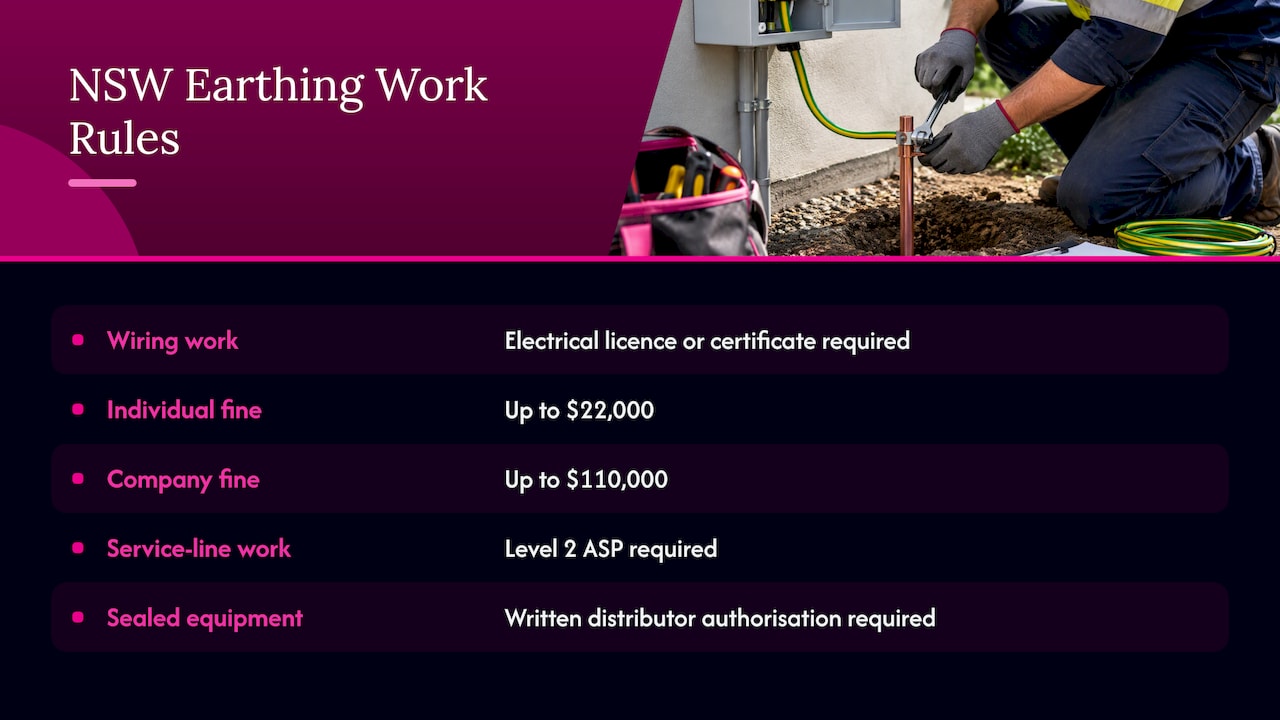
- In NSW you need an electrical licence for wiring work, and network or service-connection work needs a Level 2 ASP.
- After the work, a qualified person must test earthing continuity, insulation resistance, polarity and any RCDs, then lodge a CCEW within 7 days.
- From 1 July 2026 every CCEW goes through the BCNSW eCert portal; handwritten and PDF forms are no longer accepted.
- Changes to a direct earthing system must include an upgrade to MEN, and a phase upgrade or switchboard replacement often brings earthing into scope.
Table of Contents
- What an earthing system does
- Signs your earthing may need attention
- Who can carry out earthing work in NSW
- What an earthing system upgrade involves
- Your paperwork: the CCEW and the eCert change
- Earthing, switchboards and single phase to three phase
- Planning around cost
- Who this guide is for
- Our perspective
- Book a Level 2 inspection
- FAQ
- Sources
What an earthing system does
Every installation has a path that lets fault current flow back to the source if a live conductor touches metalwork. A good path carries enough current to trip a circuit breaker or safety switch fast. A poor one lets a metal casing sit at a dangerous voltage while the protection does nothing.
Most NSW homes and businesses use a Multiple Earthed Neutral (MEN) system. Here the neutral conductor is connected to earth at the switchboard and at other points along the network, and the installation’s earth is bonded to that neutral at the main earth link. The Wiring Rules, AS/NZS 3000:2018, cover earthing arrangements and earthing conductors, including the MEN system, in Section 5. If you want the rules explained in plain terms, our homeowner’s guide to the Wiring Rules covers them.
The Wiring Rules do not set one fixed ohm figure for every site. What matters is that the circuit’s earth fault path is low enough for the protective device to disconnect within the required time. That is why an earthing assessment is a set of measurements at your installation, not a rule of thumb.
Signs your earthing may need attention
You cannot see an earth connection failing. These are the situations where a Level 2 electrician should look at it:
- A tingle or mild shock from a tap, appliance casing, metal sink or switchboard door.
- A failed earth test during a safety inspection, or a defect notice that mentions earthing, bonding or the main earth connection.
- An older switchboard with ceramic fuses, no RCDs, or a mix of old and new work.
- Renovation or extension plans. NSW Fair Trading advises renovators to have their electrician check the earth system, and says the electrician must give you a compliance certificate showing the work has been tested and is safe.
- A supply change, such as moving from single phase to three phase, adding a private power pole or replacing the consumer mains.
- Corrosion-prone ground. Buried earthing conductors can corrode over time, particularly in low-resistivity, acidic or acid-sulphate soils. Snowy Hydro’s technical standard notes that corrosion is the outstanding issue for earthing systems and that performance degrades progressively, so periodic condition assessment is needed.
If you feel a shock from metalwork, stop using that appliance or outlet and switch off at the switchboard if it is safe to do so. Call an emergency electrician straight away. Our emergency electricians are available 24/7, and we offer a 10-minute callback guarantee.
Owners also carry a duty here. The Gas and Electricity (Consumer Safety) Act 2017 and Regulation 2018 require owners or controllers to maintain installations so the earthing system operates effectively, live parts stay insulated or protected, and the installation does not become a significant potential cause of fire. Property managers and strata committees should read that as a maintenance obligation, not only a renovation issue.
Who can carry out earthing work in NSW
You need an electrical licence or certificate before doing electrical wiring work in NSW, regardless of cost and whether the property is residential, commercial or industrial. Unlicensed work breaches the Home Building Act 1989 and can attract fines of $22,000 for an individual or $110,000 for a company. Earthing is not a job for the weekend.
Then there is the question of Level 2. Under the NSW Service and Installation Rules (June 2025 edition), Level 2 ASP accreditation permits installation and connection of contestable customer connection work between the point of common coupling and the connection point, and at the main switchboard. The individual must also be authorised in writing by the electricity distributor to connect, disconnect or work on sealed distributor equipment.
In plain terms: if your earthing upgrade is part of work on the service lines, the meter position, the main switchboard or the connection to the network, you need a Level 2 ASP. We are a certified Level 2 contractor, so one team can handle the earthing and the connection work together. Details of that service are on our Level 2 electrician page.
What an earthing system upgrade involves
The scope depends on what the inspection finds. These are the usual stages.

1. Inspection and measurement
The electrician checks the main earth conductor, the main earth link at the switchboard, bonding to metal water pipes where applicable, and the earth connections on circuits. They measure continuity and the earth fault path. Our free site inspection for Level 2 work is where this scope is set out, so you know what is being proposed before work starts. For a failed test, see our page on earthing upgrade fixes after a failed earth test.
2. Correcting the earthing arrangement
Typical work includes replacing damaged or undersized earth conductors, restoring or adding bonding, fixing the main earth link, or improving the earth electrode. Where an installation still uses a direct earthing system, Endeavour Energy’s Level 2 contestable work guidelines state that changes or additions must include an upgrade to MEN. That is an important point for older properties in Sydney’s outer suburbs that were wired decades ago.
3. Polarity and connection checks
Getting polarity right matters more than most owners expect. The same guidelines warn that reversed polarity can connect the active conductor directly to earth at the MEN link, so metallic parts and earthing connections could become live at 230 volts. Polarity is tested before the supply is energised, not assumed.
4. Safety and compliance testing
Under section 36 of the Gas and Electricity (Consumer Safety) Regulation, a qualified person must carry out a safety and compliance test after the work. It verifies compliance with the Wiring Rules, including earthing continuity, insulation resistance, polarity and circuit connections. It includes a switchboard inspection and testing of any RCDs installed or replaced.
Where the work is a connection, the Service and Installation Rules add that tests must cover polarity, phase rotation where applicable, insulation resistance and earthing integrity, and the ASP must not energise the installation past the main switch without the relevant CCEW. Before a connection, the customer’s earth integrity up to the main switch must be tested to AS/NZS 3000 and AS/NZS 3017, with results recorded on the distributor’s eNOSW app, per the Level 2 contestable work guidelines.
5. Certificate and notification
The tester must lodge the CCEW on the BCNSW eCert portal within 7 days of completing the test. The Service and Installation Rules also require the results to be notified within 7 days to the customer. Where the work involves a new installation, network-connection changes, or switchboard work that alters loading, protection method, system of earthing or physical location, the distributor and Building Commission NSW are notified as well, per the Service and Installation Rules.
Your paperwork: the CCEW and the eCert change
The CCEW is your proof that the work was tested and complies with the Gas and Electricity (Consumer Safety) Act 2017, the 2018 Regulation and the relevant Australian Standards. From 1 July 2026, all CCEWs must be submitted through BCNSW eCert. Handwritten, PDF, Essential Energy portal and hard-copy NECA book forms are no longer accepted. On-the-spot fines of up to $1,000 apply each time a CCEW is not supplied, and penalties of up to $550,000 apply for failing to carry out installation work to technical standards.
For you, this means two things:
- Ask for the CCEW details after the job. It should be lodged within 7 days.
- Keep the certificate with your property records. Buyers, insurers, strata managers and tenants’ agents regularly ask for it.
We explain what the certificate proves in our guides to the electrical compliance certificate in NSW and what it shows for Sydney properties.
Earthing, switchboards and single phase to three phase
Earthing rarely stands alone. It usually comes up when you change something else.
Switchboard upgrade. A new switchboard means new protective devices and a new main earth connection point. The testing above, including RCD testing and earthing continuity, applies to the new board. If you are replacing an old board anyway, this is the cheapest moment to correct earthing faults. See our guide on what homeowners need to know about switchboard upgrades, or our switchboard upgrade service.
Single phase to three phase. Planning to run an EV charger, a large air conditioner, a workshop or a commercial kitchen? The Service and Installation Rules say customers must lodge an application for connection with the distributor and not commit to designs, materials or works until written approval is received, because three-phase loads may require distribution extension and transformer upgrading. Ausgrid’s requirements add that where shared road-crossing service lines need upgrading to increase capacity or phases, the customer requiring the work must fund the full cost of the contestable work. An ASP/2 may carry it out, except for pole transformer work and Ausgrid underground pillar installation, which need Level 1 accreditation.
Because the supply, the switchboard and the earth are all tested together at completion, it makes sense to have one Level 2 contractor look at the full picture. Our power supply upgrades page covers single phase to three phase work.
Planning around cost
We do not publish fixed prices for earthing work, because the scope genuinely varies. What drives the quote:
- How much of the earthing path needs replacing: a single bonding fix is a different job from a new main earth conductor and electrode.
- Soil and site conditions where an electrode is involved.
- Whether the earthing sits inside a bigger job, such as a switchboard replacement or a supply upgrade.
- Whether distributor approval or network work is involved, which adds application steps and, in some cases, costs that fall on the customer.
- Access, such as a switchboard in a tight meter box or a strata common area.
The quickest way to a reliable number is a written scope after a site inspection. Seniors can ask us about our discounts when booking.
Who this guide is for
Homeowners with a shock, a failed test or a renovation planned should start with an inspection. Property managers and strata committees should link earthing to routine safety checks and defect notices; our electrical safety inspection checklist is a good starting point. Businesses adding load or fitting out premises should plan earthing and supply together. Contractors needing a Level 2 ASP for connection work can work with us directly.
Our perspective
Earthing is the part of an installation nobody sees and everybody depends on. When we open a switchboard, the first thing we want to know is whether a fault would trip the protection quickly. That is the question the testing answers, and it is why we treat earthing as part of every switchboard and supply upgrade, not an extra.
Our view is simple. Have the work done once, by a Level 2 ASP, tested to the Wiring Rules and lodged on eCert. That way the earthing, the switchboard, the supply and the paperwork are all dealt with by one accountable team. We are triple ISO certified, we are available 24/7, and our free site inspection for Level 2 work puts the scope in writing before you commit.
If you are planning a phase upgrade or a new switchboard, ask us to look at the earth at the same visit. It is much easier to do it then.
Christopher
Book a Level 2 inspection
If you have a failed earth test, a defect notice, or a switchboard or supply upgrade on the horizon, we can inspect the site, set out the earthing work and handle the testing and CCEW. We serve residential, commercial and strata properties across Sydney, and our team has more than 300 five-star reviews.

Start with our Level 2 electrician service, or if it is urgent, call our 24/7 emergency electricians.
FAQ
Do I need a licensed electrician for an earthing upgrade in NSW?
Yes. NSW requires an electrical licence or certificate for wiring work regardless of cost, and unlicensed work can be fined up to $22,000 for an individual or $110,000 for a company. Work on the service or network connection needs a Level 2 ASP.
How long after the work is the compliance certificate lodged?
The tester must lodge the CCEW on the BCNSW eCert portal within 7 days of completing the safety and compliance test. Since 1 July 2026, handwritten and PDF forms are no longer accepted.
Is there a set ohm reading an earth must meet?
No single figure applies to every site. The Wiring Rules require the earth fault path to be low enough for the protective device to disconnect within the required time, so your electrician measures and calculates for your installation.
Does a single phase to three phase upgrade involve earthing?
Often it does. The supply, switchboard and earthing are tested before the installation is energised, and the distributor must approve the connection application in writing before you commit to designs or works.
Sources
- When to submit a Certificate of Compliance for Electrical Work (CCEW), NSW Government
- Electrical compliance requirements, NSW Government
- Electrical safety requirements and consumer rights, NSW Government
- Electrical work licensing, NSW Government
- NSW Standard Electricity Service and Installation Rules, June 2025
- Level 2 ASP Contestable Work Guidelines, May 2025
- Premises Connection Requirements, May 2026
- AS/NZS 3000:2018 Wiring Rules
- SHL-ELE-128 Earthing, Snowy Hydro
Recommended
Need Help Fast?
Powering Your Needs with Expertise
If you’re looking for a reliable, experienced, and prompt electrician, look no further than High Demand Electrical. We cater to all your electrical needs, from routine maintenance to emergency repairs and complete system installations. Our skilled team is committed to providing professional service that ensures your electrical systems run smoothly. Whether it's a small task or a large project, give us a call today. Let us meet all your electrical demands with the quality and reliability you deserve.

Licensed Level 2 ASP electricians across Sydney. Same-day service and 24/7 emergency response.
Licence 397193C
ABN 87 051 836 527