Demand Charges for NSW Businesses: How They Work
A demand charge prices the single busiest half hour of your month, not the total energy you use. On Ausgrid’s network, the 2026–27 small business demand rate starts at 44.53 c/kW/day, so one short spike when several large loads start together can set what you pay for the whole month. The charge is driven by your electrical set-up, which is why a Level 2 electrician is often the right person to work out how to bring it down. High Demand Electrical is a certified Level 2 contractor serving Sydney and surrounding NSW.
TL;DR
- A demand charge is based on your highest kW or kVA reading in a set peak window, not on your total kWh.
- Which rate applies depends on your network (Ausgrid, Endeavour Energy or Essential Energy), your tariff code and your meter.
- One half-hour interval can set the month, and on some retailer plans a 12-month rolling maximum, so a single bad afternoon is expensive.
- You lower the charge by staggering start-ups, managing power factor and making sure your supply, meter and switchboard suit your real load.
- Your bill shows whether you are charged in kW or kVA and which tariff you are on. Start there.
Table of Contents
- What a demand charge is, and how it differs from usage and supply charges
- Who is on a demand tariff
- How the charge is calculated
- Why 2026–27 bills are worth a second look
- kW or kVA: read your bill first
- How to bring the peak down
- Our view on demand charges
- Where High Demand Electrical fits
- FAQ
- Sources
What a demand charge is, and how it differs from usage and supply charges
A NSW business bill usually has three kinds of charge.
- Supply charge: a daily charge you pay even if you use no energy.
- Usage charge: the energy you used, multiplied by the cost per unit (kWh).
- Demand charge: based on the highest demand in kW in the peak window, measured over the highest 30-minute interval (or 15 minutes with a 15-minute smart meter), rather than total kWh.
The NSW Government explains that with a smart meter your retailer may add a demand or capacity tariff. It is common on small business plans, and it covers the cost of keeping the network able to supply you when demand is high.
The logic is about infrastructure. Poles, wires and transformers are built for the busiest moment, not the average one. EnergyAustralia uses a stadium comparison on its small business tariff page: the network is sized for the grand final crowd, so the cost follows the full capacity, not the average attendance. Essential Energy makes the same point in its demand tariff Q&A: the more you demand, the more capacity must be built and maintained for you.
Who is on a demand tariff
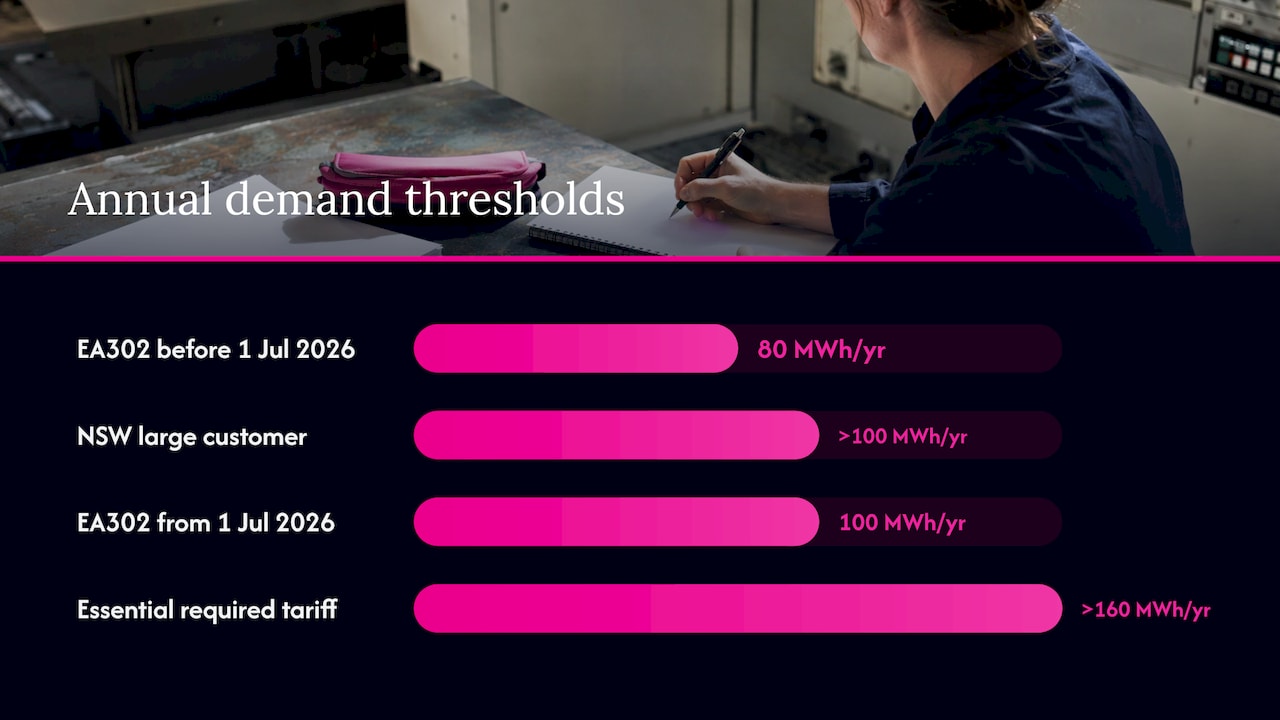
In NSW, large customers use more than 100 MWh a year and small customers less. Essential Energy says it requires customers to move to a demand tariff once they consume more than 160 MWh a year. Smaller businesses can still land on one when their retailer passes through a network demand tariff, as it commonly does on smart-metered small business plans.
The thresholds also move. Ausgrid’s 2026–27 pricing proposal says the cut-off for its small business tariff EA302 rises from 80 MWh to 100 MWh a year on 1 July 2026. That is the last step in aligning with the small-customer definition in the National Energy Retail Law (NSW). If you were reclassified in the past three years, your tariff code may have changed even though your premises did not.
Which network you are on decides the whole structure. If you are not sure, our guides on who covers what in NSW and how to tell which network your property is on take a couple of minutes. For the tariff side in more depth, see network demand tariffs explained for Sydney businesses.
How the charge is calculated
The network sets the demand window, the rate and the unit. The retailer passes it through, sometimes with its own structure. All of the figures below are published 2026–27 rates, ex GST. They are reset each financial year from 1 July, so always check your own bill against the live price list.
The formula
Endeavour Energy’s 2026–27 price list gives the calculation as chargeable demand for the month, times the rate per kW or kVA per day, times the days in the month. Demand is the highest half-hour interval in the peak window, which for Endeavour is 4pm to 8pm on business days. High season runs November to March and low season April to October.
Network windows and rates at a glance
| Network | Peak demand window | 2026–27 published rate (ex GST) |
|---|---|---|
| Ausgrid | 3pm to 9pm weekdays | From 44.53 c/kW/day (EA256, summer and winter only) to 59.53 c/kVA/day (EA310) |
| Endeavour Energy | 4pm to 8pm business days | Rate per kW or kVA per day, by tariff and season |
| Essential Energy | Peak, shoulder and off-peak periods | LV large business demand: $12.0390/kVA/month peak |
The Ausgrid and Endeavour details come from Endeavour’s price list. Essential Energy’s figures are in its 2026–27 price list, which also sets shoulder demand at $10.8924/kVA/month and off-peak demand at $2.8541/kVA/month, plus a $22.3346/day network access charge.
A worked example
Take a café on a tariff priced at 44.53 c/kW/day. On one hot afternoon the oven, two coolrooms, the dishwasher and the air conditioning all run together, and your highest half hour in the window reaches 30 kW.
- 30 kW × $0.4453 per day = about $13.36 a day
- Across a 30-day month that is about $401 ex GST
If you had kept the peak to 22 kW by staggering the start-up of the dishwasher and coolroom defrost, the same month would cost about $294. Your kWh total would be identical. Only the shape of the load changed.
On a kVA tariff the maths works the same way. An Essential Energy LV large business site with a 40 kVA peak would be charged 40 × $12.0390, or $481.56 for that month’s peak component.
Retailer plans can run on a rolling maximum
Some retailer plans do not reset monthly. EnergyAustralia’s Standard Retail Contract rates, effective 1 July 2026, show a business demand tariff for customers over 100 MWh with a demand charge of 54.20690 c/kW/day. It is measured over 2pm to 8pm Monday to Friday and based on the maximum 30-minute period in the past 12 months. On that kind of plan, one spike stays on your bill for a year, so prevention matters far more than correction.
Contract limits and penalties
The federal energy.gov.au guide notes that large users are typically charged in line with their maximum demand and may face penalties if they exceed the maximum demand agreed in their contract. It also notes that retailers charge more for unpredictable demand profiles.
Why 2026–27 bills are worth a second look
Ausgrid’s 2026–27 proposal projects an average network price rise of 9.7% from 2025–26. In its examples, a 10 MWh small business on a flat tariff sees a $174.74 (10.3%) network bill increase, a 125 MWh medium LV business $937.43 (8.3%) and a 331 MWh large LV business $3,318.54 (8.5%). Network prices are set annually and take effect on 1 July, so the figure for your own site is on your next bill and in your distributor’s current price list.
kW or kVA: read your bill first
Before changing anything, find two things on your bill or tariff schedule: the tariff code and whether demand is charged in kW or kVA.
- kW is the real power doing work: running motors, heating, cooling.
- kVA is the total power the network must supply, including the part that does no work when power factor is poor.
Essential Energy notes that customers with a good power factor pay less on average than those with a poor one under a kVA tariff. Its Q&A also says demand tariffs suit sites with a good load factor, meaning steady use, and hit hardest where demand is short and peaky, such as motor-driven equipment, welders and large lighting ballasts. If your bill is in kVA, part of your peak may be inefficiency in the installation, not real production. That is a different problem from simply using too much.
How to bring the peak down
1. Get the interval data
The energy.gov.au guidance is to request at least a year of usage data from your retailer or a registered meter service provider. Look for the date and half hour of your highest reading inside the demand window. It is usually a hot afternoon with everything running.
2. Stagger the big loads
The NSW Energy Saver toolkit explains that high peaks come from equipment running together at full load, such as cooling, refrigeration, lighting and cooking on a hot day. It suggests pre-cooling a cool room overnight so it can be shut down through the hottest hours, which cuts peak demand without cutting total energy use. Delay start-up of compressors, dishwashers and heaters until after the window, or stagger them by 10 to 15 minutes.

3. Know your window
Only the peak window counts for the demand component. A heavy load at 9.30pm on an Ausgrid tariff or 8.30pm on Endeavour sits outside it. Our guide to peak and off-peak times in NSW shows how the periods fit together.
4. Check the plan as a whole
ENGIE points out that demand plans often carry lower supply and usage charges, so shifting load out of peak periods can let those lower charges offset the demand charge. Whether you come out ahead depends on your pattern, which is why the interval data comes first.
5. Make sure the installation suits the load
This is where the electrical work comes in. Meter type decides how your demand is recorded. Your supply capacity and switchboard decide whether large loads can be spread safely. A site that has outgrown a single-phase supply tends to push everything through one circuit path, and a power supply upgrade or single phase to three phase upgrade gives you the capacity to balance loads. A switchboard upgrade lets heavy equipment be separated onto its own circuits so it can be controlled or scheduled. Metering changes go through your retailer and distributor, and our team handles the electrical side as a Level 2 electrician offering metering services.
One point on who pays for what: if the work involves a new or upgraded connection to the network, see who pays for a new power connection in Sydney.
Our view on demand charges
Most business owners we talk to have been told their bill is high because they use a lot of power. With a demand tariff that is often the wrong diagnosis. The charge is set by a short window of the month, and what sits behind that window is the electrical installation: how the supply is sized, how the loads are split across phases and circuits, and how the metering records them.
That is why we treat a demand charge as an electrical question as much as a tariff question. A site that is trying to run a workshop, coolrooms and air conditioning on an undersized supply and an overloaded switchboard has little room to manage its peaks. A Level 2 upgrade gives you that room.
As an accredited Level 2 ASP contractor, we do the supply upgrades, switchboard upgrades and metering services that put you in control of when your heavy loads run. We offer free site inspections for Level 2 work, so you can see what your site needs before you decide.
Christopher
Where High Demand Electrical fits
If your bill shows a demand component and you suspect the installation is part of the reason, we can look at it on site. We are a certified Level 2 electrical contractor, triple ISO certified, with over 300 five-star reviews, working across residential, commercial and strata properties in Sydney. Our offer includes free site inspections for Level 2 work and a 10-minute callback guarantee. Our work covers power supply upgrades, switchboard upgrades, metering and defect rectification, all to NSW standards.
For an urgent fault or outage we are available 24/7 through our emergency electrician service. To book an inspection, start from our main site.
FAQ
What is a demand charge on a NSW business bill?
It is a charge based on your highest demand in kW or kVA during a set peak window, usually measured over the highest 30-minute interval. It is separate from the daily supply charge and from the per-kWh usage charge. It reflects the cost of keeping network capacity available for your peak.
Does every NSW business pay demand charges?
No. They apply on demand tariffs, which are required for larger customers (Essential Energy, for example, uses a 160 MWh a year threshold) and are common on smart-metered small business plans. Check the tariff code on your bill, because thresholds between tariffs are reviewed each year and Ausgrid’s EA302 cut-off moved to 100 MWh on 1 July 2026.
Can one busy afternoon really set my whole bill?
On many NSW demand tariffs, one interval sets the chargeable demand for the month. On some retailer plans, such as EnergyAustralia’s over-100 MWh business demand tariff, the maximum looks back over 12 months. In both cases the answer is to prevent the spike, by staggering loads inside the peak window.
Can an electrician reduce my demand charge?
An electrician cannot change your tariff, but the installation affects how well you can manage demand. Supply capacity, three-phase balance, switchboard layout and metering all shape your peaks. A Level 2 inspection shows whether upgrades would give you room to schedule and spread heavy loads.
Sources
- Endeavour Energy Network Price List 2026–27
- Essential Energy Network Price List and Explanatory Notes 2026–27
- Essential Energy: Moving customers to demand tariffs Q&A
- EnergyAustralia: Energy Tariffs and Rates for Small Business
- EnergyAustralia Standard Retail Contract Rates 2026–27
- NSW Climate and Energy Action: Energy tariffs
- NSW Climate and Energy Action: Energy charges and fees
- Ausgrid 2026–27 Pricing Proposal Overview, AER
- energy.gov.au: Understand your energy needs
- NSW Energy Saver Registered Clubs Toolkit
- ENGIE: Maximum Demand Tariff
Recommended
Need Help Fast?
Powering Your Needs with Expertise
If you’re looking for a reliable, experienced, and prompt electrician, look no further than High Demand Electrical. We cater to all your electrical needs, from routine maintenance to emergency repairs and complete system installations. Our skilled team is committed to providing professional service that ensures your electrical systems run smoothly. Whether it's a small task or a large project, give us a call today. Let us meet all your electrical demands with the quality and reliability you deserve.

Licensed Level 2 ASP electricians across Sydney. Same-day service and 24/7 emergency response.
Licence 397193C
ABN 87 051 836 527