Commercial Surge Protection for Sydney Businesses
Commercial surge protection is a set of surge protective devices (SPDs) fitted at your main switchboard, your distribution boards and sometimes at individual equipment, so a voltage spike is diverted before it reaches your tills, servers, lifts, HVAC and lighting controls. It only works when the devices are chosen for the site, placed in the right order and wired with short, direct leads. That is design work for a certified Level 2 electrician, and it is what we do at High Demand Electrical across Sydney, with free site inspections for Level 2 work.
TL;DR
- A surge, or transient overvoltage, can destroy equipment outright or wear it down slowly, so the cost often shows up as downtime and repeat faults rather than one visible failure.
- Protection works in layers: a device at the main switchboard, further devices at distribution boards, and extra protection for sensitive equipment on longer cable runs.
- Installation quality matters as much as the device. Long or tangled leads raise the voltage that reaches your equipment.
- AS 1768:2021 sets out a risk-based approach to lightning protection, and it does not promise that damage can be prevented entirely.
- Permanently wired SPDs are electrical work. In NSW that means a licensed electrician, not a maintenance handyman or an in-house IT team.
Table of Contents
- What a surge does inside a commercial building
- How the layers of protection fit together
- Where installations go wrong
- Which Australian rules apply
- Who must do the work
- Property managers and strata: a practical checklist
- How we approach a commercial surge protection job
- Our view: protection is design, not a gadget
- Get your site assessed
- FAQ
- Sources
What a surge does inside a commercial building
An SPD limits transient voltages by diverting or limiting surge current, as the NEMA Surge Protection Institute explains. NEMA lists the places where this matters: distribution equipment, control cabinets, programmable logic controllers, lighting, metering, medical equipment, UPS systems, HVAC and communications.
The damage comes in two forms. According to the institute’s surge damage guidance, a transient can cause lock-ups, malfunctions, erroneous outputs, lost or corrupted files, progressive component degradation or immediate physical failure. The slow version is the one businesses miss. A server that reboots at random, a variable speed drive that fails every second summer or a point-of-sale terminal that keeps dropping out can all be a symptom of repeated small hits rather than bad luck.
A 2025 NEMA paper on transient overvoltage reports that surges can lead to equipment failure, downtime, lost productivity and lost revenue. It also makes two points that change how you plan:
- Both power lines and signal lines need to be considered. A data or communications cable between buildings can carry a surge in just as a power cable can.
- Estimates in the paper put externally generated surges at about 20% of transient activity inside a facility. Internal sources such as switching contactors, relays, breakers, capacitor banks and large electrical loads produce the rest.
That second point matters for a business. A workshop, a cold room or a building full of motors and compressors creates its own surges every day. Protection is not only a storm-season measure.
How the layers of protection fit together
You will see SPDs described as Type 1, Type 2 and Type 3. In plain terms, it is a ranking by where the device sits and how much surge energy it is built to handle. Type 1 is for the point where a building’s supply is most exposed to lightning current. Type 2 is the workhorse for switchboards. Type 3 is for the final stretch close to sensitive equipment.
For main and distribution boards, specifications from Australian utilities show how this looks in practice. South Australia Water’s technical standard lists combined Type 1 plus Type 2 devices and Type 2 devices for main and distribution boards. It also calls for a backup fuse, circuit breaker or dedicated SPD disconnector matched to the manufacturer’s maximum backup-fuse rating. That is one organisation’s project specification, not a national rule, but it shows the level of detail a proper installation involves.
A typical commercial layout works like this:
| Location | Purpose | What we look at |
|---|---|---|
| Main switchboard | First line of defence for everything the building draws | Device rating, backup protection, earthing |
| Distribution boards | Catches what passes the main board and surges generated inside the building | Rating suited to the board and loads it feeds |
| Sensitive equipment | Protects servers, controls and communications at the end of longer runs | Cable length from the protected board, signal and data lines |
Cable length is the practical test for whether you need the third layer. Guidance published in 2024 by an Australian electrical distributor suggests considering additional protection once the run from a protected switchboard to equipment goes beyond 10 metres. For a floor of offices that is rarely an issue. For a warehouse with a comms room at the far end, it is.
Where installations go wrong
Buying a good device does not guarantee a good result. Four things decide the outcome.
Lead length and wiring
SA Water’s standard asks for the SPD to be installed as close as practicable to the neutral and earth bar, with wiring as straight and direct as possible. The reason is physics: every extra metre of lead adds inductance, and during a fast surge that inductance adds voltage on top of what the device lets through. A neat-looking board with a surge device on long, looped leads can protect far less than a tidy one with short leads.
A single earth reference
An installation should define a surge-protection boundary across every entering power, signal and RF service. Devices inside that boundary should reference the same earth, and protected and unprotected cables should be kept apart. If an unprotected cable runs beside a protected one, the surge can jump across and bypass the device.
Failure indication
An SPD wears as it absorbs surges. SA Water’s standard calls for failure indication so that a spent device is noticed. A device that has quietly stopped working while its green light is ignored gives you the cost of protection and none of the benefit. We include SPD status in electrical maintenance visits for this reason.
Treating existing protection as adequate
When a building is altered, previous protection should not be assumed to still fit. Sydney Water’s 2025 earthing and lightning specification requires that alteration works re-evaluate existing earthing and lightning protection against AS 1768, AS 2067 and AS/NZS 3000. A fitout, a new tenancy, a generator or an EV charging bay all change the load and the cable routes, and that is the moment to review.
Which Australian rules apply
AS 1768 is the lightning protection standard. Standards Australia describes the 2021 edition as a major revision aligned with IEC standards. It covers risk assessment, structural protection, protection of electrical and electronic equipment, testing and maintenance, and personal safety. It also recognises that many modern buildings are inherently self-protecting, and it says conformance reduces the probability of damage and injury but cannot guarantee their prevention.
Two practical lessons follow:
- Protecting the structure and protecting the electronics are separate questions. A steel-framed building may handle a direct strike structurally while the services entering it still carry surges to your equipment.
- The answer is risk-based. Lightning exposure, tall nearby structures or hills, long or exposed supply lines, internal switching sources and the value of what is connected all feed into the decision.
The installation itself falls under the wiring rules, AS/NZS 3000. Sydney Water’s specification, for example, requires SPD installation to follow AS 1768 including its Appendix F for SPD installation requirements. Your insurer, landlord or lease may also set requirements of their own, so check them before you scope the work.
Who must do the work
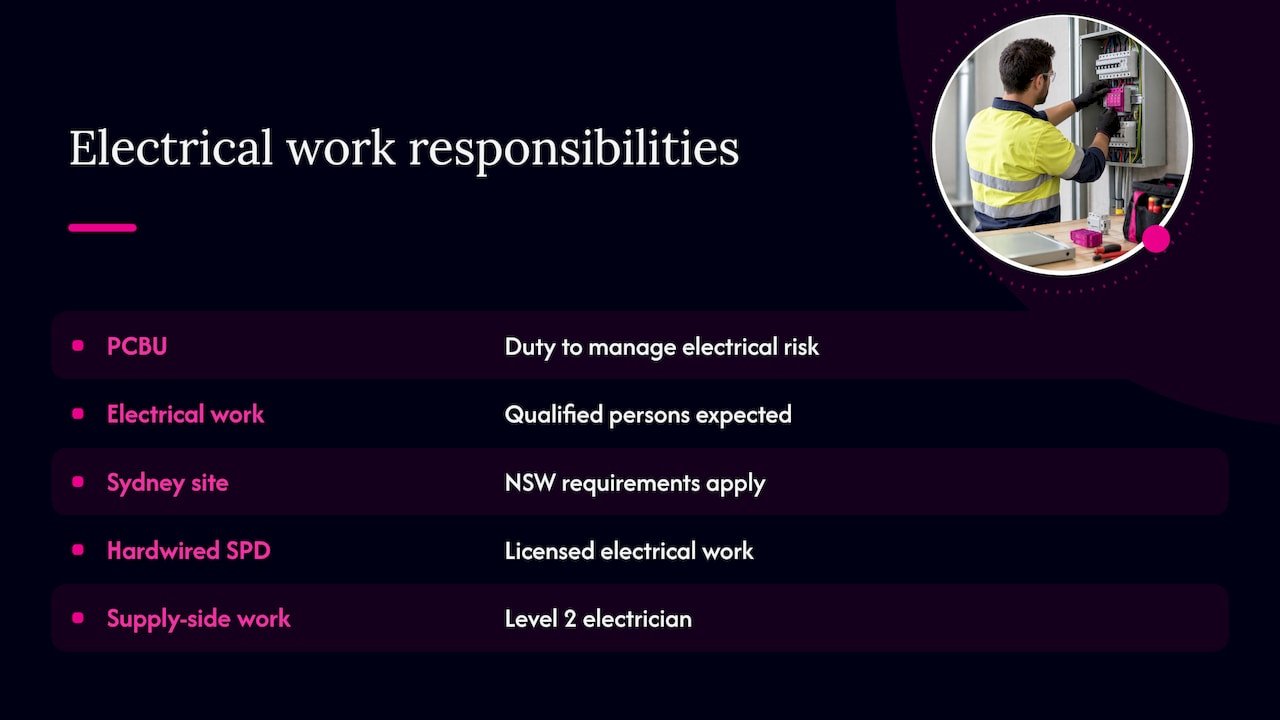
In a workplace, the person conducting the business or undertaking carries the duty to manage electrical risk. The Safe Work Australia model code of practice expects electrical work to be carried out by qualified persons, and it explains that state and territory authorities, not Safe Work Australia, regulate and enforce the rules. For a Sydney business, that means NSW requirements apply to your site.
A hardwired SPD is part of your installation, so it is licensed electrical work. Where the work touches the supply, such as a switchboard upgrade, a new consumer mains or a move from single phase to three phase, an accredited Level 2 electrician is the right tradesperson. Our electricians are fully accredited Level 2 ASP electricians, which means the same team can scope the protection and handle the supply-side work around it.
Property managers and strata: a practical checklist
If you manage a building rather than run a business in it, these are the questions to settle first:
- What is critical? List the equipment whose failure stops trading or safety: lifts, fire panels, security, servers, refrigeration, EV chargers.
- How does power and data enter? Overhead or underground mains, and any cabling between buildings.
- What was the last change? Fitouts, tenancy changes, new loads and upgrades all reset the question of whether existing protection still fits.
- Is there a recent inspection record? An electrical safety inspection gives you a baseline of the switchboard and earthing before protection is specified.
- Who checks the devices? Failure indicators only help if somebody reads them on a schedule.
For wider obligations across a portfolio, our commercial electrical compliance page sets out how we support property managers.
How we approach a commercial surge protection job
We start with a free site inspection for Level 2 work, so you know what the building needs before any decision is made. We look at the supply, the switchboards, the earthing and the equipment you cannot afford to lose, then design the layers around that. If your switchboard is old or overloaded, we can upgrade it at the same visit rather than bolting protection onto a board that is already at its limit. See our switchboard upgrades and power supply upgrades pages for that side of the work.
We publish no prices for this work because the scope depends on the site. A single-tenancy office with one board is a different job from a multi-level building with several boards and external cabling, and you receive a quote after the inspection.
Our view: protection is design, not a gadget
We get asked for a surge protector the way people ask for a smoke alarm: one box, one price. The better question is which of your systems can least afford a bad day, and how a surge would reach them.
Sometimes it arrives on the incoming supply. Sometimes it comes in over a data cable, and sometimes your own compressors and contactors make it. A device on the main board helps with the first, but not with the others unless the layers, leads and earthing are designed together.
That is why we start with the inspection and design from there. Our Level 2 ASP electricians can look at the supply, the switchboard and the protection as one system, and respond 24/7 if a surge has already done its damage. Triple ISO certification and over 300 five-star reviews are the result of doing the unglamorous parts, like lead length and earthing, properly.
If your business depends on its power, the right time to look at protection is before the storm, the fitout or the failed server.
Christopher
Get your site assessed
If you run a shop, office, warehouse or strata building in Sydney and want protection that is designed for your site, our surge protection installation service starts with a free site inspection for Level 2 work. We offer a 10-minute callback guarantee and special discounts for seniors. If something has already failed, our emergency electricians are available 24/7.
You can also reach us through the High Demand Electrical home page to describe your site and book an inspection.
FAQ
Is commercial surge protection compulsory in Australia?
Protection is driven by risk assessment under AS 1768 and by the requirements of the wiring rules, your insurer, your lease and, for some assets, the owner’s own specification. Whether a particular building needs it is a design question. A Level 2 electrician can assess your site and tell you what applies.
Is a power board enough for a business?
Plug-in protection at a desk covers equipment at the end of the line. A surge that enters through the supply or a data cable can reach many items before it gets there. Protection at the switchboards, with extra devices for sensitive equipment, covers the building as a whole.
Can surge protection stop all lightning damage?
No system can promise that. Standards Australia notes that conformance with AS 1768 reduces the probability of damage and injury but cannot guarantee their prevention. A well-designed, correctly installed set of devices reduces the risk to your electrical and electronic equipment considerably.
How do I know if my devices still work?
SPDs wear as they absorb surges, so they carry failure indicators in line with good practice. Have them read during routine electrical maintenance, and after any major storm or electrical event. Our electrical maintenance service covers regular checks of this kind.
Who can install surge protection in a Sydney commercial building?
A licensed electrician, because the devices are wired permanently into your installation. If the work involves the supply or mains, a Level 2 accredited electrician is the right choice, and that is the work we do across Sydney.
Sources
- What Are SPDs, NEMA Surge Protection Institute
- Surge Damage, NEMA Surge Protection Institute
- Impact of Transient Overvoltage on Equipment, NEMA 2025
- AS 1768:2021 preview, Standards Australia
- Model Code of Practice: Managing electrical risks in the workplace, Safe Work Australia
- TS 0300 low voltage supply and installation, South Australia Water
- Technical specification, earthing and lightning, Sydney Water
Recommended
Need Help Fast?
Powering Your Needs with Expertise
If you’re looking for a reliable, experienced, and prompt electrician, look no further than High Demand Electrical. We cater to all your electrical needs, from routine maintenance to emergency repairs and complete system installations. Our skilled team is committed to providing professional service that ensures your electrical systems run smoothly. Whether it's a small task or a large project, give us a call today. Let us meet all your electrical demands with the quality and reliability you deserve.

Licensed Level 2 ASP electricians across Sydney. Same-day service and 24/7 emergency response.
Licence 397193C
ABN 87 051 836 527