Get a Single Line Diagram: Backup Power for Australian Businesses
Reliable backup power for business sites is rarely one product. It is a system: a UPS for instant, silent continuity, paired with a generator or battery bank for extended outages. The real work is classifying your essential loads first, then designing the transfer and protection around them. We assess sites regularly and the design, not the equipment brand, is what determines whether the lights actually stay on.
TL;DR:
- Matching the backup power technology to specific load types is critical, with UPS for sensitive equipment and generators for longer runtimes.
- Proper generator sizing starts with a detailed load assessment, including motor inrush currents and transfer switch behavior, not just kVA estimates.
- Sizing UPS runtime must align with generator start times or shutdown procedures, and system redundancy depends on criticality, not just capacity.
- Regular load testing, documentation, and maintenance are essential to ensure backup systems function reliably during actual outages.
- A site-specific inspection and documented commissioning report are vital for effective and compliant backup power system installation.
Table of Contents
- Backup power options and when each one fits
- Generator integration: sizing, sequencing and control done properly
- UPS systems: sizing runtime, redundancy and generator handover
- Batteries and hybrid systems: what they deliver and when to pick them
- Testing, commissioning and maintenance: what to require
- Regulatory, standards and safety checks before you install
- Business continuity planning and a practical cost checklist
- How our site inspection and installation process works
- Specs matter less than sequencing and proof
- Book a free Level 2 site inspection
- FAQ
- Sources
- Primary standards and guidance worth checking
Backup power options and when each one fits
Before comparing quotes, it helps to know what each technology actually does. A UPS (uninterruptible power supply) bridges the gap between mains failure and backup start, protecting sensitive equipment from the interruption itself. A standby generator picks up the load once a transfer switch detects an outage, and keeps supplying power for as long as fuel lasts. Battery storage systems discharge instantly and quietly but for a limited window, and hybrid systems combine batteries with solar or a generator to balance runtime against noise and fuel use.
Matching the technology to the load matters more than buying the biggest unit available:
- IT and server rooms need near-instant, clean power, which is a UPS job first and a generator second.
- Life-safety and medical equipment typically need dual protection, UPS for the gap plus generator for duration, under backup power for medical equipment style requirements.
- Refrigeration and cold storage tolerate brief gaps but need hours of generator or battery runtime.
- HVAC and sump pumps usually just need the generator to start within a defined window, without UPS support.
Commercial battery duration commonly ranges from around 2 to 8 hours depending on system size and load, which is a useful planning figure rather than a guarantee for any specific site.
Generator integration: sizing, sequencing and control done properly
Generator sizing starts with a single-line diagram and a documented essential-load list, not a kVA guess. Skipping this step is the single biggest cause of systems that look fine on paper and fail in an actual outage.
- Classify essential loads first: life-safety circuits, refrigeration, servers, lighting, and anything with a motor.
- Assess starting current, because motor inrush on pumps, compressors and air conditioning can be several times the running load, and under-sizing for this is a common, avoidable failure.
- Confirm ATS behaviour: transfer timing, neutral switching and how the automatic transfer switch talks to building controls need to be specified, not assumed.
- Plan fuel logistics, including storage, refuelling access and run-time targets under full load.
- Address parallel operation, islanding and reconnection if more than one source will ever run together, since this affects protection settings and labelling.
Dependable generator installation requires essential-load selection, starting-current assessment, proper transfer and control integration, fuel planning and realistic load testing, according to South Australian Government guidance on back-up generators. Oversizing the genset does not fix a sequencing problem, correct assessment does.
Larger commercial sites running three-phase loads should also see our page on three-phase backup power for businesses, which covers architecture for bigger buildings.
Pro Tip: Ask for the single-line diagram and a written commissioning test report before you sign off on any generator installation, not after.
UPS systems: sizing runtime, redundancy and generator handover
A UPS is only doing one job well if its runtime matches what happens next: either the generator starts within a known window, or equipment shuts down gracefully. Sizing it around an arbitrary number of battery-hours, instead of the actual transition plan, is a common mistake in commercial specifications, as UPS behaviour guidance for critical facilities makes clear.
When specifying a UPS for business continuity, include these items in the quote request:
- Runtime matched to generator start time or to a documented shutdown sequence, not a round number.
- Redundancy pattern (N or N+1) depending on how critical the load is and what single-unit failure would cost you.
- Monitoring and remote alerts so a fault is flagged before the battery is actually needed.
- Maintenance bypass switch (MBS) access so servicing never requires taking the load down.
- Battery recharge performance, since some project standards specify recharge to 80% within 8 hours, a useful benchmark worth asking any supplier to match.
Businesses with larger UPS and generator combinations should see our commercial generator installation page for how we integrate the two.
Batteries and hybrid systems: what they deliver and when to pick them
Batteries respond instantly and run silently, which suits offices, retail and anywhere noise or exhaust is a problem, but they are limited by capacity. Generators trade a short start delay for far longer runtime, limited mainly by fuel supply.
Hybrid systems, pairing batteries with solar or a generator, suit businesses with a specific outage pattern rather than a generic one:
- Frequent short outages favour batteries doing most of the work, with the generator as backup for extended events.
- Peak shaving and reduced fuel use make hybrids attractive where fuel delivery is awkward or costly.
- Sustainability targets are easier to meet with solar-charged batteries covering routine short interruptions.
Battery duration in practice runs around 2 to 8 hours, and that figure swings with load, ambient temperature, battery chemistry and state of health, so treat any single number as a planning guide rather than a spec.
Testing, commissioning and maintenance: what to require
A backup system that has never been load-tested is a guess, not a plan. Testing under a representative load, not just an idle start-up, is what separates a system that works on paper from one that works at 2am during a genuine outage.
- Require a commissioning test report documenting a realistic load test, not just a no-load start.
- Confirm handover includes a single-line diagram, operator instructions and a maintenance log.
- Schedule routine maintenance: exercise the generator under load monthly, check battery health quarterly, and test the ATS on a set cadence.
- Keep a simple monthly checklist your own staff can run between specialist visits, covering fuel level, warning lights and battery status.
Pro Tip: A generator that starts but has never carried its full essential load under test is an unproven system, not a working one.
Regulatory, standards and safety checks before you install
Generator connections and generator-fed switchboards need to meet AS/NZS 3010 and SafeWork requirements for protection and licensed installation.
- Confirm the installer is a licensed, accredited contractor working to AS/NZS 3010 for generator-fed submains.
- Check connection points and equipment requirements against current distributor service and installation rules before work starts.
- Confirm RCD and protection requirements are covered on any generator-fed switchboard.
- Treat permits and network notifications as part of the project, not an afterthought.
- Never rely on a portable generator plugged into a switchboard as a substitute for an integrated standby system; this is explicitly flagged as unsafe in continuity guidance.
Business continuity planning and a practical cost checklist
Power decisions should sit inside a wider continuity plan that also covers data backup and communications. Small Business NSW continuity guidance recommends cloud backups, alternative communications and caution with portable generators as part of a complete plan, not an add-on.
Cost drivers worth scoping before you request quotes:
- Generator capacity and fuel storage, scaled to your actual essential loads, not the whole building.
- UPS capacity and battery banks, sized to your transition plan.
- Switchboard or supply upgrades, often needed alongside generator or three-phase UPS installation, covered under power supply upgrades.
- Labour and commissioning, including test reports and documentation.
Sites with complex fuel storage or external works may also need coordinated civil and utility planning, which is where a concept site and utility plan from a planning specialist becomes worth involving early. Any figure here is illustrative only: a site-specific quote is the only reliable number.
How our site inspection and installation process works
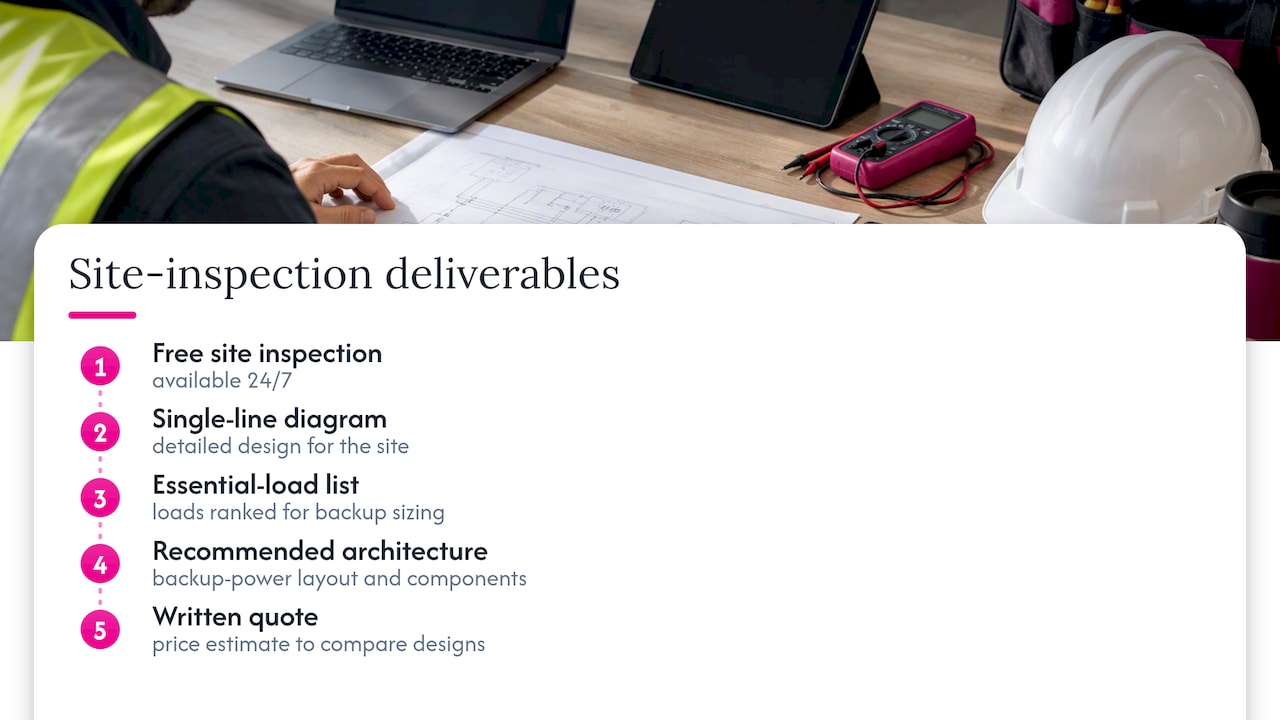
We offer a free site inspection for Level 2 work, available 24/7. That inspection delivers a single-line diagram, an essential-load list, a recommended architecture and a written quote, so you are comparing a real design, not a guess.
On handover, you get a commissioning test report, documented test evidence and operator training, so your team knows exactly what to do during an outage and what the maintenance schedule looks like afterwards.
Specs matter less than sequencing and proof
The biggest mistake we see is businesses chasing a bigger generator or a pricier UPS as if capacity alone solves continuity. It does not. Correct load sequencing, a tested transfer switch and a documented commissioning report matter more than kVA on a spec sheet. Ask any installer for their test and maintenance plan before you ask about price.
— Christopher
Book a free Level 2 site inspection
If you are ready to move from planning to installation, our team handles the full scope: site inspection, generator installation, UPS integration and any switchboard upgrades the design needs. The free Level 2 site inspection gives you a single-line diagram, a load list and a written quote, so there is no guessing involved.
Get in touch through our Level 2 Electrician services page to book an inspection, or call our emergency electrician line if you are dealing with an outage right now.
FAQ
What is the best backup solution for small businesses?
For most small businesses, a UPS covering critical equipment paired with a correctly sized generator for longer outages is the practical combination. The right mix depends on which loads you cannot afford to lose and for how long, which is why essential-load classification comes before choosing hardware.
How many hours can 1000VA UPS last?
Runtime depends entirely on the connected load and battery capacity, so there is no single fixed figure for any specific UPS unit. The better question for a business UPS is whether its runtime matches your generator start time or your planned shutdown sequence, not a battery-hour target in isolation.
How much does a commercial backup generator cost?
Commercial generator costs vary with capacity, fuel storage, switchboard work and installation complexity, so a site-specific quote is the only reliable figure. Request a written quote following a proper site inspection rather than comparing unit prices alone.
What is the best backup power source?
There is no single best source: UPS covers instant continuity, generators cover extended duration, and batteries or hybrid systems offer quiet, short-term backup with lower fuel dependence. The right combination depends on your essential loads, outage pattern and sustainability goals, which is why a site assessment comes before any purchase decision.
Sources
- Using generators for back-up power (SA government guidance)
- Electrical practices — construction and demolition sites fact sheet | SafeWork NSW
- Prepare for the unexpected — Business continuity plan | Small Business NSW
- AC uninterruptable power supply (UPS) standard specification | Seqwater
- New South Wales Standard Electricity Service & Installation Rules (draft)
Primary standards and guidance worth checking
- Using generators for back-up power (SA government guidance)
- Electrical practices — construction and demolition sites fact sheet | SafeWork NSW
- Prepare for the unexpected — Business continuity plan | Small Business NSW
- New South Wales Standard Electricity Service & Installation Rules (draft)
- AC uninterruptable power supply (UPS) standard specification | Seqwater
Recommended
Powering Your Needs with Expertise
If you’re looking for a reliable, experienced, and prompt electrician, look no further than High Demand Electrical. We cater to all your electrical needs, from routine maintenance to emergency repairs and complete system installations. Our skilled team is committed to providing professional service that ensures your electrical systems run smoothly. Whether it's a small task or a large project, give us a call today. Let us meet all your electrical demands with the quality and reliability you deserve.