What does an after hours electrician cost in NSW?
Most NSW homeowners calling an electrician outside business hours should expect a call-out fee plus first-hour labour landing in a moderate to high price range, with total jobs often costing several hundred dollars depending on complexity. Overnight calls (midnight to 7am) and public holidays generally cost more; a Tuesday evening callout usually costs less. Timing genuinely matters here, and it is the biggest single lever on your final bill.
- Weeknight evening (before midnight): generally the lowest after-hours tier
- Overnight (midnight to 7am): highest premium, reflects disrupted rostering
- Weekends and public holidays: comparable to overnight rates, sometimes higher
Quick fact: Industry pricing guides show emergency and after-hours electrical work commonly attracts a rate multiplier above standard business-hours pricing, with a minimum charge block applied regardless of how quickly the fault is fixed.
Before you dial anyone, confirm they hold a valid NSW contractor licence and are genuinely available 24/7. Hdlevel2electriciansydney operates as a Sydney-based Level 2 provider covering after-hours emergencies across the metro area, and NSW Fair Trading’s licence checks apply whoever you call.
Key Takeaways
After-hours electrical costs in NSW hinge on timing, minimum charge blocks, and whether the job needs Level 2 accreditation, not just the fault itself.
| Point | Details |
|---|---|
| Typical total range | Most after-hours jobs typically involve charges ranging from moderate to higher amounts depending on time of day and complexity. |
| Timing drives price | Overnight and public holiday callouts sit at the top of the pricing tier, weeknight evenings at the bottom. |
| Minimum billing applies | Most electricians bill a one to two hour minimum regardless of how quickly the fault is resolved. |
| Verify before booking | Check the electrician’s NSW contractor licence and insurance before agreeing to dispatch. |
| Local Level 2 option | Hdlevel2electriciansydney offers 24/7 Level 2 certified emergency service across Sydney with free site inspections. |
Table of Contents
- After hours electrician cost breakdown: call-out fees and hourly rates
- Time-based premiums: what changes at night and on public holidays
- Is your electrical fault a genuine emergency?
- Hidden costs and what the call-out fee actually covers
- How to cut after-hours electrical repair costs without cutting corners
- What to check before you dispatch an after-hours electrician
- Sydney metro versus regional NSW: why prices differ
- Why Level 2 certification matters when choosing your electrician
- Why the standard pricing advice misses the point
- Get a Level 2 electrician out tonight, not just a quote
- Sources
After hours electrician cost breakdown: call-out fees and hourly rates
Every after-hours quote is built from two or three components, and understanding them stops you second-guessing an invoice at 2am.
The call-out fee (sometimes called a dispatch or service fee) covers the electrician driving to your property, an initial diagnostic assessment, and often the first portion of labour. It is not a hidden add-on. It is standard practice across the trade, and it exists because dispatching a qualified electrician outside rostered hours costs the business more, regardless of how simple the fix turns out to be.
Hourly labour then stacks on top, and this is where time of day makes the real difference:
- Business hours (7am to 6pm weekdays): the cheapest tier, typically used as the baseline everyone compares against.
- After-hours weeknight (6pm to midnight): a moderate premium, usually the entry point for “urgent but not overnight” calls.
- Overnight (midnight to 7am): the highest standard premium, reflecting the disruption to an electrician’s rest and roster.
- Weekends and public holidays: priced similarly to overnight work, occasionally higher on gazetted public holidays.
Most licensed operators bill a minimum block of labour even if the actual repair takes less time. This isn’t padding. A Reviewbook industry pricing analysis confirms minimum-charge structures are standard across emergency trades, largely because travel time and setup eat into that first hour regardless of the job’s size.
Here’s how that plays out in practice. A make-safe callout for a tripped main switch that won’t reset might resolve in 30 minutes but still bill at the one-hour minimum, landing around $300 to $400 all up. A genuine one-hour repair, such as replacing a faulty circuit breaker, tends to land between $400 and $600 once the call-out fee and after-hours rate are combined. A multi-hour job, like tracing an intermittent fault across several circuits, can climb past $800 once you factor in extended labour and any parts required.
Time-based premiums: what changes at night and on public holidays
Timing doesn’t just nudge the price. It can shift your total bill by hundreds of dollars, so it pays to know where the thresholds sit.
- Before 6pm on a weeknight: often billed at standard or lightly loaded rates if the electrician is still within a normal shift window.
- 6pm to midnight: the first genuine after-hours tier, usually a moderate percentage loading on the hourly rate.
- Midnight to 7am: the steepest premium tier, sometimes with an additional flat “overnight” surcharge on top of the loaded hourly rate.
- Saturdays, Sundays and public holidays: comparable to overnight pricing, and on a long weekend some operators apply holiday-specific loading.
Pro Tip: If your issue is stable, not spreading, and doesn’t involve exposed wiring or a burning smell, ask the electrician on the phone whether it’s safe to wait until 7am. Reputable operators will tell you honestly rather than upsell an overnight visit.
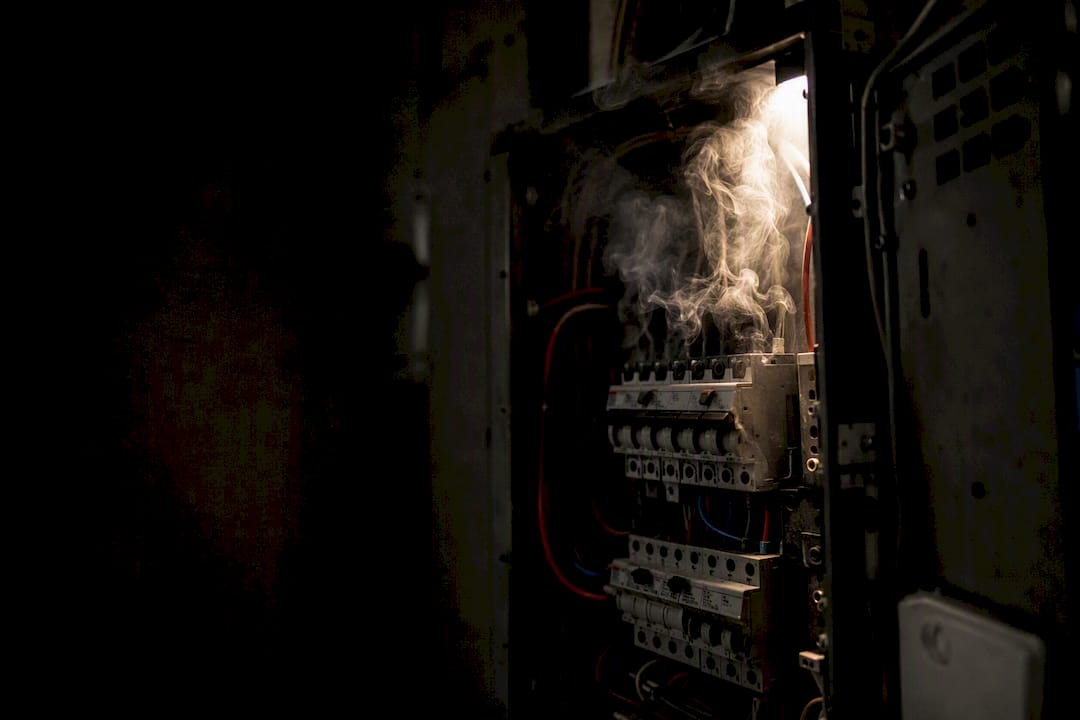
The question worth asking yourself before you book is simple: is this actively getting worse, or is it just inconvenient? A dead power point at 11pm is annoying. A switchboard buzzing and smelling of hot plastic is not something to sit on until morning, regardless of the premium. Weigh the after-hours loading against the actual risk, not just your frustration level.
Is your electrical fault a genuine emergency?
Some faults justify paying the after-hours premium without hesitation. Others can safely wait for a standard weekday visit at standard weekday rates.
Call immediately if you notice:
- Visible sparking, arcing, or a burning smell from outlets, switches or the switchboard.
- Total loss of power affecting the whole property, especially with no confirmed street-wide outage.
- Any electrical fault involving contact with water, flooding, or a storm-damaged power line.
- Smoke or scorch marks anywhere near wiring, appliances or the meter box.
If you see flames or a fire risk, call 000 first. Fire & Rescue NSW publishes clear guidance on when a household electrical hazard requires emergency services rather than a tradesperson alone.
Issues that can usually wait for business hours include a single dead power point with no heat or smell, one light fixture failing, or planned upgrade work like a switchboard swap. While you wait, switch off the affected circuit at the switchboard if it’s safe to reach, avoid any contact with water near electrical fittings, and don’t attempt DIY repairs on live circuits.
Pro Tip: Take a photo of your switchboard and note which circuit breaker trips repeatedly. It saves the attending electrician diagnostic time, which can shave real minutes off your billed hour.
Hidden costs and what the call-out fee actually covers
The call-out fee typically covers travel, arrival, and diagnostic assessment, sometimes bundled with the first hour of labour. What it usually doesn’t cover catches people out.
- Parts and materials: circuit breakers, switches, cabling and other components are billed separately from labour, and prices vary by brand and availability at that hour.
- Specialised access equipment: if the fault sits in a roof void, subfloor, or requires a ladder beyond a standard extension, expect an access fee.
- Extended labour blocks: once you’re past the minimum charge period, most operators bill in 15 or 30 minute increments.
- Make-safe versus permanent repair: an after-hours visit often only restores safety (isolating a faulty circuit, replacing a blown fuse temporarily) rather than delivering a full permanent fix, which may need a scheduled follow-up.
Diagnostics and repair are usually billed as separate line items, even when they happen in the same visit, because finding the fault and fixing it are genuinely different jobs.
Before you agree to dispatch, ask the call handler three things: what the call-out fee includes, what the hourly rate is after that period, and whether a written estimate will be provided for anything beyond a simple fix. A make-safe visit that restores power safely overnight, followed by a scheduled permanent repair during business hours, is often the most cost-effective sequence for anything beyond a straightforward fault.
How to cut after-hours electrical repair costs without cutting corners
You can’t always avoid an emergency, but you can avoid paying premium rates for something that isn’t one.
- Reset before you call. Check whether an RCD or circuit breaker has simply tripped, and try resetting it once, safely, from the switchboard.
- Check your neighbours. If the whole street is dark, it’s likely a grid outage, not your wiring, and calling your electricity distributor costs nothing.
- Isolate, don’t ignore. If one circuit is misbehaving, switching it off at the board can neutralise the risk until a standard business-hours visit.
- Bundle non-urgent work. If you’ve been meaning to book a switchboard upgrade or extra power points, schedule it alongside any planned electrical visit rather than as a separate after-hours callout.
Pro Tip: Check your home and contents insurance and, if you rent, your lease terms before calling. Storm damage or a landlord-responsibility fault may mean the after-hours cost isn’t yours to cover outright.
What to check before you dispatch an after-hours electrician
A few quick questions on the phone protect you from both rogue operators and bill shock.
- Ask for their NSW contractor licence number and confirm it against the NSW contractor licence verifier before they arrive, not after.
- Confirm they carry current insurance, and ask whether a written estimate will be issued for anything beyond the call-out and first hour.
- Get verbal confirmation of the call-out fee and hourly after-hours rate before agreeing to dispatch.
- Ask what happens if extra parts or additional hours are needed, and whether you’ll be consulted before extra costs are incurred.
- Photograph the licence card on arrival and jot down the quoted price and job description for your own records.
NSW Fair Trading maintains guidance on hiring trades and what to do if a dispute arises over pricing or workmanship, worth bookmarking before you ever need it.
Sydney metro versus regional NSW: why prices differ
Where you live changes both the price and the wait. Sydney metro areas generally have more electricians on call, which keeps availability reasonable even at 2am, though metro labour rates themselves can run slightly higher due to overheads.
- Regional NSW: fewer available after-hours electricians per region often means longer travel distances, and travel time is frequently billed on top of the standard call-out fee.
- Metro Sydney: typically lower travel surcharges but comparable or higher base hourly rates, given higher operating costs.
- Remote or outer-regional areas: expect the electrician to quote a travel component separately, and to ask upfront how far you are from their base.
Regional residents get the best result by confirming licensing through Service NSW and asking about travel fees at the very start of the call, not after the electrician is already on the road.
Why Level 2 certification matters when choosing your electrician
Not every electrical fault can be handled by a standard licensed electrician. Faults on the network side of your meter, including service line faults, meter work, and connections to the street supply, legally require a Level 2 Accredited Service Provider (ASP). Attempting network-side work without Level 2 accreditation is both unsafe and non-compliant with NSW network operator requirements.
Hdlevel2electriciansydney operates as a certified Level 2 electrician across Sydney, available 24/7, with over 300 five-star reviews and free site inspections offered for Level 2 scope work.
- Level 2 accreditation is mandatory for meter and network connection work, not optional.
- 24/7 availability matters most for genuine emergencies, not routine upgrades.
- Free site inspections remove the guesswork before committing to Level 2 project costs.
- Verified reviews and a checkable licence give you two independent trust signals, not just one.
| Point | Details |
|---|---|
| Certification requirement | Network-side faults and meter work legally require a Level 2 Accredited Service Provider. |
| Proof point | Hdlevel2electriciansydney has attracted hundreds of positive reviews across its Sydney service area. |
| Free inspection offer | Site inspections for Level 2 scope work are offered at no cost before any commitment. |
Why the standard pricing advice misses the point
Most cost guides treat after-hours electrical pricing as a simple time-of-day multiplier, and while that’s technically true, it misses what actually costs homeowners money: not knowing whether their fault is genuinely urgent in the first place. The research here points to something more useful than a rate table. It points to a phone conversation.
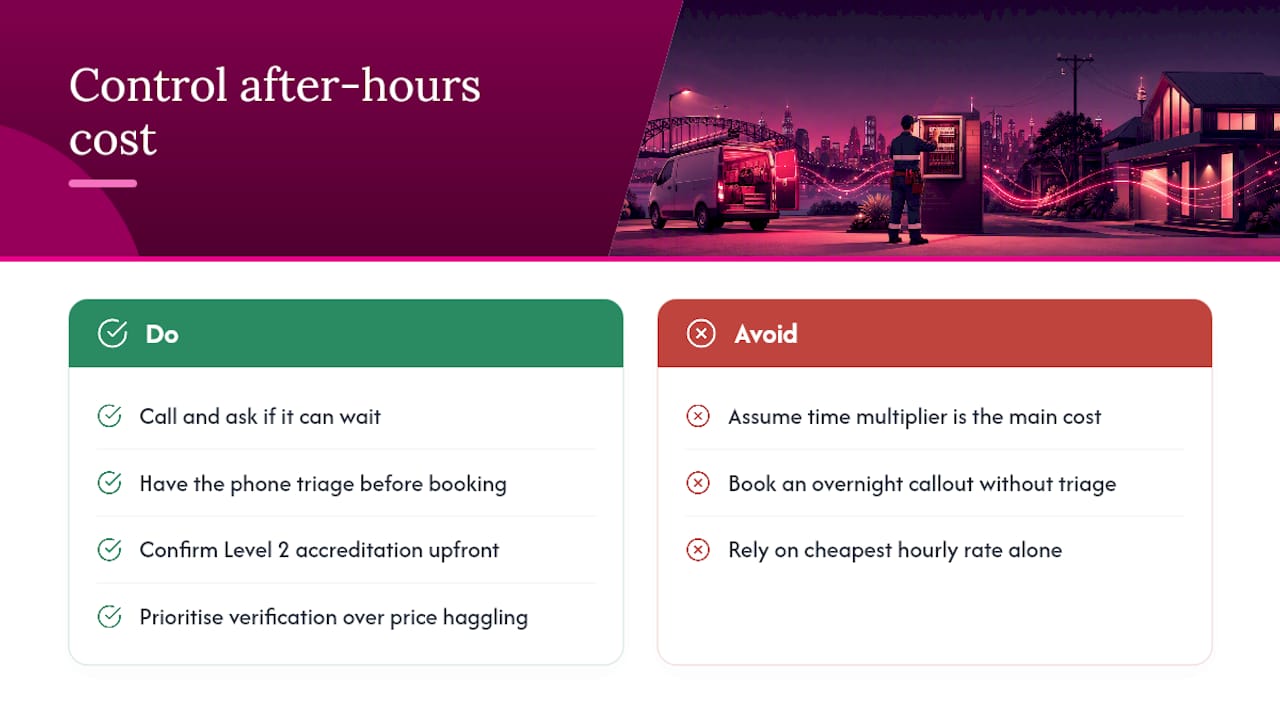
The biggest overlooked lever isn’t negotiating the hourly rate. It’s asking a licensed dispatcher, honestly, whether your fault can wait four hours until 7am. That single question, asked before you commit to an overnight callout, does more to control cost than any amount of bargaining over the invoice afterwards.
Conventional advice also underplays how often a fault sits in Level 2 territory, network connections, meter faults, where a standard electrician legally can’t help regardless of price. Confirming Level 2 accreditation upfront saves a second, more expensive callout later. Prioritise verification and honest triage over chasing the cheapest hourly rate. That’s where the real savings live.
— Christopher
Get a Level 2 electrician out tonight, not just a quote
Hdlevel2electriciansydney is the direct alternative to ringing around for quotes at midnight. You get one call, a Level 2 certified electrician dispatched across Sydney, and a team that can legally handle network-side faults most standard electricians have to turn away.

If your situation matches the emergency signs covered earlier, sparking, burning smells, total power loss, don’t wait on a callback from three different operators. Hdlevel2electriciansydney’s emergency electrician service covers residential and commercial properties across Sydney, backed by over 300 five-star reviews and free site inspections for Level 2 scope work. For faults that turn out to need a temporary fix first, the make-safe service restores safety immediately while a permanent repair gets scheduled at standard rates. Call now, confirm the licence on the spot, and get it fixed properly the first time.
Sources
Recommended
Powering Your Needs with Expertise
If you’re looking for a reliable, experienced, and prompt electrician, look no further than High Demand Electrical. We cater to all your electrical needs, from routine maintenance to emergency repairs and complete system installations. Our skilled team is committed to providing professional service that ensures your electrical systems run smoothly. Whether it's a small task or a large project, give us a call today. Let us meet all your electrical demands with the quality and reliability you deserve.