When Are Tiger Tails Mandatory in NSW? The Complete Regulatory Guide (2026)
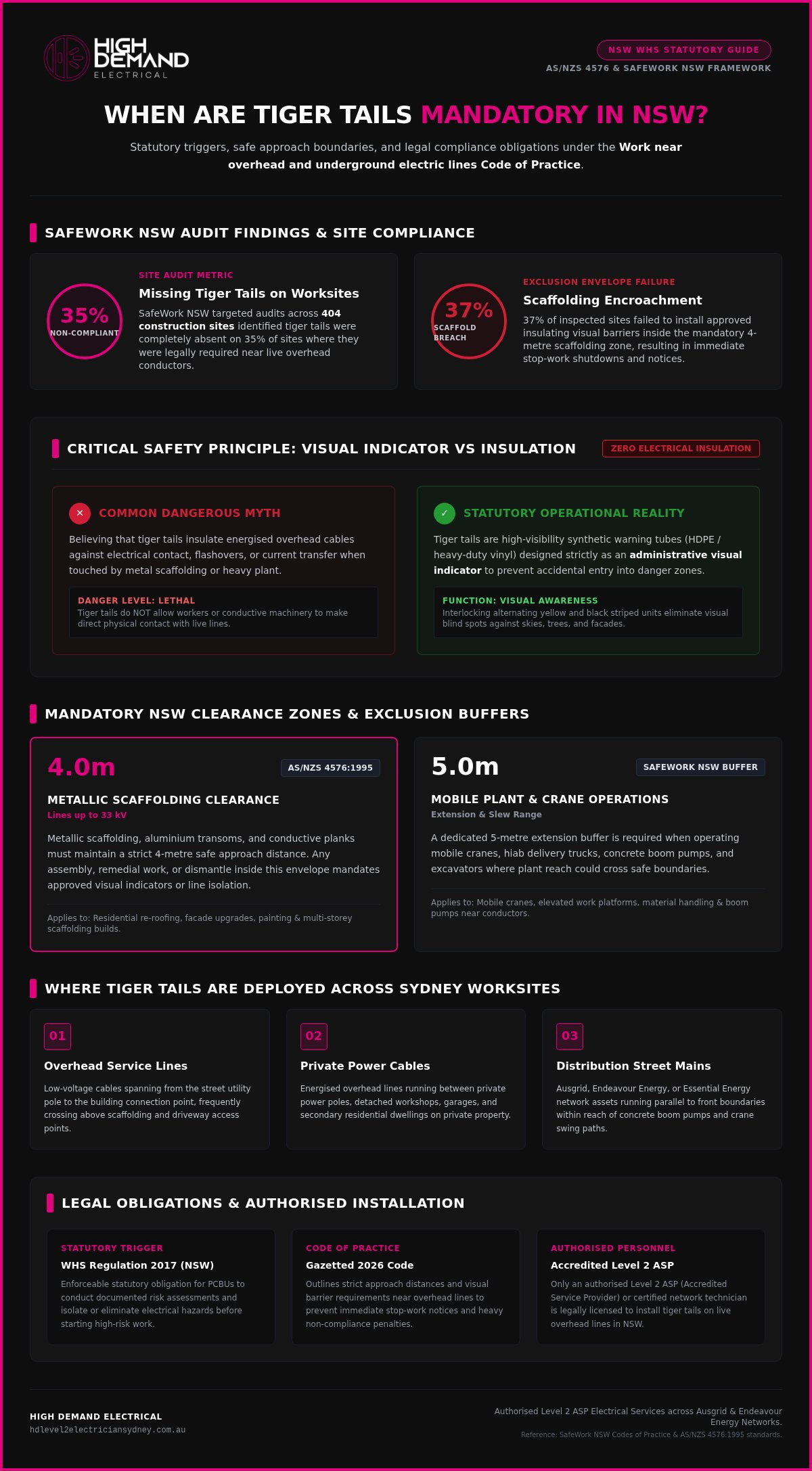
SafeWork NSW compliance audits across 404 construction sites revealed that tiger tails were missing on 35% of worksites where they were legally required near overhead lines. If you are managing a project, operating mobile plant, or coordinating trades near live conductors, understanding exactly when are tiger tails mandatory NSW safety regulations stipulate is critical to avoiding immediate stop-work notices, hefty penalties, and lethal electrical hazards.
You already know the pressure of trying to interpret complex network distributor rules while keeping a high-risk site operational and fully compliant. This guide clearly outlines the exact statutory triggers under NSW safety law, the mandatory 4-metre scaffolding clearance rule, and the operational reality of visual indicators under the gazetted Work near overhead and underground electric lines Code of Practice. Below, we examine your enforceable PCBU obligations, distinguish between network and consumer mains, and outline the exact pathway to ensure complete regulatory compliance on site.
Key Takeaways
• Identify statutory site triggers under the 2026 Code of Practice, outlining precisely when are tiger tails mandatory NSW builders and PCBUs must comply with to avoid immediate stop-work notices.
• Unpack the dangerous insulation myth to understand why tiger tails serve purely as visual indicators and offer zero protection against lethal electrical currents on live overhead conductors.
• Review statutory safe approach distances, including the mandatory 4-metre metallic scaffolding clearance and the 5-metre extension buffer required for operating mobile cranes and plant.
• Clarify distribution network boundaries between Ausgrid and Endeavour Energy, confirming why only an authorised Level 2 ASP or network technician is legally certified to install them.
What Are Tiger Tails and Why Are They Used in NSW?
Tiger tails are heavy-duty, high-visibility synthetic tubes installed directly over live overhead electrical cables. Manufactured with alternating yellow and black stripes, they create an unmistakable visual barrier that alerts crane drivers, scaffolders, and trades to energised lines overhead. Construction environments are visually crowded. Overhead conductors easily blend into building facades, trees, or grey skies, leaving machinery operators vulnerable to catastrophic contact. Tiger tails eliminate that visual blind spot.
Under SafeWork NSW risk management frameworks, these devices operate as an essential administrative warning control. Every Person Conducting a Business or Undertaking (PCBU) must actively manage electrical hazards on site. Determining when are tiger tails mandatory NSW legislation requires comes down to whether site operations encroach on statutory clearance zones. Understanding standard overhead power line characteristics and clearances explains why this matters: bare or low-voltage aerial conductors rely entirely on air space for isolation, meaning visual markers are essential to prevent accidental approach.
The Mechanics of Synthetic Warning Tubes
Each unit consists of high-density polyethylene (HDPE) or heavy-duty vinyl corrugated pipe engineered to withstand intense UV exposure and extreme weather. Built-in mechanical clips interlock each section tightly along the cable span. This interlocking design stops the sleeves from sliding in high winds or bunching together, ensuring continuous visual coverage across the entire active work zone. They do not insulate the cable, but their high-contrast striped pattern guarantees rapid visual acquisition from ground level or the cab of an excavator.
Where Tiger Tails Are Commonly Deployed
Sydney worksites feature a dense mix of legacy distribution infrastructure and tight property boundaries. Engaging an accredited team for professional tiger tail installation is standard practice across several specific cable locations:
Overhead service lines
Low-voltage cables spanning from the street utility pole to the private building connection point, often passing directly above scaffolding or driveway access points.
Private overhead power cables
Energised lines running between private power poles, detached workshops, and secondary residential dwellings.
Local distribution network lines
Ausgrid or Endeavour Energy street mains that run parallel to front property boundaries, directly within reach of concrete boom pumps or hiab delivery trucks.
Knowing when are tiger tails mandatory NSW safety rules stipulate protects your workforce and keeps your project on the right side of SafeWork inspectors. These warning pipes turn an invisible lethal hazard into a clear, impossible-to-miss boundary.
When Are Tiger Tails Legally Mandatory Across NSW Work Sites?
Statutory triggers under the Work Health and Safety Regulation 2017 (NSW) require PCBUs to eliminate or isolate electrical hazards before starting any project. The gazetted Work near overhead and underground electric lines Code of Practice mandates documented risk assessments whenever personnel, plant, or building structures breach safe approach boundaries. If your risk assessment identifies that workers or plant could infringe on statutory clearances around energised lines, visual warning indicators become an enforceable legal requirement. Understanding exactly when are tiger tails mandatory NSW safety inspectors require prevents immediate stop-work notices and steep fines.
Scaffolding and Edge Protection Clearances
Under AS/NZS 4576:1995 and SafeWork NSW directives, metallic scaffolding must maintain a strict 4-metre safe approach distance from overhead lines carrying up to 33 kV. Scaffolding tubes, aluminium transoms, and conductive planks create extreme flashover and electrocution risks during assembly and dismantle. If any scaffold structure or handling zone encroaches within this 4-metre exclusion envelope, you must install approved visual markers or arrange line isolation. SafeWork NSW construction audits revealed that 37% of inspected sites failed to install required insulating materials or barriers inside this 4-metre zone, leading to immediate shutdowns on residential re-roofing and multi-storey remedial builds.
High-Risk Trade Work and Maintenance Triggers
Ladders, extension poles, and metallic trim handled near overhead service lines routinely trigger mandatory compliance measures. Common triggers include:
Roof restoration and guttering
Plumbers handling long metal gutter lengths or corrugated sheets within reach of low-voltage service drops.
Solar installations
Technicians hauling panels and aluminium rail extrusions past overhead service lines entering the fascia.
Rendering and painting
Trades operating from mobile podiums, trestles, or ladders near point-of-attachment brackets.
Vegetation clearing
Arborists cutting tree canopies within regulatory approach zones of overhead service mains.
Mobile Plant, Cranes, and Material Deliveries
Operating concrete boom pumps, hiab trucks, tippers, or excavators near overhead cables introduces extreme danger. The Code of Practice mandates that when tiger tails are installed on low-voltage conductors, they must extend at least 5 metres beyond the active operating zone of the plant. Raised truck trays delivering road base, delivery cranes unloading structural steel, and swinging excavator booms can easily make lethal brush contact with unmarked aerial wires.
Before moving machinery or erecting metal structures near aerial conductors, you can speak with an accredited team to confirm statutory clearance zones and schedule fast-turnaround tiger tail installation services to keep your site fully certified.
Safe Work Clearances and the Critical Electrical Insulation Myth
Tiger tails are visual warning indicators; they provide zero electrical insulation and zero mechanical protection. Even with these striped synthetic pipes fitted, the conductors underneath remain fully energised at 230 volts single-phase or 400 volts three-phase. Direct physical contact with a tiger tail can cause flashover, severe shock, or fatal electrocution. Fitting them to overhead conductors does not grant workers permission to touch, lean against, or rest building materials on the lines. They serve solely to make aerial lines conspicuous to plant operators and trades working nearby.
Safe Approach Distances for Low-Voltage Lines in NSW
Under the gazetted Code of Practice, untrained personnel and non-electrical plant must maintain a strict 4.0-metre clearance boundary around overhead power lines. This default distance applies unless documented controls and formal risk assessments establish an approved system of work. For insulated low-voltage service lines up to 1,000 volts, trained workers with dedicated controls may reduce approach distances down to 0.5 metres. If the lines are uninsulated bare conductors, statutory rules enforce a minimum 1.5-metre clearance, regardless of whether visual markers are attached.
The Hazard of the Safe to Touch Fallacy
Assuming tiger tails make power lines safe to handle is a lethal mistake. While manufactured under AS 4202 (Class 1, synthetically tested up to 650 V), they are classified strictly as warning devices under NSW safety law and network rules. Several factors destroy any nominal dielectric resistance:
Conductive contamination
Rainwater, morning condensation, ambient dust, and salt spray collect inside and outside the corrugated sleeves, creating a direct tracking path for electric current.
Mechanical crushing
Scaffolding transoms or crane loads pushing against the synthetic casing quickly crush or pierce the plastic wall, transferring line voltage straight into conductive metalwork.
Underlying cable degradation
Excessive mechanical pressure against aged consumer mains strips brittle outer PVC or XLPE insulation, sparking immediate phase-to-earth arc faults.
Site managers assessing when are tiger tails mandatory NSW legislation requires must never treat visual markers as an alternative to de-energisation or physical hoarding. If your project involves ageing, weathered overhead service cabling, booking comprehensive electrical safety inspections verifies line integrity before trades begin high-risk work overhead. Clarifying when are tiger tails mandatory NSW safety standards specify ensures your site remains safe, compliant, and fully operational without risking lives on assumptions.
Network Distributor Rules: Ausgrid, Endeavour Energy, and Essential Energy
New South Wales operates under three distinct electricity distribution network service providers (DNSPs). Ausgrid covers inner Sydney, the eastern suburbs, northern Sydney, and the Hunter. Endeavour Energy manages Western Sydney, the Blue Mountains, and the South Coast. Essential Energy powers regional and rural NSW. While the Service and Installation Rules of NSW (SIRNSW) standardise technical connections across the state, each network enforces strict, unique operational protocols regarding who can touch or install equipment on overhead infrastructure.
Unauthorised attachment of any device to utility network assets is illegal under the Electricity Supply Act 1995. Determining when are tiger tails mandatory NSW worksites require also means knowing who has the statutory authority to install them on your specific supply lines.
Network Assets vs Private Overhead Lines
Electrical ownership boundaries dictate your installation pathway:
Network service mains
The overhead conductors spanning from the street utility pole to the point of attachment (POA) on your building or private pole. In Sydney's Ausgrid territory, an authorised Level 2 ASP can install visual covers on low-voltage overhead service lines. In Endeavour Energy and Essential Energy areas, work directly on utility-owned network lines often requires submitting a formal Safety Advice Request directly to the network owner.
Private overhead lines
Conductors running past your main switchboard to secondary outbuildings, granny flats, or rural pumps. Maintaining private aerial cabling and your private power pole installation is solely the property owner's legal responsibility. Any alterations or safety markings on private consumer mains must be carried out by an accredited electrician.
Ausgrid and Endeavour Energy Rules in Greater Sydney
Both major Sydney distributors require strict adherence to network safety rules. For projects in Western Sydney under Endeavour Energy, unauthorised contractors are strictly prohibited from touching energised street lines; third-party line covers must be arranged through network-approved channels. In Ausgrid territory, accredited Level 2 ASP contractors hold direct authorisations to isolate, inspect, and fit tiger tails to overhead service cables crossing construction corridors.
Once installation finishes on consumer mains or service connections, work must be formally documented on a Certificate of Compliance for Electrical Work (CCEW) and submitted to NSW Fair Trading and the relevant distributor. If your project borders overhead distribution assets and you must establish when are tiger tails mandatory NSW regulations apply to your perimeter, contact our authorised Level 2 ASP team to review distributor requirements and manage your network compliance.
How to Organise Authorised Tiger Tail Installation in Sydney
Standard licensed electricians are not legally authorised to climb network infrastructure or fit warning covers to overhead supply cables. Working on or adjacent to live service lines requires dedicated network accreditation, live-line training, and specialised insulated equipment. Under NSW distribution rules, only an accredited Level 2 Accredited Service Provider (ASP) or an authorised network distributor technician can legally mount visual indicators. DIY attempts or hiring unqualified contractors creates lethal electrocution risks and invites severe statutory penalties under NSW electricity safety acts.
Why You Must Engage an Accredited Level 2 ASP
Level 2 ASP contractors hold formal authorisations across service line disconnects, reconnects, metering, and overhead connections. You can review the complete operational scope in our guide to Level 2 ASP electrical services. Engaging an authorised professional ensures every safety control aligns with AS/NZS 3000 and the Service and Installation Rules of NSW (SIRNSW). This verified compliance protects principal contractors, keeping builders fully insured and shielded from SafeWork NSW stop-work notices.
Step-by-Step Installation and Removal Process
Securing overhead cable protection follows a methodical four-step procedure:
Step 1: Conduct site assessment.
Measure distances from proposed scaffolding, concrete pumps, or rooflines to the overhead cables. Document line spans and check whether cables cross boundary lines.
Step 2: Book an authorised Level 2 ASP.
Provide site photos, distributor network details (Ausgrid or Endeavour Energy), and the projected build duration.
Step 3: Professional installation.
The Level 2 ASP installs interlocking synthetic sleeves using insulated operating rods, securing clips along the entire required span.
Step 4: Certified de-installation.
Once construction wraps up, the Level 2 ASP safely unclips and recovers the sleeves, inspecting the underlying conductors for insulation wear.
Contacting High Demand Electrical for Sydney Compliance
Engnet Pty Ltd trading as High Demand Electrical (HDE) delivers rapid, compliant service across Sydney, including the Inner West, Sydney’s West, South West, and the Sutherland Shire. Backed by Electrical Contractor Licence EC Licence 397193C (ABN 87 051 836 527), HDE maintains triple ISO certification across ISO 9001 (Quality Management), ISO 45001 (Health and Safety), and ISO 14001 (Environmental Management). HDE is a Level 2 Accredited Service Provider (ASP) authorised for service line, metering, and connection work, as well as a Level 1 Accredited Service Provider (ASP) accredited with IAC for network construction.
When project timelines are tight and site conditions demand clarity on when are tiger tails mandatory NSW safety laws dictate, our team provides fast turnaround. Direct inquiries to Christopher Ng at 133 Balmain Road, Leichhardt NSW by calling Phone 0402 559 777 or emailing chris@highdemandelectrical.com.au. For fast site mobilisation, contact our Level 2 ASP contact team directly.
Lock In Your Overhead Electrical Safety and Compliance
Understanding when are tiger tails mandatory NSW safety regulations stipulate protects your workforce, keeps machinery operating, and shields your project from costly SafeWork NSW prohibition notices. Remember that these high-contrast striped sleeves function strictly as visual warning indicators, never as electrical insulation. Whether your site triggers mandatory installation through the 4-metre scaffolding clearance rule or mobile plant proximity envelopes, engaging an authorised specialist is your legal safeguard under state electricity network rules.
Engnet Pty Ltd trading as High Demand Electrical delivers rapid, fully certified visual marker solutions across Sydney. Operating under EC Licence 397193C (ABN 87 051 836 527), our team holds triple ISO certification across ISO 9001, ISO 45001, and ISO 14001. We are a Level 2 Accredited Service Provider (ASP) authorised for service line, metering, and connection work across Ausgrid and Endeavour Energy networks, as well as an IAC-accredited Level 1 ASP.
Don't risk project shutdowns or lethal overhead contact. Book your authorised tiger tail installation with Sydney Level 2 ASP specialists today to secure complete network compliance and keep your site moving forward safely.
Frequently Asked Questions
Are tiger tails legally mandatory for all construction work in NSW?
No, tiger tails are not universally required on every building site. However, determining when are tiger tails mandatory NSW safety law governs depends on proximity to overhead conductors. Under the SafeWork NSW Code of Practice, they become legally mandatory whenever scaffolding, mobile plant, or trades breach statutory safe clearance zones. If workers or conductive equipment operate within encroachment areas, visual indicators must be installed before work starts.
Do tiger tails insulate electrical wires and make them safe to touch?
No, tiger tails provide zero electrical insulation and zero mechanical protection. The conductors inside remain fully live at standard voltages of 230V or 400V. Physical contact can cause severe electric shock or lethal flashover. They function strictly as visual warning devices to keep workers away from conductors, meaning personnel must never touch, lean against, or rest conductive building materials on covered lines.
Can any licensed electrician install tiger tails in Sydney?
No, a standard licensed electrician cannot legally install tiger tails on overhead service lines. Working on or touching live overhead service mains requires formal Level 2 Accredited Service Provider (ASP) certification authorised by Ausgrid or Endeavour Energy, or direct network utility technicians. Qualified providers like High Demand Electrical (EC Licence 397193C) hold the required training and insulated live-line equipment to carry out compliant installations.
What are the minimum safe approach distances for overhead power lines in NSW?
For untrained workers, non-electrical plant, and metallic scaffolding, NSW regulations enforce a minimum safe approach distance of 4.0 metres from live overhead lines up to 33 kV. Qualified personnel operating under strict risk controls may reduce this clearance to 0.5 metres for insulated low-voltage service lines, or 1.5 metres for bare overhead conductors. Breaching these boundaries requires de-energisation or approved physical barriers.
Who is responsible for organising tiger tails on a building site?
The Person Conducting a Business or Undertaking (PCBU), typically the principal contractor or project manager, holds the primary legal duty under the WHS Regulation. They must identify overhead electrical hazards, conduct formal site risk assessments, and establish clearance controls. For residential works near service lines, the builder or homeowner must engage an authorised Level 2 ASP to fit approved line markers before erecting scaffolding or operating machinery.
How long can tiger tails remain installed on overhead power lines?
Tiger tails are temporary safety controls, typically hired and approved for project durations up to 12 months. If construction runs beyond 12 months, network rules require re-inspection by an authorised technician to ensure mechanical clips remain secure and sleeves haven't suffered UV degradation or weather damage. Once construction finishes, the Level 2 ASP must return to remove the tubes safely.
What happens if a work site fails to install mandatory tiger tails in NSW?
Failing to install required visual indicators exposes a site to severe regulatory penalties. SafeWork NSW inspectors routinely issue immediate Prohibition Notices and stop-work orders during targeted compliance audits. Knowing when are tiger tails mandatory NSW regulations stipulate prevents significant project downtime, substantial corporate fines for WHS breaches, and the unacceptable risk of catastrophic or fatal electrical contact on site.
Powering Your Needs with Expertise
If you’re looking for a reliable, experienced, and prompt electrician, look no further than High Demand Electrical. We cater to all your electrical needs, from routine maintenance to emergency repairs and complete system installations. Our skilled team is committed to providing professional service that ensures your electrical systems run smoothly. Whether it's a small task or a large project, give us a call today. Let us meet all your electrical demands with the quality and reliability you deserve.