Switchboard Fire Safety in NSW: Warning Signs and Next Steps
A switchboard is the one place where all the power in your property passes through, so a loose connection, an overloaded circuit or ageing parts there can start a fire inside a wall or cupboard before anyone notices. In NSW the safest approach is simple: know the warning signs, keep your safety switches working, and have a licensed electrician inspect or upgrade the board when it is old or overloaded. If you see smoke, scorching or sparking, get out and call Triple Zero (000) first. For everything short of that, our Level 2 electricians can assess the board and tell you what needs doing.
TL;DR
- Fire and Rescue NSW reports over 350 residential house fires a year in NSW are started by electrical faults.
- Warning signs include heat, a burning smell, buzzing, scorch marks, tripping and a tingle when you touch an appliance. Treat each one as a reason to call an electrician.
- If a switchboard is smoking, sparking or burning, leave the building, close doors behind you and call 000 from outside.
- Safety switches (RCDs) are the key protection on the board. NSW Government guidance says to test them every six months.
- Only a licensed electrician can repair or upgrade a switchboard in NSW, and the work must be certified with a Certificate of Compliance for Electrical Work (CCEW).
Table of Contents
- Why switchboards are a fire risk
- Warning signs your switchboard needs attention
- What to do in an electrical emergency
- Safety switches: the protection on the board that matters most
- When to inspect, repair or upgrade
- Certificates and paperwork after the work
- For landlords, property managers and commercial sites
- How we approach switchboard fire safety
- Book a switchboard check
- FAQ
- Sources
Why switchboards are a fire risk
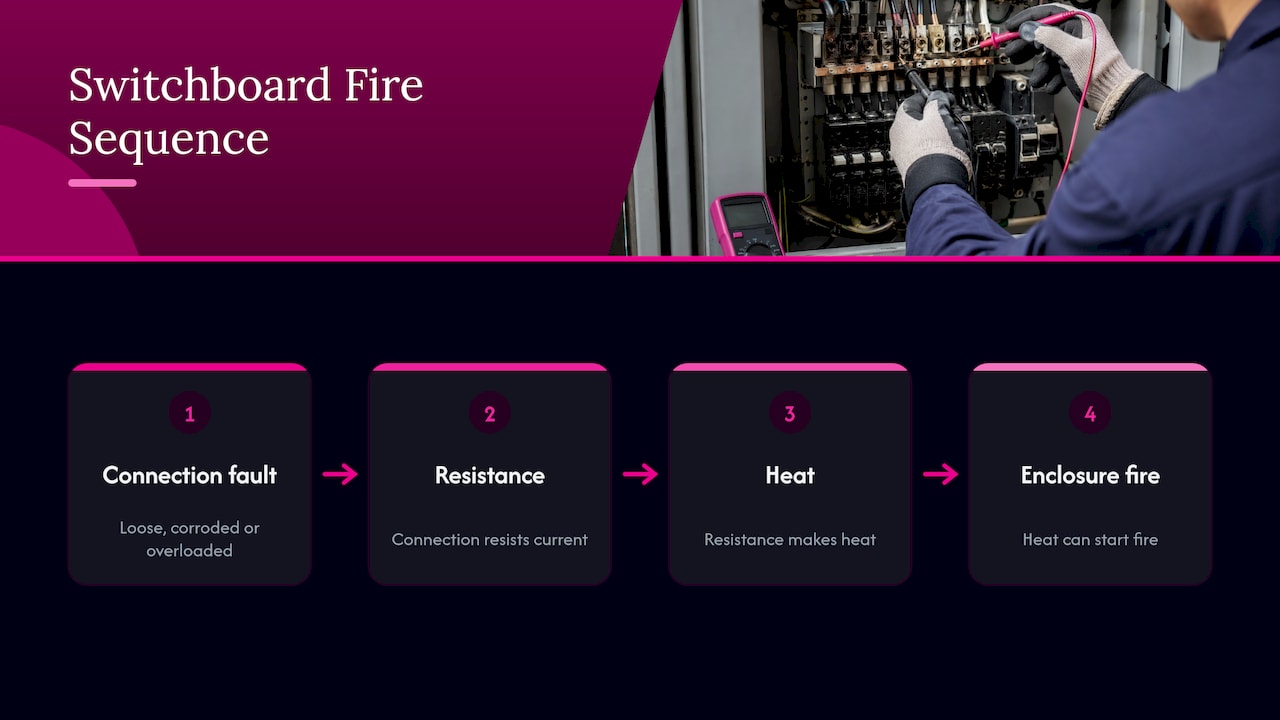
The switchboard holds the main switch, the circuit breakers or fuses, and usually the safety switches. Every circuit in the home is wired back to it. Each connection point carries current all day, and over years a connection can work loose, corrode or be overloaded by more appliances than the board was designed for. A loose connection resists the current, resistance makes heat, and heat in a timber-backed or crowded enclosure is how a fire starts.
NSW Fair Trading is direct about the underlying statistic: it says 40% of house fires in NSW each year are caused by electrical faults and appliances, and that these fires could have been prevented by safety switches. The NSW Government’s home safety page goes further, saying up to 1,800 house fires each year could have been prevented by having wiring checked by a licensed electrician and safety switches installed.
Those numbers cover the whole electrical system, not only the board. But the board is where protection either exists or does not, which is why it is the first thing we look at on a safety inspection.
What makes older boards riskier
Older switchboards often have rewireable fuses or a handful of circuits crammed into a small panel. Modern homes add air conditioners, induction cooktops, EV chargers and home offices to circuits planned decades ago. The NSW Climate and Energy Action page lists the usual reasons for an upgrade: replacing an outdated fuse box, moving from a 60 or 100 amp panel to a 200 amp panel, or adding safety devices to meet current standards.
Another point from NSW Government guidance matters here. A safety switch only protects the circuit it sits on, and in older houses and apartments a single switch may cover several circuits, leaving others exposed. A board that looks fine from the outside can have gaps in its protection.
Warning signs your switchboard needs attention
You do not need electrical training to notice these. You only need to know that none of them is normal.
- Heat. The cover or the wall around the board feels warm to the touch.
- A burning or fishy smell near the board, with no obvious source.
- Buzzing, crackling or humming from inside the enclosure.
- Scorch marks, discolouration or melted plastic on or around the board.
- Breakers or safety switches that trip repeatedly, or will not reset.
- Lights that flicker or dim when an appliance starts.
- A tingle or slight shock from an appliance or fixture. NSW Fair Trading says this should always be treated as a warning not to touch the appliance until it is repaired.
- Old ceramic fuses, exposed wiring or a board with no safety switches at all.
Do not open the switchboard cover or tighten anything yourself. The live parts behind the cover are dangerous, and SafeWork NSW warns that all electrical work can hurt someone. The work belongs to a licensed electrician.
Power boards and overloaded outlets
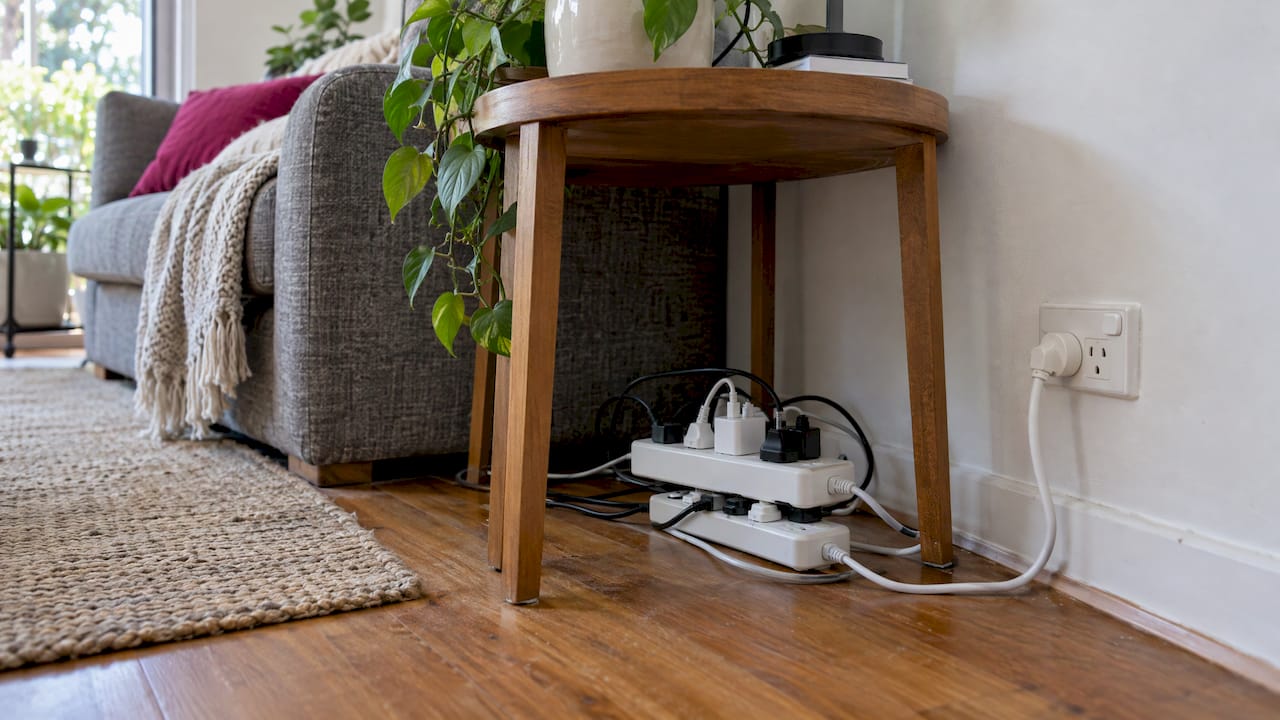
Not every electrical fire starts at the switchboard. Fire and Rescue NSW lists overloading, dust build-up in unused points, dislodged leads, poor cable placement and inadequate ventilation as causes of power-board fires, and recommends power boards with built-in safety switches or circuit breakers. If your rooms rely on stacked power boards because there are not enough outlets, that is also a sign the circuits need rethinking.
What to do in an electrical emergency
The order matters, and your safety comes before the property.
- If there is smoke, flame or sparking at the board, get everyone out. Fire and Rescue NSW’s home fire safety guidance says an extinguisher or fire blanket should be used only in the first few seconds of ignition and only if you are confident. Otherwise leave, close doors behind you to slow the spread, and stay out.
- Call Triple Zero (000) from a safe place outside the building.
- Never use water on an electrical fire. The NSW Rural Fire Service’s electrical incidents doctrine says that for a small electrical fire, if it is safe, the power should be turned off and an appropriate extinguisher used, not water, wet chemical or foam. It also notes that large electrical fires need advice from the electricity authority.
- Do not go back in to turn off the main switch if the board is already burning or arcing.
- Once the fire service says it is safe, call an emergency electrician before anyone restores power. A board that has overheated needs a licensed assessment, even if the fire never took hold.
If the situation is less dramatic, for example a hot board cover, a burning smell or breakers that keep tripping, and nothing is burning, switch off the appliance you were using if you can do so safely, keep clear of the board and call an electrician straight away. Our emergency electrician service runs 24/7, and we offer a 10-minute callback guarantee.
Safety switches: the protection on the board that matters most
A safety switch, also called an RCD (residual current device), monitors the current going out and coming back on a circuit. If some of it leaks, for example through a person or a damaged cable, it cuts the power in a fraction of a second. NSW Fair Trading says fixed safety switches offer the best protection, and that they protect against the most frequent cause of electrocution.
Testing schedule
NSW sources give two figures, so here is how they fit. Fair Trading advises pressing the TEST button every three months. The NSW Government home safety page recommends testing twice a year. Testing more often is the safer habit. If a switch does not trip when you press the button, the board needs an electrician.
A push-button test is a quick check, not a full inspection. A licensed electrician can test the switch with instruments and confirm that every circuit that should be covered is covered. We carry out RCD and safety switch testing as part of our maintenance work. For cost and options, see our guide to safety switch costs in Sydney.
What the 2018 Wiring Rules changed
The current wiring standard, AS/NZS 3000:2018, became mandatory in NSW on 1 January 2019. The NSW Government’s electrical standards page lists the changes: RCDs for domestic and residential final sub-circuits, additional non-domestic RCD requirements, extra clearances in switch rooms and enhanced protection for arcing faults. In practice, a new or upgraded board is built to that standard, while an old one may predate it entirely. Our explainer on AS/NZS 3000 switchboard requirements in NSW covers the detail for those who want it.
When to inspect, repair or upgrade
NSW Fair Trading says it is vital to keep wiring, fittings, the switchboard and earthing connections in good working order, and that electrical repairs should be done by a competent repairer. In NSW, that means a licensed electrician.
Use this table as a guide to what to do and who should do it.
| Situation | What it suggests | Next step |
|---|---|---|
| Smoke, flame or sparking at the board | Active fire risk | Leave, call 000, then an emergency electrician once it is safe |
| Hot cover, burning smell, buzzing | Overheating connection or overload | Call an emergency electrician now |
| Repeated tripping | Overloaded circuit or a fault | Book a fault-finding visit |
| Ceramic fuses, no safety switches | Outdated protection | Safety inspection and likely switchboard upgrade |
| Adding an EV charger, air conditioner or going to three-phase | Board capacity may be too small | Assessment before the job |
| Buying, renting out or managing a property | Compliance and records | Safety inspection and RCD testing |
Upgrades and capacity
A switchboard upgrade replaces the board with a modern one that has circuit breakers and safety switches on the circuits. Capacity matters too: a home heading from a 60 or 100 amp supply towards 200 amps, or from single phase to three phase for larger loads, may need power supply work as well as a new board. Our switchboard upgrades and power supply upgrades pages describe both, and our guide on what every homeowner needs to know about switchboard upgrades is a good starting point.
The NSW Government notes that a licensed electrician must carry out the compliant installation, and that the electrician should manage any council permit requirements. That is one less thing to chase for the owner.
Certificates and paperwork after the work
After switchboard work, the electrician must lodge a Certificate of Compliance for Electrical Work (CCEW). NSW Fair Trading says electricians submit it to Building Commission NSW, and to the electricity network where applicable, through the eCert portal, confirming the work has been tested and complies with regulations. Keep your copy. It is the record you will want when you sell, lease or make an insurance enquiry. Our CCEW guide for Sydney explains what the certificate contains.
For landlords, property managers and commercial sites
If you manage tenanted or strata property, the switchboard is a shared risk and a records issue. A faulty or tripping safety switch in a rental is treated as an urgent repair, so it pays to know the board’s condition before a tenant reports a problem. Our guide to landlord electrical safety in NSW covers RCD testing and CCEWs, and for non-residential buildings see commercial switchboard requirements in NSW.
A consistent routine helps: a documented inspection, RCD testing on a schedule, defects fixed by a licensed electrician and certificates filed with the property records. We handle defect notice rectification for properties that have received a notice, and residential, commercial and strata clients can all book our electrical maintenance service.
How we approach switchboard fire safety
Most switchboard fires give notice before they start. A warm cover, a faint burning smell, a breaker that will not stay on. People ignore those signs because the power still works.
Our view is that a switchboard should be checked by someone who can fix what they find. That is why we are a certified Level 2 electrical contractor with accredited Level 2 ASP electricians, rather than a service that diagnoses and hands the job on. We inspect the board, tell you what is wrong in plain terms, and where a repair or upgrade is needed, we carry it out to NSW standards and lodge the paperwork.
We keep emergency cover running 24/7 because an overheating board does not wait for business hours, and we give a 10-minute callback guarantee so you are not left wondering what to do next. For Level 2 work we offer a free site inspection, so you know the scope before anything starts. Seniors can ask us about our discounts.
If you are unsure about your board, ring us. It is far better to have us look at it than to wonder.
Christopher
Book a switchboard check
If your board is old, warm, noisy or tripping, we can assess it. We are a certified Level 2 electrical contractor serving residential, commercial and strata properties across Sydney, with over 300 five-star reviews and triple ISO certification. Our team offers a free site inspection for Level 2 work, and you can read how it works on our free switchboard safety inspection page. To arrange it, go to High Demand Electrical.
If the problem is urgent now, use our emergency electrician line, and if there is fire, call 000 first.
FAQ
Can a switchboard really cause a house fire?
Yes. Loose or corroded connections, overloaded circuits and ageing components create heat inside the board. Fire and Rescue NSW reports that over 350 residential fires a year in NSW start from electrical faults. A licensed electrician’s inspection can find these problems before they become a fire.
How often should I test my safety switches?
NSW Fair Trading advises pressing the TEST button every three months, and the NSW Government recommends at least every six months. If a switch fails to trip, or will not reset, have a licensed electrician look at it promptly.
Who can repair or upgrade a switchboard in NSW?
Only a licensed electrician. The NSW Government says the installation must be carried out by a licensed electrician, who also manages any council permit needs. The electrician then lodges a CCEW through the eCert portal.
What should I do if my switchboard is sparking or smoking?
Get everyone out, close the doors behind you and call 000 from outside. Do not use water. Use an extinguisher only in the first few seconds and only if you are confident, as Fire and Rescue NSW advises. Call an emergency electrician before power is restored.
Sources
- Electrical Power Boards, Fire and Rescue NSW
- Fire Safety and Prevention, Fire and Rescue NSW
- Electrical Incidents, NSW Rural Fire Service
- Electrical safety requirements and consumer rights, NSW Government
- Electrical safety in the home, NSW Government
- Switchboard upgrade, NSW Climate and Energy Action
- Electrical standards, rules and notes, NSW Government
Recommended
Need Help Fast?
Powering Your Needs with Expertise
If you’re looking for a reliable, experienced, and prompt electrician, look no further than High Demand Electrical. We cater to all your electrical needs, from routine maintenance to emergency repairs and complete system installations. Our skilled team is committed to providing professional service that ensures your electrical systems run smoothly. Whether it's a small task or a large project, give us a call today. Let us meet all your electrical demands with the quality and reliability you deserve.

Licensed Level 2 ASP electricians across Sydney. Same-day service and 24/7 emergency response.
Licence 397193C
ABN 87 051 836 527
