Get Up to 80% NSW Grant for Sydney Strata Upgrades: Committee Checklist
Under NSW strata law, the owners corporation generally pays for electrical work on common property, such as main switchboards, risers and car-park infrastructure, while owners fund upgrades inside their own lots unless a special resolution says otherwise. The immediate step for any Sydney committee facing an upgrade is to commission a Level 2 site assessment and lodge a preliminary inquiry with the local distribution network service provider. Gather your car-park plans and basic cable-route details before you invite quotes.
TL;DR:
- Upgrading a switchboard often requires considering network augmentation costs, which can significantly increase the final bill if the site lacks spare capacity.
- Most EV charger installations in strata buildings need a special resolution or by-law approval because they modify shared property under NSW laws.
- Quotes for electrical work should clearly separate network provider costs from contractor charges and be based on accurate, consistent site information.
- Conducting a Level 2 site assessment and lodging a preliminary inquiry with the local distribution network provider is crucial before obtaining formal quotes.
- Funding options include the capital works fund, a specific levy, or staged installations, with grants covering up to 80% of eligible infrastructure costs in some cases.
Table of Contents
- Common property vs lot: approvals, voting and who pays under NSW strata rules
- Switchboard and supply upgrades: technical triggers and main cost drivers committees must expect
- EV charging in strata: the NSW options, by-laws and billing approaches
- Site-assessment checklist and what to collect before you ask for quotes
- Funding and grants: how the NSW EV ready buildings program works and practical funding routes
- Selecting a Level 2 electrician in Sydney and evaluating quotes
- How High Demand Electrical supports Sydney strata projects
- Book a free Level 2 site inspection and feasibility quote
- Author perspective: three common pitfalls and a one-page checklist for committee meetings
- FAQ
- Sources
Common property vs lot: approvals, voting and who pays under NSW strata rules
The Strata Schemes Management Act 2015 (NSW) draws a clear line between common property and lot property, and that line decides who approves and who pays. Main switchboards, risers, car-park wiring and shared metering infrastructure are almost always common property. Wiring and equipment serving a single apartment usually sit inside the lot.
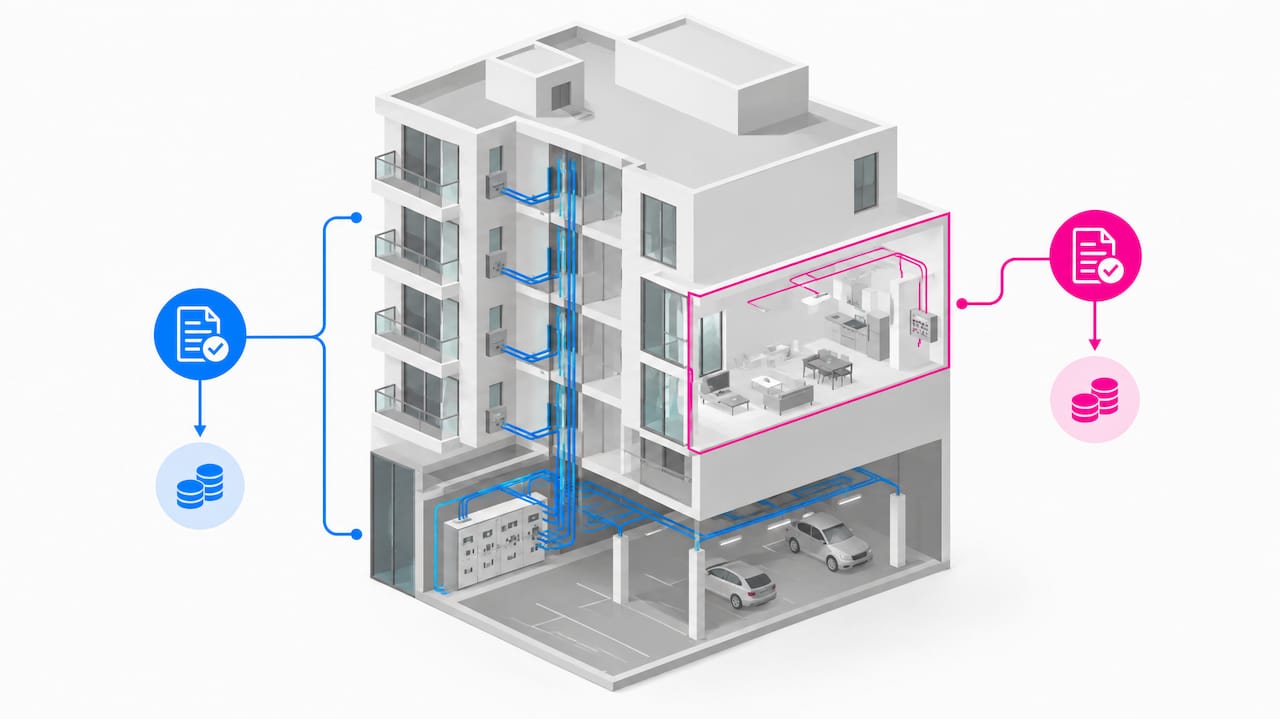
NSW guidance treats EV chargers and similar sustainability infrastructure as matters owners corporations must consider under section 132B, often requiring a special resolution under section 108 or a dedicated by-law before work proceeds.
Funding typically comes from one of these sources:
- The capital works fund, where the upgrade has already been budgeted for in the ten-year plan.
- A special levy raised specifically for the project when the capital works fund falls short.
- Staged funding across financial years for larger switchboard or EV-backbone projects.
Whichever path applies, the committee should record the resolution wording, the funding source and any cost-allocation terms in the minutes before work begins.
Switchboard and supply upgrades: technical triggers and main cost drivers committees must expect
A full switchboard or supply upgrade usually becomes necessary when one or more of these show up during an inspection:
- An old or non-compliant switchboard that no longer meets current safety standards.
- No spare capacity for added load, such as EV chargers or air conditioning.
- Repeated safety device failures or nuisance tripping.
- A planned change from single-phase to three-phase power, or a jump in commercial load.
Network augmentation costs can be substantial when a site lacks spare capacity, and this upstream work, rather than the switchboard itself, is often what drives the final bill. If the distribution network service provider needs to augment a transformer or feeder to support new load, that cost sits outside the electrician’s quote and needs its own confirmation.
A trustworthy quote itemises:
- Switchboard and distribution board materials and labour.
- Metering changes and any new sub-mains.
- Trenching or cable-tray work for new circuits.
- Load-management equipment where capacity is tight.
Ask every contractor to separate DNSP-dependent costs from their own scope so the committee can compare quotes on the same basis; for advice tailored to strata settings, see Bugs Patrol Canberra - Professional pest control services.
EV charging in strata: the NSW options, by-laws and billing approaches
Sydney buildings generally settle on one of four approaches to EV charging, and the right one depends on building size, parking layout and budget:
- Individual-lot installation, where one owner pays to connect a charger to their own metered supply, suited to buildings with only a handful of early adopters.
- Shared common-property chargers, installed and managed by the owners corporation for broader resident access.
- A modular backbone, where cabling and capacity are installed once and chargers are added lot by lot over time.
- A whole-of-building solution, sized for near-full uptake from the outset, suited to larger or newer developments.
NSW guidance frames EV charging as sustainability infrastructure under the Strata Schemes Management Act, which generally means a special resolution or a dedicated by-law is needed before common property is altered. NSW’s template motions and by-law wording cover clauses such as separate metering, indemnities and insurance that committees can adapt rather than draft from scratch.
Billing usually takes one of three forms: separate metering per charger, owners corporation-managed billing through the body corporate accounts, or a services agreement with a third-party operator.
Pro Tip: Ask your Level 2 electrician to confirm metering options before the by-law is drafted, since the billing method affects the wiring design.
Site-assessment checklist and what to collect before you ask for quotes
Quotes only become comparable when every contractor works from the same information. Before you invite bids, prepare:
- A car-park floor plan showing the number of spaces and proposed charger or switchboard locations.
- Trenching and cable-tray routes, with sub-main and final-circuit lengths measured, not estimated.
- Current maximum demand figures, switchboard rating and existing metering arrangements.
- An estimate of likely future uptake, so the design isn’t undersized within a few years.
NSW’s EV-ready costing tool recommends lodging a preliminary inquiry with your distribution network service provider, Ausgrid, Endeavour Energy or Essential Energy depending on your suburb, and including an assumed additional kVA figure in that inquiry. This step tells you early whether network augmentation is likely, rather than discovering it after contracts are signed.
Funding and grants: how the NSW EV ready buildings program works and practical funding routes
The NSW EV ready buildings grant program runs in two stages: stage 1 co-funds a feasibility assessment, and stage 2 co-funds up to 80% of eligible infrastructure costs, subject to caps and building-class eligibility rules.
Stage 2 funding requires a completed feasibility assessment plus at least two commercial quotes, which means committees need to budget time for proper scoping before they apply, not just before they build.
Where a building doesn’t qualify or the grant doesn’t cover enough of the cost, fallback funding usually comes from:
- The capital works fund, where the project was already forecast.
- A special levy, raised specifically for the upgrade.
- A staged, modular install that spreads cost across budget years.
Modelling lifecycle costs, not just the upfront quote, helps committees avoid underfunding maintenance and future expansion.
Selecting a Level 2 electrician in Sydney and evaluating quotes
Level 2 Authorised Service Provider accreditation matters because only Level 2 electricians can legally work on the network side of the meter, including service mains, metering and some switchboard connections. Confirm current insurance and ask what warranty applies to completed work.
When comparing quotes, check for:
- A clearly defined scope, including what’s included and what’s excluded.
- Stated assumptions about DNSP work, staging and future load.
- A contingency allowance and a realistic project timeline.
- Defined testing and commissioning steps before handover.
Insist on at least two independent site-assessment quotes, and ask each contractor for written evidence of their DNSP preliminary inquiry rather than a verbal assurance.
Pro Tip: A quote that doesn’t mention the DNSP at all is usually a quote that hasn’t checked network capacity.
How High Demand Electrical supports Sydney strata projects
High Demand Electrical is a Level 2 contractor working with strata buildings, with Level 2 ASP electricians available for site assessments and installation work. A typical strata electrician site inspection covers:
- A switchboard condition report and load assessment.
- Identification of likely DNSP triggers before quoting.
- A written scope separating contractor work from network-side work.
Services relevant to strata committees include switchboard upgrades, single to three-phase power upgrades, metering work through their Level 2 electrician service, and EV enabling infrastructure through their apartment and strata EV charger work, alongside 24/7 emergency response. This article is written by Christopher, drawing on High Demand Electrical’s work across Sydney strata buildings.
Book a free Level 2 site inspection and feasibility quote
A free site inspection for Level 2 work can provide your committee with a switchboard report, a load assessment and an indicative scope without committing to a contract first. Bring your car-park plan, any existing metering records and your capital works fund balance to the visit, and the inspection will return photos, a written scope and a cost indication your committee can table at the next meeting.

Relevant pages to share with your strata manager before booking:
- Switchboard upgrades for ageing or non-compliant boards.
- Level 2 electrician services for metering and DNSP interface work.
- EV charger installation for enabling infrastructure and charger fit-out.
| Step | What happens | Typical output |
|---|---|---|
| Site inspection | Free Level 2 assessment of switchboard and load | Condition report and photos |
| Feasibility quote | Scope and cost indication prepared | Written quote for committee vote |
| DNSP inquiry | Preliminary inquiry lodged with the relevant provider | Written capacity response |
Request a free site inspection and bring the resulting report straight into your next committee meeting.
Author perspective: three common pitfalls and a one-page checklist for committee meetings
The three mistakes I see most often in Sydney strata electrical projects are skipping the DNSP check, accepting quotes built on different and unstated load assumptions, and voting on EV infrastructure without a by-law covering cost allocation and metering. Each one turns a manageable project into a dispute.
A workable meeting checklist:
- Bring current switchboard rating, car-park plan and any prior electrical reports.
- Propose a motion authorising a site assessment before seeking full quotes.
- Ask every contractor the same question: what DNSP assumptions sit behind this price.
For funding disputes or complex by-law drafting, get tailored legal advice rather than relying on template wording alone.
— Christopher
FAQ
Is electrical covered by strata?
Electrical equipment on common property, such as switchboards, risers and car-park wiring, is generally the owners corporation’s responsibility… Wiring and fittings inside an individual lot are usually the owner’s responsibility unless a by-law states otherwise.
What are the average strata fees for apartments in Sydney?
Strata fees vary widely depending on building size, amenities and the state of the capital works fund, and there is no single published Sydney-wide average. Your strata manager or the owners corporation’s financial statements are the most reliable source for your specific building.
Where can I find strata advice in NSW?
NSW Fair Trading publishes guidance on strata scheme rules, and the Strata Schemes Management Act sets out the legal framework committees must follow. For electrical-specific questions, a Level 2 electrician can assess the technical side while a strata lawyer handles by-law drafting.
Do I need a special resolution for EV chargers in my strata building?
In most cases, yes: NSW treats EV charging as sustainability infrastructure under section 132B, which usually means a special resolution or a dedicated by-law is needed before common property work begins. The exact requirement depends on whether the installation affects common property or sits entirely within a lot.
How long does a strata electrical upgrade take from approval to completion?
Timelines depend on scope, but committees should expect site assessment and DNSP preliminary inquiry first, followed by quote comparison, a resolution vote, then installation and testing. Projects involving DNSP network augmentation generally take longer because that work sits outside the contractor’s direct control.
Sources
- Building EV charging costing tool | NSW Climate and Energy Action
- Strata Schemes Management Act 2015 (NSW)
Recommended
Powering Your Needs with Expertise
If you’re looking for a reliable, experienced, and prompt electrician, look no further than High Demand Electrical. We cater to all your electrical needs, from routine maintenance to emergency repairs and complete system installations. Our skilled team is committed to providing professional service that ensures your electrical systems run smoothly. Whether it's a small task or a large project, give us a call today. Let us meet all your electrical demands with the quality and reliability you deserve.