Service Fuse Requirements in NSW: Rules, Ratings and Who Can Work on It
In NSW the service fuse (formally the service protection device) is the property owner’s responsibility to provide and maintain, but only an accredited Level 2 electrician can work on it or reconnect supply through it. It must be an approved high rupture capacity (HRC) device, rated at least 100A in its assembly, and sealed by the network. If your fuse has failed, looks damaged or you are upgrading supply, you need a Level 2 Accredited Service Provider (ASP). That is our work at High Demand Electrical, and we can start with a free site inspection for Level 2 work.
This guide explains the rules in plain terms for homeowners, property managers, businesses and contractors, and shows where jobs go wrong.
TL;DR
- The customer (property owner) must provide, install and maintain an approved service protection device, at their own cost. The distributor owns the network up to the connection point.
- The assembly must be rated at least 100A for new meter installations and new or replacement devices, and carry a sealable anti-intrusion escutcheon.
- Work on a customer-owned service protection device, and energising new or altered connections, is restricted to accredited Level 2 ASPs under section 31A of the Electricity Supply Act 1995.
- The current rulebook is the NSW Service and Installation Rules, April 2026 edition. Any upgrade to service lines or metering triggers the HRC fuse or circuit breaker requirement.
- Never pull a sealed fuse yourself. If a fault is urgent, call 000 where anyone is in danger, then a Level 2 electrician.
Table of Contents
- What a service fuse does
- The rulebook: NSW Service and Installation Rules
- Who is responsible for the service fuse
- Ratings and construction requirements
- Sealing: why you cannot just swap a fuse
- Who can work on the service fuse
- Asbestos in older fuse panels
- If the service fuse fails or there is an urgent fault
- Perspective
- Our Level 2 service for fuse and supply work
- A checklist for property managers and owners
- FAQ
- Sources
What a service fuse does
The service fuse sits at the start of your installation, between the network’s service line and your meter and switchboard. It protects the whole installation and the network from a serious overload or short circuit. It is separate from the circuit breakers and safety switches inside your switchboard, which protect individual circuits.

In older Sydney homes the service fuse is often a cartridge fuse in a carrier on the meter panel, sometimes behind a sealed cover. Newer properties may have a fused assembly or a main circuit breaker in a sealed enclosure. Which one you have depends on the age of the installation and the size of the supply.
The rulebook: NSW Service and Installation Rules
The Service and Installation Rules (SIRs) are the industry code electricians and ASPs must follow when connecting a customer to the NSW distribution network. They bring together the connection requirements of all NSW distributors, and the Department of Climate Change, Energy, the Environment and Water convenes the management committee. The current edition is April 2026, which replaced the June 2025 edition and includes a summary of changes. The March 2025 dispensation for installing EV charging infrastructure on distribution assets was folded into it.
NSW has three distributors, Ausgrid, Endeavour Energy and Essential Energy, and each has its own connection policy on top of the shared SIRs. In Sydney you will mostly deal with Ausgrid or Endeavour Energy, depending on your suburb.
The technical figures below come from the June 2025 edition of the SIRs. Your Level 2 electrician works from the current edition and your distributor’s requirements, so treat these as the framework rather than a design for your site.
Who is responsible for the service fuse
Clause 4.7 of the SIRs says the customer must provide, install and maintain an approved service protection device. It sits on the installation side of the connection point, at the customer’s cost. The distributor owns and maintains the network up to the connection point.
In practice:
- Homeowners: the fuse and its assembly are yours to keep in sound condition, even though you cannot touch them yourself.
- Landlords and property managers: a cracked fuse base, a scorched carrier or a damaged escutcheon is a compliance and safety item to schedule, not a cosmetic one.
- Strata: the answer depends on whether the device serves an individual lot or common property, so check the by-laws and get the work scoped by a Level 2 electrician.
Ratings and construction requirements
The SIRs set out what counts as an approved device. The key points:
| Item | Requirement |
|---|---|
| Device type | Approved HRC service protection device |
| Assembly rating | At least 100A |
| Anti-intrusion | Sealable escutcheon (cover plate) on the fuse assembly |
| Services up to 100A | Type 11b 80A/100A links to IEC 60269-3, either a single HRC fuse per phase or a single device controlling all phases |
| Services above 100A | A single device controlling all three phases, using 200A to 400A HRC fuses rated at least 500V with 80kA breaking capacity, in a sealable insulated enclosure |
| Triggers | Any alteration, addition or upgrade to service lines or metering brings in the clause 2.8 HRC fuse or circuit breaker requirement |
Building Commission NSW has also flagged HRC fuse assemblies used for meter and service protection that do not comply. Its guidance says new meter installations and new or replacement devices need an assembly rated at least 100A, and assemblies must be marked with their rated current. For metering-only work, an existing service fuse with an 80A or smaller HRC cartridge does not need upgrading unless the fuse assembly itself has to be replaced.
What this means for a typical home
A standard single-phase home usually sits well within the up to 100A category. If you are moving from single phase to three phase for a pool, workshop, EV charger or large air conditioning, the supply changes and the service protection device and metering are part of that job. Our power supply upgrade work, including single phase to three phase, covers that scope.
Worked example: a 1970s brick home has an old porcelain fuse carrier and a meter panel with a cracked cover. The owner wants a three phase supply for a workshop. The old assembly will not meet the current rating and sealing requirements once the service is altered, so the service protection device, metering and sealing are all handled together, not as separate trips.
Sealing: why you cannot just swap a fuse
Service and metering equipment is sealed by the network. Endeavour Energy’s guidelines say service fuses, service active and neutral links and metering links must be sealed with approved seals and sealing pliers. Building Commission NSW notes that the meter terminal cover, service neutral link and the escutcheon plate must be sealed too.
The seal is a record that the equipment has not been interfered with since an authorised person last worked on it. Breaking it yourself, even with the best intentions, is interference with network equipment and leaves the property without a valid record of who did what.
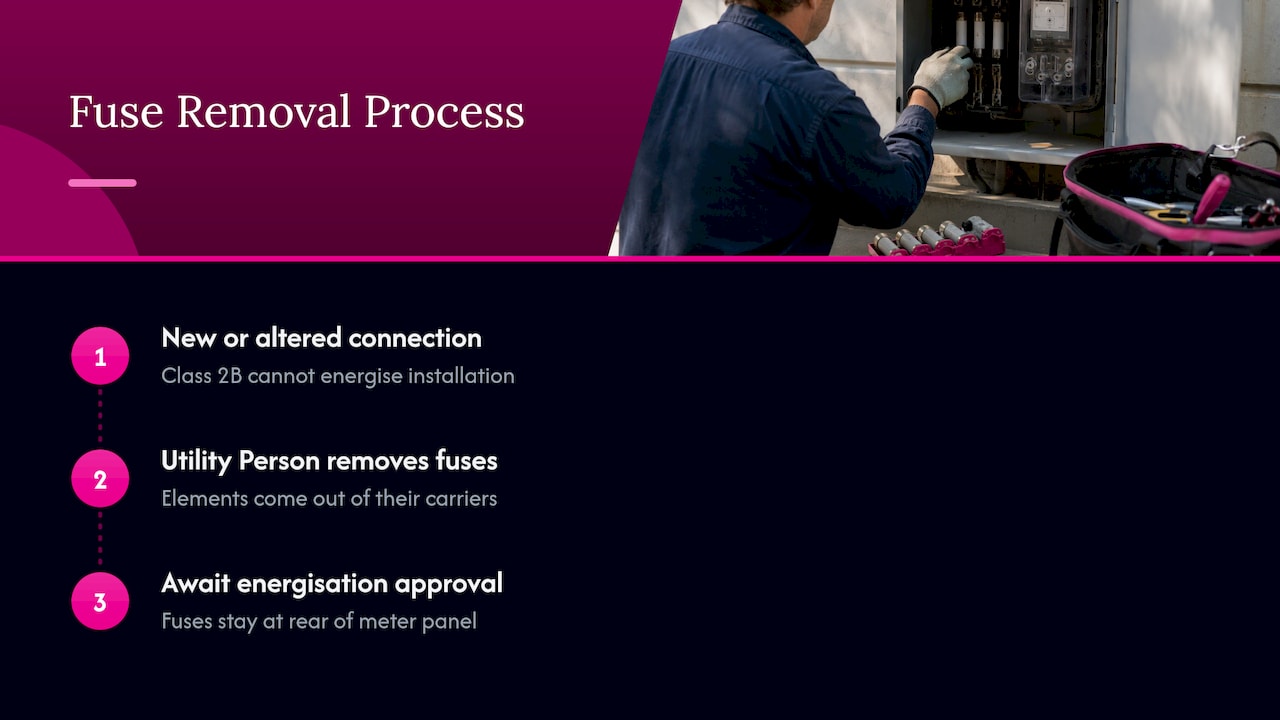
There is a second rule that surprises owners. On new or altered connections, Endeavour Energy’s guidelines state that a Class 2B authorised person cannot energise the installation. The Authorised Utility Person removes the service fuse elements from their carriers and leaves them at the rear of the meter panel until energisation is approved. If you see the fuses sitting loose behind the panel after a job, that is the process working, not a mistake.
Who can work on the service fuse
Under section 31A of the Electricity Supply Act 1995, only accredited Level 2 ASPs may:
- construct or change service lines between the distribution network and the point of connection
- energise new or altered connections
- work on network devices such as the customer-owned service protection device on the main switchboard
Individual workers must also be authorised by the local distributor. This is the reason a general electrician, however good, cannot replace your service fuse. A Level 2 ASP is a different accreditation, and it is the one we hold. Our team are accredited Level 2 ASP electricians, and we are a certified Level 2 contractor based in Sydney.
The NSW Government’s page on altering supply confirms that only ASPs can carry out connection, disconnection or alteration work on the supply between a property and the network. Fuse work on a sealed supply falls under that.
When you need a Level 2 ASP
- A service fuse has blown and will not stay in, or the base or carrier is cracked, burnt or loose.
- The seals are broken or the escutcheon is missing or damaged.
- You are upgrading from single phase to three phase, or increasing supply capacity.
- You are installing a new meter, consumer mains, a private power pole, or overhead or underground service mains.
- A defect notice from the network or an inspector names the service equipment.
- You are adding an EV charger or generator that changes the demand on the service.
If you are doing a switchboard replacement, the service protection device sits next to it and is usually assessed at the same time. Our guide to switchboard upgrades for homeowners shows how the two fit together.
Asbestos in older fuse panels
Older meter panels and some fuse links contain asbestos. SafeWork NSW says any house or building constructed or renovated before 1990 could contain asbestos, and a licence is required to remove it. The SIRs also require asbestos-containing fuse links to be disposed of in line with SafeWork NSW codes. If your panel is an old backing board, do not drill, cut or scrape it. Tell your electrician before any work starts so the job is planned correctly.
If the service fuse fails or there is an urgent fault
- Danger first. If anyone is at risk, or there is fire, sparking or a fallen powerline, call 000.
- Stay clear. Do not open the meter box, remove covers or touch the fuse or seals.
- Check the simple things. If only your property has lost power, look at the main switch and whether a safety switch has tripped in your switchboard. If you cannot identify the cause, do not try to fix it.
- Call your distributor if the street is out. If neighbours are also without power, it is a network fault. Your distributor, not your retailer, handles it.
- Call a Level 2 electrician when the fault is at your property and the fuse, meter panel or service equipment is involved. See our emergency electrician service, available 24/7.
Perspective
Most of the fuse calls we get start the same way: an owner who has noticed a hot smell, a blackened carrier or a loose cover and has no idea who is allowed to deal with it. The honest answer is that the fuse is yours to maintain but not yours to touch.
That split is why we are set up as a Level 2 ASP business. A fuse job is rarely only a fuse. It usually involves the meter panel, the seals, the escutcheon, sometimes asbestos-era boards and often a supply upgrade that the owner had been putting off. Having the accredited team on one job means the fuse, the sealing requirements and the paperwork are looked at together.
For property managers and strata, we would rather inspect and document service equipment before it fails than attend after a tenant has lost power. Our free site inspection for Level 2 work is there so you know the scope before anything is booked.
Christopher
Our Level 2 service for fuse and supply work
High Demand Electrical is a certified Level 2 electrical contractor in Sydney. We handle service protection devices as part of power supply upgrades, metering services, consumer mains, overhead and underground service mains, private power poles and defect notice rectification. We are triple ISO certified, offer free site inspections for Level 2 work, and give a 10-minute callback guarantee on emergency calls. Seniors can ask about our discounts.
If you want the rules applied to your own property, book a free site inspection through our Level 2 electrician page. For the technical detail behind the device itself, read our service protection device rules explainer.
A checklist for property managers and owners
Use this when you review a property or prepare for an upgrade:
- Is the service fuse or assembly marked with its rated current?
- Is the assembly rated at least 100A where it has been replaced or newly installed?
- Is the escutcheon plate present, undamaged and sealed?
- Are the meter terminal cover and service neutral link sealed?
- Are there signs of heat, discolouration or cracked bases on the fuse carrier?
- Is the backing board old enough that asbestos could be present?
- Is any upgrade planned (three phase, EV charger, generator, solar) that will alter the service or metering?
Any “no” or “unsure” is a reason to have a Level 2 electrician look at it. Our electrical safety inspection and maintenance service covers testing of safety switches and general installation checks alongside it.
FAQ
Who is responsible for the service fuse in NSW?
The property owner. Clause 4.7 of the Service and Installation Rules says the customer provides, installs and maintains an approved service protection device at their own cost. The distributor is responsible for the network up to the connection point. Because the work needs an accredited provider, owners arrange it through a Level 2 ASP.
Can I replace a blown service fuse myself?
No. Service fuses are sealed, and work on the customer-owned service protection device is restricted to accredited Level 2 ASPs under the Electricity Supply Act 1995. Breaking the seal yourself is also a safety risk, as the supply side of the fuse remains live. Call a Level 2 electrician.
What size service fuse does a house need?
The SIRs require an assembly rated at least 100A for new meter installations and new or replacement devices. Services up to 100A use Type 11b 80A or 100A links, and larger services use 200A to 400A HRC fuses or a single device controlling all three phases. The right setup for your property depends on your supply and your distributor’s requirements, which we confirm on the free site inspection.
Do I need to upgrade my service fuse when a new meter goes in?
Not always. For metering-only work, Building Commission NSW says an existing fuse with an 80A or smaller HRC cartridge does not need upgrading unless the fuse assembly itself must be replaced. But any alteration, addition or upgrade to the service lines or metering brings in the HRC fuse or circuit breaker requirement, so your electrician needs to assess it first.
Why are my fuses sitting behind the meter panel after an upgrade?
On new or altered connections, the distributor’s authorised person removes the fuse elements from their carriers and leaves them at the rear of the panel until energisation is approved. Your Level 2 electrician cannot energise that installation. Once the distributor approves, the supply is connected.
Sources
- NSW Service and Installation Rules (June 2025)
- Service and installation rules, NSW Climate and Energy Action
- Accredited Service Provider (ASP) Scheme, NSW Climate and Energy Action
- Installing or altering electricity supply to your property, NSW Climate and Energy Action
- Issues with electrical metering installations, Building Commission NSW
- Level 2 ASP Contestable Work Guidelines, Endeavour Energy (sealing)
- Level 2 ASP Contestable Work Guidelines, Endeavour Energy (energisation)
- Building and construction, SafeWork NSW
Recommended
Need Help Fast?
Powering Your Needs with Expertise
If you’re looking for a reliable, experienced, and prompt electrician, look no further than High Demand Electrical. We cater to all your electrical needs, from routine maintenance to emergency repairs and complete system installations. Our skilled team is committed to providing professional service that ensures your electrical systems run smoothly. Whether it's a small task or a large project, give us a call today. Let us meet all your electrical demands with the quality and reliability you deserve.

Licensed Level 2 ASP electricians across Sydney. Same-day service and 24/7 emergency response.
Licence 397193C
ABN 87 051 836 527
