Overhead to Underground Power Conversion Cost Sydney: 2026 Homeowner’s Guide
Could those sagging overhead wires be the single biggest risk to your property's value and safety during the next Sydney storm season? It's a question many residents ask when looking at the tangled cables crossing their front yard. You aren't alone in wanting a cleaner, more resilient connection to the grid that doesn't leave your power supply at the mercy of a falling branch. Understanding the overhead to underground power conversion cost sydney homeowners face in 2026 is the first step toward reclaiming your skyline and securing your home's infrastructure.
While the investment is strategic, the move to underground mains offers a level of reliability and aesthetic appeal that overhead lines simply can't match. This guide provides a clear breakdown of the factors influencing your total spend, including the essential role of a Level 2 ASP in managing complex network applications. We'll explore how to navigate the differing requirements of Ausgrid and Endeavour Energy, the impact of trenching on your budget, and why this upgrade is the perfect time to future-proof your switchboard for electric vehicle charging.
Key Takeaways
• Understand how transitioning from unsightly overhead cables to an underground pillar eliminates storm-related safety hazards and significantly enhances your home's kerb appeal.
• Identify the primary variables, such as trenching distance and the presence of Sydney sandstone, that determine the total overhead to underground power conversion cost sydney.
• Learn the essential regulatory steps required by Ausgrid and Endeavour Energy, including the mandatory involvement of an accredited Level 2 ASP to manage network applications.
• Discover why synchronising your underground conversion with a switchboard upgrade is a strategic move for future-proofing your property for high-capacity EV charging.
What Does Overhead to Underground Power Conversion Involve in Sydney?
Moving your electrical connection from the air to the earth is a significant infrastructure shift for any property. In Sydney, this process involves relocating the point of attachment from an overhead street pole to a subterranean pillar, often referred to as a turret or "green dome." This transition replaces the sagging cables crossing your property with high-durability consumer mains buried safely beneath the ground. While many homeowners initially investigate the overhead to underground power conversion cost sydney for aesthetic reasons, the primary drivers are often long-term safety and network resilience.
Standard electricians lack the legal authority to handle these connections. Because the work involves direct interaction with the Ausgrid or Endeavour Energy networks, only a Level 2 Accredited Service Provider (ASP) is certified to perform the disconnection and reconnection. This ensures the installation meets the strict AS/NZS 3000 Wiring Rules and the specific distributor standards required for a legal, safe connection. Relying on a specialist Level 2 ASP guarantees that your property remains compliant with the evolving electrical codes of 2026.
Aesthetics vs. Reliability: The Dual Benefit
Modern architectural designs demand a clean skyline. Removing visual clutter like service fuses and overhead wires instantly modernises a property's facade and can significantly increase market value. However, the reliability benefits are even more critical. An underground power line is shielded from Sydney's notorious summer storms and high winds. By eliminating the risk of clashing wires or falling branches tearing down your service mains, you drastically reduce the likelihood of sudden outages. Transitioning underground also removes the burden of maintaining private power poles, which are prone to termite damage and structural rot.
When is a Conversion Mandatory?
In several scenarios, the shift to underground power is a regulatory requirement rather than an elective upgrade. Large-scale renovations that change a building’s roofline or footprint often bring the structure too close to existing overhead lines. This creates a safety violation regarding clearance zones. In these cases, a conversion is necessary to meet NSW safety standards.
Local councils across Sydney frequently mandate undergrounding through their Development Control Plans (DCPs) during subdivisions or new builds. Similarly, if you receive a defect notice from your distributor regarding unsafe overhead clearances, converting to an underground supply is often the most permanent way to rectify the issue. Understanding the overhead to underground power conversion cost sydney early in your project planning prevents expensive delays during the final stages of your construction or renovation.
Executing a successful conversion requires more than just digging a hole. It involves a fundamental redesign of your property's electrical entry point. The Point of Attachment (POA), which previously sat high on your house fascia or a private timber pole, must be migrated to a ground-level connection point. This shift necessitates the installation of a Service Protection Device (SPD) to ensure your home can be isolated from the grid safely during maintenance or emergencies. This device acts as the primary gatekeeper between the street network and your private installation.
The technical scope of these components directly impacts the overhead to underground power conversion cost sydney property owners should budget for. Every element must adhere to the AS/NZS 3000 Wiring Rules. These regulations mandate specific burial depths, typically a minimum of 500mm, along with heavy-duty mechanical protection for conduits. High-quality PVC piping ensures your new cables are shielded from soil shifts and accidental damage during future landscaping or excavation work.
Consumer Mains and Capacity Upgrades
A conversion represents the most cost-effective window to upgrade your property to 3-phase power. Most older Sydney homes rely on a single-phase supply, which often struggles with the high-current demands of modern technology. By installing high-capacity consumer mains now, you ensure your infrastructure can support Tesla and home EV charger installations without requiring expensive remedial work later. Our specialists calculate the precise cable gauge needed to prevent voltage drop. This is especially critical for properties with long driveways where the distance from the street pillar to the switchboard can lead to efficiency losses if the wrong materials are selected.
Network Infrastructure: Pillars, Turrets, and Domes
The physical hardware installed on your nature strip depends entirely on your local distributor. Residents in Western Sydney under the Endeavour Energy network will typically see a "green dome" or turret. In contrast, Ausgrid areas generally utilise a standard grey pillar. You must understand the ownership boundary; while the network provider owns the pillar itself, the homeowner is responsible for the consumer mains running from that pillar to the house switchboard.
Placement of this infrastructure is a delicate balance. We must follow strict network rules regarding accessibility for meter readers and emergency crews while trying to minimise the impact on your property's aesthetics. If you're unsure where your pillar should be located to meet compliance, consult our Level 2 team for a technical site assessment to confirm the most efficient layout.
Cost Factors: What Influences the Price of Conversion?
Calculating the overhead to underground power conversion cost sydney property owners pay involves several site-specific variables. No two residential properties are identical; a flat block in Western Sydney presents different challenges than a sloping site on the North Shore. The primary driver of your investment is linear distance. The number of metres between the street pillar and your switchboard determines the volume of materials and the duration of labour required. However, the complexity of the terrain often outweighs the sheer distance in your final quote.
Ground density is a factor that many homeowners overlook until the excavation begins. Sydney’s geography is famous for its sandstone. If your property sits on a rock shelf, specialised equipment like rock saws or pneumatic hammers becomes necessary. This increases equipment hire costs and labour hours significantly compared to a dig in soft clay or sandy loam. Beyond the physical work, Ausgrid and Endeavour Energy levy mandatory fees for application processing, site inspections, and network access. These administrative charges are non-negotiable and vary depending on your local distributor's current fee schedule.
Trenching and Civil Works
A large portion of your budget typically goes into the ground. Hard digging through existing concrete driveways or sandstone adds layers of technical difficulty. If our team has to cut through a stamped concrete or tiled driveway, the restoration costs for re-concreting or paving must be factored into your total estimate. A strategic way to manage these civil costs is to organise a shared trench. If you're already installing NBN or gas lines during a renovation, laying the electrical conduit in the same trench can reduce your overall excavation expenses by splitting the labour and hire costs across multiple services.
Electrical Infrastructure Requirements
Your existing meter box is often the biggest hurdle to a successful conversion. Integrating a modern underground supply usually requires a switchboard upgrade to house the new service protection devices and isolation fuses. Older boards simply don't have the physical space or the compliance ratings to handle modern underground mains. Material choices also play a role in the final price. While copper is the gold standard for conductivity, aluminium is sometimes used for very long runs to manage material costs, provided the cable gauge is sufficient to prevent voltage drop. Finally, the Level 2 ASP labour for the actual cut-over at the street pillar and the final testing ensures your connection is legal and safe from day one.
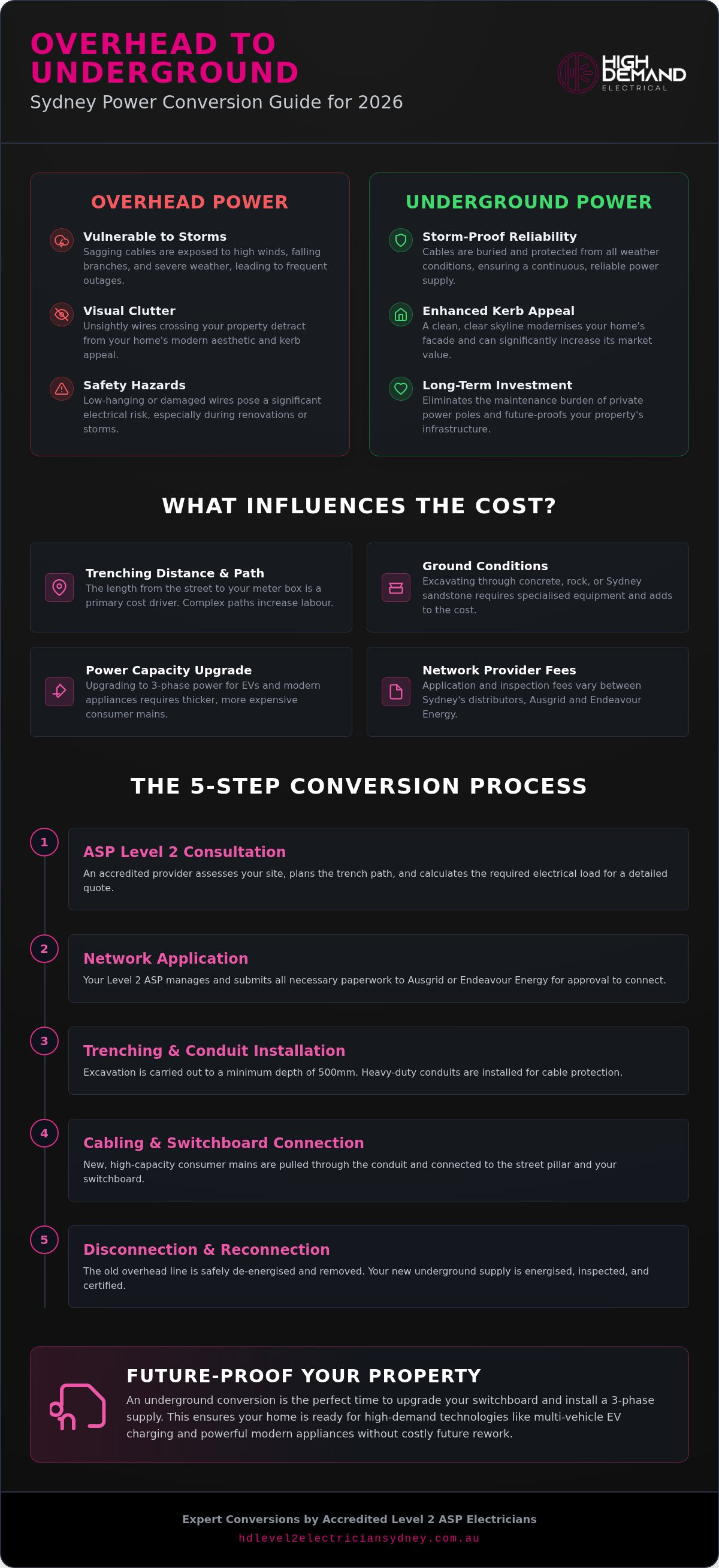
What Is the Step-by-Step Conversion Process in Sydney?
A successful transition to subterranean power is a methodical operation that balances technical planning with physical execution. It begins long before the first shovel hits the ground. Our Level 2 ASPs initiate the process with a comprehensive site inspection and load assessment. This determines if your property's current electrical demand aligns with the existing network capacity. Identifying these requirements early is the most effective way to manage the total overhead to underground power conversion cost sydney property owners will eventually incur.
Once the technical specifications are finalised, we lodge a formal application with your distributor. This stage is purely administrative but requires absolute precision. Whether your property sits within the Ausgrid or Endeavour Energy network, the application must detail the proposed point of attachment and the intended cable route. Following approval, the civil works begin. We install the heavy-duty conduits at a minimum depth of 500mm, ensuring full compliance with AS/NZS 3000 standards. This depth protects your infrastructure from future gardening or excavation accidents.
The final phase is "Changeover Day." This is the highly coordinated window where we disconnect the legacy overhead lines and energise your new underground supply. After the power is restored and safety testing is complete, we submit the Notice of Service Work (NOSW). This document is the legal record that your installation meets the Service and Installation Rules of NSW. Without this certification, your connection remains unauthorised and potentially uninsured.
Navigating Ausgrid and Endeavour Energy
Sydney's two primary distributors operate with different application portals, processing times, and hardware preferences. Ausgrid, serving the CBD, North, and East, has distinct inspection protocols compared to Endeavour Energy in the West. It is vital that your Level 2 ASP holds specific authorisations for your network. We handle these bureaucratic hurdles directly, ensuring your project doesn't stall due to paperwork errors. For a streamlined experience that covers all network requirements, seek professional Level 2 ASP assistance to manage your application from start to finish.
Managing the Power Outage
Changeover Day requires a planned power outage, which we schedule to minimise disruption to your daily routine. If you operate a home office or rely on life-support equipment, we coordinate the "cut and reconnect" to ensure the downtime is as brief as possible. Our team arrives early to perform the physical removal of the old overhead consumer mains and verify the integrity of the new subterranean path. We treat every reconnection with a high-stakes focus on safety, performing rigorous insulation and continuity tests before the grid is re-engaged.
Why Choose High Demand Electrical for Your Sydney Conversion?
Selecting the right contractor is the most critical decision in managing the overhead to underground power conversion cost sydney. In New South Wales, the law is clear: a standard licensed electrician cannot legally connect your property to the street network. Only a Level 2 Accredited Service Provider (ASP) possesses the necessary certifications to work on the service lines owned by Ausgrid or Endeavour Energy. High Demand Electrical fills this role as an authoritative rapid responder, ensuring your project moves from application to energisation without the delays often caused by inexperienced generalists. Once your new underground supply is live, keeping it that way is just as important, see our electrical maintenance checklist for the ongoing checks worth scheduling.
The Level 2 ASP Advantage
By hiring us directly, you eliminate the "middleman" and the associated markups. We are authorised to perform every stage of the work, from the physical trenching and cable laying to the high-risk "live" connections at the street pillar. This comprehensive capability is vital for rapid response, especially if you're looking to rectify a defect notice or need emergency infrastructure repairs. We take full responsibility for the network application process, providing professional reassurance that every technical detail meets the strict Service and Installation Rules of NSW.
Our expertise extends beyond the conversion itself. We offer integrated solutions that include consumer mains upgrades during the installation. This ensures that your new subterranean lines are matched with a robust internal system, preventing the bottlenecks that occur when modern underground power meets outdated internal wiring. We understand the specific nuances of Sydney's geography and distributor requirements, allowing us to navigate complex site conditions with absolute competence.
Future-Proofing Your Home Infrastructure
The energy landscape of 2026 is defined by high-demand technology. A simple conversion isn't enough; your infrastructure must be ready for solar arrays, home battery storage, and high-speed EV charging. We design our installations with this future in mind, selecting cable gauges and switchboard components that exceed current standards. This forward-thinking approach protects your overhead to underground power conversion cost sydney investment by ensuring you won't need further upgrades as your household's energy needs grow.
A clean, underground connection is a long-term value proposition that enhances safety and property appeal. Don't leave your electrical infrastructure to chance. Contact High Demand Electrical for a professional assessment of your Sydney property and secure a reliable, high-performance connection to the grid.
Secure Your Property’s Energy Future Today
Moving your electrical supply underground is more than an aesthetic choice; it is a strategic investment in your home's long-term resilience and market value. By removing vulnerable overhead lines, you eliminate the risk of storm-related outages and prepare your infrastructure for the high-capacity demands of the 2026 energy landscape. While the overhead to underground power conversion cost sydney depends on site-specific variables like trenching distance and network provider fees, the safety and reliability benefits provide a lasting return on investment.
As accredited Level 2 ASP specialists, High Demand Electrical provides the technical depth required to navigate the complexities of both Ausgrid and Endeavour Energy networks. We don't just handle the physical changeover; we manage the critical network applications and ensure your switchboard is fully compliant for future EV charging or solar integration. Our team acts as your authoritative guide, turning a complex regulatory process into a streamlined infrastructure upgrade.
Don't leave your property's most vital connection to chance. Request a Level 2 ASP site assessment for your underground conversion to receive a precise technical evaluation tailored to your specific site. Take the first step toward a safer, cleaner, and more reliable electrical connection for your Sydney home.
Frequently Asked Questions
Related Services


Powering Your Needs with Expertise
If you’re looking for a reliable, experienced, and prompt electrician, look no further than High Demand Electrical. We cater to all your electrical needs, from routine maintenance to emergency repairs and complete system installations. Our skilled team is committed to providing professional service that ensures your electrical systems run smoothly. Whether it's a small task or a large project, give us a call today. Let us meet all your electrical demands with the quality and reliability you deserve.