When to Call a Level 2 Electrician for Overhead Power Lines in Sydney
Overhead power lines are conductors suspended on poles or towers that carry electrical energy from generators to homes and businesses, using air as the main insulator. Every overhead line should be treated as live, regardless of how old or unused it looks, and you must maintain the minimum clearance set by your state regulator. Before any work near a line, the first move is checking Look Up and Live or contacting the line owner directly.
TL;DR:
- Overhead power lines rely on air insulation, so actual clearance varies with temperature, wind, and ground conditions, often requiring more space than official tables suggest.
- The safest approach is to always verify the line’s status with the network owner and request line shutdown if work needs to be within the exclusion zone, rather than relying on visual cues or assumptions.
- Vegetation management, including regular inspections via aerial patrols and real-time monitoring, is crucial to prevent branches or debris from encroaching on conductors and causing outages or fires.
- Overhead lines are generally cheaper and quicker to repair but are more vulnerable to weather-related damage compared to underground cables, which are more expensive and harder to access.
- Only a licensed Level 2 electrician can legally perform work on the network connection, overhead service mains, or cable relocation, with emergency response and inspections recommended before planned upgrades.
Table of Contents
- What are overhead power lines and how are they classified?
- The parts that make up an overhead line
- How close can you get to overhead power lines?
- Working near power lines: risk assessment and site controls
- Overhead versus underground: the real trade-offs
- Who maintains power lines and how vegetation is managed
- When to call a Level 2 electrician for overhead line work
- Why “just stay back” isn’t good enough advice
- Get a certified electrician for overhead line work in Sydney
- Sources
- FAQ
What are overhead power lines and how are they classified?
An overhead power line moves electrical energy across distance by suspending bare or lightly insulated conductors between poles or towers, relying on the surrounding air to insulate the conductor from the ground and from anything nearby. That open-air design is deliberate. It lets conductors run cooler than an equivalent underground cable and it means faults are usually visible from the ground, which speeds up inspection compared with a buried system where a fault can hide for weeks.

Every line on the network falls into one of two jobs. Transmission lines move bulk power over long distances from generators to substations, running at high voltages to minimise energy loss over those runs. Distribution lines take over from there, stepping down to lower voltages and fanning out to the streets, farms and buildings that actually use the electricity.
Engineers group lines by operating voltage, and that band determines almost everything about how a line is built and how far you need to stay away from it:
- Low voltage (LV): up to roughly 1,000 volts. This is the range you’ll see on most suburban streets and household connections.
- Medium voltage (MV): typically 1,000 volts up to around 33,000 volts (33 kV), common on local distribution feeders.
- High voltage (HV): distribution lines in this category commonly run up to 66,000 volts, stepping power down toward suburbs and towns.
- Extra high voltage (EHV): generally 132 kV to 400 kV, used for major transmission corridors between regions.
- Ultra high voltage (UHV): above 800 kV, reserved for the longest, highest-capacity transmission projects, mostly overseas.
The voltage band dictates the insulation thickness, the spacing between conductors and the ground clearance a line needs. A 240 volt service line sitting a few metres above a driveway carries a different risk profile entirely to a 132 kV transmission tower crossing a paddock, and the regulator’s clearance tables reflect that difference directly.
The parts that make up an overhead line
Four components do almost all the work in an overhead line, and each one carries its own maintenance headache.
Conductors are the wires themselves, and most networks use Aluminium Conductor Steel Reinforced (ACSR) cable, where a steel core carries the mechanical load and an aluminium sheath carries the current. All Aluminium Alloy Conductor (AAAC) and newer composite core designs are also common, and the choice affects ampacity, sag and thermal limits under load. On higher voltage lines, conductors are often bundled in twos or threes to reduce electrical losses and manage the effects of high current.
Insulators keep the conductor separated from the pole or tower structure. Pin insulators sit on top of a crossarm for lower voltage lines, suspension insulators hang the conductor below a support point on higher voltage runs, and strain insulators handle the mechanical pull at corners and line ends. The conductor itself usually stays bare. Air does the insulating job between the wire and everything around it, which is exactly why standing too close to a “just a wire” overhead line is still dangerous.
Support structures range from timber and concrete poles on suburban streets to steel lattice towers on transmission corridors. Pole spacing, height and the type of crossarm all change with voltage and terrain, and each structure type has its own inspection routine and failure pattern.
Earth wires, sometimes bundled with fibre optic cable as Optical Ground Wire (OPGW), run above the phase conductors on many high-voltage lines. They intercept lightning strikes before they hit the current-carrying conductors, and doubling them as communications cable has become standard practice on new transmission builds.
Pro Tip: If you’re assessing storm damage to a private line, look for sag that seems uneven between spans before you look for obvious breaks. Uneven sag under load often signals a compromised conductor strand well before it fails outright.
How close can you get to overhead power lines?
The honest answer is: closer than the regulator’s published distance is never acceptable, and the published distance itself is a minimum, not a target. SafeWork NSW and equivalent regulators set ground clearance figures that scale with voltage, and these numbers exist because contact with a live line, not electromagnetic exposure, is the real hazard around these assets.
Energy Safe Victoria’s “No Go Zone” framework is one of the clearest practical models available. It sets exclusion distances that increase with voltage and specifies stricter distances again for anything with reach, such as a crane jib, an excavator boom or a tipper tray. As a rule, low voltage lines demand several metres of clearance for people and equipment, while higher voltage transmission lines require considerably more, and local rules vary between states, so always check the current published table for your job rather than working from memory.
Three things make static clearance tables less reliable than they look on paper:
- Sag increases with temperature. A conductor loaded heavily on a hot day sags lower than the same line on a cool morning, shrinking the real-world clearance below what a clearance table assumes for “typical” conditions.
- Wind moves the conductor sideways. A line swinging in gusty conditions can close the horizontal distance to a structure or piece of plant far faster than anyone expects.
- Ground level changes matter. Filled land, stockpiles, scaffolding and vehicle decks all reduce the vertical gap between the ground and the conductor, even when the conductor itself hasn’t moved.
That combination of sag and swing is exactly why insiders doing a serious lift or a long crane reach model the conductor’s expected position under maximum operating temperature and load, rather than trusting a fixed number pulled from a table. Safe Work Australia’s general guide backs this up, recommending a documented risk assessment before any activity near overhead or underground electric lines, not just a glance at a clearance chart.
If your planned work brings you or your equipment inside the exclusion distance, you have two lawful options: request the network owner switch off and isolate the line, or arrange temporary protective measures like insulated barriers with the owner’s approval. Never assume a line is dead because it looks old, disused or is lying on the ground after a storm. Confirm it in writing with the owner, every time.
Working near power lines: risk assessment and site controls
Before machinery, ladders or long loads go anywhere near a span, run through a short risk assessment that covers reach, swing and terrain honestly.
- Map every line on site, including the one everyone forgets: the private overhead service running from the street pole to the meter box.
- Identify the maximum reach of every piece of plant involved, not its resting height. A crane’s jib extended, a tipper tray raised or an excavator boom swung fully out all change the real clearance envelope.
- Check the ground conditions. Sloping or filled sites change the vertical gap between plant and conductor even when nobody has touched the line.
- Confirm voltage and clearance requirements with the network owner or your regulator’s published table for that voltage band.
- Decide whether isolation is required. If any part of the task brings equipment within the exclusion distance, request a switch off rather than relying on operator caution alone.
Safety professionals apply a controls hierarchy here, and it’s worth following in order rather than skipping straight to the bottom option because it’s convenient. Avoid the hazard first by rerouting the task or the load path. Isolate the line next by arranging a switch off with the owner. Where isolation isn’t practical, protect with physical barriers, tiger tails or insulating guards approved by the network operator. Only after those three should you fall back on supervision, spotters and operator training, because a trained spotter is a last line of defence, not a substitute for keeping distance in the first place.
Some practical rules follow directly from that hierarchy:
- Crane and EWP operators should treat the exclusion zone as absolute, not as a distance to work toward.
- Trucks carrying long loads, ladders or scaffold components need a dedicated spotter when transiting under or near any span.
- Stockpiles, shipping containers and scaffold towers should never be positioned so their height reduces clearance below the regulator’s minimum.
- Anyone operating a tipper, crane or EWP near a private power pole should assume the connection is live even if the property looks vacant.
If contact does happen, the response is simple and non-negotiable: stay clear of the vehicle or equipment, keep others away, call emergency services immediately, and follow lightning pool safety: policies, drills, and quick checklists to help coordinate safety until the network operator can isolate the line. Never attempt to move a fallen line or free a vehicle that’s touching one.
Overhead versus underground: the real trade-offs
Overhead lines cost less to build and are faster to repair, which is why the vast majority of the electricity network still runs above ground. Undergrounding is typically two to four times more expensive than an equivalent overhead route, and in dense urban corridors that multiple can climb far higher again, which is why utilities target undergrounding selectively rather than adopting it network wide.
The reliability picture cuts both ways rather than favouring one option outright:
- Overhead lines are exposed to wind, falling branches, lightning and vehicle strikes, making them more vulnerable to weather-related outages.
- Underground lines are shielded from wind and storm damage but are harder and slower to access when something does go wrong, since locating and digging up a fault takes considerably longer than climbing a pole.
- Repair time after a fault therefore tends to favour overhead systems, even though overhead systems fault more often in extreme weather.
- Bushfire risk is a genuine factor in fire-prone regions, where overhead conductor contact with vegetation is a recognised ignition source that undergrounding removes entirely.
Because of that cost gap, most networks use a mixed approach: overhead construction for the bulk of the grid, with targeted undergrounding in bushfire-prone corridors, new-release residential estates, and city centres where visual amenity and storm resilience justify the extra spend. Aerial bundled cable, which wraps conductors in an insulating sheath, sits as a middle ground on some suburban streets, cutting vegetation-contact risk without the full cost of trenching.
Who maintains power lines and how vegetation is managed
Network operators carry the legal responsibility for maintaining the lines themselves, while landowners and councils usually share responsibility for vegetation on private property near a service line. Tree and branch intrusion into a conductor’s path remains the single most common recurring hazard on overhead networks, which is why vegetation clearing runs on a fixed cycle rather than waiting for a complaint.
Routine inspection blends several methods depending on the asset’s importance and location:
- Aerial patrols by helicopter or drone cover transmission corridors quickly and can spot leaning poles or vegetation encroachment across long distances in a single pass.
- Infrared and thermal imaging picks up overheating joints and connectors before they fail, often during the same aerial pass.
- On-ground patrols check pole condition, insulator wear and ground clearance at street level, especially in urban and suburban areas.
- Sensor-based monitoring is increasingly common on critical spans, feeding real-time load and fault data back to the network operator.
If you notice a tree branch closing in on a line, a leaning pole, or a line sagging lower than it should, report it to the network operator straight away rather than waiting for the next scheduled patrol. Utilities generally treat vegetation-contact reports as priority items given the fire and outage risk involved, and a same-day or next-day response is common for anything flagged as an immediate hazard.
When to call a Level 2 electrician for overhead line work
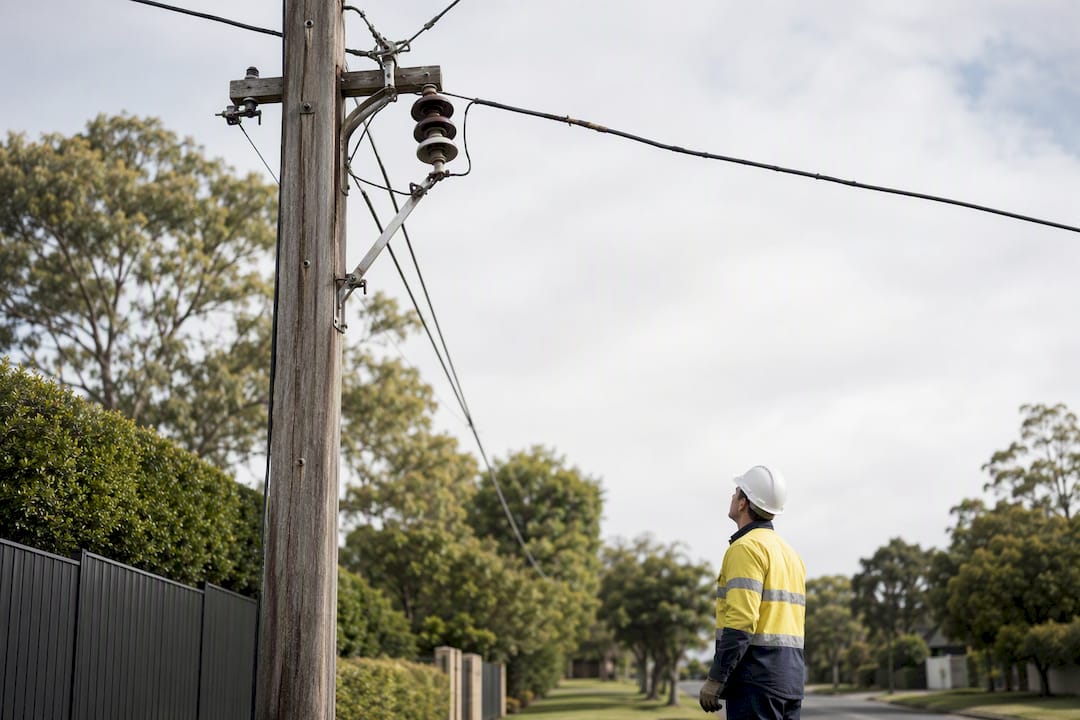
Standard electricians can’t legally touch the network connection point, the private power pole, or the overhead service main feeding your property. That work sits with an accredited Level 2 Authorised Service Provider (ASP) electrician, and it covers everything from overhead service mains installation to relocating or replacing damaged overhead cable after storm impact or a renovation that needs the line moved.
A free site inspection for Level 2 work typically covers the pole condition, the service main route, clearance against your roofline or new structure, and whether your existing connection can handle a planned upgrade. Urgent faults, like a downed line, damaged insulator, or exposed conductor, need an emergency call out immediately. Non-urgent items, such as a planned relocation ahead of a renovation, can be scheduled with a proper inspection first.
Why “just stay back” isn’t good enough advice
Most public guidance on overhead lines stops at a single number: stay this many metres away. That’s not wrong, but it’s incomplete, and treating it as the whole answer is where a lot of near misses come from. A clearance table assumes a conductor sitting at its stated height, on a mild day, with no load. Real conductors sag under heat, swing in wind, and sit lower over filled or built up ground than anyone accounts for on a quiet afternoon.
The gap I keep seeing is between the regulator’s published minimum and the margin a competent risk assessment actually builds in. Tradespeople who plan a crane lift or a long load movement around the exact minimum distance are gambling on a still, cool day every time. The ones who add a real buffer, and who ask the network owner for an isolation rather than working around a live line by feel, are the ones who don’t end up in an incident report.
If there’s one priority worth acting on first, it’s this: stop treating “Look Up and Live” as a slogan on a poster and start treating it as a genuine pre-start check, every single time, on every job.
— Christopher
Get a certified electrician for overhead line work in Sydney
A Level 2 electrician is the option to call when the job involves the network connection itself, not just the switchboard inside your wall, because overhead service main work, private pole installation and cable relocation legally require an accredited Level 2 ASP electrician. Such teams typically offer 24/7 emergency response for downed lines and damaged connections, and may provide site inspections for Level 2 work so you know exactly what a job involves before committing to it.

If a storm has left your overhead service main sagging, damaged, or torn from the roofline, that’s an emergency callout, not a wait-and-see job. For planned work like a service relocation ahead of a renovation or an upgrade to your connection capacity, book a free Level 2 site inspection and get a clear scope before any work starts. Jobs by qualified professionals should comply with NSW standards and have a timely response commitment, so you’re not left guessing what’s safe to touch and what isn’t.
Sources
- Improving safety around overhead powerlines — Look Up and Live | WorkSafe Queensland
- Power lines | SafeWork NSW
- No Go Zones – working around energy assets | Energy Safe Victoria
- Overhead and underground electric lines: general guide | Safe Work Australia (PDF)
- Overhead conductors | IEEE Technology Navigator
FAQ
Are overhead power lines a health risk?
Standard exposure to the electromagnetic fields from overhead lines is not considered a direct health risk under current safety guidance. The real hazard is physical contact with a live conductor, which can cause severe injury or death, so clearance distances matter far more than proximity alone.
What is an overhead power line?
An overhead power line is a conductor, usually aluminium or an aluminium alloy, suspended on poles or towers to carry electrical energy from the network to homes and businesses. Air acts as the main insulator around the conductor, which also makes visual inspection easier than with buried cable.
What are the three types of power lines?
Networks are generally grouped into transmission lines, which move bulk power at high voltage over long distances; distribution lines, which step voltage down and deliver power to streets and buildings; and service lines, the short overhead or underground run connecting an individual property to the distribution network. Each type carries different voltage ranges and clearance rules.
How close can you be to overhead power lines?
Minimum clearance distances scale with voltage and are set by your state regulator, such as SafeWork NSW or Energy Safe Victoria’s No Go Zones. Sag, wind and ground level changes can reduce real clearance below the table figure, so always check the current published distance for your voltage band and add a margin before starting any work.
Recommended
Powering Your Needs with Expertise
If you’re looking for a reliable, experienced, and prompt electrician, look no further than High Demand Electrical. We cater to all your electrical needs, from routine maintenance to emergency repairs and complete system installations. Our skilled team is committed to providing professional service that ensures your electrical systems run smoothly. Whether it's a small task or a large project, give us a call today. Let us meet all your electrical demands with the quality and reliability you deserve.