Overhead Consumer Mains Installation Sydney: The 2026 Level 2 ASP Guide
You open your letterbox to find a formal defect notice from Ausgrid, giving you exactly 21 days to rectify your electrical connection or face total disconnection. It's a high-stakes situation that leaves many homeowners feeling cornered, especially when a regular electrician explains they aren't legally authorised to touch the service lines. Whether you are dealing with brittle VIR cables or flickering lights every time your air con kicks in, a professional overhead consumer mains installation Sydney is the critical step to restore safety and compliance to your property.
We understand that navigating network provider regulations feels like a complex burden you didn't plan for. This guide is designed to simplify the process, helping you master the technical essentials of consumer mains while ensuring your home is ready for the 2026 demands of EV charging and solar exports. We will walk you through the mandatory Level 2 ASP requirements, the latest NSW Service and Installation Rules, and the precise steps needed to clear your defect notice and future-proof your home's electrical infrastructure with absolute confidence.
Key Takeaways
• Understand that consumer mains are the property owner's responsibility and serve as the vital electrical artery between the street network and your home switchboard.
• Learn why a Level 2 ASP is legally required for any overhead consumer mains installation Sydney, as standard electricians lack the accreditation to work on live network connections.
• Identify the severe fire risks associated with brittle Vulcanised Indian Rubber (VIR) cabling and why current safety standards mandate full replacement rather than temporary repairs.
• Discover how to manage the high-pressure 21-day rectification window following an Ausgrid or Endeavour Energy defect notice to prevent the disconnection of your power supply.
• Master the essentials of capacity planning to ensure your new mains can support modern high-load infrastructure, including Tesla EV chargers and advanced solar energy systems.
What are Overhead Consumer Mains? Your Sydney Power Lifeline
Consumer mains are the heavy-duty electrical arteries that facilitate the flow of high-voltage electricity from the street network into your property. While the Overhead power line network in the street is managed by providers like Ausgrid or Endeavour Energy, the specific cables that branch off to your house are classified as "Consumer Mains" because they are the legal responsibility of the property owner. If these cables perish or fail, the burden of repair or a full overhead consumer mains installation Sydney falls on you, not the energy provider. This legal distinction is often a surprise to homeowners who receive a defect notice for equipment they assumed belonged to the "council" or the "grid."
The physical path of these mains is straightforward but critical for safety. It starts at the street pole, spans across your property boundary, and terminates at your home's Point of Attachment (POA). From this junction, the cables run through a protective riser or conduit directly into your meter box and switchboard. This setup remains the most prevalent connection type across established Sydney suburbs. Many of our local electrical grids were engineered decades before undergrounding became the norm, making overhead connections the standard for the vast majority of residential homes in the Inner West, Northern Beaches, and Eastern Suburbs.
The Point of Attachment (POA) Explained
The Point of Attachment is the physical bracket, fascia bolt, or riser pole where the network service provider’s cables meet your structure. It serves as the primary mechanical and electrical junction for your home. Because this hardware is constantly exposed to the harsh Sydney elements, it is a frequent point of failure. Our Level 2 ASP technicians often identify rusted brackets, loose connections, or severe UV damage to the cable insulation during inspections. If an Ausgrid inspector identifies any of these issues, they will issue a formal defect notice. A compromised POA represents a significant fire and safety risk, and it must be rectified by an authorised professional to ensure your power remains connected.
Overhead vs. Underground: Why Choose Overhead?
While some homeowners consider converting to underground power, maintaining an overhead system offers distinct advantages for many Sydney residences. The most significant factor is cost-effectiveness. An overhead consumer mains installation Sydney avoids the high expenses associated with trenching, concrete cutting, and landscaping restoration required for underground lines. Beyond the budget, overhead mains allow for rapid visual inspections and easier access for maintenance. This is particularly beneficial for properties with limited front-yard space or those with heritage restrictions where ground excavation is prohibited or impractical.
Why a Level 2 ASP is Mandatory for Overhead Mains Installation
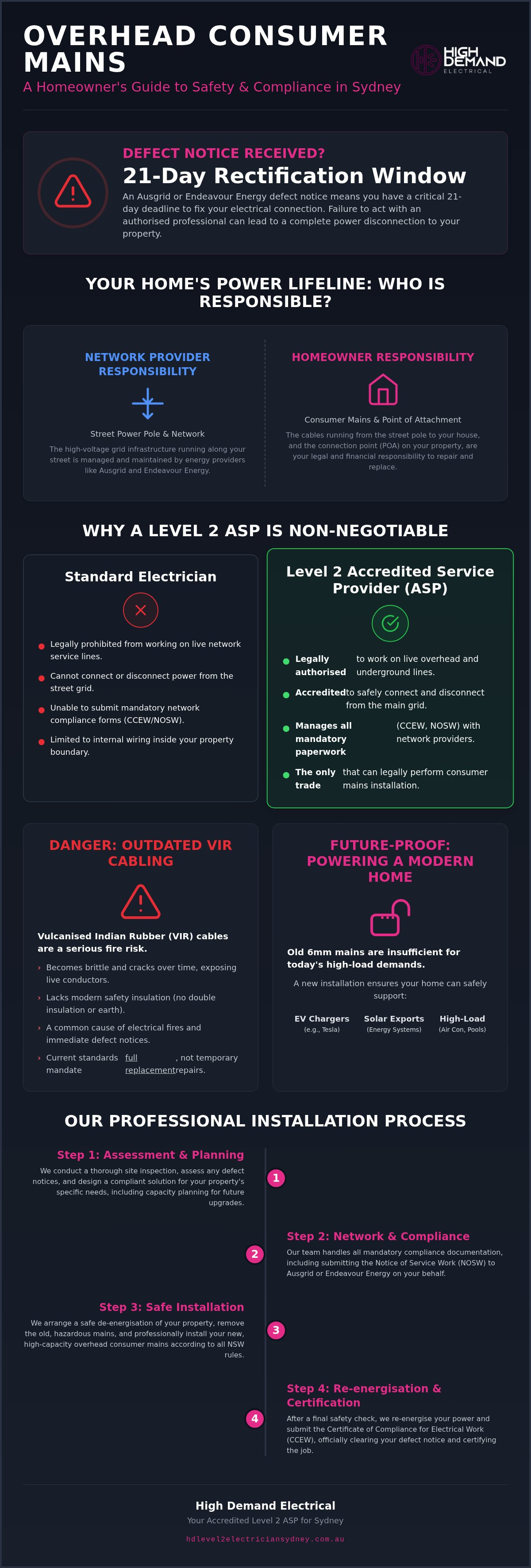
Standard electricians are highly skilled in internal wiring, but they lack the legal accreditation required to connect your property to the distribution network. In New South Wales, any work involving the connection or disconnection of power at the street pole must be performed by a Level 2 Accredited Service Provider (ASP). This is not just a safety recommendation; it is a strict legal mandate under the NSW Service and Installation Rules. A professional overhead consumer mains installation Sydney requires the authority to work on "live" network lines, a task that carries significant risk and requires specialised high-voltage training and equipment for working at heights.
Beyond the physical installation, a Level 2 ASP manages the mandatory compliance documentation required by the network providers. This includes the electronic submission of the Certificate of Compliance for Electrical Work (CCEW) via the BCNSW eCert portal and the Notice of Service Work (NOSW). These documents are essential for ensuring your installation is officially registered with Ausgrid or Endeavour Energy, protecting you from future liability or insurance disputes. If you are facing a complex connection issue or a defect notice, our team of accredited Level 2 electricians can handle the entire regulatory process on your behalf.
Modern Cable Sizing: Why 6mm is No Longer Enough
In previous decades, 6mm consumer mains were the industry standard for Sydney homes. However, in 2026, these thin cables are often the primary cause of flickering lights and tripped breakers. Modern lifestyles demand significantly more current. Between ducted air conditioning systems and high-draw induction cooktops, 6mm cables simply cannot cope with the thermal load. We now recommend a minimum of 10mm or 16mm cabling for any new installation. Upgrading your mains capacity is the only way to ensure your infrastructure can handle a high-performance EV charger installation Sydney without compromising the safety of your entire electrical system.
The Role of XLPE Cabling in Modern Standards
The transition to Cross-Linked Polyethylene (XLPE) cabling represents a major leap in electrical safety and durability. Unlike the old rubber or PVC insulation that becomes brittle and cracks under the intense Sydney sun, XLPE is engineered for superior heat resistance and a vastly extended lifespan. It is the current gold standard for overhead consumer mains installation Sydney because it maintains its structural integrity even under high current loads. Adhering to the latest NSW Service and Installation Rules updated in April 2026, our technicians exclusively use XLPE to ensure your home remains compliant and safe for decades to come.
Dangers of Outdated Mains: VIR Cables and Fire Risks
If your home was constructed before the mid-1960s, there is a high probability that your electrical system relies on Vulcanised Indian Rubber (VIR) cabling. Over decades of service, the rubber insulation on these cables undergoes a chemical breakdown, becoming extremely brittle. This is the "brittle cable" crisis facing thousands of Sydney property owners. When these cables are disturbed, even slightly, the insulation simply crumbles away, leaving bare copper conductors exposed. In the confined, often dusty environment of a Sydney roof cavity, this exposure creates a severe fire hazard that can ignite without warning. A professional overhead consumer mains installation Sydney is the only legal and safe method to eliminate this risk, as current regulations strictly prohibit the patching or repair of VIR infrastructure.
The danger is not limited to insulation failure. Outdated mains were typically designed for a maximum load of 30 to 40 Amps, which is insufficient for 2026 energy demands. When you run multiple high-load appliances, these narrow cables act as a bottleneck, causing significant heat build-up. This thermal stress accelerates the deterioration of any remaining insulation and leads to "voltage drops." You might notice your appliances struggling or your lights dimming when the compressor on your fridge or air conditioner kicks in. This isn't just an inconvenience; the heat generated by overworked cables can eventually melt through conduits and adjacent building materials, leading to catastrophic structural fires.
Signs Your Consumer Mains are Failing
Detecting failure before a fire occurs is paramount. Keep a close watch for these warning signs:
Flickering lights
Persistent dimming or flickering when high-load appliances start up indicates your mains are struggling to deliver sufficient current.
Burning smells
Any acrid, "metallic" or ozone smell near your meter box or where the cables enter the roof is a critical emergency.
UV rot
Inspect the service line where it meets your house. If the outer sheath looks frayed, cracked, or "hairy," the core insulation is likely compromised.
The Link Between Consumer Mains and Switchboard Safety
A comprehensive switchboard upgrade Sydney is rarely effective without also addressing the consumer mains. Modern switchboards are built to handle 63 Amps or higher to accommodate solar systems and EV charging. If you install a high-capacity board but leave the original 6mm VIR mains in place, you create a dangerous imbalance. Our Level 2 technicians ensure that the entire system is synchronised. This includes installing modern Residual Current Devices (RCDs) as mandated by the 2018 Wiring Rules and ensuring your overhead consumer mains installation Sydney provides the necessary "headroom" for your home’s peak power consumption. Whether you are in the Ausgrid network in the East or Endeavour Energy territory in the West, we ensure every component meets the specific technical standards required for your area.
Navigating Sydney Defect Notices: Ausgrid and Endeavour Energy
Receiving an electrical defect notice is a high-stakes event that demands immediate attention. These notices are official warnings issued by network inspectors when they identify infrastructure on your property that fails to meet the mandatory NSW Service and Installation Rules. Ignoring this document is not an option. If the identified hazards are not resolved within the specified timeframe, usually a 21 to 30-day window, the network provider has the legal authority to disconnect your power supply to protect the grid and the public. Resolving these issues requires a methodical approach led by a qualified Level 2 technician.
The resolution process begins with a technical assessment of the defect code listed on your notice. Once the specific failure is identified, our team executes the necessary rectification work, which frequently involves a full overhead consumer mains installation Sydney to replace non-compliant or degraded cabling. Following the physical installation, the final and most critical step is the submission of compliance documentation. Since July 2026, all Certificates of Compliance for Electrical Work (CCEW) must be lodged electronically through the BCNSW eCert portal. We manage this entire administrative process, including the Notice of Service Work (NOSW), to ensure your property is cleared on the network’s database. If you have just received a notice, you can contact our Level 2 ASP team to organise a rapid site inspection.
Common Defect Codes for Overhead Mains
While there are dozens of possible infractions, three issues dominate Sydney’s defect landscape. Low insulation resistance is the most frequent culprit, typically triggered by the breakdown of VIR cabling discussed in previous sections. Another common failure involves incorrect clearance heights. If your service lines hang too low over a driveway or within five metres of a swimming pool, they represent a significant safety breach. Finally, inspectors often flag the structural integrity of the Point of Attachment. A rusted fascia bracket or a rotting timber riser cannot safely support the tension of the overhead lines and must be replaced to maintain network standards.
Ausgrid vs. Endeavour Energy: Knowing Your Provider
Understanding which network manages your suburb is essential for a fast resolution. Ausgrid primarily services the Sydney CBD, Inner West, Eastern Suburbs, and Northern Beaches. Endeavour Energy manages the vast Western Suburbs, the Hills District, and South-Western Sydney. Each provider has distinct reporting protocols and inspection criteria. While the overarching safety rules are consistent across the state, the internal technical standards for equipment like private poles or meter box enclosures can vary. Our technicians are authorised to work across both networks, providing us with the specialised knowledge to navigate their specific bureaucratic requirements and ensuring your overhead consumer mains installation Sydney is approved without delay.
Professional Overhead Mains Installation: The High Demand Process
High Demand Electrical follows a rigorous, safety-first protocol for every overhead consumer mains installation Sydney. The process begins with a comprehensive site audit where our Level 2 ASP experts perform precise load calculations. This step is vital; we don't just replace like-for-like, we engineer a solution based on your home's actual and projected power draw. By assessing the distance from the street pole to your Point of Attachment (POA), we determine the exact cable gauge and tension requirements to meet 2026 safety standards.
Once the engineering phase is complete, we move to safe isolation. Working with live network connections requires absolute precision and specialised high-voltage equipment. We disconnect the street supply, remove non-compliant VIR cabling, and strip back outdated infrastructure that poses a fire risk. Our team then installs high-grade XLPE insulated mains, secured by reinforced POA hardware designed to withstand Sydney's coastal winds and intense UV exposure. This ensures that the physical connection point is as durable as the cables themselves.
The final phase involves rigorous testing and commissioning. We verify insulation resistance, earth continuity, and polarity before energising the system. To finalise the legal requirements, we handle all digital NOSW (Notice of Service Work) paperwork. We lodge these certificates directly with the network provider, ensuring your property is fully compliant with Ausgrid or Endeavour Energy records without you having to manage the bureaucracy.
Future-Proofing Your Sydney Property
Modernising your mains is an investment in your home’s future utility. With the rise of whole-home electrification, your infrastructure must be ready for solar export and high-capacity battery storage. If you are planning a switchboard upgrade for EV charger Sydney, having 16mm XLPE consumer mains already in place prevents costly bottlenecks later. Beyond technical readiness, updated electrical infrastructure is a significant value-add for property resale, providing potential buyers with the reassurance that the home is 2026-compliant and capable of supporting modern appliance loads.
Why Sydney Homeowners Trust High Demand Electrical
We have built our reputation as an authoritative rapid responder across the Sydney region. When you receive a defect notice, you don't have time for vague lead times or hidden "Level 2" surcharges. We provide upfront pricing and immediate action to ensure your power stays on and your family stays safe. Contact our Level 2 ASP team for a comprehensive compliance audit today and secure your home's power lifeline with absolute confidence.
Secure Your Sydney Power Connection Today
Your electrical infrastructure is more than just wires; it's the foundation of your home's safety and future capabilities. We've explored how outdated VIR cabling and rusted points of attachment aren't just technical failures but active risks to your property. By prioritising a professional overhead consumer mains installation Sydney, you eliminate the threat of sudden network disconnections and ensure your switchboard is ready for 2026 energy demands like EV chargers and high-efficiency solar systems.
High Demand Electrical stands ready to protect your home. As accredited Level 2 ASP specialists, we provide 24/7 emergency defect resolution across all Sydney metropolitan areas. Don't let a 21-day notice period or flickering lights cause unnecessary stress. Our team handles the technical engineering and the complex network paperwork so you can enjoy a safe, reliable power supply. We're committed to delivering rapid, compliant solutions that give you total peace of mind.
Get a Fast Quote for Your Overhead Mains Upgrade and secure your property today. Taking action now ensures your home remains a safe haven for years to come.
Frequently Asked Questions
How much does overhead consumer mains installation cost in Sydney?
Costs for an overhead consumer mains installation Sydney vary based on the technical complexity of the site. Factors include the length of the cable run from the street pole, whether you are upgrading from single to three-phase power, and the structural integrity of your current Point of Attachment. Every installation requires a bespoke load calculation to ensure compliance with 2026 standards. We provide transparent, upfront quotes after a site audit to ensure there are no hidden surprises.
Can I change my overhead mains to underground during an upgrade?
You can certainly convert your connection to underground, though it involves additional civil works like trenching and conduit installation. This transition often requires the installation of a private power pole or a green pillar at your boundary line. While more expensive than a standard overhead upgrade, undergrounding removes the risk of storm damage and improves the visual appeal of your property. Our Level 2 ASP team can manage this entire conversion process for you.
What happens if I ignore an Ausgrid defect notice for my consumer mains?
Ignoring an Ausgrid or Endeavour Energy defect notice will result in the mandatory disconnection of your power supply. Network providers typically allow a 21 to 30-day grace period for rectification before they send a crew to pull the fuses at the street pole. Beyond the loss of power, failing to address identified hazards like brittle VIR cables leaves you liable for any fire damage and places your family at significant risk of electrical shock.
How long does it take to replace overhead consumer mains?
Most residential replacements are completed within a single working day, typically taking between four and eight hours. This timeframe includes the safe isolation of the street network, the physical removal of old cables, and the installation of new XLPE mains. We also perform comprehensive testing and commissioning before restoring power. We aim to minimise downtime, ensuring your home is energised and fully compliant by the time our technicians leave the site.
Do I need to be home while the Level 2 electrician is working?
We generally require an adult to be present while our Level 2 electricians are on-site. We need clear access to your meter box and internal switchboard to perform mandatory safety tests and verify that the new connection is functioning correctly. Additionally, we must briefly enter the premises to ensure that all circuits are safely restored once the power is re-energised. This presence ensures the project is completed safely and all compliance paperwork is signed off.
Is my insurance valid if I have old VIR consumer mains?
Your home insurance policy may be at risk if you knowingly maintain non-compliant electrical infrastructure like VIR cabling. Most insurers include clauses that require property owners to maintain their home in a safe condition. If a fire is traced back to deteriorated consumer mains that were previously flagged or are known to be hazardous, the insurer may deny your claim based on negligence. Upgrading your mains provides the documentation needed to prove your home meets current safety standards.
Why did my lights flicker before my mains failed?
Lights often flicker because your outdated consumer mains are suffering from significant voltage drops. When high-load appliances like air conditioners or induction cooktops draw power, undersized or decaying 6mm cables cannot deliver the required current instantly. This causes a momentary dip in the voltage supplied to your lighting circuits. This is a primary warning sign that your current infrastructure is struggling and that a professional overhead consumer mains installation Sydney is required to prevent a total system failure.
What is the maximum length an overhead service line can be in NSW?
In New South Wales, the maximum allowable span for an overhead service line is generally 45 metres from the street pole to the Point of Attachment. If your property requires a longer connection, you must install a private power pole to support the weight and tension of the cables. These rules ensure that the lines maintain safe clearance heights over driveways and pedestrian areas, preventing accidental contact and ensuring the structural integrity of your home’s attachment point.
Powering Your Needs with Expertise
If you’re looking for a reliable, experienced, and prompt electrician, look no further than High Demand Electrical. We cater to all your electrical needs, from routine maintenance to emergency repairs and complete system installations. Our skilled team is committed to providing professional service that ensures your electrical systems run smoothly. Whether it's a small task or a large project, give us a call today. Let us meet all your electrical demands with the quality and reliability you deserve.