Old Fuse Box vs Modern Circuit Breaker Panel: Key Differences
The old fuse box vs modern circuit breaker panel comparison comes down to how each device interrupts a fault: a blown fuse must be replaced, while a tripped circuit breaker can be reset once the cause is addressed. Neither appearance alone nor the presence of breakers tells you whether the switchboard has safety-switch protection.
It’s easy to assume a modern-looking panel protects against every electrical hazard, but circuit breakers and safety switches serve different purposes. Breakers protect circuits from overloads and short circuits; safety switches help protect people from electric shock.
This guide explains how to identify a fuse box or modern switchboard, what happens when a breaker trips, and how their protections differ. You’ll also learn when an upgrade may be worth considering and which warning signs need prompt attention. The aim is to help you understand your home’s switchboard and choose a sensible next step.
Key Takeaways
• Look for replaceable fuse elements or rewireable fuse carriers to identify an older fuse box; modern switchboards generally use resettable circuit breakers.
• A blown fuse needs replacing, while a tripped breaker can be reset after the cause has been addressed.
• Circuit breakers protect against overloads and short circuits, but that’s different from protection against electric shock.
• Frequent tripping, visible scorching, sparks, a burning smell or an unusually warm panel are warning signs that need prompt attention.
• If the switchboard can’t meet your household’s electrical needs or needs upgrading, High Demand Electrical provides switchboard upgrades and Level 2 ASP Electrical Services.
Old Fuse Box vs Modern Switchboard: What's the Difference?
An older fuse box and a modern switchboard interrupt faults differently, and their protective features aren’t interchangeable. Appliance demand, circuit protection and safety switches all matter when assessing electrical capacity.
Fuse Box Capacity and Modern Appliances
Fuse boxes use fuse elements to protect individual circuits. Their suitability for modern appliances depends on the installation’s capacity and combined electrical demand, not simply the box’s age. For example, adding several high-demand appliances can place greater demands on existing circuits.
A house older than 25 years may need a mains power upgrade to meet increased power requirements. That doesn’t mean every older home needs replacing: the electrical supply, wiring and intended appliance use all affect the assessment. A licensed electrician can assess those factors before recommending upgrading.
Fuse and Breaker Fault Interruption
A rewirable fuse interrupts a circuit when excessive current melts its fuse wire. Once blown, it must be replaced with the correct fuse element; it can’t be reset. A circuit breaker also interrupts current during an overload or short circuit, but it can be reset after the fault has been addressed.
That difference changes what happens after a fault, but not the need to identify its cause. Replacing fuses or resetting a breaker repeatedly without resolving the underlying issue won’t fix the electrical fault. Neither device, by itself, provides the same electric-shock protection as a safety switch.
Safety Switches and Replacement Requirements
Safety switches, also called residual current devices (RCDs), monitor current and cut power when they detect leakage that could cause electric shock. According to the NSW Government, an RCD safety switch cuts electricity in a fraction of a second when it detects current leakage. A combined circuit breaker and safety switch, called an RCBO, protects its circuit from overloads, short circuits and electric shocks.
In Australia, a licensed electrician should replace a fuse box. A switchboard upgrade should include testing every circuit and meet applicable wiring rules. In Sydney, electrical work must also account for the Service and Installation Rules of NSW (SIRNSW) and other requirements that apply to the property.
Rebates or incentives depend on the relevant state or territory program and its eligibility conditions. Check the program’s terms before factoring an incentive into your upgrade decision.
| Option | Fault interruption | Electric-shock protection | Reset or replacement |
|---|---|---|---|
| Fuse box | Fuse element melts during a fault | Requires a separate safety switch | Replace the blown fuse element |
| Modern switchboard | Breaker trips during a fault | Safety switch or RCBO protection | Reset the breaker after addressing the fault |
Choose based on the installation’s condition, appliance demand and available safety protection. Have a licensed electrician assess the switchboard before electrical work begins.
What is a Circuit Breaker?
A circuit breaker is a resettable switch that interrupts electrical flow when its circuit develops a fault. In a switchboard, each breaker controls a circuit, such as lighting or power points. Its handle or indicator shows whether it is on or has tripped. A tripped breaker is a reason to investigate, not to keep resetting it without finding the cause.
Fuses and breakers both interrupt current to protect wiring, but they work differently. A fuse contains an element that melts when excessive current passes through it. Once blown, replacing it restores the circuit only if the underlying fault has been resolved. A breaker opens its contacts during a fault and can be reset afterwards.
For example, a rewirable ceramic fuse has replaceable fuse wire held inside a ceramic carrier. It provides short-circuit and overload protection, but not protection against electric shock. A blown fuse must be replaced with the appropriate fuse wire; an unsuitable element can compromise protection. The carrier’s appearance alone doesn’t establish whether the wiring or circuit is safe.
Plug-in circuit breakers provide the same circuit protection as fuses, with the added convenience of being resettable in a compatible fuse box. Their presence doesn’t automatically mean the installation has safety switches. Those devices serve a separate purpose: they help protect people from electric shock by monitoring electrical flow and disconnecting power when they detect a problem.
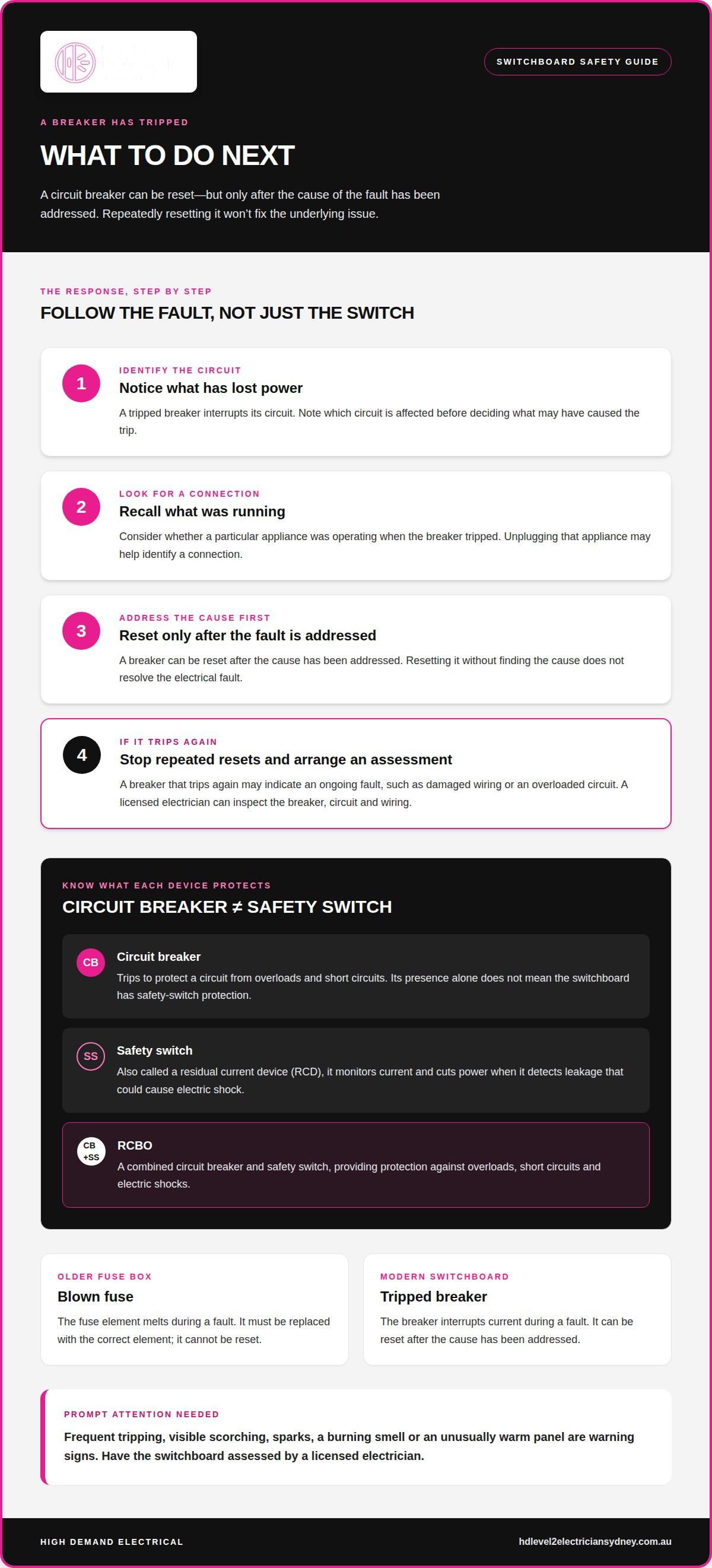
After a breaker trips, note which circuit has lost power and whether a particular appliance was operating. Unplugging that appliance may help identify a connection, but repeated tripping still needs attention. A breaker that trips again after being reset may indicate an ongoing fault, such as damaged wiring or an overloaded circuit. Don’t bypass the protection or replace a fuse with one rated higher.
Replacing or installing switchboard components is electrical work, not a routine household reset. A licensed electrician can inspect the fuse type, breaker, circuit and wiring before deciding what work is appropriate. Changing a protective device without considering the wiring can leave the circuit inadequately protected. The right solution depends on the fault and existing installation.
If a fuse repeatedly blows or a breaker keeps tripping, avoid further resets and arrange a professional assessment. Arrange an electrical assessment to identify the issue before deciding whether a repair or switchboard change is needed.
Circuit breakers and overload protection
A hardwired circuit breaker protects its circuit from overloads and short circuits. An overload occurs when a circuit carries more current than intended, such as when several appliances draw power at once. A short circuit creates an unintended path for current. In either case, the breaker interrupts the flow rather than allowing the fault to continue unchecked.
The breaker must suit the circuit and its wiring to provide appropriate protection. A device with the wrong rating can leave wiring inadequately protected or interrupt the supply unnecessarily. Selecting or changing a breaker isn’t simply a matter of fitting a convenient size. A licensed electrician assesses the circuit, wiring and connected loads before installing a replacement.
A combination circuit breaker and safety switch is called an RCBO. According to the NSW Government, an RCD safety switch cuts electricity in a fraction of a second when it detects current leakage. An RCBO combines this electric-shock protection with circuit protection against overloads and short circuits. It therefore provides distinct protections for the circuit it serves.
AFCI and GFCI are terms readers may encounter in North American electrical material. AFCI means arc-fault circuit interrupter, while GFCI means ground-fault circuit interrupter. These aren’t the terms generally used for Australian safety switches and RCBOs. When discussing an Australian switchboard, identify the device and its marked function rather than assuming an unfamiliar abbreviation describes equivalent protection.
Different devices respond to different electrical problems. An overload or short circuit can trip a circuit breaker; a safety switch monitors current leakage that may risk personal safety. An RCBO combines those functions for its circuit. A breaker alone shouldn’t be mistaken for a safety switch, even when both devices are in the same switchboard.
If a breaker trips repeatedly, note which circuit loses power and what was running beforehand. A heater and other appliances operating on the same circuit are a practical example of combined demand. Don’t keep resetting the breaker without addressing the cause. Repeated tripping can signal an overload or electrical fault that needs assessment.
Correct protection depends on the circuit, wiring and device working together. An electrician can inspect the switchboard and determine whether its breakers, safety switches or RCBOs provide the intended protection. This is especially relevant when a switchboard has mixed device types or a circuit’s use has changed.
Modern circuit breaker safety features
A modern switchboard can contain circuit breakers, safety switches or combined RCBOs. These devices don’t all protect against the same faults. A circuit breaker responds to overloads and short circuits, while a safety switch monitors electrical flow for current leakage. An RCBO combines both functions for its circuit, providing more than a breaker alone.
That difference matters when comparing safety and reliability. A breaker can interrupt a fault affecting its circuit, but it doesn’t provide electric-shock protection by itself. A safety switch is designed to disconnect power when it detects current leakage that could threaten personal safety. According to Energy Safe Victoria, a safety switch monitors circuit flow and cuts power within milliseconds if it detects a problem that may risk personal safety.
Safety switches need regular testing. Australian householders are advised to press each safety switch’s test button every three months. The test button checks that the switch operates and disconnects the circuit. Follow the instructions on the switch or switchboard, and expect the protected circuit to lose power during the test. Regular testing supports peace of mind, but doesn’t replace an electrician’s inspection.
Before pressing a test button, consider what the switch controls. For example, equipment on a power circuit may need to be shut down safely first. If the switch doesn’t trip or won’t reset afterwards, don’t open the switchboard or attempt repairs. Arrange an assessment by a licensed electrician, who can check the device and affected circuit.
A modern-looking enclosure alone doesn’t prove that every circuit has safety-switch protection. The switchboard may contain breakers without safety switches, or protection may cover some circuits but not others. Circuit labels can help identify their purpose, but don’t show which protective device serves them. An electrician can confirm the arrangement and whether the devices operate correctly.
Warning signs need prompt attention, whether the board has fuses or breakers. Contact a licensed electrician if a breaker keeps tripping, or if you notice scorch marks, sparks, a burning smell or an unusually warm panel. These signs can point to an electrical problem; repeatedly resetting a switch won’t resolve the cause. Keep clear of visible damage and avoid touching exposed components.
Testing and visual checks serve different purposes. The test button checks a safety switch’s operation, while an electrical inspection can assess the switchboard, connections and circuits. If a test causes repeated tripping, a switch won’t reset or warning signs appear, stop using the affected circuit if it’s safe to do so and seek professional attention. Regular testing helps, but suitable devices, correct installation and functioning wiring are also essential.
Identifying a fuse box or breaker panel
Start with the controls visible on the switchboard, not its age or outer appearance. An older fuse box may have ceramic fuse carriers, while a breaker panel has rows of small switches or toggles. A newer enclosure alone doesn’t prove the equipment inside is modern. The clearest clue is whether each circuit has a replaceable fuse element or a resettable breaker handle.
A ceramic rewirable fuse may have a screw-in carrier or removable cover holding fuse wire. Some fuse boxes contain several carriers, each associated with a different circuit. Don’t remove a carrier to identify it. If labels are visible, names such as “lights” or “power” can help show which household circuits the fuses serve.
A breaker switch is usually a small lever or toggle beside circuit labels. It may sit in line with other breakers, or a handle may appear out of position after tripping. That position can be a clue, but it doesn’t explain why the breaker tripped or confirm the circuit is safe. Don’t keep switching it on to test it.
Fuse element
a ceramic carrier or fuse wire points to a fuse box.
Switching handles
rows of resettable toggles indicate circuit breakers.
Test button
a marked button can identify a safety switch or combined protective device.
A safety switch may look like a breaker, so look for a clearly marked test button rather than relying on shape alone. Some switchboards contain both ordinary breakers and safety switches. An RCBO combines circuit-breaker and safety-switch functions, so a test button and switching handle may appear together on one device.
Keep the switchboard closed while identifying visible features. Don’t touch exposed parts, remove a cover or handle loose fuse wire. If a label is missing, a control is unclear, or the board shows scorching, sparks or heat, stop inspecting it yourself. A licensed electrician can identify the devices and assess their condition without guesswork.
A quick visual check can show what type of equipment is present, but not whether it provides the right protection or suits the home’s electrical needs. Record only visible details, such as fuse carriers, breaker handles and test buttons. If tripping, a burning smell or visible damage accompanies your check, treat it as a warning sign, not just an age-related difference.
If you can’t identify the switchboard confidently, arrange an electrical assessment before attempting any work.
High Demand Electrical
High Demand Electrical helps Sydney property owners address switchboard concerns through Level 2 ASP Electrical Services and switchboard upgrades. If you’ve identified fuse carriers, aren’t sure whether safety switches protect your circuits, or have a breaker that keeps tripping, an electrician can assess the switchboard and explain the appropriate next step.
An upgrade may also be relevant when electrical work or new equipment changes what your home needs from its switchboard. The assessment can consider the existing board, wiring and protection, rather than relying on appearance alone. If the issue involves the wider electrical supply, Level 2 ASP expertise may also be relevant.
For help deciding what your switchboard needs, contact High Demand Electrical.
Make your next switchboard decision with confidence
Choosing between an old fuse box and a modern circuit breaker panel isn’t simply a matter of preferring newer equipment. Relate what you’ve observed to how the property is used and any electrical changes you’re planning. That context makes an assessment more practical, whether you’re preparing for renovations, adding equipment or addressing a switchboard concern.
Keep your notes to visible details and household symptoms, such as which circuit loses power or whether a switch trips repeatedly. Don’t open the enclosure or attempt electrical work yourself. A qualified assessment can clarify the installation’s condition and whether an upgrade suits your needs.
For guidance on your switchboard, contact High Demand Electrical. A clear assessment can help you take the next step with greater confidence.
Frequently Asked Questions
Benefits of Upgrading: Why Consider Fuse Box Replacement?
Replacing an old fuse box may be worth considering if the board can’t support planned electrical changes or lacks suitable protection. For example, adding an EV charger or renovating a kitchen may prompt an assessment of supply capacity, circuits and safety devices. An upgrade can replace fuse-based controls with breakers and allow protective devices to suit the installation. The benefits depend on the home’s electrical needs.
What is a Fuse Box?
A fuse box is an enclosure that distributes electricity from the home’s supply to individual circuits and contains fuses that protect circuit wiring. Each fuse is associated with a circuit, such as lighting or power points. In an older Australian home, you may see ceramic carriers or rewirable fuse elements inside. The fuse box’s appearance doesn’t show whether its wiring, connections or protection remain suitable.
How much does a switchboard upgrade cost?
The price depends on the work required and is provided after a site assessment. Factors include the existing switchboard’s condition, number of circuits, protection required and whether mains work or relocation is needed. A straightforward replacement differs from a project involving changes to the electrical supply. An assessment establishes the work required before a fixed-price quote can be prepared.
Why Would You Replace Your Old Fusebox or Switchboard?
Replacement may be appropriate if the board is damaged, circuits repeatedly lose power or planned electrical work changes household demand. For instance, a renovation or new high-demand appliance can prompt a review of capacity and circuit protection. An electrician can assess the board alongside the wiring and incoming supply. Age alone doesn’t mean replacement is necessary if the equipment has been inspected and found to be in working order.
What is the difference between an old fuse box and a modern circuit breaker panel?
The main practical difference is how circuit protection is restored after operation: a fuse element needs replacing, while a breaker can be reset after its cause is addressed. Modern switchboards may also contain safety switches or combined RCBOs, but appearance alone can’t confirm which circuits they protect. Look for fuse carriers or switching handles without opening the enclosure, then have unclear devices identified professionally.
What are the signs an Australian fuse box needs replacing?
Warning signs include repeated blown fuses, a breaker that keeps tripping, scorch marks, sparks, a burning smell or an unusually warm panel. These symptoms can indicate an electrical fault and need prompt attention. Don’t remove the cover or keep replacing fuses to restore power. If you see damage or smell burning, keep clear of the switchboard and arrange a professional assessment.
What are the risks of an old fuse box, including asbestos and fire hazards?
An old fuse box isn’t automatically unsafe, but faulty wiring, moisture damage and overloaded circuits can create serious hazards. Scorch marks, sparks or a burning smell warrant prompt inspection. Age and appearance alone can’t establish whether materials contain asbestos. Don’t disturb material you suspect may contain asbestos; arrange appropriate assessment before work affects it. An electrician can assess electrical condition, while material identification requires suitable expertise.
Does an Australian home need safety switches on all circuits?
Whether safety switches are required on every circuit depends on the applicable state or territory requirements and the installation. Don’t assume a modern-looking switchboard protects every circuit, or that one test button covers the whole home. A licensed electrician can identify which circuits have safety-switch protection and assess the installation against relevant requirements. This is particularly useful before renovations or electrical changes.
Need Help Fast?
Powering Your Needs with Expertise
If you’re looking for a reliable, experienced, and prompt electrician, look no further than High Demand Electrical. We cater to all your electrical needs, from routine maintenance to emergency repairs and complete system installations. Our skilled team is committed to providing professional service that ensures your electrical systems run smoothly. Whether it's a small task or a large project, give us a call today. Let us meet all your electrical demands with the quality and reliability you deserve.

Licensed Level 2 ASP electricians across Sydney. Same-day service and 24/7 emergency response.
Licence 397193C
ABN 87 051 836 527
