NSW Point of Attachment Guide for Property Owners
What if the part of an overhead power connection you can see isn’t the part you’re responsible for? It’s easy to confuse the network’s service line with the attachment hardware and electrical equipment on your property. Understanding point of attachment regulations NSW property owners need to consider starts with knowing where those responsibilities meet and which requirements apply to the site.
This guide explains what the point of attachment is and how the NSW Service and Installation Rules, AS/NZS 3000 and your electricity distributor’s requirements relate to it. You’ll also learn why site conditions matter, what to do if you notice a defect or receive a notice, and what information to gather before an assessment.
If work is needed, the next step depends on whether the issue involves the service connection, overhead service mains or consumer mains. For Sydney properties, a Level 2 Accredited Service Provider can assess relevant connection work. Keep any defect notice handy, and don’t touch or approach damaged overhead equipment.
Key Takeaways
• Learn what the point of attachment means and how it differs from the service line and consumer mains.
• Understand how point of attachment regulations NSW fit within the Service and Installation Rules of NSW and relevant distributor requirements.
• A visible defect or notice may not identify the affected component. Gather the details before arranging an assessment.
• If you suspect a fault, keep clear of the equipment, note its location and retain any notice or safety instructions.
• High Demand Electrical is a Level 2 Accredited Service Provider (ASP), authorised to carry out service line, metering and connection work for Ausgrid, Endeavour Energy and Essential Energy.
What does point of attachment mean under NSW electrical rules?
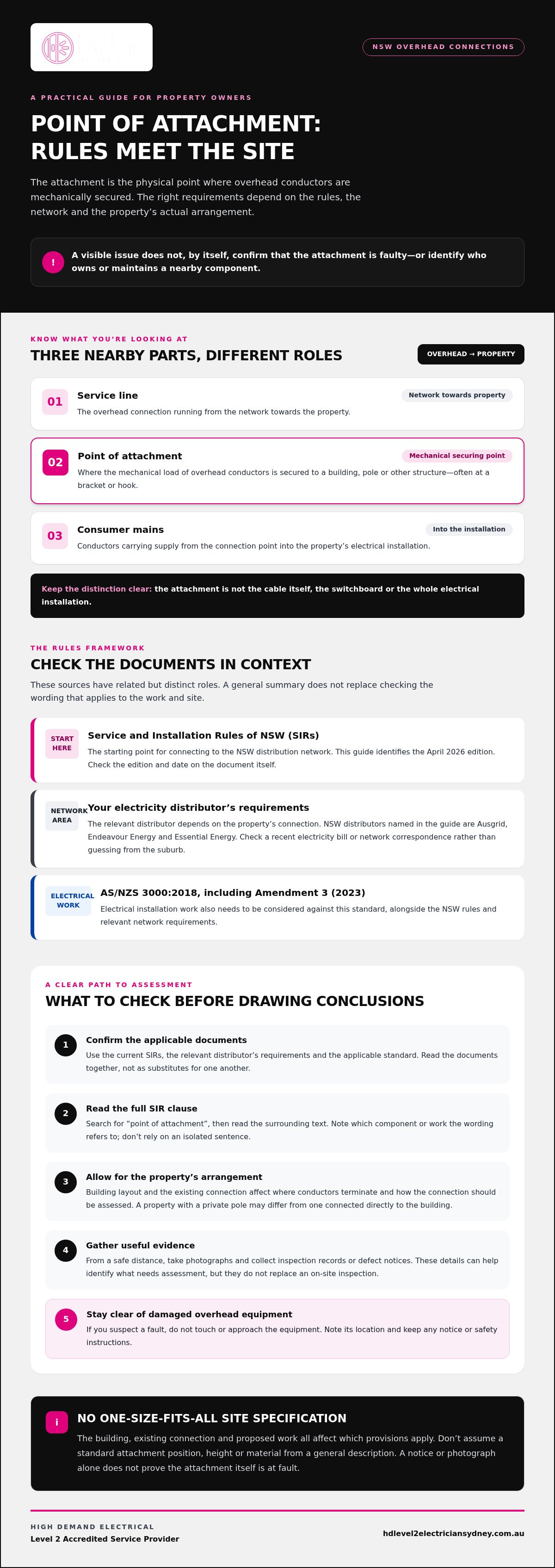
In the Service and Installation Rules of NSW (SIRs), the point of attachment is where the mechanical load of overhead conductors is secured to a customer’s building, pole or other structure. In plain English, it’s the physical connection point, often involving a bracket or hook, where the overhead conductors terminate at the property.
This point marks an interface in an overhead electricity connection. However, the term alone doesn’t establish who owns or maintains each nearby component, or confirm that a fault is at the attachment. The arrangement and applicable network requirements need to be considered together.
A short video can help illustrate the general idea. It was produced by a US electricity cooperative, so use it as a visual aid, not as guidance on NSW requirements.
How the point relates to service lines and consumer mains
The service line is the overhead connection running from the network towards the property. Consumer mains are the conductors that carry supply from the connection point into the property’s electrical installation. The point of attachment is where the overhead conductors are mechanically secured. It isn’t the cable itself, the switchboard or the whole electrical installation. For background on the general concept, see service drop. NSW terminology and requirements are set out in the SIRs.
These components are close together, so a visible issue may not reveal which part needs attention. If the concern involves the overhead section, read about overhead service mains installation. Sydney property owners can also find information about Level 2 electrical services in Sydney.
Why the exact location is site-specific
Building layout and the existing electrical arrangement affect where conductors terminate and how the connection should be assessed. A house with a private pole, for example, may have a different arrangement from one connected directly to the building. Don’t assume a standard position, height or material based on a general description. Apply point of attachment regulations NSW alongside the current rules and relevant network requirements for the property.
To describe a concern, take photographs from a safe distance and gather any inspection records or defect notices. These details can help identify what needs assessment, but they don’t replace an on-site inspection or prove that the attachment itself is at fault.
Which NSW rules and network requirements apply to a point of attachment?
For property owners, the starting point is the Service and Installation Rules of NSW (SIRs). The current edition identified for this guide is April 2026. The SIRs set out requirements for connecting to the NSW distribution network. The relevant distributor may also publish requirements for connection work in its network area.
For a NSW connection, consult the April 2026 Service and Installation Rules of NSW and the applicable distributor requirements. Electrical installation work also needs to be considered against AS/NZS 3000:2018, including Amendment 3 (2023). These documents serve related but distinct purposes. A general summary shouldn’t replace checking the wording that applies to the work at the property.
How to use the NSW Service and Installation Rules
Start with the current SIRs published by NSW Climate and Energy Action. Check the edition and date on the document itself before relying on a saved copy or an older search result. Search the document for “point of attachment” and read the surrounding text, not just an isolated sentence. Nearby terms about overhead connections may clarify the context, but don’t assume a reference applies to your property without considering the full clause and arrangement.
When interpreting the wording, note which component or work it refers to, then separate that from assumptions about ownership, responsibility or a required repair. If a term or its application is unclear, it needs to be reviewed against the current official document and site conditions.
When the electricity distributor’s requirements matter
Ausgrid, Endeavour Energy and Essential Energy are NSW electricity distributors. The relevant network depends on the property’s connection. Identify the distributor from a recent electricity bill or network correspondence rather than assuming it from the suburb name.
For a property connected to Ausgrid’s network, its published connection policies and requirements can provide guidance alongside the NSW framework. Distributor documents may cover connection processes and technical requirements. Read them in context with the SIRs and applicable standards rather than treating one document as a substitute for the others.
The phrase point of attachment regulations NSW refers to a rules framework, not one universal site specification. The building, existing connection and proposed work all affect which provisions are relevant. For work involving a Sydney connection, a Level 2 electrician in Sydney can assess the connection in context. Get in touch with High Demand Electrical to discuss the next step for your property.
Point of attachment, service mains or pole: how to identify the issue
Overhead electrical equipment sits close together, but each part has a different function. The Service and Installation Rules of NSW (SIRs) distinguish the point where overhead conductors are mechanically terminated from the conductors themselves. That distinction helps describe a concern, but it doesn’t confirm which component is damaged or who is responsible for it.
Use this comparison as a starting point. The precise arrangement and wording in the current SIRs should guide an assessment.
| Component | What it refers to | What to keep in mind |
|---|---|---|
| Point of attachment | The point on a building, pole or structure where the mechanical load of overhead conductors is terminated. | It’s the attachment location, not the overhead cable or the entire electrical connection. |
| Service line | The overhead conductors that connect the distribution network towards the property’s attachment point. | A concern with the cable may be separate from a concern with the bracket or other attachment hardware. |
| Consumer mains | The conductors that form part of the property’s electrical installation and carry supply towards the main switchboard. | They may be near the attachment point, but they’re a distinct part of the connection. See the consumer mains installation guide. |
A private power pole is a support structure, not another name for the point of attachment. A property may have a pole supporting overhead conductors, an attachment point on a building, or both. A concern with the pole and one with the attachment point can be related, but one doesn’t establish the other.
What visible signs can and cannot tell you
Loose-looking fittings, visible damage, sagging conductors or a distributor’s notice are reasons to arrange an appropriate assessment. They aren’t a diagnosis. A photo may show where an issue appears, but it can’t reliably establish which component is affected, whether it meets current requirements or what work is needed.
Don’t touch, move or attempt to repair electrical infrastructure. Keep clear and follow any safety directions in a notice or from network personnel. If you’re documenting the concern, take photographs from a safe distance and note the location.
When a pole or overhead service may also need attention
Damage near a private pole or overhead service may warrant inspection of nearby equipment as well as the visible point of concern. That doesn’t mean the pole, service line or attachment is necessarily faulty. An on-site assessment is needed to identify the affected component and determine the appropriate next step under point of attachment regulations NSW and applicable network requirements.
What should Sydney property owners do about a suspected attachment-point defect?
Act safely first, then gather information. A loose-looking fitting or a distributor’s defect notice can signal a concern, but neither tells you by itself whether the affected part is the attachment, service line, consumer mains or a nearby structure. Rectification should follow the documented issue and applicable NSW rules and network requirements, not a generic repair checklist.
Keep clear.
Don’t touch, move or attempt to repair the attachment, conductors or other electrical infrastructure. Follow safety directions issued by the relevant network or qualified personnel.
Record the location.
Note the property address and where the concern is, such as the front façade, driveway or private pole.
Gather the paperwork.
Keep any distributor or inspection notice and relevant prior service records together.
Arrange an appropriate assessment.
Provide the information you’ve gathered so the affected equipment and required work can be assessed.
Information to gather before arranging an assessment
Write down what you observed and when, using descriptions rather than conclusions. For example, record that a bracket appears loose or a cable looks damaged. Don’t label the installation unsafe or non-compliant based on appearance alone. Take photographs only from a safe distance. Never approach exposed or damaged electrical equipment for a clearer image. Previous service records can provide useful context, but they don’t prove that the current installation complies with present requirements.
When Level 2 ASP involvement is relevant
Where assessment or rectification involves service line, metering or connection work, a Level 2 Accredited Service Provider (ASP) is the relevant specialist. High Demand Electrical is authorised to carry out service line, metering and connection work for Ausgrid, Endeavour Energy and Essential Energy. The required work depends on the site and the issue recorded, so don’t assume a notice means the attachment itself needs replacement.
If you’ve received a formal notice, keep it available when arranging next steps. High Demand Electrical provides defect notice rectification for relevant electrical defects. The notice wording and any directions from the distributor help inform the assessment. Follow the stated instructions and timeframes rather than relying on general advice about another property.
Point of attachment regulations NSW apply in context: the location, component named in a notice and scope of connection work all matter. A clear description and the relevant documents help focus an assessment on the actual issue.
How High Demand Electrical can help with related NSW connection work
A concern near an overhead connection doesn’t automatically mean the point of attachment is defective. The affected part could be the service line, overhead service mains, consumer mains or another item in the existing arrangement. High Demand Electrical assesses the connection and reported issue in context, then carries out relevant service line, connection and infrastructure work where required.
What HDE’s documented Level 2 ASP accreditation covers
Level 2 Accredited Service Provider (ASP) - authorised to carry out service line, metering and connection work for Ausgrid, Endeavour Energy and Essential Energy. This scope is relevant when work involves the electricity connection, such as service line or metering work. Accreditation doesn’t determine who is responsible for every component at a property or establish what work is needed before the site and any notice are assessed.
High Demand Electrical holds EC Licence 397193C. The business also has Triple ISO certification - ISO 9001, ISO 45001 and ISO 14001. These credentials describe the business’s licensing, accreditation and management systems. They aren’t a separate approval for a particular property or a substitute for checking the applicable NSW rules and network requirements.
Depending on the assessment, relevant work may involve overhead service mains, consumer mains, private power poles or defect notice rectification. The appropriate scope depends on the documented concern and the installation, not just the name used to describe it. For an overview of Level 2 electrical services in Sydney, see the local service page.
Arrange a Sydney assessment or discuss the next step
High Demand Electrical serves Sydney’s Inner West, Sydney’s West, South West and the Sutherland Shire. To explain the issue, have the property location, any network or inspection notice, and a brief description of what you observed ready. Photographs taken from a safe distance may also provide context. Don’t approach or touch electrical equipment to gather information.
Point of attachment regulations NSW need to be applied to the actual connection and issue. An appropriate assessment can help distinguish the attachment point from adjacent service and property-side components, and clarify the next step.
Discuss the issue with High Demand Electrical:
Phone 0402 559 777
Email chris@highdemandelectrical.com.au
Take the next step with confidence
Point of attachment regulations NSW are easier to understand when you distinguish the attachment itself from nearby service line and consumer mains equipment. A visible concern or defect notice is a reason to gather relevant details and arrange an assessment, not to assume which component is at fault. The right work depends on the property’s electrical arrangement and the requirements that apply to the connection.
High Demand Electrical holds EC Licence 397193C and is a Level 2 Accredited Service Provider (ASP) - authorised to carry out service line, metering and connection work for Ausgrid, Endeavour Energy and Essential Energy. The business also holds Triple ISO certification - ISO 9001, ISO 45001 and ISO 14001. These credentials support an informed approach to related NSW connection work.
Have your property location, any notice and a description of what you’ve observed ready. Contact High Demand Electrical about NSW connection work to discuss the next step. With clear information and an appropriate assessment, you can move forward with confidence.
Frequently Asked Questions
What does point of attachment mean in NSW?
Under the NSW Service and Installation Rules, the point of attachment is where the mechanical load of overhead conductors is terminated on a customer’s building, pole or structure. In plain English, it’s where the overhead connection is secured to the property. It’s distinct from the conductors themselves, but the term alone doesn’t establish who owns or maintains nearby equipment. The physical arrangement needs to be considered when applying point of attachment regulations NSW.
Which rules cover a point of attachment in NSW?
The named NSW framework is the Service and Installation Rules of NSW (SIRs). The edition identified for this guide is April 2026. Check the current official document and relevant section before relying on a particular requirement. Distributor-specific requirements may also apply, depending on the property’s network. These documents provide the regulatory context, but a general explanation can’t determine whether a particular connection complies without considering the installation and work involved.
Is the point of attachment the same as consumer mains?
No. The point of attachment describes where overhead conductors are mechanically secured to a building, pole or structure. Consumer mains are conductors that form part of the property’s electrical installation. They may be close to the attachment point, but they’re not interchangeable terms, and their physical relationship can depend on the installation. For more context on property-side cabling, see the consumer mains installation guide and the relevant section of this article.
Who can assess a point-of-attachment issue in Sydney?
The appropriate assessment depends on what’s affected and what work is required. Where service line, metering or connection work is relevant, High Demand Electrical is a Level 2 Accredited Service Provider (ASP) - authorised to carry out service line, metering and connection work for Ausgrid, Endeavour Energy and Essential Energy. The business holds EC Licence 397193C. An assessment can clarify the issue, but the outcome shouldn’t be assumed before the site and details are reviewed.
What should I do if I receive an electrical defect notice about the attachment point?
Follow the instructions in the notice, keep the document available and don’t touch the attachment or other electrical equipment. The notice helps identify the reported concern, but the required rectification depends on its wording, the affected component and applicable current requirements. Don’t assume the attachment itself is at fault. For help with a formal notice, see High Demand Electrical’s defect notice rectification service.
Can I repair or move a point of attachment myself?
Don’t attempt to repair, move or handle the point of attachment or connected electrical infrastructure yourself. Keep clear, follow any safety directions you’ve received and arrange an assessment by an appropriately accredited professional where connection work is involved. In Sydney, High Demand Electrical’s Level 2 ASP accreditation covers service line, metering and connection work for Ausgrid, Endeavour Energy and Essential Energy. The appropriate work depends on the property’s arrangement and the issue found during assessment.
Powering Your Needs with Expertise
If you’re looking for a reliable, experienced, and prompt electrician, look no further than High Demand Electrical. We cater to all your electrical needs, from routine maintenance to emergency repairs and complete system installations. Our skilled team is committed to providing professional service that ensures your electrical systems run smoothly. Whether it's a small task or a large project, give us a call today. Let us meet all your electrical demands with the quality and reliability you deserve.