Is My Old Switchboard a Fire Hazard? Warning Signs and Next Steps
An old switchboard isn’t automatically a fire hazard, but age can hide faults or outdated protection. If you’re asking, “is my old switchboard a fire hazard?”, the answer depends on its condition, warning signs and how it performs, not age alone.
It can be hard to tell normal wear from a reason to act. Flickering lights, circuits that trip repeatedly, buzzing or humming, burn marks, heat damage or corrosion can all warrant a professional assessment. Don’t remove the switchboard cover or attempt electrical repairs yourself.
This guide explains which signs deserve attention, what safe next steps to take and when to seek urgent help. A qualified electrician can assess the board and explain whether repairs or a switchboard upgrade may be appropriate. For Sydney homes, an assessment can help replace guesswork with a clearer understanding of the risks and options.
Key Takeaways
• Age alone doesn’t confirm a fire hazard. Learn how to judge whether “is my old switchboard a fire hazard” needs a qualified assessment.
• Recognise warning signs such as repeated tripping, buzzing or visible damage, and know what to report to an electrician.
• Keep clear of the switchboard and never remove its cover or touch wiring. Find out what safe next steps to take if you’re concerned.
• Understand how an electrician’s findings can help determine whether repairs or a switchboard upgrade may be suitable.
• Learn what to ask about an assessment and how relevant electrical requirements may apply to work on your switchboard.
Is an old switchboard a fire hazard, or does age alone not tell the whole story?
Age alone doesn’t prove that a switchboard is a fire hazard. If you’re wondering, “is my old switchboard a fire hazard?”, its age may be a reason to arrange an assessment, but condition, installation and signs of damage matter too. A qualified electrician needs to evaluate the board and installation before drawing conclusions.
A switchboard is the central point that distributes electricity to a property’s circuits and provides protection for them. The Distribution board reference explains this general role. This guide can help you recognise possible concerns, but it can’t diagnose an electrical fault or confirm that a board is safe.
For a visual introduction to switchboard upgrades, watch this video:
What can make an older switchboard a safety concern?
Age can mean a board has had more time to wear or sustain damage, but switchboards and their installation histories vary between properties. Burn marks, heat damage or corrosion are reasons to seek professional advice. These signs don’t establish what caused the problem or how serious it is.
Don’t open the enclosure or touch wiring to investigate. A qualified electrician can assess the board and installation, then explain what the findings mean. What you can see from outside won’t reveal the condition of internal components or confirm how the installation performs.
Does an old switchboard always need replacing?
No. A switchboard’s age isn’t a diagnosis or an automatic instruction to replace it. A visual impression may raise questions, but it isn’t a substitute for an assessment. The electrician’s findings should guide any recommendation. The right option can’t be determined before the board is evaluated.
If the assessment identifies a concern, ask the electrician to explain what they found, what action they recommend and why. In Sydney, High Demand Electrical provides switchboard upgrades. An upgrade may be an option if the assessment supports it. You can read more about switchboard upgrades, but the board’s condition, not its age alone, should inform the decision.
Which old switchboard warning signs should make you act?
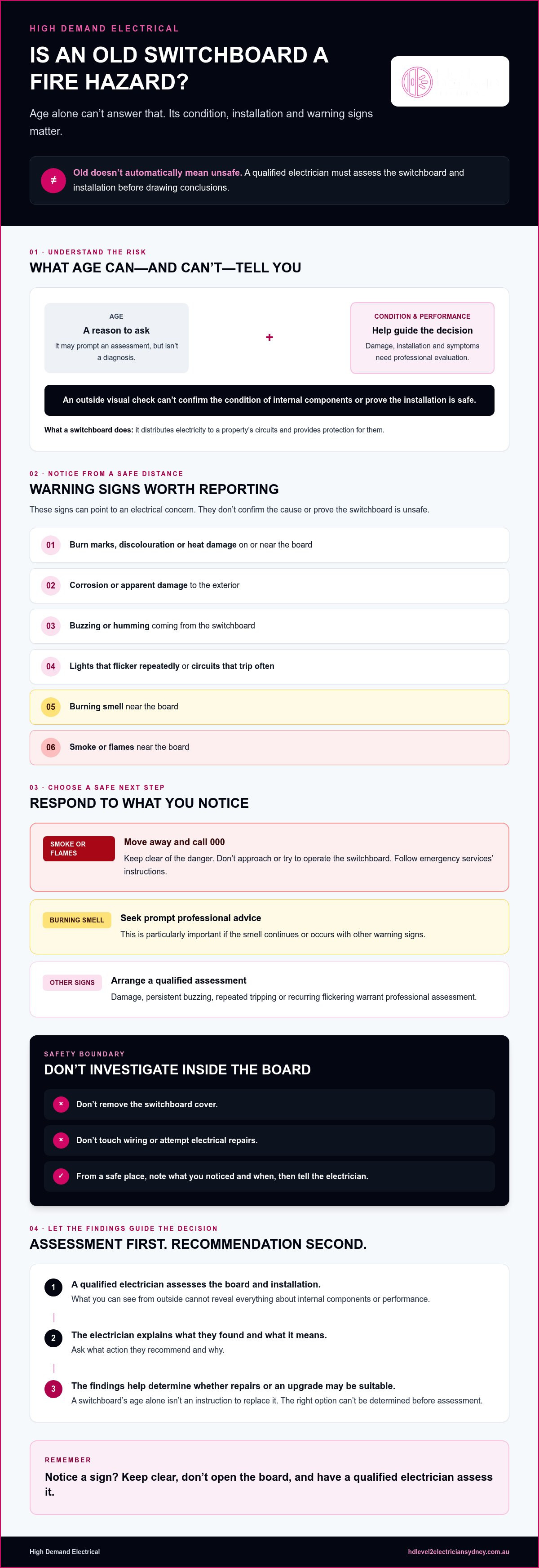
If you’re asking, “is my old switchboard a fire hazard?”, changes around the board or recurring electrical problems are reasons to seek professional advice. They don’t confirm the cause or prove the switchboard is unsafe, but they shouldn’t be ignored. Notice what’s happening from a safe distance. Don’t open the board, touch wiring or try to test internal components.
What signs can you notice without opening the switchboard?
Look only at what you can observe without approaching a suspected hazard. Possible warning signs include:
Visible burn marks, discolouration or heat damage
on or near the switchboard.
Corrosion or apparent damage
to the exterior of the board.
Buzzing or humming
coming from the switchboard.
Lights that flicker repeatedly
or circuits that trip often.
A burning smell, smoke or flames
near the board.
These observations can point to an electrical concern, but only an electrician can assess the switchboard and determine what’s causing it. From a safe place, note what you noticed and when, then share that information when seeking help. The US Consumer Product Safety Commission’s Home Electrical Safety Checklist offers general household safety prompts, but it isn’t NSW-specific guidance or a substitute for an electrical assessment.
When should a concern be treated as urgent?
Arrange a qualified assessment if you notice damage, persistent buzzing, repeated tripping or recurring flickering. If there’s smoke or fire, move away from the danger and call 000. Don’t approach the switchboard or try to operate it. Follow instructions from emergency services. A burning smell without visible smoke or flames still warrants prompt professional advice, particularly if it continues or comes with other warning signs.
For an immediate electrical hazard, keep people clear and seek appropriate professional help rather than attempting repairs. You can read about emergency make-safe services to understand the kind of response a hazardous situation may require. Don’t treat a webpage as emergency advice, and don’t delay calling 000 where there’s smoke or fire.
How does an electrician assess an old switchboard’s fire risk?
A professional assessment helps answer “is my old switchboard a fire hazard?” by examining the board and installation, rather than relying on age or a homeowner’s impression. The checks and any follow-up depend on the property and what the electrician finds. An assessment doesn’t guarantee that the board will pass or that a particular repair or upgrade will be suitable.
In NSW, electrical work must be carried out by an appropriately qualified electrician. Where work involves connecting to the electricity network, the NSW Service and Installation Rules (SIRNSW) are relevant. AS/NZS 3000 is also relevant to electrical installation work. The electrician can explain which requirements apply to the proposed work.
What does a professional switchboard inspection consider?
The electrician may ask about symptoms, previous work and changes to the property, then assess the board’s visible condition. Depending on the installation and findings, they may check the circuit protection and carry out appropriate electrical tests. For example, an RCD, or safety switch, can be tested to assess its operation. These are professional checks, not tasks for homeowners to attempt.
The electrician should explain any terms, test results and limitations in plain language. An electrical safety inspection can provide a formal assessment of electrical safety concerns. Ask what was inspected, what the findings mean and whether anything needs prompt attention.
How are repair and replacement options explained?
Repair or replacement may be considered, but neither should be assumed before inspection. Ask the electrician to link each recommendation to a specific finding: what needs attention, why, what work is proposed and whether other suitable options exist. If an upgrade is recommended, ask why repair alone may not address the identified issue.
This gives you a clearer basis for deciding on further work without treating an inspection as an automatic instruction to replace the board. If you’re in Sydney and need to discuss an assessment or possible switchboard work, contact High Demand Electrical on 0402 559 777 or at chris@highdemandelectrical.com.au.
What should you do if your old switchboard may be unsafe?
If you’re concerned about your switchboard, stay calm and keep clear of it. Don’t remove the cover, touch exposed parts or attempt electrical repairs. Repeated tripping or flickering without immediate danger calls for qualified advice and an assessment. Smoke, flames or an active electrical emergency need a different response: leave the area and call 000.
What should you avoid doing before an electrician arrives?
Don’t investigate inside the board, reset switches or operate electrical equipment at the switchboard. Avoid approaching it if you notice heat, smoke, burning or visible damage. If there’s immediate danger, don’t wait for an article or an appointment. Move people away, follow emergency services’ instructions and call 000 for fire or smoke.
For a concern that doesn’t appear immediately dangerous, contact a qualified electrician to discuss the symptoms and arrange an appropriate assessment. Don’t assume a quiet period means the issue has resolved, especially if the problem has happened more than once.
What information helps arrange the right assessment?
When you speak with an electrician, share the property’s Sydney suburb and describe what you observed, such as recurring tripping, flickering lights, unusual sounds or visible damage. Mention when it happened and whether it has recurred. If relevant, have details of previous electrical work or a defect notice ready. Don’t go closer to the switchboard to gather information or take photos if you suspect it’s hazardous.
These details help the electrician understand your concern before assessing the property. They don’t diagnose the fault or determine whether repair or replacement is needed. High Demand Electrical provides switchboard upgrades and repairs across Sydney. These may be relevant options after an electrician has assessed the board. Read about switchboard upgrades and repairs, but don’t assume an upgrade is the right outcome before inspection.
If you’re in Sydney and would like to discuss a switchboard concern, contact High Demand Electrical on 0402 559 777 or email chris@highdemandelectrical.com.au. Follow emergency guidance first if there’s smoke, fire or immediate danger.
When to repair or upgrade your switchboard?
There’s no reliable way to choose between repair and an upgrade based on age alone. The electrician’s inspection findings should inform the recommendation, including what was observed, whether it affects safety or operation, and what work could address it. The table below can help you discuss possible options, but it isn’t a diagnosis or a guarantee of a particular outcome.
| Assessment finding | Possible next step | Questions to ask |
|---|---|---|
| A specific fault or damage is identified. | The electrician may recommend a repair, or further investigation if the cause isn’t clear. | What did you find? How would the proposed work address it? |
| The board’s condition or installation raises broader concerns. | An upgrade may be considered, depending on the inspection and applicable requirements. | Why is an upgrade recommended instead of a repair? What does the work involve? |
| The assessment doesn’t identify a reason for immediate work. | The electrician can explain the findings and any further action they consider appropriate. | What was checked? Are there any limitations or signs I should report if they arise? |
What questions should you ask about the recommended work?
Ask the electrician to explain the findings and link each recommendation to a specific concern. Clarify whether the proposed work is a repair, an upgrade or another service, and which requirements apply. If terms such as “circuit protection” or “compliance” come up, ask what they mean for your property. Make sure you understand the reason for the recommendation before deciding on further work.
How can a Sydney electrician help you take the next step?
High Demand Electrical provides switchboard upgrades and repairs across Sydney. An inspection can help clarify which options, if any, are appropriate for your board. The business holds Electrical Contractor Licence EC Licence 397193C and ISO 9001, ISO 45001 and ISO 14001 certifications.
If you’re still asking “is my old switchboard a fire hazard?”, arrange a qualified assessment rather than relying on age or appearance. Contact High Demand Electrical to discuss your switchboard concern: Phone 0402 559 777; Email chris@highdemandelectrical.com.au.
Take the next step with confidence
If you’re still asking, “is my old switchboard a fire hazard?”, remember that age alone can’t answer that. Visible damage or recurring electrical problems deserve attention, but a qualified assessment is needed to understand the board’s condition. The electrician’s findings, not a visual guess, should guide whether repair, an upgrade or another response is appropriate.
High Demand Electrical provides switchboard upgrades and repairs across Sydney, including the Inner West, Sydney’s West, South West and the Sutherland Shire. The business holds Electrical Contractor Licence EC Licence 397193C and ISO 9001, ISO 45001 and ISO 14001 certifications.
For a clear next step, contact High Demand Electrical to discuss a switchboard assessment. You can also call Phone 0402 559 777 or email chris@highdemandelectrical.com.au. A professional assessment can help clarify your options.
Powering Your Needs with Expertise
If you’re looking for a reliable, experienced, and prompt electrician, look no further than High Demand Electrical. We cater to all your electrical needs, from routine maintenance to emergency repairs and complete system installations. Our skilled team is committed to providing professional service that ensures your electrical systems run smoothly. Whether it's a small task or a large project, give us a call today. Let us meet all your electrical demands with the quality and reliability you deserve.