Generator Installation Regulations in NSW: What Applies
In NSW, any generator that connects to a building’s wiring must be installed by a licensed electrician, to the Wiring Rules (AS/NZS 3000) and the generating sets standard (AS/NZS 3010), then tested and reported on a Certificate of Compliance for Electrical Work (CCEW). A portable generator must never be plugged into a switchboard, power point or meter box. If you want a generator to run your home or business during an outage, the safe and legal path is a permanent connection through a compliant changeover switch, installed by an accredited Level 2 electrician. That is the work we do at High Demand Electrical across Sydney.
TL;DR
- Permanent generator connections are electrical wiring work, so only a licensed electrician can do them in NSW.
- The work must meet AS/NZS 3000 and AS/NZS 3010, and be tested before it is energised.
- A changeover switch (or transfer switch) stops backfeed into the network, which is illegal and can kill line workers.
- The electrician lodges a CCEW through the BCNSW eCert portal. Handwritten and PDF forms are not accepted from 1 July 2026.
- New connections or network changes can also need approval from your electricity distributor before energisation.
Table of Contents
- Which rules apply to a generator in NSW
- Portable and fixed generators are treated differently
- Why backfeed is the rule that matters most
- What a compliant installation includes
- Who is allowed to do the work
- Distributor approval before you switch on
- Testing and the Certificate of Compliance
- A worked example: a Sydney home with a standby generator
- Our perspective
- Get your generator connected the compliant way
- FAQ
- Sources
Which rules apply to a generator in NSW
Three layers of rules sit behind every generator installation in the state.
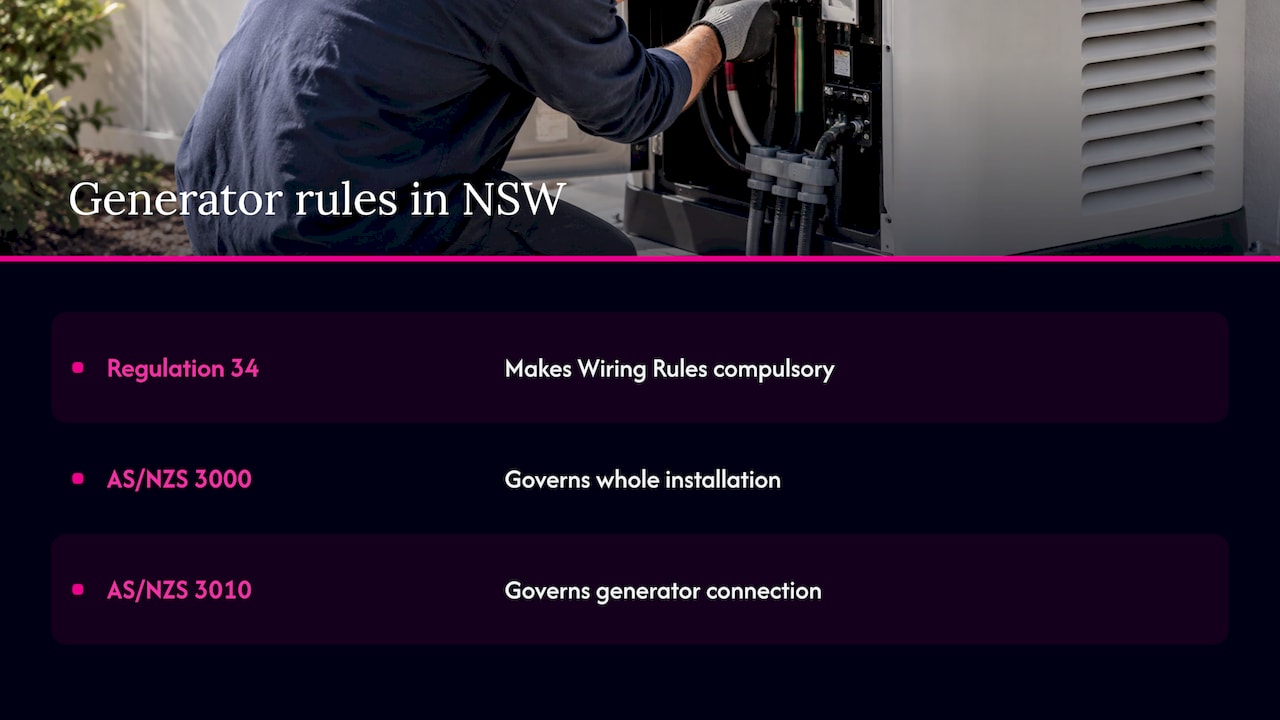
The law. Under Regulation 34 of the Gas and Electricity (Consumer Safety) Regulation 2018, electrical installation work must comply with the Australian/New Zealand Wiring Rules. Workers on installations connected to a distribution system must also have regard to the NSW Service and Installation Rules.
The Wiring Rules. The NSW Government confirms that the 2018 edition of AS/NZS 3000 has been mandatory in NSW since 1 January 2019. Among other things it requires RCDs (safety switches) on all domestic final sub-circuits and clarifies requirements for generation systems.
The generator standard. Standards Australia published AS/NZS 3010:2017 Electrical installations: Generating sets in May 2017. It covers connecting generating sets to a low voltage installation (up to 1000 V a.c.) as a normal supply, an alternative supply, or a supply for appliances and portable tools.
In plain terms: the Wiring Rules govern the installation as a whole, AS/NZS 3010 governs how the generator is joined to it, and the Regulation makes both compulsory.
Portable and fixed generators are treated differently
The rules turn on one question: does the generator touch your building’s wiring?
| Setup | What it means | Who can do it |
|---|---|---|
| Portable generator, appliances plugged straight into its outlets | No connection to building wiring. Used outdoors with heavy-duty outdoor-rated leads | You, following the network’s safety advice |
| Portable generator feeding the switchboard through an inlet and changeover switch | Wiring work covered by AS/NZS 3000 and 3010 | Licensed electrician only |
| Fixed standby generator with manual or automatic changeover | Permanent installation, protection, earthing and isolation | Licensed electrician only, often with distributor approval |
Ausgrid is clear that a portable generator must never be connected to home wiring, a power point, switchboard or meter box. It is illegal, and it can backfeed the network. If you want a permanent connection, a licensed electrician must install a compliant changeover switch.
When you do run a portable unit directly into appliances, Ausgrid advises:
- Operate it outdoors in a well-ventilated area, away from doors, windows and vents.
- Plug appliances directly into the generator using heavy-duty outdoor-rated extension leads.
- Turn it off and let it cool before refuelling.
The moment you want the lights, fridge, pump or medical equipment on without extension leads, you are in licensed territory.
Why backfeed is the rule that matters most
Backfeeding happens when a generator is connected the wrong way and electricity flows out through your meter into the street. Ausgrid explains that this can energise powerlines that crews believe are switched off, creating a serious hazard for line workers and the public. It also raises fire risk in the property.
A correctly installed changeover switch physically prevents this: the building is supplied by the grid or by the generator, never both. For how the switch types differ, see our guide to the generator changeover switch in NSW and our explanation of generator backfeed danger.
What a compliant installation includes
The details are set by the standards and checked by testing. For a permanently connected set, expect the following.
Isolation at the generator
AS/NZS 3010:2017 Amendment 1 requires each generating set to have an isolating switch that operates in all live conductors, installed beside or on the set so a person working on it has a clear view of it. The same amendment summary notes that a changeover device switching a contact in the generator neutral is not the recommended connection method for permanently connected sets in Australia.
Earthing and neutral arrangements
Most NSW homes use a Multiple Earthed Neutral (MEN) system. In a MEN system where a generator is connected as a primary or alternative supply, the amendment says the alternator winding must have no internal connection to the generating-set earthing system, and an earth electrode must not be connected directly to the set. Any existing neutral-earth link in the generator has to be disconnected.
This is why a generator pulled out of the shed and “wired in” often fails. Portable units are commonly built with a neutral-earth link that is wrong for a MEN installation. Our page on generator earthing requirements in NSW goes further.
RCD protection
Safety switches are central to the Wiring Rules. On construction and demolition sites, SafeWork NSW sets a maximum tripping current of 30 mA for generators and inverters supplying power through permanently connected RCDs. If you run a work site, a hire generator or temporary supply, our note on temporary power safety in NSW covers the practical side. For homes, see NSW RCD requirements.
Stand-alone systems
Regulation 34(5) requires the stand-alone power system of a free-standing installation to comply with AS/NZS 4509.1:2009 before it is energised. This applies to off-grid sites rather than a typical suburban standby set.
Switchboard capacity
A generator adds a second source to your board. Space for a changeover device, the right circuit protection and the load you want backed up all affect whether the existing board is up to the job. We explain this in switchboard upgrade for a generator.
Who is allowed to do the work
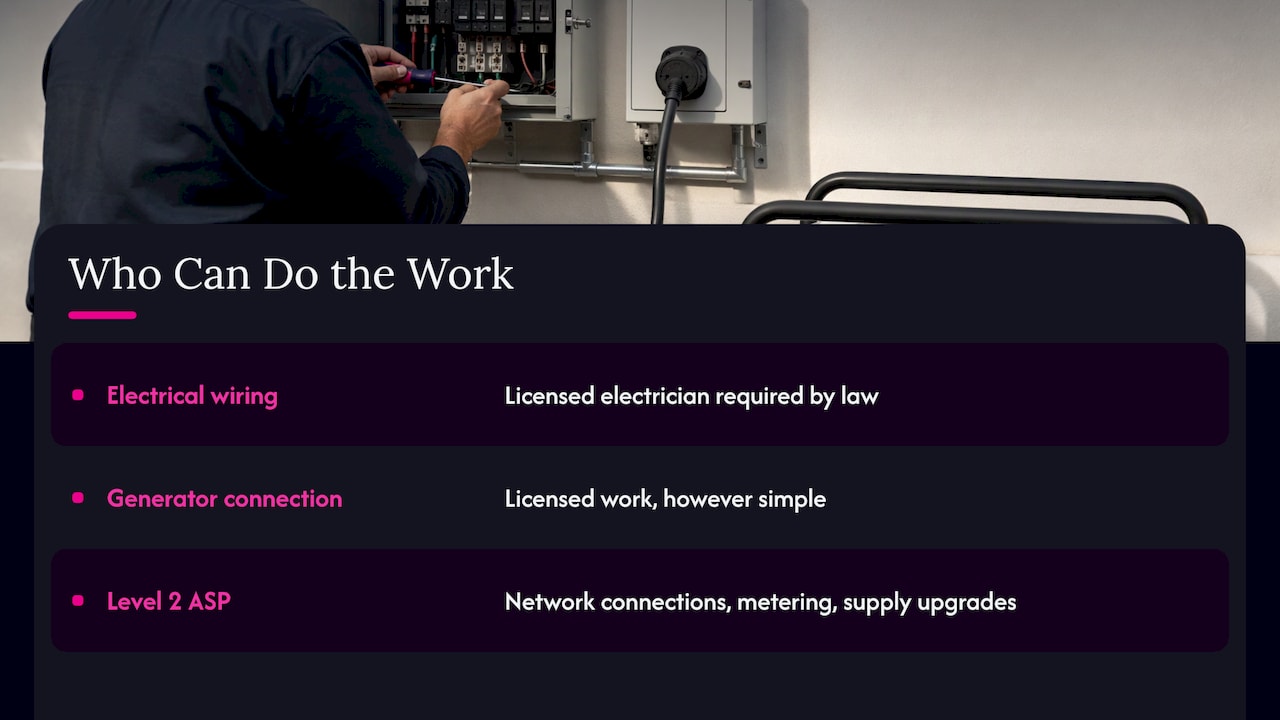
NSW Fair Trading states that by law electrical wiring work must be done by a licensed electrician. That includes connecting a generator, an inlet, or a changeover switch to a switchboard. It does not matter if the generator is small or the job looks simple.
A Level 2 electrician is an accredited service provider (ASP) who is authorised to carry out work on the connection between your installation and the electricity network, such as service mains, metering and supply upgrades. For a generator that needs a larger supply, a new meter arrangement or a distributor approval, a Level 2 is the person you want on the job from the start. Our Level 2 electrician service covers that network-side work.
Distributor approval before you switch on
Some generator jobs touch the network connection. Regulation 34(2) says a new installation that has not been energised before, or an alteration or addition that requires a change to the network connection, may not be energised unless the distributor first authorises it. The NSW Service and Installation Rules say the same thing.
In practice that means:
- A standby generator on an existing, unchanged connection usually needs the correct changeover arrangement and testing.
- A job that also changes your supply (for example moving from single phase to three phase to run a larger set or heavier loads) needs the distributor’s permission first.
- The distributor depends on your address. In Sydney it is typically Ausgrid, Endeavour Energy or Essential Energy, and each has its own application process and eligibility limits. Endeavour Energy, for example, publishes basic connection eligibility criteria covering maximum demand, zoning and the number of strata units.
Our guide to standby generator distributor approval in Sydney explains the sequence. If a three phase supply is part of the plan, see our power supply upgrades page.
Testing and the Certificate of Compliance
Before energisation, Regulation 34(4) requires the installation to pass a safety and compliance test showing it is safe and meets the Wiring Rules. The CCEW template from NSW Fair Trading lists the kinds of checks recorded, including:
- earthing system integrity
- RCD operation
- insulation resistance
- polarity
- correct current connections
- fault loop impedance where necessary
- compliance of a stand-alone system with AS/NZS 4509
The electrician then submits the CCEW to Building Commission NSW and the network through the eCert portal. From 1 July 2026, handwritten and PDF CCEWs are no longer accepted and every certificate must be lodged through BCNSW eCert. Ask for your copy. It is your record that the work was tested and compliant, and insurers and buyers’ conveyancers look for it. Read more in our electrical compliance certificate guide and what a compliance certificate proves.
If you manage a team that tests and signs off electrical work, a structured electrical safety refresher training course is one way to keep safe-work knowledge current.
A worked example: a Sydney home with a standby generator
Take a family in the Inner West who lose power for two days in a storm and decide to buy a 5 kVA portable generator to keep the fridge, lights and internet running.
- Option A: extension leads. They run the generator outside and plug the fridge in with a heavy-duty outdoor lead. No licensed work is needed, but they can power only what the leads reach.
- Option B: a generator inlet and changeover switch. A licensed electrician installs an inlet on the outside wall and a changeover switch at the switchboard. The circuits they choose to back up are fed from the generator, and the grid is isolated while it runs. The electrician tests the work, checks the earthing arrangement, and lodges the CCEW.
- The shortcut that is illegal. Plugging the generator into a power point with a “suicide lead” so the whole house is live. It breaks the law and backfeeds the network.
Option B is the one that gives a reliable, repeatable setup. Choosing the generator size and the circuits to back up before you buy avoids the common mistake of paying for a unit that does not suit the board.
Our perspective
Most of the generator problems we are called out to come down to one thing: the connection was made before anyone thought about earthing, isolation and the network. A generator is only as safe as the way it joins your wiring.
That is why we treat a generator job as a whole installation, not a plug-in. We look at the switchboard, the changeover arrangement, the loads you want to keep running, and whether your supply or network connection needs attention. As a certified Level 2 contractor, we can handle the network-side work as well as the wiring, so you are not juggling two trades.
Our advice is to speak to us before you buy the generator. Sizing it against the board and the circuits you need is far easier on paper than after the unit is on the driveway. We offer free site inspections for Level 2 work, so you will know what the job involves before you commit.
Christopher
Get your generator connected the compliant way
Our generator installation service is delivered by accredited Level 2 ASP electricians serving homes, businesses and strata properties across Sydney. We install to the strictest NSW standards, and we offer free site inspections for Level 2 work, so you can see what your property needs before any work begins.
If your switchboard needs attention first, see our switchboard upgrades. If the power is out right now and it is unsafe, call our 24/7 emergency electrician line. Seniors can ask us about our discounts.
FAQ
Can I connect a portable generator to my house myself in NSW?
No. Connecting a generator to your switchboard, power points or house wiring is electrical wiring work, which must be done by a licensed electrician. Ausgrid describes doing it yourself as illegal because of the backfeed risk to the network and line workers.
Do I need a licensed electrician if I only run appliances from the generator?
If appliances plug directly into the generator’s own outlets with suitable outdoor-rated leads, nothing is connected to your wiring. Use it outdoors, well away from doors, windows and vents. As soon as you want the generator to feed your switchboard, you need a licensed electrician.
Which standards apply to generator installation in NSW?
Installation work must comply with AS/NZS 3000, the Wiring Rules, and generating sets connected to an installation are covered by AS/NZS 3010. Stand-alone systems must also meet AS/NZS 4509.1. The NSW Service and Installation Rules apply where the installation connects to the network.
Do I need a Certificate of Compliance for a generator installation?
Yes, when licensed electrical wiring work is done, the electrician must lodge a CCEW. Since 1 July 2026 it must go through the BCNSW eCert portal. Keep the copy for your records.
Do I need network approval for a generator?
Not always. A new installation, or an alteration that changes your network connection, cannot be energised until the distributor authorises it. A Level 2 electrician can confirm whether your job triggers that step.
Sources
- Electrical standards, rules and notes | NSW Government
- Standards Australia: Enhancements to the generating sets standard
- Gas and Electricity (Consumer Safety) Regulation 2018, reg 34
- Ausgrid: Portable generators
- AS/NZS 3010:2017 Amendment 1 changes
- SafeWork NSW: Electrical practices on construction and demolition sites
- NSW Government: Electrical safety requirements and consumer rights
- NSW Service and Installation Rules
- Endeavour Energy: Connect supply or relocate assets
- NSW Fair Trading: CCEW template
- Electrical safety refresher training
Recommended
Need Help Fast?
Powering Your Needs with Expertise
If you’re looking for a reliable, experienced, and prompt electrician, look no further than High Demand Electrical. We cater to all your electrical needs, from routine maintenance to emergency repairs and complete system installations. Our skilled team is committed to providing professional service that ensures your electrical systems run smoothly. Whether it's a small task or a large project, give us a call today. Let us meet all your electrical demands with the quality and reliability you deserve.

Licensed Level 2 ASP electricians across Sydney. Same-day service and 24/7 emergency response.
Licence 397193C
ABN 87 051 836 527
