Generator Inlet Legality in NSW: What Sydney Owners Need to Know
A generator inlet is legal in NSW when a licensed electrician installs it as part of a compliant system. That system must stop the generator and the grid from ever feeding the same wiring at the same time. It must also be tested and certified, and notified to the right authorities. Plugging a generator into a power point, switchboard or meter box is not legal, and it is dangerous. This guide explains what the rules require, who can do the work, and what paperwork you should receive.
TL;DR
- A generator inlet is only lawful as part of a compliant installation: a licensed electrician, a proper changeover arrangement, testing and a Certificate of Compliance for Electrical Work (CCEW).
- Connecting a generator through a power point, switchboard or meter box is illegal, according to Ausgrid, because it can backfeed the network.
- Electrical wiring work without a licence can attract fines of $22,000 for an individual and $110,000 for a company.
- The person who tests the work must lodge the CCEW within seven days of the test.
- Our Level 2 electricians can design, install, test and certify the inlet and changeover for Sydney homes and businesses.
Table of Contents
- Is a generator inlet legal in a Sydney home or business?
- What is illegal: connecting a generator the quick way
- Who can install a generator inlet in NSW
- The changeover rule: why the grid and generator can never meet
- Testing, certification and records
- Network connection rules and generators
- Strata, commercial and care settings
- Our perspective
- Choosing the right setup: inlet, changeover or standby generator
- Before you book: a short checklist
- Get a compliant generator inlet installed in Sydney
- FAQ
- Sources
Is a generator inlet legal in a Sydney home or business?
Yes, provided it forms part of an installation that meets NSW electrical safety law. The law does not ban inlets. It regulates how generators connect to a building’s wiring, because a badly connected generator can send power back out through your service line.
The NSW Government’s electrical standards page confirms that the 2018 edition of AS/NZS 3000 (the Wiring Rules) has been mandatory in NSW since 1 January 2019. Under Regulation 34 of the Gas and Electricity (Consumer Safety) Regulation 2018, electrical installation work must comply with the Wiring Rules. A new installation, or an alteration that needs a change to the network connection, can’t be energised until the distributor authorises it. And an installation can’t be energised until a safety and compliance test shows it is safe and meets the Wiring Rules.
Generator connections have their own standard, AS/NZS 3010. Standards Australia announced the 2017 edition in May 2017. It covers generating sets connected to low voltage installations (up to 1000 V a.c.) and added a section on plug-in generators, whether they serve portable equipment or connect to an installation as an alternative or normal supply.
In plain terms, an inlet is acceptable when:
- a person authorised under NSW law installs it;
- it sits behind a changeover arrangement that isolates the grid from the generator;
- it is tested, certified and notified; and
- any network connection requirements are met.
What is illegal: connecting a generator the quick way
The most common unlawful setup is the “suicide lead”: a cable with a plug on each end, running from a generator into a power point. Other shortcuts include connecting at the switchboard or meter box, or tapping into internal wiring.
Ausgrid says that connecting a generator to home wiring through a power point, switchboard, meter box or other internal wiring is illegal and extremely dangerous, because electricity can flow back into the network. It also warns that backfeed can energise powerlines that crews believe are switched off, a serious hazard for line workers. For a permanent generator connection, Ausgrid’s advice is to speak with a licensed electrician about a compliant changeover switch.
There is a risk inside the home too. A lead with exposed male pins is live at the plug when the generator runs. Wiring that was never designed to be fed from a generator may also lack the protection you assume is in place.
Who can install a generator inlet in NSW
Only a licensed person. NSW Government guidance says an electrical licence or certificate is required before doing electrical wiring work, regardless of cost and whether the job is residential, commercial or industrial. Unlicensed work breaches the Home Building Act 1989 and can attract fines of $22,000 for an individual or $110,000 for a company.
The NSW Service and Installation Rules add that installation work must be tested for safe operation and compliance by a person authorised under the Home Building Act to do electrical wiring work without supervision. That is why a handyman, a generator retailer or a competent DIYer can’t legally fit an inlet, however simple the job looks.
The changeover rule: why the grid and generator can never meet
The core technical requirement behind every legal inlet is isolation. Under AS/NZS 3010, the generator and the normal supply must not be connectable to the installation at the same time, unless the system is specifically designed for that purpose. This is usually achieved with a changeover switch, manual or automatic, that physically isolates one supply before the other connects.
A few practical points follow from manufacturer documentation. Hager’s changeover switch technical information states that in Australia and New Zealand the Main Supply Neutral upstream of the MEN connection must not be switched, in line with AS/NZS 3010. It also says the incoming changeover must be protected by an appropriate MCB rated 63A, 6kA, C curve for that product. These details are why the switch, the protection and the neutral arrangement need to be designed together for your switchboard, not bought separately and bolted on.
How a compliant portable generator setup works
A typical residential arrangement looks like this:
- A weatherproof generator inlet is fixed to an outside wall in a sensible position.
- A cable runs from the inlet to a changeover switch at or near the main switchboard.
- The changeover switch selects either grid supply or generator supply, never both.
- Protection devices, earthing and neutral arrangements are set up for the specific generator and switchboard.
- The generator is sized to the circuits you want to run, which is often a selected set of essential circuits rather than the whole house.
The generator itself should stay outdoors and well clear of windows, doors and vents, because engine exhaust contains carbon monoxide. Follow the manufacturer’s manual for placement.
Testing, certification and records
A legal inlet doesn’t end when the last screw goes in. Under the NSW system the work has to be tested and recorded.
According to NSW Government electrical compliance requirements, the person who carries out the electrical test must submit a CCEW to Building Commission NSW as soon as practical, and no later than seven days after the test. On-the-spot fines of up to $1,000 apply each time a CCEW isn’t supplied. Penalties of up to $550,000 apply for work that fails the Regulation’s technical standards.
The NSW Fair Trading CCEW template shows what the record contains: the installation address, customer details, installation type, work carried out, equipment installed and installer licence details. Its test report covers earthing integrity, RCD operation, insulation resistance, polarity and correct current connections.
The Service and Installation Rules also say the work must be recorded and notified to the electricity distributor and the owner within seven days of commissioning or completion of the safety and compliance tests.
Building Commission NSW says it may audit electricians at any time, request work records, and inspect installations. A properly documented job protects you as the owner as well as the electrician.
What you should receive after the job
| Item | Why it matters |
|---|---|
| Copy of the CCEW | Proof the work was tested and certified |
| Installer licence details on the certificate | Confirms an authorised person did the work |
| Operating instructions for the changeover | So everyone in the household or workplace uses it correctly |
| Generator and changeover manuals | Needed for servicing and for insurers or property managers |
Network connection rules and generators
Your distributor, Ausgrid across much of Sydney or Endeavour Energy in the west and south-west, has a say whenever a connection changes. The Service and Installation Rules say an installation can’t be connected to the network unless the distributor has permitted it. Where work alters your network connection, the electrician needs to arrange the right notification or application.
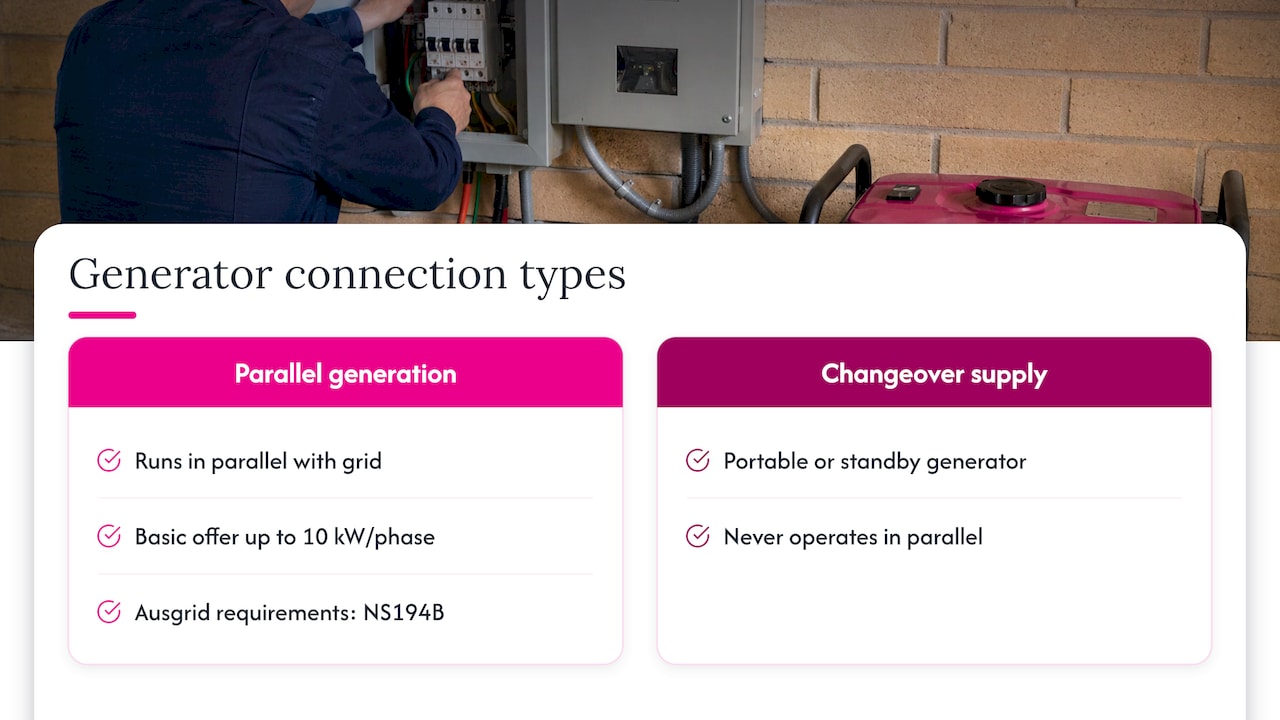
There is a separate category for generators that run in parallel with the grid, such as solar and batteries. The research shows that Endeavour Energy’s connection policy treats micro embedded generating units up to 10 kW per phase as eligible for a basic connection offer, and that Ausgrid sets minimum technical requirements for embedded generation under its NS194B standard. A portable or standby generator behind a changeover switch is a different arrangement, because it never operates in parallel with the network. If you have solar, a battery and a generator, tell your electrician so the whole system is designed as one.
Strata, commercial and care settings
Buildings with shared services raise extra questions. In a strata building, a generator inlet can touch common property, shared switchboards or fire safety systems, so the owners corporation and strata manager are usually involved before work starts. Commercial sites often need three-phase backup and a defined list of critical loads. Our team covers commercial electrical compliance and commercial generator installation across Sydney.
For homes that rely on powered medical or disability equipment, a changeover and inlet is worth planning ahead of storm season. We also work on SDA and NDIS backup power projects.
Our perspective
Most of the generator enquiries we hear start the same way: the power is out, someone has a generator in the shed, and they want to know if they can just plug it in. The honest answer is no, but the safe answer is quick and affordable to put in place before the next outage.
As a certified Level 2 electrical contractor in Sydney, we look at the whole picture, not just the inlet. We check the switchboard, the earthing, the generator size and the circuits you actually need to run. Often a switchboard upgrade or a power supply upgrade makes the generator connection cleaner and safer.
Our electricians are fully accredited, work to NSW standards, and complete the testing and paperwork that make the installation legal. We offer free site inspections for Level 2 work, so you know the scope before anything starts.
Christopher
Choosing the right setup: inlet, changeover or standby generator
The right answer depends on how you use backup power.
- Portable generator with inlet and changeover: suits households that want to run essentials such as the fridge, lights, internet and a few power points during an outage.
- Manual changeover for selected circuits: keeps the generator load small and the switchboard simple.
- Automatic standby generator: starts on its own when the grid fails, suited to homes, small businesses and anyone who can’t be present to start a portable unit. See our home standby generator installation options.
Whichever you choose, the legal tests are the same: authorised installer, isolation between supplies, testing and certification.
Before you book: a short checklist
- Decide which circuits you need during an outage.
- Note your generator’s rated output and whether it is single or three phase.
- Photograph your switchboard and meter box.
- Check with your strata manager or landlord if you don’t own the property outright.
- Ask the electrician for a CCEW at completion, and keep it with your property records.
Get a compliant generator inlet installed in Sydney
We install generator inlets, changeover switches and standby generators for residential, commercial and strata properties across Sydney, with the testing and CCEW lodged as part of the job. Our electricians are available 24/7 for emergencies, and we offer a 10-minute callback guarantee.
Start with our generator installation page or contact our Level 2 electrician team for a free site inspection of Level 2 work. If your switchboard needs attention first, see our switchboard upgrades.
FAQ
Can I plug my generator into a power point during a blackout?
No. Ausgrid says connecting a generator to home wiring through a power point, switchboard or meter box is illegal and extremely dangerous. Use appliances directly on the generator’s own outlets, or have a licensed electrician fit a compliant inlet and changeover switch.
Can I install a generator inlet myself?
No. Electrical wiring work in NSW needs a licence or certificate, and unlicensed work can attract fines of up to $22,000 for an individual. A licensed electrician must also test the work and lodge a CCEW.
What paperwork proves my inlet is legal?
Your Certificate of Compliance for Electrical Work (CCEW) is the key record. The tester must submit it to Building Commission NSW within seven days of the test. Ask for your copy and keep it with your property documents.
Do I need my network provider’s approval?
An installation can’t be connected to the network unless the distributor has permitted it, and installation work must be notified to the distributor within seven days. Your electrician handles this and will tell you if your job needs a connection application.
Does a generator inlet need a changeover switch?
The system must prevent the generator and normal supply from being connected to the installation at the same time, unless it is designed for that purpose. A changeover switch that isolates the supplies is the usual way to achieve that.
Sources
- Gas and Electricity (Consumer Safety) Regulation 2018, Regulation 34
- Standards Australia: AS/NZS 3010 generating sets enhancements
- NSW Government: Electrical standards, rules and notes
- Ausgrid: Portable generators
- NSW Government: Electrical work licensing
- NSW Service and Installation Rules, 2018 edition
- Hager: Changeover switches technical information
- NSW Government: Electrical compliance requirements
- NSW Fair Trading: CCEW template
- NSW Government: How we audit electricians
Recommended
Need Help Fast?
Powering Your Needs with Expertise
If you’re looking for a reliable, experienced, and prompt electrician, look no further than High Demand Electrical. We cater to all your electrical needs, from routine maintenance to emergency repairs and complete system installations. Our skilled team is committed to providing professional service that ensures your electrical systems run smoothly. Whether it's a small task or a large project, give us a call today. Let us meet all your electrical demands with the quality and reliability you deserve.

Licensed Level 2 ASP electricians across Sydney. Same-day service and 24/7 emergency response.
Licence 397193C
ABN 87 051 836 527
