Generator Changeover Switch in NSW: Rules, Types and Sydney Installation
In NSW, a generator changeover switch must be installed by a licensed electrician. It stops your generator and the grid from feeding your wiring at the same time. That is the only safe way to run a house or business from a generator through your fixed wiring. If you are in Sydney and want one fitted, this guide covers how it works, which type suits you, how to size it for single or three-phase supply, and what the install involves.
TL;DR
- A changeover switch isolates your property from the grid before the generator supplies it, which prevents backfeed onto the street network.
- In NSW the work must be done by a licensed electrician, who issues a Certificate of Compliance for Electrical Work (CCEW) afterwards.
- Manual switches suit occasional backup. Automatic transfer switches suit medical equipment, refrigeration and other loads that cannot wait for you to walk to the board.
- Switch rating, pole count and generator size depend on whether you are on single-phase or three-phase supply, and on your real peak load.
- Our Level 2 team can inspect your switchboard and supply, and Level 2 site inspections are free.
Table of Contents
- What a generator changeover switch does
- NSW rules: who can install and certify it
- Manual changeover switch or automatic transfer switch?
- Which generators work with a changeover switch
- Single-phase or three-phase: sizing the switch and the generator
- What affects the cost in Sydney
- How installation and operation work
- Our perspective
- Get your changeover switch assessed
- FAQ
- Sources
What a generator changeover switch does
A changeover switch is a heavy-duty switch that selects one power source at a time: the grid or your generator. It is wired so the two can never be connected to your installation together. Think of it as a mechanical interlock between the street supply and the generator.
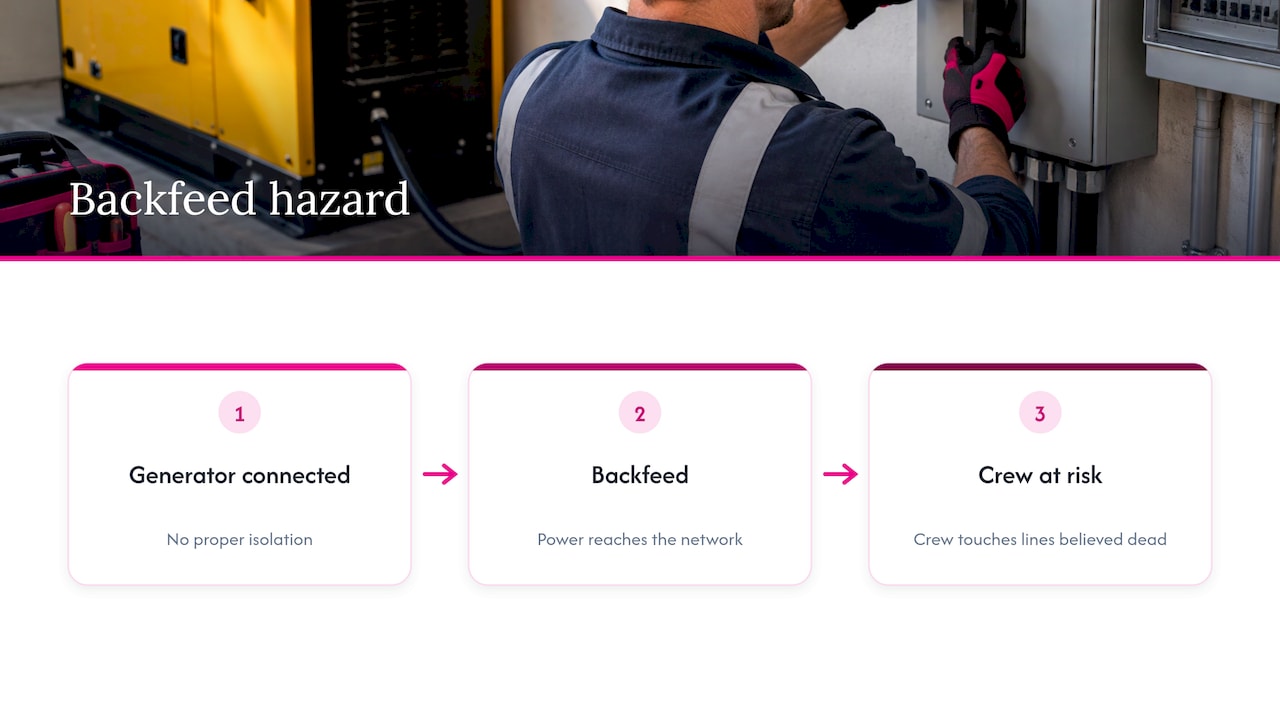
The reason is backfeeding. If a generator is plugged into a house circuit without proper isolation, power can travel back out through your meter and onto the network. Line workers repairing a storm-damaged line may then touch conductors they believe are dead. A guide to changeover switch installation describes this as a deadly hazard for utility crews, and it is also a risk to the general public and to your own generator and wiring.
The Australian standard that deals with this is AS/NZS 3010, Electrical installations: generating sets. Hager’s technical documentation notes that under this standard the main supply neutral upstream of the Multiple Earth Neutral (MEN) connection must not be switched, and that the incoming changeover needs appropriate short-circuit protection. These are details your electrician designs around, which is one more reason this is not a weekend project.
Why not just use a power board or a plug?
A generator with its own outlets is fine for running a fridge or a few tools by extension lead. It is a different thing to energise the circuits in your switchboard. Lights, power points, a hot water unit or an air conditioner on fixed wiring need a changeover arrangement with a generator inlet. Without it, the only options are leads across the floor, or an illegal and dangerous connection.
NSW rules: who can install and certify it
Electrical installation work in NSW must be carried out by a licensed electrician. The NSW Government’s electrical safety guidance states that a licensed electrical contractor must install a changeover switch, and that the electrician provides a Certificate of Compliance for Electrical Work (CCEW) when the job is done.
Other states say the same thing in plain terms. The South Australian Government’s generator guidance says the switch must prevent the generator and normal supply running together, that the installation must follow AS/NZS 3000, and that the electrician issues a certificate confirming the work is correct and safe. That is South Australian guidance, but the principle matches what applies here.
What the rules mean for you in practice
- Do not wire a generator into your board yourself or ask a handyman to do it.
- Ask for the CCEW at the end of the job and keep it with your property records. Insurers, buyers and property managers may ask for it.
- If the switch is added to an older board, expect the electrician to check the board’s condition, the main switch and protection devices as part of the work.
- Strata and commercial sites often need approval from the owners corporation or building manager first.
Our electricians are accredited Level 2 ASPs, and we work to NSW standards on every job. Level 2 matters here because upgrading your connection to the network or changing the point of supply sits in the same field as complex generator work.
Manual changeover switch or automatic transfer switch?
This is the main decision. Both do the same safety job. The difference is who operates them.
| Feature | Manual changeover switch | Automatic transfer switch (ATS) |
|---|---|---|
| How it works | You start the generator, then move the switch handle | Senses the outage, starts the generator and transfers the load |
| Best for | Occasional home backup, workshops, sheds | Medical equipment, cold chain, security and business-critical loads |
| Presence needed | Yes, someone must be on site | No, it works unattended |
| Typically paired with | Portable or inverter generators with an inlet | Permanent standby generators |
| Complexity | Simpler wiring | More controls and commissioning |
AIMS Industrial’s changeover switch and ATS guide makes the same split: manual suits occasional home backup, automatic suits critical loads such as medical equipment.
When to choose automatic
Pick an ATS if anyone in the home depends on powered equipment, if you run a shop or office with refrigeration, or if the property is unattended for long periods. For life-support and similar equipment, read our page on backup power for medical equipment. A permanent home standby set, wired to an ATS, is covered on our home standby generator installation page.
When manual is enough
If you want to keep the fridge, lights, internet and a few power points running through a storm outage, and someone is home, a manual switch with a generator inlet is a sensible setup. It keeps the cost and complexity down.
Which generators work with a changeover switch
Portable petrol generators, inverter generators and permanent standby units can all be connected through a correct changeover arrangement. What matters is that the generator is sized for your chosen circuits and fitted with a proper inlet.
Inverter generators produce clean 240V output, which suits sensitive electronics. Schnap’s inverter generator article notes that connecting one to house wiring needs an inlet socket and a changeover switch installed in the switchboard by a licensed professional. That applies to any generator type, not just inverters.
For larger properties, our generator installation service covers connection of the set to your board, and we also handle Generac Guardian standby generators.
Single-phase or three-phase: sizing the switch and the generator
Most Sydney houses are on single-phase 240V supply. Many commercial sites, larger homes with ducted air conditioning, workshops and some strata buildings are on three-phase 415V. The switch needs to match.
Single-phase
A single-phase installation needs a changeover switch rated above the maximum current you will run through it. A basic estimate for generator size is volts times amps divided by 1,000. If your essential circuits peak at 40 A at 240 V, that is 240 × 40 ÷ 1,000 = 9.6 kVA, so you would look at a 10 kVA generator. Your electrician will measure real demand rather than guess, and will allow for motor starting loads such as air conditioners and pumps.
Three-phase
Three-phase adds a factor of 1.732. For a three-phase 415 V supply, kVA is volts times amps times 1.732 divided by 1,000. The calculation needs the load per phase and how balanced it is, which is why three-phase jobs should be designed, not estimated. Pole count also matters: CCC Engineering’s essential services guidance recommends a four-pole transfer switch that switches the neutral along with the three phases on generator installations, to avoid parallel neutral paths. How that fits with the neutral rule above depends on where the switch sits in your installation, so it is a design decision for your electrician.
If you run a business, see our three-phase backup power for businesses and commercial generator installation pages.
Do you need a phase upgrade first?
Some properties want a bigger generator than a single-phase supply can sensibly serve, or are adding EV chargers, heat pumps and workshop equipment at the same time. In that case it can make sense to look at a single phase to three phase power upgrade at the same visit as the changeover work.
What affects the cost in Sydney
We do not publish fixed prices for changeover work because the job depends on your site. These are the factors that move the quote:
- Manual or automatic: an ATS involves more equipment, controls and commissioning than a manual switch.
- Single or three-phase: three-phase switches and four-pole devices cost more than single-phase.
- Switchboard condition: a full board, old fuses or missing safety switches may need work first. See our switchboard upgrades.
- Distance: the further the switch and inlet are from the board, the more cable and conduit are needed.
- Generator inlet location: weatherproof inlet on an outside wall, in a garage, or at a shed.
- Site access: strata buildings, rooftop plant and multi-storey sites take longer.
- Certification and testing: every job ends with testing and the CCEW.
If your switchboard is already full, a changeover switch installed in a separate enclosure near the board is a common solution. Your electrician decides whether that is workable based on the layout and the protection arrangements.
How installation and operation work
This is what to expect, so you can plan the day. It is not a guide to doing the work yourself.
- Site assessment. The electrician inspects your switchboard, meter position, main switch, and the circuits you want to power.
- Load selection. You decide which circuits are essential: typically fridge, lights, power points, internet, gas heating controls, a bedroom or two. Large loads like ovens and ducted air conditioning are usually left out of small systems.
- Design and selection. The switch type, rating and pole count are chosen, with a generator inlet and any dedicated sub-board.
- Installation. The switch is wired with correct protection, labelling and earthing, to the relevant standards.
- Testing and certification. The electrician tests the changeover, checks the interlock and issues the CCEW.
- Handover. You are shown how to run the sequence safely.
The safe operating routine for a manual system
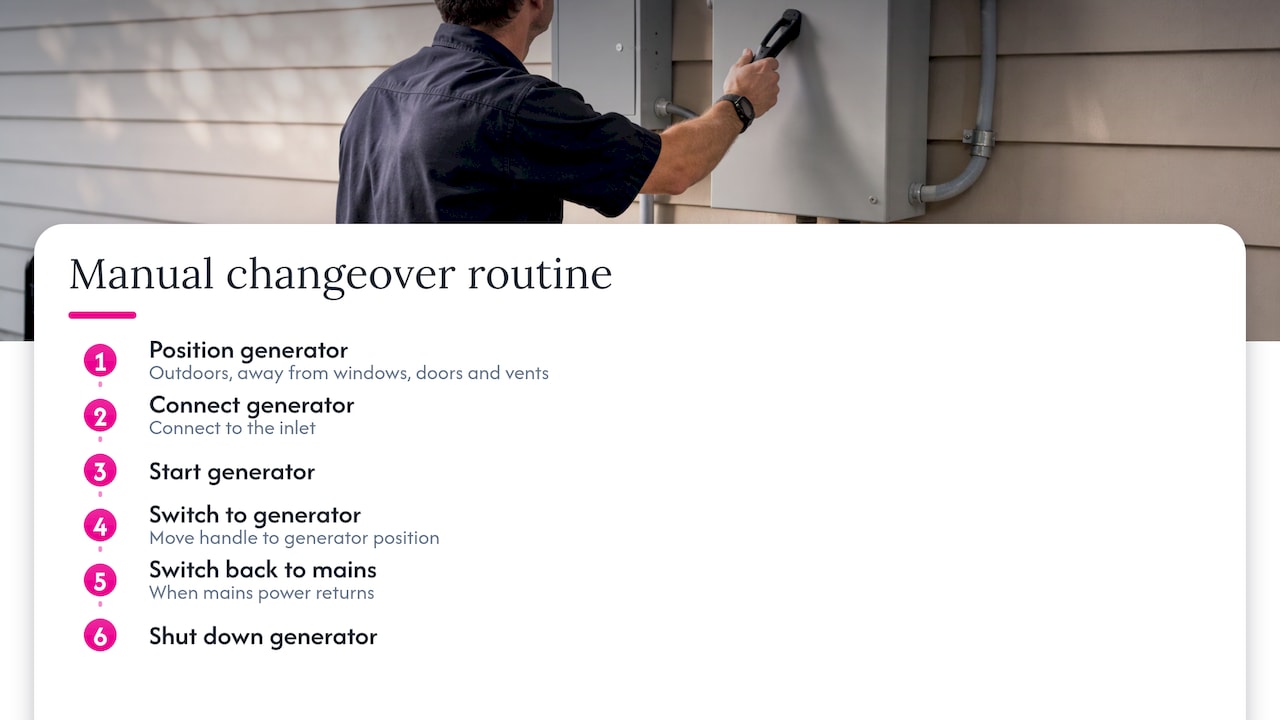
Your electrician will give you the exact steps for your board, and they should be labelled at the switch. In general, a manual system works like this: place the generator outdoors in open air, well away from windows, doors and vents; connect it to the inlet; start it; then move the changeover handle to the generator position. When mains returns, you reverse the order: switch back to mains first, then shut the generator down.
Never run a generator indoors or in a garage with the door closed. Carbon monoxide from petrol and diesel engines is the other serious hazard of backup power, and no switch fixes that.
Our perspective
Most callers ask us for “a switch”, but the real job is a small power system: the switch, the inlet, the generator size, the switchboard and the paperwork all have to agree with each other.
We see the best results when the changeover is planned together with the board. A board that is crowded or ageing is better dealt with at the same visit, because the switch is only as safe as what it connects to.
For Sydney homes that want storm-season peace of mind, a correctly rated manual changeover with a proper inlet is often all that is needed. For anyone relying on medical equipment, refrigeration or a business that cannot stop, we recommend an automatic arrangement designed for the load and the phase configuration.
Our Level 2 ASP electricians do the assessment, the design and the certification. We back it with 24/7 emergency support and a 10-minute callback guarantee, and our free Level 2 site inspections mean you know what is needed before you commit.
Christopher
Get your changeover switch assessed
High Demand Electrical is a certified Level 2 electrical contractor serving Sydney homes, businesses and strata properties. We are triple ISO certified, we carry over 300 five-star reviews, and we offer seniors discounts. Whether you need a switch for a portable generator, an ATS for a standby set, or a switchboard or supply upgrade to go with it, we can scope it on site.
Start with our Level 2 electrician page for a free site inspection of Level 2 work, or see our generator installation service. If the power is already out and you need help now, our emergency electrician team is available 24/7.
FAQ
Can I install a generator changeover switch myself in NSW?
No. NSW requires electrical installation work to be done by a licensed electrician, who provides a CCEW once the work is complete, as set out on the NSW Government electrical safety page. Wiring a generator into a switchboard without isolation also risks backfeeding the network and harming line workers.
Can an inverter generator be used with a changeover switch?
Yes. Inverter generators can be connected to house wiring through a proper inlet and changeover switch fitted by a licensed electrician. Your electrician will confirm the generator’s output suits the circuits you want to power and that its rating covers starting loads.
What size generator do I need for my Sydney home?
It depends on the circuits you want to run and their peak current. On single-phase 240V, volts times amps divided by 1,000 gives kVA, so a 40 A peak is about 9.6 kVA. We assess your actual load at a site inspection so the generator and switch are matched.
Do I need an automatic transfer switch?
Choose automatic if you rely on medical equipment, refrigeration or business-critical systems, or if nobody is home to operate a manual switch. For occasional storm backup with someone on site, a manual changeover is usually enough.
Does a changeover switch need to be on a separate enclosure from my switchboard?
Not always. If your board is full, the switch can sit in its own enclosure near the board. Your electrician decides based on layout, protection devices and the standards, and certifies the final arrangement.
Sources
- Electrical safety in the home, NSW Government
- Using generators for back-up power, SA.GOV.AU
- Control and indication changeover switches, Hager technical information
- Mastering your generator changeover switch installation, MTS Power Products
- Essential services and life safety power, CCC Engineering
- Changeover switch vs ATS guide, AIMS Industrial
- The inverter generator, Schnap Electric Products
Recommended
Need Help Fast?
Powering Your Needs with Expertise
If you’re looking for a reliable, experienced, and prompt electrician, look no further than High Demand Electrical. We cater to all your electrical needs, from routine maintenance to emergency repairs and complete system installations. Our skilled team is committed to providing professional service that ensures your electrical systems run smoothly. Whether it's a small task or a large project, give us a call today. Let us meet all your electrical demands with the quality and reliability you deserve.

Licensed Level 2 ASP electricians across Sydney. Same-day service and 24/7 emergency response.
Licence 397193C
ABN 87 051 836 527
