EV charger mounting height: what homeowners need to know
Mount your EV charger at a minimum of 800 mm above finished floor level in most domestic Australian installations. The practical preferred range sits between 900 mm and 1,200 mm for comfortable daily use, though your manufacturer's installation instructions and your state's Service and Installation Rules (SIRs) can shift that figure. A licensed Level 2 electrician must confirm the final position after completing a maximum-demand calculation and reviewing your specific site conditions.
Key takeaways
The single most important fact: mount your EV charger at a minimum of 800 mm above finished floor level, follow manufacturer instructions and state SIRs, and use a licensed Level 2 electrician for load calculations and commissioning.
| Point | Details |
|---|---|
| Minimum mounting height | 800 mm above finished floor level is the commonly cited domestic minimum in Australia. |
| Preferred practical range | 900 mm–1,200 mm suits most adult users and reduces cable strain at the connector. |
| Standards and SIRs both apply | AS/NZS 3000, AS/NZS 3008.1.1:2017, and your state's SIR must all be satisfied; SIRs can cap switched loads at 20 A–35 A depending on state. |
| Level 2 electrician required | A licensed Level 2 electrician must perform the maximum-demand calculation and handle network liaison and commissioning paperwork. |
| High Demand Electrical | Provides free site inspections, load calculations, and full commissioning for compliant EV charger installations across Sydney. |
Table of Contents
- What are the key EV charger mounting height requirements?
- Which Australian standards and authorities govern charger installation?
- How does an installer choose the exact mounting height?
- Why does supply capacity matter as much as mounting height?
- What cable, protection and earthing does a compliant install need?
- Can you install in a detached garage, strata property, or near water?
- How to measure and verify mounting position before installation
- What should homeowners check before booking an electrician?
- What happens after the charger is mounted? Commissioning and maintenance
- What High Demand Electrical commonly sees on-site
- Compliant EV charger installation in Sydney, done right
- Sources
What are the key EV charger mounting height requirements?
Before your electrician arrives, here are the numbers and non-negotiables to have in mind:
Numeric minimums and preferred ranges:
- 800 mm above finished floor level is the commonly cited minimum for domestic EV charger height in Australia
- 900 mm–1,200 mm is the practical preferred range for most adult users, balancing comfortable reach with cable drape
- No more than 2.0 m above floor level for main switches, per the Electric Vehicle Council's EVSE installation guideline, which also states that charger locations should be proximate to the vehicle and main switches must remain readily accessible
- Manufacturer templates may specify a different coupling height; those instructions override general guidance
Immediate safety must-haves:
- RCD (residual current device) or RCBO protection on the charger circuit
- Cable sized to AS/NZS 3008.1.1:2017, typically 6 mm² for a 32 A single-phase domestic charger
- Correct overcurrent protection (MCB or fuse) matched to cable rating
- Labelled installation with compliance paperwork signed off by the installer
- A licensed Level 2 electrician for all network-connected work and maximum-demand assessments
Pro Tip: Take a photo of your proposed mounting wall before the electrician visits. Include a tape measure in the shot so they can assess cable routing, clearances and conduit paths without a separate preliminary visit.
Which Australian standards and authorities govern charger installation?
Getting the mounting height right means consulting more than one document. Here is the hierarchy every installer works through.
AS/NZS 3000 (Wiring Rules)
AS/NZS 3000 is the foundational standard for all fixed electrical wiring in Australia. It governs the positioning of electrical equipment, access requirements for main switches, and general installation practice. For EV charger placement, it sets the baseline rules around clearances, protection against mechanical damage, and accessibility.
AS/NZS 3008.1.1:2017
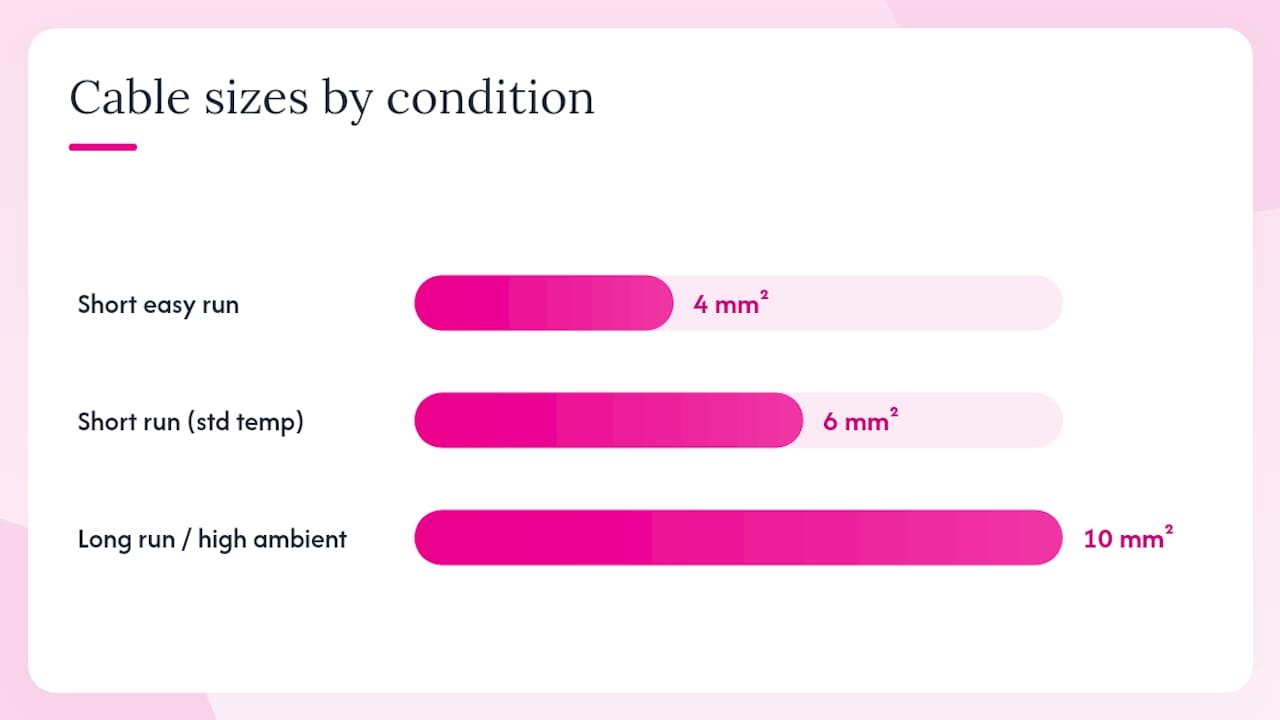
This standard defines how to size cables from the upstream supply to the charger. For a typical 32 A single-phase domestic charger, 6 mm² cable is commonly adequate; long runs or high-ambient-temperature environments may require 10 mm², while some straightforward short runs can use 4 mm² where the standard permits. Manufacturer instructions take precedence where they specify a larger gauge.
Electric Vehicle Council EVSE installation guideline
The EVSE installation guideline translates national wiring rules into EV-specific practice. It covers location selection (proximity to the vehicle, clearance from moving parts), a roughly two-meter main-switch accessibility rule, and references to AS/NZS 3008 for cable sizing. This is the document most installers use as a practical checklist alongside the wiring rules.
State Service and Installation Rules (SIRs)
SIRs are where the most common compliance gaps appear. An installation can satisfy every AS/NZS requirement and still be non-compliant if it exceeds the local network's switched-load limit. NSW Energy's SIRs are one example; every state and territory has its own version, and each network distributor (Ausgrid, Endeavour Energy, Energex, Western Power, and others) may add further conditions. Installers must verify both the national wiring rules and the relevant SIR before finalising any placement or circuit rating.
Government agencies and programs
The Electrical Equipment Safety System (EESS) provides the national framework for equipment registration and installer credentials. Check that your charger carries an EESS registration mark and that your electrician holds the required licence. Safe Work Australia publishes national electrical safety guidance covering safe positioning, access, and commissioning obligations. The Department of Climate Change, Energy, the Environment and Water (DCCEEW) runs programs such as the Cheaper Home Batteries programme that may interact with home energy upgrades and influence charger or battery choices.
| Document / Authority | What it controls |
|---|---|
| AS/NZS 3000 Wiring Rules | Equipment positioning, clearances, main switch access |
| AS/NZS 3008.1.1:2017 | Cable sizing from supply to charger |
| EVC EVSE Installation Guideline | EV-specific location and accessibility practice |
| State SIRs (e.g. NSW, QLD, WA) | Switched-load caps, network approval requirements |
| EESS | Equipment registration, installer credentials |
| Safe Work Australia | Electrical safety obligations during installation |
| DCCEEW | Government energy programmes affecting equipment choices |
How does an installer choose the exact mounting height?
The 800 mm minimum is a starting point, not a final answer. On-site, a licensed electrician weighs several factors before marking the wall.
Factors that affect the final position:
- Vehicle inlet height: The inlet on most passenger EVs sits between 700 mm and 1,100 mm above ground. Positioning the charger coupling close to that height reduces cable strain and wear.
- Cable tether or reel length: Most domestic chargers ship with a 5 m or 7 m tethered cable. A charger mounted too high or too far from the parking position forces the cable into tight bends that degrade the connector over time.
- User access and mobility: For households with mobility considerations, a mounting height closer to 900 mm is often more practical than 1,200 mm.
- Splash and ingress risk: Outdoor installations near driveways need clearance from pooling water and vehicle wash-down spray. The Eaton installation guide notes that manufacturer templates may cite indoor coupling-height ranges of approximately 450 mm–1,200 mm; outdoor installations typically sit at the higher end of that range to avoid splash ingress.
- Driveway slope: A sloped driveway changes the effective height of the vehicle inlet relative to the wall. Measure with the vehicle in its actual parked position.
- Clearances from windows, doors and main switches: The charger must not obstruct door swings or window openings, and the main switch must remain accessible within 2.0 m of floor level.
- Conduit and cable routing paths: The final position must allow a clean conduit run back to the switchboard without excessive bends or penetrations through structural elements.
Three common site examples:
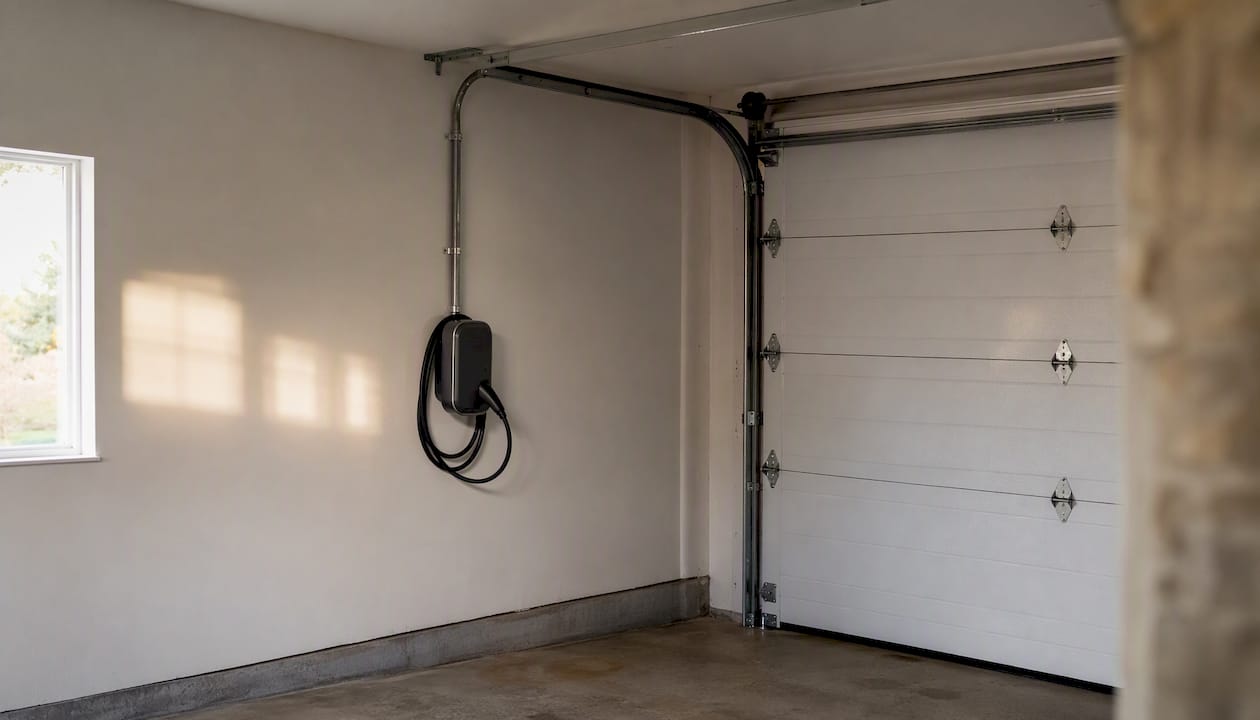
Single-car garage, internal wall: The charger typically mounts at 1,000 mm–1,100 mm on the side wall, clear of the garage door travel path, with conduit running up to the ceiling cavity and back to the switchboard.
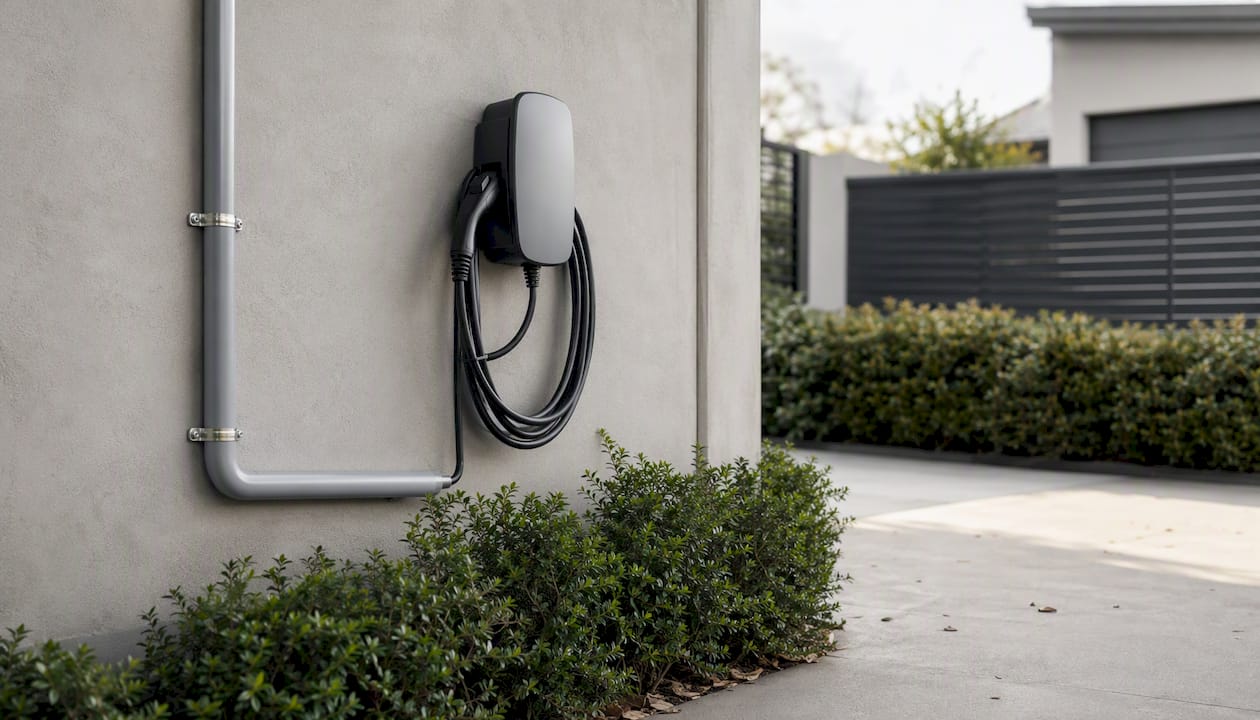
External brick wall beside a driveway: A starting height of 1,000 mm–1,200 mm keeps the coupling above typical splash height. An IP-rated enclosure and a weatherproof conduit entry are standard here.
Freestanding post in a carport: Post-mounted chargers often sit at 900 mm–1,100 mm coupling height. The post must be structurally sound and the conduit buried or surface-run to the supply. For carport versus garage approval considerations in Sydney, a carport and garage approval guide can help homeowners understand any council requirements before work begins.
Why does supply capacity matter as much as mounting height?
Mounting the charger at the right height is straightforward. Getting the electrical supply right is where most domestic installs require careful planning.
A domestic 32 A (7 kW) single-phase charger contributes its full rated load to the maximum-demand calculation. Per the Electric Vehicle Council's maximum-demand guidance, the calculation method for domestic installations up to five dwellings treats the EV charger at 100% of its rated current. On a typical 63 A service, adding 32 A for the charger alongside existing household loads can push the total above the service capacity, triggering a supply upgrade.
The most practical low-cost mitigation is a limitation device: an upstream circuit breaker or load-limiting control that caps the charger's maximum draw. This avoids a supply upgrade but requires the homeowner to understand they cannot run the charger at full power simultaneously with other high-draw appliances such as electric ovens, air conditioners, and hot water systems.
State SIRs add additional switched-load caps, which vary by state and territory, with limits generally between about 20 A and 35 A depending on the jurisdiction and network conditions.
A Level 2 electrician must perform or supervise the maximum-demand calculation and liaise with the network distributor where an approval or exemption is required. Using the EV charger load calculator before booking a site visit gives you a useful starting estimate of your supply impact.
What cable, protection and earthing does a compliant install need?
Cable sizing and protection devices are determined by the charger's rated current, the run length, and the installation environment. These choices interact directly with where the charger is mounted.
| Parameter | Typical domestic 32 A charger | Notes |
|---|---|---|
| Cable size (short run, standard temp) | 6 mm² | Per AS/NZS 3008.1.1:2017; manufacturer may specify larger |
| Cable size (long run or high ambient) | 10 mm² | Derating for run length and bundling applies |
| Cable size (short easy run, where permitted) | 4 mm² | Only where AS/NZS 3008 and manufacturer allow |
| Overcurrent protection | MCB rated to cable and charger | Coordinate with cable rating |
| RCD/RCBO | Type A or Type B per manufacturer spec | Some chargers require Type B; check manufacturer instructions |
| Earthing (outdoor install) | Earth electrode or verified earthing | Required where TT earthing system or outdoor exposure |
| Surge protection | Recommended for outdoor or exposed installs | Follow manufacturer guidance |
Derating applies when cables are bundled, run through insulation, or exposed to high ambient temperatures common in Australian roof cavities. A cable that is adequate at 25°C may need to step up a gauge at 40°C. Manufacturer instructions override these general notes where they specify a particular cable size or protection type.
Can you install in a detached garage, strata property, or near water?
Detached garages
Detached garages are generally suitable for EV charger installation, but the supply path is longer and the compliance picture is more complex. The meter and main switchboard are usually in the main dwelling, so the sub-circuit to the garage must be sized for the charger load plus any existing garage circuits. Check ventilation: enclosed garages with petrol vehicles present an arcing risk, and some network SIRs address this. Outdoor chargers on detached garages need weatherproof conduit entries and drainage clearance from roofline gutters.
Strata and rental properties
Strata installations require owner and body corporate consent before any work begins. In many cases, the charger will connect to the individual lot's meter, but common-area wiring or dedicated metering may be needed if the parking space is in a common area. For secondary dwellings or granny flats, metering arrangements can be more involved; a state-by-state granny flat approval guide covers the planning and approval context that often runs alongside electrical work on separate dwellings.
Rental properties add a landlord-consent layer. Tenants cannot install fixed electrical equipment without written permission, and any installation must still meet all AS/NZS and SIR requirements.
Near water or outdoors
- Use IP-rated equipment matched to the exposure level (IP54 minimum for most outdoor Australian installations; IP65 for high-exposure locations)
- Keep connectors and cables clear of gutters, downpipes, and areas subject to pooling water
- RCD protection and verified earthing are mandatory for all outdoor circuits
- Inspect seals and cable entries annually; UV exposure degrades conduit and cable sheathing faster in Australian conditions than manufacturer data from cooler climates may suggest
How to measure and verify mounting position before installation
Getting the measurement right before the electrician marks the wall saves time and avoids rework. Here is a practical sequence:
- Park the vehicle in its normal charging position and chock the wheels so it sits exactly where it will during charging.
- Measure from finished ground level to the vehicle's charging inlet centre. This is your reference height. Most passenger EVs place the inlet between 700 mm and 1,100 mm.
- Mark 800 mm on the proposed mounting wall as the absolute minimum. Mark 900 mm and 1,200 mm as the preferred range boundaries.
- Hold the charger's mounting template (supplied by the manufacturer) against the wall at each candidate height and check that the coupling aligns within comfortable reach of the inlet without the cable pulling tight.
- Check clearance to the garage door travel path. The charger body and any protruding cable must clear the door by at least 50 mm at all door positions.
- Trace the conduit path from the proposed mounting position back to the switchboard. Identify any structural penetrations, bends, or obstacles that would force a longer run and potentially require a cable upsize.
- Photograph the wall, the vehicle inlet, and the proposed conduit path and share these with your electrician before the site visit. This allows them to arrive with the right materials and avoids a second visit for measurement.
The 800 mm minimum and 900 mm–1,200 mm preferred range apply to the coupling centre, not the top or bottom of the charger body. Confirm which reference point the manufacturer uses in their template.
What should homeowners check before booking an electrician?
Arriving at a site inspection with the right information cuts the quote time and reduces the chance of surprises on installation day.
Information to have ready:
- Main switch or service fuse rating (usually 63 A or 100 A for residential; check your switchboard label)
- Typical parking position relative to the proposed charger wall (distance and angle)
- Vehicle make and model, including the inlet location (front, rear, driver's side, passenger's side)
- Existing meter type (single-phase or three-phase; smart meter or accumulation meter)
- Photos of the proposed mounting wall, the switchboard, and the cable path between them
- Garage door dimensions and travel clearance if the charger will be inside a garage
- Manufacturer's installation instructions or model number for the charger you intend to purchase
Questions to ask the electrician:
- Are you licensed for Level 2 electrical work and authorised to liaise with the network distributor?
- Will you perform a maximum-demand calculation and advise on whether a supply upgrade is needed?
- Will network approval be required, and will you handle that paperwork?
- Who performs the commissioning tests and issues the compliance certificate?
- Does the quote include labelling, RCD testing, and any conduit work?
Pro Tip: Download the manufacturer's installation template before the site visit and print it at 1:1 scale. Taping it to the proposed wall lets the electrician immediately assess cable routing and conduit entry points without guesswork.
For homeowners planning a residential EV charger installation, having this information ready means the site inspection can move straight to measurement and quoting.
What happens after the charger is mounted? Commissioning and maintenance
A compliant installation does not end when the charger is bolted to the wall. Commissioning tests and documentation are part of the legal handover.
Commissioning tests your electrician should perform:
- Insulation resistance test on the supply cable and charger circuit
- Earth continuity test, particularly for outdoor installations with an earth electrode
- RCD trip-time test to verify the protection device operates within the required time
- Functional test of the charger unit, including any load-limiting controls or smart-charging features
- Verification that the charger communicates correctly with the vehicle (where applicable)
Documentation you should receive:
- Electrical safety certificate or Certificate of Compliance for Electrical Work (CCEW), as required in your state
- Labelling on the circuit at the switchboard identifying the EV charger circuit
- Any network approval or exemption documentation completed by the installer
- Manufacturer warranty registration confirmation
Routine maintenance checks:
- Visual inspection of the cable, connector, and mounting hardware every 12 months
- Check outdoor seals and cable entries for UV degradation or water ingress after severe weather
- Test the RCD manually using the test button every six months
- Contact a licensed electrician for EV charger repair if the unit trips repeatedly, shows error codes, or the cable shows visible wear
Keep all commissioning paperwork and compliance certificates. They are required for warranty claims and will be requested by buyers if you sell the property.
What High Demand Electrical commonly sees on-site
The most frequent issue our team encounters is a charger mounted too low, typically around 600 mm, because the homeowner or a general electrician chose a height that looked neat on the wall rather than one that matched the vehicle inlet or the manufacturer's template. At that height, the cable drapes across the ground on every charge cycle, accelerating connector wear and creating a trip hazard.
The second most common gap is an incorrect assumption about supply capacity. Many homeowners expect a 32 A charger to simply plug into an existing circuit. In practice, a 32 A load on a 63 A service, combined with a typical evening household load, regularly pushes the service to its limit. The fix is usually straightforward: a limitation circuit breaker added at the switchboard, sized to keep the total demand within the service rating. It costs far less than a supply upgrade and takes a fraction of the time.
We also see installations where the manufacturer's template was never consulted. The template specifies not just the coupling height but the conduit entry point, the cable bend radius, and the clearance zones around the unit. Ignoring it can void the manufacturer's warranty and create a non-compliant installation even when the height itself is within the general guidance range.
When High Demand Electrical attends a site, we bring the maximum-demand calculation, the network liaison process, and the commissioning paperwork as part of the scope. A free site inspection for Level 2 work means you get a clear picture of what the installation actually involves before committing to a price.
Compliant EV charger installation in Sydney, done right
Getting the EV charger mounting height and supply capacity right the first time is the difference between a compliant, warrantied installation and a costly rework. High Demand Electrical's certified Level 2 electricians in Sydney handle the full scope: free site inspection, maximum-demand calculation, network liaison, installation to AS/NZS standards, and commissioning paperwork. Our team is available 24/7, holds over 300 five-star reviews, and carries the authorised service provider credentials required to connect directly to the network. Whether your install is a straightforward single-car garage or a strata property requiring body corporate coordination, we manage every step. Book your free site inspection today and get a clear, no-obligation quote for a fully compliant installation.
Sources
The following primary references were used to build this guide. Installers must also consult manufacturer instructions for product-specific mounting requirements, as these override general guidance where they differ.
- Domestic EV charging-related national and state-based regulations (Guideline59) — Electric Vehicle Council
- Electrical Equipment Safety System (EESS)
- EV Charger Load Calculator | High Demand Electrical
Recommended
Powering Your Needs with Expertise
If you’re looking for a reliable, experienced, and prompt electrician, look no further than High Demand Electrical. We cater to all your electrical needs, from routine maintenance to emergency repairs and complete system installations. Our skilled team is committed to providing professional service that ensures your electrical systems run smoothly. Whether it's a small task or a large project, give us a call today. Let us meet all your electrical demands with the quality and reliability you deserve.