Failed Earth Test? Level 2 Compliant Earthing Upgrades in Sydney
If your earth resistance test has failed, you’re renovating a wet area, or you’re adding a switchboard upgrade, EV charger or three-phase supply, you likely need an earthing upgrade. Any upgrade must meet AS/NZS 3000’s multiple earthed neutral requirements and the NSW Service and Installation Rules, with results confirmed by testing. The next step is straightforward: book a site inspection and earth resistance test with a licensed Level 2 contractor such as High Demand Electrical before any work begins.
TL;DR:
- An earth resistance test failure, wet area renovation, or new infrastructure addition usually requires an earthing upgrade that complies with AS/NZS 3000 and NSW regulations.
- Upgrades typically involve installing or reinforcing earth electrodes like rods, plates, or foundation systems, with soil type influencing the choice of method.
- Testing includes clamp-on resistance checks and fall-of-potential measurements, aiming for resistance below 5 ohms for safe fault clearing.
- The process involves site inspection, design, installation, retesting, and certification, often completed within one to two days for residential properties.
- Costs vary based on soil conditions, electrode type, installation difficulty, and whether network interfaces need coordination; a free site visit is recommended for accurate quoting.
Table of Contents
- What an earthing upgrade includes
- Standards and NSW rules that govern earthing upgrades
- When you should upgrade: signs, triggers and urgency levels
- Testing and verification: what tests will be done and what results mean
- Process, timeline and cost factors for earthing upgrades in Sydney
- How to choose a compliant earthing contractor in NSW
- Why hire a trusted local Level 2 contractor
- Environmental considerations and site-specific factors influencing earthing upgrade methods in NSW
- Impact of earthing upgrades on home insurance policies
- Common non-compliances and how to avoid them
- Overview of NSW earthing regulations and compliance authorities
- Safety risks and consequences of non-compliant earthing systems
- Prioritising earthing work for homeowners vs commercial clients
- How High Demand Electrical helps
- Sources
- FAQ
What an earthing upgrade includes
An earthing upgrade rebuilds or reinforces the path that lets fault current return safely to earth. At its core sits an earth electrode (typically a driven rod, plate or pipe), an earthing conductor running to the main switchboard, and, in many properties, an earth pit that allows periodic access and watering during dry months to keep soil conductivity up.
The method chosen depends on the site. Driven copper rods suit most suburban blocks with reasonable soil depth. Plate electrodes work where rock or shallow bedrock blocks a rod. Chemical electrodes, which use a conductive compound to lower resistance around the electrode, help in sandy or rocky ground where standard rods perform poorly. New builds often use a foundation or ring earth cast into the footings, giving a more consistent result than a single point electrode.
Equipotential bonding is the part homeowners notice least but rely on most. It connects structural steel, metal water pipes and other conductive elements back to the earthing system so that no metal surface in the building can sit at a different voltage during a fault. Without it, a fault can turn a tap or a steel frame into a shock hazard.
- Earth electrodes (rods, plates or chemical types) provide the physical connection to the ground.
- The earthing conductor links the electrode to the main switchboard’s earth bar.
- Bonding conductors tie structural steel, water services and metal fittings into the same system.
- Earth pits allow inspection, testing and, where needed, watering to maintain low resistance.
Pro Tip: Ask your electrician which electrode type suits your soil before agreeing to a price. A rod that hits rock at 1.5 metres will need a different approach and a different quote.
Standards and NSW rules that govern earthing upgrades
Every earthing upgrade in NSW is governed by AS/NZS 3000, which mandates the multiple earthed neutral (MEN) system for customer installations and requires a dedicated earth electrode on the property. This isn’t optional guidance: it’s the baseline every licensed electrician works to, and it’s what an inspector checks against.
For specialised or high-voltage work, such as substations, mining sites or rail infrastructure, the EES005 electrical protection and earthing guideline sets out engineering design, testing and commissioning requirements well beyond a typical residential job.
Most residential inspection failures in NSW trace back to bonding, not the electrode itself. NSW advisory notes flag incorrect equipotential bonding, particularly in wet areas, as a common non-compliance issue.
A compliant outcome, regardless of property type, means:
- Correct equipotential bonding to all required metallic elements.
- Earth resistance low enough to clear faults reliably.
- Written documentation naming the certifying electrician and licence number.
When you should upgrade: signs, triggers and urgency levels
Some situations demand immediate action, others can be scheduled with your next renovation. Knowing which is which saves money without risking safety.
- Immediate: a failed earth resistance test, a defect notice from your distributor, or persistent RCD tripping that suggests a fault is already finding an unintended path to earth.
- Recommended: you’re upgrading your switchboard, adding an EV charger, or converting to three-phase power. Bundle the earthing check into that job.
- Recommended: you’re renovating a bathroom, laundry or kitchen. Wet area bonding is one of the most commonly missed requirements.
- Optional but worth checking: visible corrosion on earth clamps, an earth electrode you can’t locate, or a property older than 20 years that has never been tested.
If you’re unsure which category applies, a site inspection settles it quickly and cheaply compared with rectifying a fault after the fact.
Testing and verification: what tests will be done and what results mean
Two main tests confirm an earthing system works. A clamp-on earth resistance test gives a fast reading without disconnecting the electrode, useful as a screening check. A fall-of-potential test, which uses temporary auxiliary electrodes to measure resistance more precisely, is the method that supports a proper compliance certificate. Continuity checks confirm every bonding conductor actually connects, and the electrician should also consider prospective earth fault current to make sure protective devices will trip fast enough.
A residential earth resistance below 5 ohms is a common practical target, with critical installations requiring much lower values. Practitioner guidance treats this as a yardstick rather than a legal ceiling: the working principle is that lower is always safer.
A compliant test report should show:
- The calibrated instrument used and its identification.
- The measured resistance value and the test method applied.
- A site diagram showing electrode and bonding locations.
- The certifying electrician’s name and licence number.
Process, timeline and cost factors for earthing upgrades in Sydney
A typical upgrade follows a predictable sequence, though the timeline stretches for commercial or high-voltage work.
- Site inspection and initial test: the electrician measures existing earth resistance and checks bonding.
- Design and scope: electrode type, conductor sizing and bonding points are confirmed for your soil and layout.
- Distributor liaison where needed: works touching the consumer mains or metering point require coordination as a Level 2 ASP task.
- Installation: electrodes, conductors and bonding are installed or rectified on site.
- Retest and certification: a final test confirms the result, and a written report is issued.
Most household upgrades are completed within one to two working days once the site inspection is done, though distributor coordination or difficult access can add time.
Cost varies with soil resistivity (sandy or rocky ground often needs a different electrode type), excavation difficulty, how many bonding points require rectification, and whether an engineer needs to sign off a complex design. Access and reinstatement, such as concrete or paving over the electrode location, also affect the final figure.
Pro Tip: Get your soil type mentioned in the quote. A fixed price given without a site visit rarely survives contact with rocky or reactive clay ground.
How to choose a compliant earthing contractor in NSW
Not every electrician can legally touch the parts of your earthing system that interface with the network. For any work at the consumer mains or metering point, you need a Level 2 authorised service provider (ASP), holding the appropriate licence, current insurance and calibrated test equipment.
Before booking, ask:
- Will you test the existing system before quoting, rather than pricing blind?
- Will I receive written test results with instrument and method details?
- Do you coordinate with the distributor if the work touches the network interface?
- Will I get a signed compliance certificate at completion?
Red flags include a fixed price offered with no inspection, reluctance to bond structural steel or water services, and no mention of a written test report.
| Signal | Why it matters |
|---|---|
| Level 2 ASP authorisation | Required for work touching consumer mains or metering |
| Written test report | Confirms measured resistance and method used |
| Calibrated instruments | Ensures test results are defensible if challenged |
| Compliance certificate | Provides the paper trail for insurers and future sales |
Why hire a trusted local Level 2 contractor
A certified Level 2 ASP can provide emergency and scheduled earthing work along with free site inspections for Level 2 work, offering property owners a genuine test result before committing to a quote.
That inspection covers earth resistance testing, bonding checks and, where a job touches the network interface, coordinated liaison with the distributor. Customers receive written test results and compliance certification at the end of the job, whether the work is a straightforward residential upgrade or part of a larger switchboard project.
Environmental considerations and site-specific factors influencing earthing upgrade methods in NSW
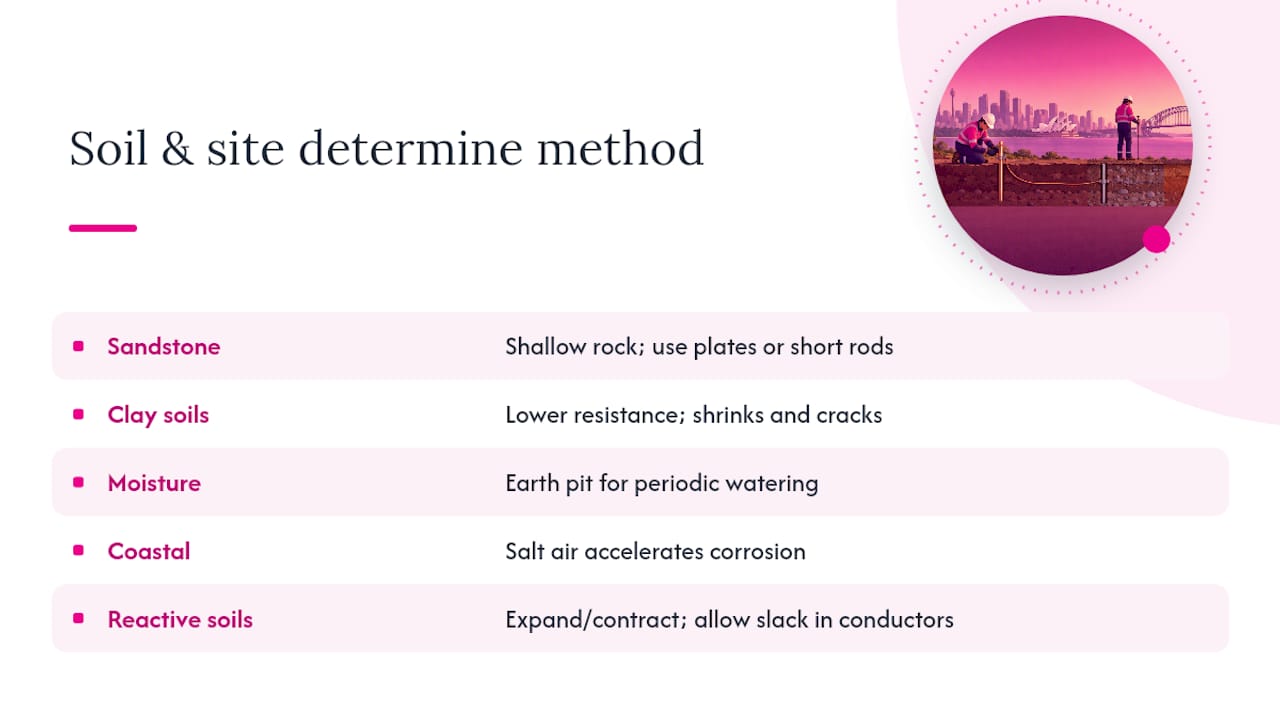
Sydney’s soil varies enormously across suburbs, and that variation drives which electrode type actually works. Sandstone country in the northern and eastern suburbs often means shallow rock, which pushes electricians toward plate electrodes or multiple shorter rods spread across a wider area rather than one deep rod. Clay-heavy soils common in the western suburbs hold moisture well and generally give lower resistance readings, but they shrink and crack in dry periods, which can loosen an electrode’s contact with the ground over a hot Sydney summer.
Moisture content matters more than most homeowners expect. An earth pit exists partly so the electrician can water the electrode during extended dry spells, keeping resistance low without redoing the installation. Coastal properties bring a different consideration: salt-laden air accelerates corrosion on clamps and exposed conductors, which is why corroded connections turn up so often in older beachside homes.
Reactive soils, which expand and contract with moisture, can also stress rigid conductors over time if they aren’t installed with enough slack. A competent contractor accounts for local ground conditions rather than installing the same electrode type on every job regardless of suburb. Getting this right the first time avoids a callback a few years later when a technically compliant system stops performing because the ground around it changed.
Impact of earthing upgrades on home insurance policies
Insurers generally expect a property’s electrical system to meet the standards in force at the time work was carried out, and a documented earthing upgrade with a compliance certificate is part of that evidence trail. If a claim ever involves electrical damage, fire or an insurance assessor’s review, having a written test report and certifying electrician’s details on file makes the difference between a straightforward claim and a drawn-out dispute over whether the installation was compliant.
Older homes without any earthing documentation can face closer scrutiny during a claim, since there’s nothing to show the system was ever verified. This is worth raising proactively if you’re renovating, adding solar, or installing an EV charger, since insurers increasingly ask about these upgrades during underwriting or at renewal.
The practical step is simple: keep the compliance certificate and test report from any earthing work with your other property documents, and mention the upgrade when you next review your policy. It costs nothing and gives your insurer a clear record if it’s ever needed. A licensed electrician’s certification is also the only evidence an insurer will accept, so informal work or a mate’s opinion on the wiring won’t hold up if a claim is contested.
Common non-compliances and how to avoid them
The single most frequent failure in NSW earthing inspections is incorrect equipotential bonding, particularly the assumption that slab rebar alone provides a safe earth path. NSW advisory notes confirm this is a recurring issue, especially in bathrooms and other wet areas where the consequences of a missed bond are most severe.
Industry commentary on AS 3000 compliance notes that earthing and bonding are among the most frequently tested, and most frequently failed, items during inspection, which is part of why regulators focus on them so closely.
Other recurring issues include:
- Poorly tightened or corroded earth clamps that increase resistance over time.
- A missing or undersized earthing conductor between the electrode and switchboard.
- No dedicated earth electrode at all, relying instead on incidental metal contact with the ground.
- Bonding conductors that don’t meet the minimum 4 millimetre size required under AS/NZS 3000.
Avoiding these comes down to insisting on a proper test before and after any work, rather than accepting a visual check alone. A clamp meter reading gives a fast screen, but a full fall-of-potential test and a written report are what actually catch a marginal bonding connection before it becomes a certifying electrician’s problem, or worse, a safety incident. Rectifying bonding after a slab is poured is far more disruptive and costly than getting it right during construction.
Overview of NSW earthing regulations and compliance authorities
NSW’s electrical safety framework runs on a few interlocking layers. AS/NZS 3000 sets the technical baseline nationally, while the NSW Service and Installation Rules add state-specific requirements, particularly around how installations interface with the local distribution network. For higher-risk or specialised installations, EES005 provides additional engineering guidance covering earth grid design and documented life-cycle plans for critical infrastructure.
Work that touches the consumer mains, metering point or the distributor’s network interface can only be carried out by a Level 2 ASP, a distinction that matters because a standard electrical licence doesn’t cover this scope. For high-voltage, rail or heavy industrial earthing, Level 1 ASP specialists hold a further tier of authorisation for high-voltage earthing and lightning protection work.
Property owners occasionally receive a mandatory defect notice from their distributor or an inspecting authority when an earthing fault is identified. These notices carry a rectification deadline and generally require the fix to be certified by an appropriately licensed electrician before the notice is cleared. Ignoring one isn’t simply a paperwork risk: it usually means a known safety issue remains live in the property until it’s fixed and signed off.
Safety risks and consequences of non-compliant earthing systems
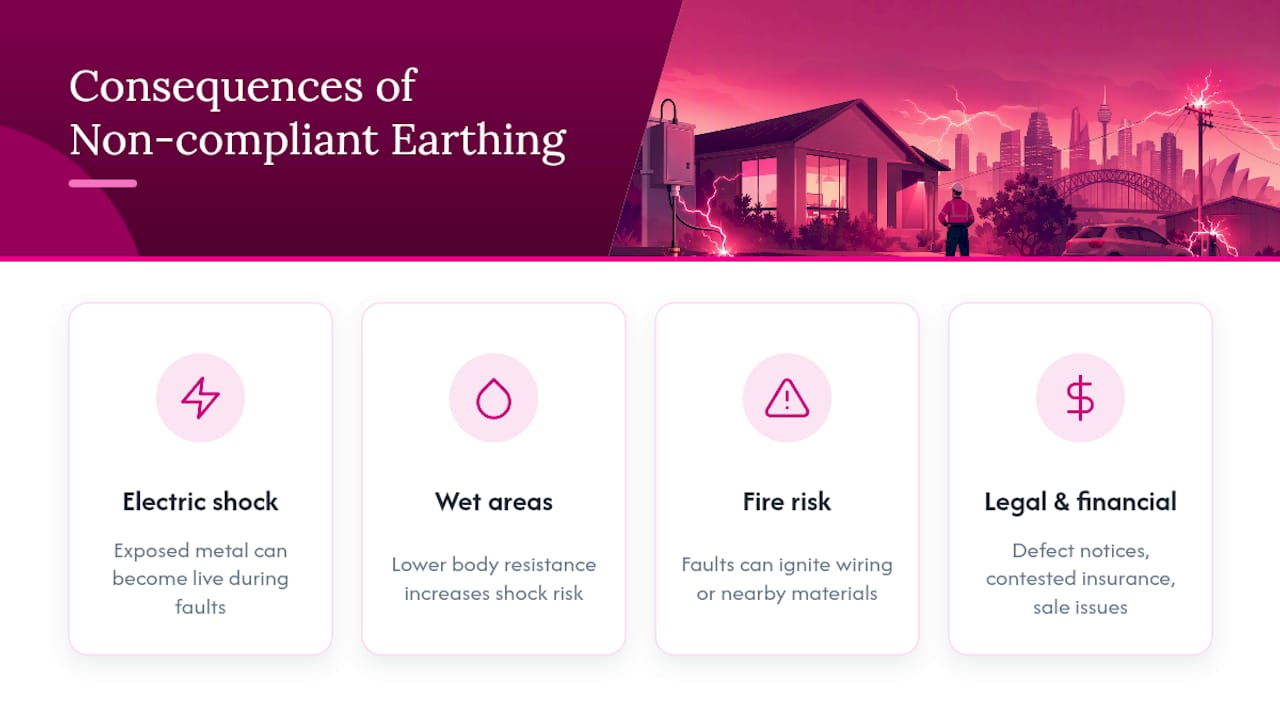
A non-compliant earthing system doesn’t announce itself until something goes wrong, which is exactly what makes it dangerous. Without a properly bonded and low-resistance earth path, a fault in an appliance or fixed wiring can raise the voltage on exposed metal surfaces, including taps, railings and structural steel, to a level that delivers a serious shock rather than tripping a protective device harmlessly.
This is the mechanism behind step and touch voltage hazards: a person standing near, or touching, an inadequately earthed surface during a fault can become part of the fault current’s path to ground. In wet areas, where moisture lowers the body’s resistance, the risk is higher still, which is exactly why bonding failures in bathrooms draw so much regulatory attention.
Beyond the immediate shock and fire risk, non-compliance carries legal and financial consequences. A defect notice left unresolved can escalate, insurance claims can be contested where no compliance certificate exists, and any future property sale or refinancing may be complicated by unresolved electrical safety issues. For landlords and strata properties, an uncertified earthing fault also raises questions about duty of care to tenants and occupants. None of this is abstract: it’s the practical reason regulators and insurers alike treat earthing and bonding as a baseline requirement rather than a discretionary upgrade.
Prioritising earthing work for homeowners vs commercial clients
For most homeowners, the priority is straightforward safety and having a valid certificate on hand, especially during a renovation. Commercial and industrial clients face a different bar: low impedance, coordinated grid design and interface requirements with the network operator, which is when an electrical engineer, not just an experienced Level 2 contractor, should be brought in. If your job is a standard house, book the inspection now. If it’s a substation, data centre or rail asset, insist on engineered design first.
— Christopher
How High Demand Electrical helps
If you need an earthing upgrade in Sydney, High Demand Electrical offers a free site inspection for Level 2 work, backed by 24/7 availability for both scheduled upgrades and urgent faults. Booking gets you a genuine test result, a written report and a fixed quote that includes the compliance deliverables you’ll need, not a guess made without seeing your property.

What to expect when you book:
- A site visit and earth resistance test before any price is finalised.
- A written test report with instrument, method and measured values.
- A fixed quote covering installation, retesting and your compliance certificate.
Earthing work is often bundled with a broader upgrade. If your project also involves a switchboard upgrade, start with our Level 2 electrician services to get both scoped in one visit, or book an electrical safety inspection if you’re not yet sure what’s needed.
Sources
For readers wanting the primary rules rather than a summary, these are worth keeping on hand:
- NSW government — electrical standards, rules and notes
- EES005 — Electrical protection and earthing guideline (NSW Resources)
- PowerEarth — earthing design and engineering consultancy
FAQ
What is the Australian standard for earthing?
AS/NZS 3000 governs earthing for electrical installations across Australia, mandating the multiple earthed neutral (MEN) system and a dedicated customer earth electrode. In NSW, this sits alongside the state’s own Service and Installation Rules for network interface work.
What are the disadvantages of installing an earthing system?
The main drawbacks are cost and disruption, particularly where excavation, slab access or distributor coordination is needed. These are generally outweighed by the shock and fire risks that come with an uncompliant or absent earthing system, which is why the work is a standard requirement rather than optional.
What are the latest earthing methods?
Common current methods include driven copper rods, plate electrodes, chemical electrodes for difficult soil, and foundation or ring earths cast into new-build footings. For complex commercial or industrial sites, engineers increasingly use software modelling such as CDEGS through specialist earthing design consultancies to size grids accurately.
What earthing system does Australia use?
Australia uses the multiple earthed neutral (MEN) system under AS/NZS 3000, which links the neutral conductor to earth at the main switchboard and requires a dedicated earth electrode at each installation. This is the baseline system any Level 2 electrician will design your upgrade around.
How much does an earthing upgrade cost in Sydney?
Cost depends on soil type, electrode choice, excavation difficulty and whether distributor coordination is required, so there’s no single figure that applies to every property. High Demand Electrical provides a free site inspection so you get a fixed quote based on your actual site conditions rather than an estimate; details are available through their Level 2 electrician service page.
Recommended
Powering Your Needs with Expertise
If you’re looking for a reliable, experienced, and prompt electrician, look no further than High Demand Electrical. We cater to all your electrical needs, from routine maintenance to emergency repairs and complete system installations. Our skilled team is committed to providing professional service that ensures your electrical systems run smoothly. Whether it's a small task or a large project, give us a call today. Let us meet all your electrical demands with the quality and reliability you deserve.