21 Day Defect Notice: Fast Fix and Clearance for NSW Property Owners
A defect notice means a network provider has found your electrical installation doesn’t comply with AS/NZS 3000 and must be inspected and repaired before it’s cleared. Arrange a licensed electrician immediately, and if the fault sits on the network side of your meter, you’ll need a Level 2 ASP. Repairs alone won’t clear the notice: your electrician also has to lodge the correct compliance paperwork with the network provider.
TL;DR:
- Most defect notices require a licensed electrician to inspect and repair the fault within 21 days unless the issue poses an immediate safety hazard, in which case response is faster.
- Faults on the network side, such as consumer mains, poles, or metering equipment, demand an authorized Level 2 ASP electrician, and lodging correct paperwork is essential to clear the notice.
- Ignoring a defect notice can lead to disconnection, legal breaches, or insurance problems if the non-compliance causes property damage or injuries.
- Booking early with a qualified electrician and ensuring correct paperwork submission are key to avoiding re-inspection costs and delays.
- High-demand electrical services offer free Level 2 site inspections and 24/7 urgent repairs, emphasizing the importance of proper assessment and documentation.
Table of Contents
- What an electrical defect notice actually means
- Who issues defect notices and how severity is graded
- What to do the moment you receive a defect notice
- Licensed electrician or Level 2 ASP: who actually fixes it
- The paperwork that actually clears the notice
- What happens if you ignore a defect notice
- How long it takes and what drives the cost
- How High Demand Electrical handles defect notice rectification
- An electrician’s take on where owners lose time
- Get your defect notice inspected and cleared
- Where these rules come from
- Sources
- FAQ
What an electrical defect notice actually means
An electrical defect notice is a formal document from your electricity network provider stating that your installation or service connection fails to meet AS/NZS 3000 Wiring Rules and the Service and Installation Rules of NSW. It’s not a suggestion. It’s a compliance finding, usually raised after a routine inspection, a meter upgrade visit, or a fault callout where the technician spots something unsafe while they’re on site.
Common triggers include:
- Damaged or leaning private power poles
- Exposed or deteriorated consumer mains cabling
- Non-compliant switchboard wiring or missing safety switches
- Corroded or water-damaged metering equipment
- Incorrect earthing or bonding at the point of connection
Network providers such as Ausgrid don’t write these notices to catch people out. They’re flagging a genuine safety gap between what’s installed and what the wiring rules require, and someone has to close that gap.
Who issues defect notices and how severity is graded
Network providers employ inspectors who assess installations against the wiring rules, and they’re the ones who issue the notice, not your electrician and not the strata manager. That authority matters because it determines what happens next.
- Standard defects get a rectification window, commonly around 21 days, with no immediate isolation of supply.
- Major defects are treated as an immediate safety hazard, and the inspector can disconnect power on the spot, attach a warning label, or isolate the affected equipment.
- Both the property owner and the original installing electrical contractor typically receive a copy of the defect report.
- If the original contractor can’t be reached or has closed up shop, responsibility falls to the owner to engage another qualified contractor.
Using anything carrying a “do not use” label is illegal until it’s repaired and the provider has been notified, so that label isn’t a formality you can work around.
What to do the moment you receive a defect notice
Acting fast here saves money and stress later. Work through this in order:
- Read the entire notice. Note the defect reference number, the specific fault described, and the rectification deadline.
- If you’re a tenant or a facilities contact, forward it to the owner or property manager immediately. Delay at this stage eats into your rectification window for no good reason.
- Book an inspection with a licensed electrician who can confirm the scope of the fault and tell you straight away if it needs a Level 2 ASP.
- Respect any safety labelling. If equipment has been tagged or isolated, don’t attempt to use it, reset it, or remove the label yourself.
- Keep the notice and any correspondence in one place, you’ll need the reference details when your electrician lodges paperwork.
Pro Tip: Photograph the defect and the notice itself before any repair work starts. If there’s ever a dispute about what was found versus what was fixed, dated photos are worth more than memory.
Licensed electrician or Level 2 ASP: who actually fixes it
Getting the right tradesperson on the job the first time avoids rejected paperwork and repeat site visits. A standard licensed electrician can handle most defects sitting on your side of the meter: switchboard faults, internal wiring, safety switches, and general non-compliance inside the property.
Network-side defects are different. Work on consumer mains, private power poles, metering equipment, or anything requiring a disconnect and reconnect at the network generally requires an authorised Level 2 ASP.
- Ask your electrician directly whether the fault is “network-side” or “customer-side”, this single question determines which licence applies.
- Consumer mains replacement, pole repairs, and metering work almost always sit in Level 2 territory.
- Lodging paperwork under the wrong authorisation is one of the most common reasons a network provider rejects a clearance and reopens the notice.
Confirming this upfront, rather than discovering it halfway through the job, is the difference between one visit and three.
The paperwork that actually clears the notice
Fixing the fault is only half the job. Your electrician has to formally close the loop with the network provider, and that’s done through specific compliance documents, not a phone call or a text saying it’s done.
- A Certificate of Compliance for Electrical Work (CCEW) confirms the repair meets the wiring rules.
- A Notification of Service Work (NOSW) is required where the work touches the network connection itself.
- The network provider audits and accepts what’s lodged, and can disconnect supply again or leave equipment labelled if the paperwork doesn’t match the work done.
Roughly one in every rejected clearance comes down to a missing or mismatched certificate, not the quality of the actual repair. Keep copies of every certificate, test result, and receipt after the notice clears. If a future buyer, insurer, or the network provider ever asks for proof the defect was properly resolved, that paper trail is your entire defence.
What happens if you ignore a defect notice
Nothing about ignoring a defect notice gets easier with time. The risks compound the longer it sits unactioned.
- Major defects can result in the network provider isolating or disconnecting supply without further warning.
- Continuing to use labelled or unrectified equipment breaches the law, not just the notice terms.
- Insurance claims linked to fire, shock, or property damage can be knocked back if the installation was known to be non-compliant and left unfixed.
- Unlicensed or DIY “repairs” almost always fail inspection and can restart the compliance clock from scratch.
- The longer a defect sits open, the more likely it escalates from a standard rectification window to an urgent, costlier fix.
How long it takes and what drives the cost
Standard defects typically carry a 21 day rectification window unless the notice states otherwise. Major defects move faster, sometimes requiring action within days because the safety risk won’t wait.
Cost and scheduling depend on a handful of factors:
- Whether the fault requires Level 2 ASP work, which typically costs more than standard electrical repairs due to the specialised authorisation involved.
- Whether a private pole or consumer mains section needs full replacement rather than a patch repair.
- Whether the job requires an outage coordinated with the network provider, which can add days to scheduling.
- How quickly you book the inspection after receiving the notice, last-minute bookings near the deadline often mean waiting longer for an available Level 2 electrician.
Booking your inspection early in the rectification window, rather than in the final week, is the single easiest way to avoid a rushed, more expensive fix.
How High Demand Electrical handles defect notice rectification
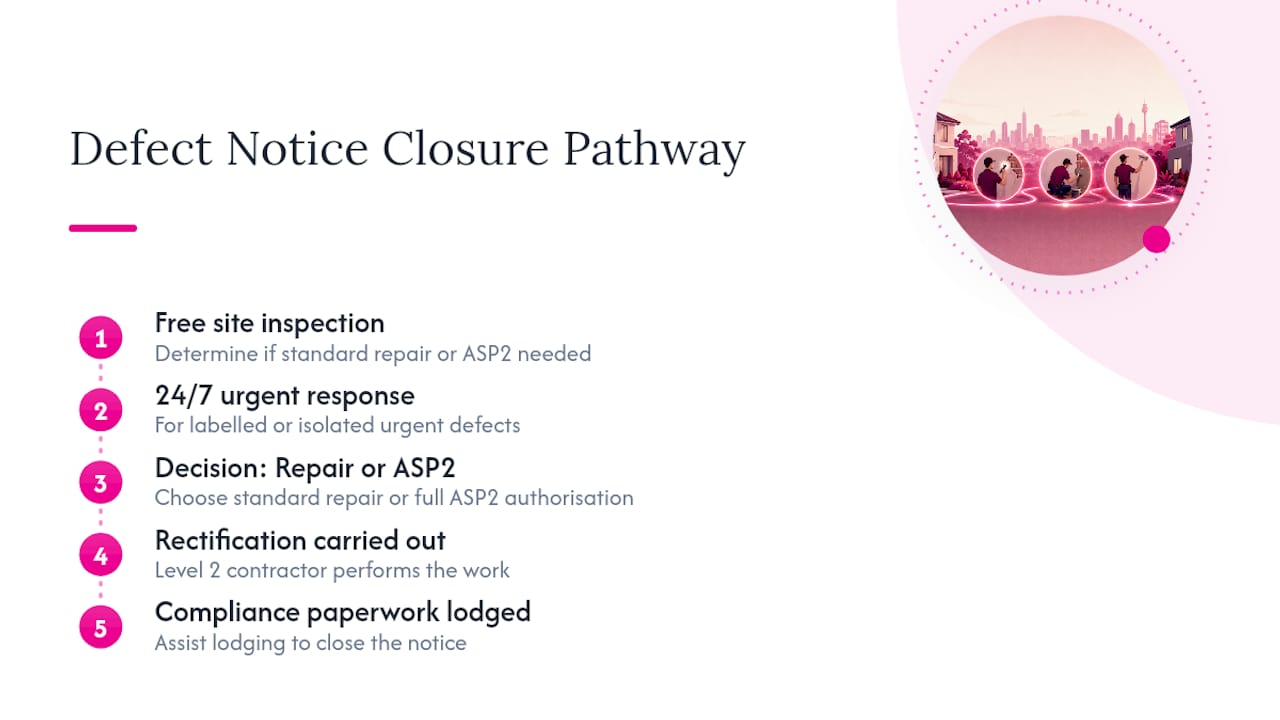
Defect notice rectification is a service regularly handled by a certified Level 2 electrical contractor based in Sydney. We offer free site inspections for Level 2 work, so you know upfront whether your defect needs standard repairs or full ASP2 authorisation before any money changes hands.
Electricians are available 24/7 for urgent defects, especially labelled or isolated ones requiring prompt service. Beyond the repair, assistance with lodging the required compliance paperwork to close the notice is provided.
An electrician’s take on where owners lose time

Three mistakes come up again and again: engaging unlicensed labour to save money, treating the repair as finished without lodged paperwork, and waiting until the final week of the deadline to book anyone. Each one turns a straightforward fix into a second visit.
Keep your test results and certificates regardless of how minor the defect seems. Reasoning through the paperwork side matters as much as the electrical work itself, because a network provider won’t reopen a file for a repair it can’t verify on paper.
— Christopher
Get your defect notice inspected and cleared
A direct service alternative is offered with Level 2 ASP electricians on call 24/7, and every Level 2 site inspection is free, providing clarity before any commitment.

If your notice mentions consumer mains, a private power pole, or metering equipment, that’s Level 2 territory, and it’s worth confirming before you book anyone. For faults confined to your switchboard or internal wiring, our electrical repairs team can usually attend sooner. Have your notice reference and deadline ready when you call, it lets us assess scope and book your free site inspection without back and forth.
Where these rules come from
The rectification periods, defect classifications, and paperwork requirements in this guide come from Ausgrid’s safety defects guidance and NSW Government electrical compliance requirements. Both are worth bookmarking if you manage multiple properties, since notice terms can shift between updates.
Sources
- Safety defects — Ausgrid
- Electrical compliance requirements — NSW Government
- Electrical defects (Ausgrid content hub)
FAQ
What is a defect notice?
A defect notice is a formal document from your electricity network provider stating your electrical installation doesn’t comply with AS/NZS 3000 wiring rules. It requires inspection and rectification by a licensed electrician, and sometimes a Level 2 ASP, before it can be cleared.
How long do I have to fix a defect notice?
Standard defects typically carry a 21 day rectification window from the date of the notice. Major defects presenting an immediate safety hazard can require action far sooner, sometimes within days.
Can I fix the defect myself?
No. Electrical defect work must be carried out by a licensed electrician, and network-side faults such as consumer mains, poles, or metering require an authorised Level 2 ASP. Unlicensed repairs are illegal and will fail the compliance check.
Does fixing the fault automatically clear the notice?
No. Your electrician also has to lodge a Certificate of Compliance for Electrical Work or a Notification of Service Work with the network provider. The notice stays open until that paperwork is submitted and accepted.
What does High Demand Electrical charge for a defect inspection?
Free site inspections for Level 2 work are available to find out what a defect notice requires. Rectification pricing depends on the scope of work, and current details are available directly through our Level 2 electrician service page.
Recommended
Powering Your Needs with Expertise
If you’re looking for a reliable, experienced, and prompt electrician, look no further than High Demand Electrical. We cater to all your electrical needs, from routine maintenance to emergency repairs and complete system installations. Our skilled team is committed to providing professional service that ensures your electrical systems run smoothly. Whether it's a small task or a large project, give us a call today. Let us meet all your electrical demands with the quality and reliability you deserve.