DC Power vs AC: The Homeowner’s Guide to Electrical Currents and EV Charging
Why does your electric vehicle charge at lightning speed at a public station but crawl at a snail's pace in your own garage? It's a common frustration for Sydney homeowners who find that their high-tech investments are often throttled by the very infrastructure meant to support them. You've likely noticed the confusing terminology around charging levels and wondered why your existing switchboard feels like a relic of a different era. It's perfectly normal to feel overwhelmed by contradictory advice regarding charging speeds and the technical requirements of a modern, energy-efficient home.
This guide will help you master the fundamental differences between direct current (DC) and alternating current (AC) power so you can make smarter decisions about your property’s electrical future. We'll demystify the conversion process that happens every time you plug in and explain why certain upgrades require the specialised skills of a Level 2 ASP electrician. By the end of this article, you'll know exactly how to optimise your home charging setup for both speed and safety, ensuring your switchboard is ready for the 454,000 EVs already hitting Australian roads. We'll cover everything from street-to-home connections to the latest NSW energy standards, giving you the professional reassurance you need to power your life without the guesswork.
Key Takeaways
• Understand the fundamental physics of how current flows from the Sydney grid to your appliances and why this distinction is critical for your home's energy efficiency.
• Learn how to overcome the EV charging bottleneck by mastering the relationship between dc power ac and the vital role of your vehicle's onboard rectifier.
• Identify why solar panels and home batteries require specific inverter technology to bridge the gap between DC generation and AC household consumption.
• Discover when your property requires a 3-phase power upgrade or consumer mains replacement to handle the heavy-duty sustained loads of modern electric vehicles safely.
• Recognise the essential role of an ASP Level 2 electrician in managing the street-to-home connection to ensure your infrastructure complies with NSW safety regulations.
Understanding the Basics: What is AC and DC Power?
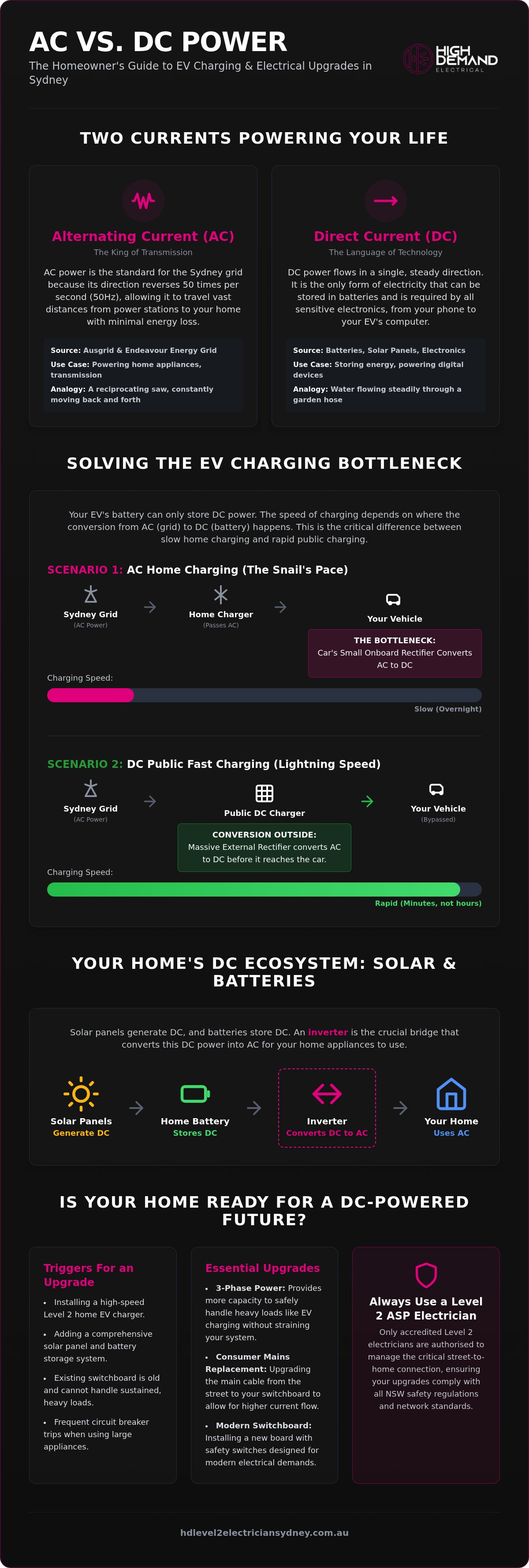
The electricity powering your Sydney home isn't a single, uniform force. It exists in two distinct forms that dictate how every appliance in your house operates. To grasp the relationship between dc power ac, you need to understand how energy moves. Alternating Current (AC) is the standard for our electrical grid because it can be transmitted over vast distances with minimal loss. It functions like a reciprocating saw; the electrons constantly change direction, vibrating back and forth 50 times per second. Conversely, Direct Current (DC) is a steady, one-way flow of electrons, much like water through a garden hose. This difference isn't just academic. It's the reason your switchboard looks the way it does and why your electric vehicle requires specialised equipment to charge safely.
The historical "War of Currents" between Nikola Tesla and Thomas Edison ultimately favoured Tesla's AC for large-scale infrastructure. However, the modern home is increasingly a hybrid environment. While the grid provides AC, almost everything we value, from smartphones to solar batteries, requires DC. Understanding AC and DC Power is the first step in ensuring your home's infrastructure is compliant with current Australian standards. When these two currents meet, conversion is mandatory, and that process creates heat and electrical stress that your home must be equipped to handle.
How Alternating Current (AC) Powers Sydney Homes
In the Ausgrid and Endeavour Energy networks, AC is the undisputed king of transmission. High-voltage AC is pushed across the state and then stepped down by local transformers to a safer level for residential use. In Australia, your standard power points deliver 230V AC at a frequency of 50Hz. This vibrating current is ideal for powering heavy-duty motors in washing machines or refrigerators. However, it presents a functional challenge for digital technology that demands a constant, unwavering voltage to operate without failure.
Why Direct Current (DC) is the Secret Language of Technology
Direct Current is the only way to store energy. You cannot store AC in a battery; it must be converted to DC first. Every time you plug in your laptop, the heavy "brick" on the cable acts as a miniature power conversion factory called a rectifier. It takes the 230V AC from your wall and transforms it into the low-voltage DC your device needs. In the context of dc power ac, your electric vehicle operates on the same principle but at a much higher, more demanding scale. This conversion process is why your home's electrical foundation must be robust enough to manage the sustained loads required by modern charging technology.
AC vs. DC: Key Differences and Why They Matter
The physical distinction between dc power ac defines how your home handles energy. AC constantly reverses its flow, which allows it to be pushed through narrow consumer mains over long distances with manageable heat loss. This is why the Sydney grid relies on it. DC flows in a single, unwavering direction. This makes it perfect for storage but historically difficult to transport across a city. While AC is efficient for distance, it's "noisy" because of its 50Hz frequency. Your sensitive electronics, such as computers and EV control modules, demand the "clean", steady voltage of DC to prevent premature component failure. Changing the voltage of AC is simple using transformers, whereas changing DC voltage requires complex and expensive solid-state electronics.
Transmission vs. Storage: The Great Divide
You can't store a wave. Batteries are chemical reservoirs that only accept a steady, one-way flow of electrons. This is why your solar panels produce DC and why systems like the Tesla Powerwall store energy in that same state. Every time you move power from your roof to your battery, or from the grid to your car, a conversion must occur. The specialised hardware required to manage this high-stakes conversion is often the most significant and expensive investment in your home's modern power system. This is particularly true when designing EV charging infrastructure that needs to balance rapid delivery with sophisticated thermal management to protect the vehicle's battery longevity.
Safety and Protection in Your Switchboard
Safety switches in Sydney homes are traditionally designed to monitor the rhythmic pulse of AC. When an RCD (Residual Current Device) detects a leak, it cuts power instantly to prevent electrocution. DC faults are far more aggressive. Because DC doesn't have a "zero-crossing" point, an electrical arc won't naturally extinguish itself like an AC arc might. This makes DC faults in solar arrays or EV chargers a serious fire risk if they aren't managed by specialised Type B RCDs. These advanced protectors are specifically engineered to detect "smooth" DC leakage that standard safety switches might miss. Ensuring your home is ready for these modern currents is vital for both compliance and safety. You can check the latest switchboard upgrade cost Sydney to see how modern safety standards protect against these specific DC-related risks.
If you're unsure if your current infrastructure is safe for a new charger, you can consult with a specialist to verify your home's compliance with the latest NSW electrical regulations.
The EV Charging Bottleneck: How AC and DC Impact Speed
The charging speed of your electric vehicle is dictated by where the conversion from dc power ac actually occurs. When you plug in at home, the process follows a strict three-step sequence. First, AC power flows from your dedicated circuit into the vehicle. Second, the car’s onboard rectifier converts that AC into DC. Finally, the energy is stored in the battery cells. Because the onboard rectifier is a compact component designed to fit within the vehicle's chassis, it has a physical limit on how much power it can process at once. This internal conversion is the fundamental reason why home charging feels significantly slower than the high-output public alternatives you find at service centres.
Public DC fast chargers solve this speed problem by moving the heavy lifting outside the car. These massive units perform the conversion themselves and feed DC energy directly into your battery, completely bypassing the car's internal bottleneck. This direct-to-battery approach allows for massive power delivery that would otherwise overwhelm the car's compact internal electronics. Understanding this distinction helps you manage your expectations for daily use versus long-distance travel.
Home Charging (AC): The Reliable Overnight Solution
Home charging remains the most cost-effective and practical solution for Sydney drivers because it aligns with our existing grid infrastructure. Most residential installations utilise Level 2 AC chargers, which are reliable for consistent overnight sessions. However, the speed of this process depends heavily on your property's electrical supply. You must understand the difference between single phase and three phase power to determine if your home can support faster 22kW charging rates. While single-phase is standard, many modern EVs require a three-phase upgrade to reach their maximum AC charging potential, making the switchboard the true heart of your charging setup.
Public Charging (DC): High Speed, High Demand
Public Level 3 chargers are engineered for rapid turnaround, delivering between 50kW and 350kW of power. They achieve this by performing the dc power ac conversion within the station itself, which is why these units are often the size of a large refrigerator. You won't be able to install a true Level 3 DC fast charger in a standard Sydney residential garage. The infrastructure required to manage that level of current draw would likely exceed the capacity of standard residential consumer mains and requires specialised industrial-grade connections. While these stations are perfect for road trips, the intense heat generated during DC fast charging means it's best used as a supplement to your home routine to preserve long-term battery health.
Solar Power and the DC Revolution in Sydney
Your roof is effectively a private power station that speaks a different language than your kitchen appliances. Solar photovoltaic (PV) panels generate Direct Current, yet the Sydney grid and your household fridge operate on Alternating Current. Managing the transition between dc power ac is the primary job of your solar inverter. This device acts as the sophisticated brain of your energy ecosystem, synchronising the one-way flow from your panels with the rhythmic pulse of the grid. While we've historically relied on AC for everything, modern smart homes are increasingly designed to keep energy in its native DC state for as long as possible to avoid the energy losses inherent in every conversion cycle.
Efficiency depends heavily on whether you choose a DC-coupled or AC-coupled battery system. In a DC-coupled setup, the energy from your panels flows directly into your home battery without being converted to AC first. This is significantly more efficient for Sydney homeowners looking to squeeze every watt out of their investment. AC-coupled systems are often easier to retrofit into existing solar arrays but require an extra round of conversion, which inevitably wastes energy as heat. Choosing the right architecture is critical as we move toward a future where our homes function as mini-grids.
Maximising Self-Consumption
With the NSW solar feed-in tariff benchmark for 2026-2027 set between 3.4 and 6.5 cents per kWh, sending power back to the grid is no longer the most profitable move. The ultimate goal is self-consumption: using your DC solar energy to charge your EV battery directly. This bypasses the grid entirely and saves you from paying retail rates for electricity. However, pushing high volumes of solar energy into a car battery or back to the street requires heavy-duty infrastructure. You must ensure your consumer mains are rated for these sustained loads, as older Sydney wiring often lacks the thermal capacity to handle modern solar exports safely.
The Future of Bidirectional Charging (V2H)
The next frontier in the Sydney energy market is Vehicle-to-Home (V2H) technology. This allows your car battery to act as a backup generator for your house during a blackout, converting its stored DC back into AC for your lights and appliances. This complex loop requires specialised Level 2 ASP equipment to ensure your home can safely disconnect from the grid while the car is powering the house. Without a professional "islanding" setup, your car could accidentally push power back into the street, endangering utility workers. As the grid evolves to support these DC-to-AC-to-DC loops, having a compliant, high-capacity switchboard is no longer optional.
If you are planning to integrate high-output solar with a new vehicle charger, contact our Level 2 ASP team to verify your home’s infrastructure is ready for the DC revolution.
Upgrading Your Infrastructure for a DC-Powered Future
Sydney’s older residential suburbs were never designed to handle the sustained high-amp draw of modern electric vehicles. If your home still relies on original consumer mains from the mid-20th century, you are likely operating at the edge of your infrastructure's thermal limits. Charging an EV isn't like boiling a kettle; it is a heavy-duty load that runs for hours. This constant demand creates significant heat within your switchboard and consumer mains. To manage the relationship between dc power ac effectively, your home needs a robust foundation that can handle the rapid conversion process without risking a circuit failure or an electrical fire.
The transition to a more efficient home energy setup often reveals hidden weaknesses in your connection to the street. While a standard 63-amp single-phase connection might have sufficed for a basic house ten years ago, it often struggles when you add a Level 2 charger, a solar array, and air conditioning into the mix. Upgrading your infrastructure ensures that the conversion from the grid's AC to your car's DC happens at peak efficiency, reducing wasted energy and protecting your sensitive household electronics from voltage sags.
When to Call a Level 2 ASP Electrician
In New South Wales, any work involving the connection between your property and the street grid requires an Accredited Service Provider (ASP). A standard electrician cannot legally upgrade your consumer mains or modify your point of attachment. If you are planning to move from a standard supply to a 3 phase power installation, a Level 2 ASP is mandatory. This upgrade is the gold standard for modern homeowners because it triples the available power. This extra capacity allows your vehicle to process dc power ac at much higher speeds, typically jumping from 7kW to 22kW charging rates. It ensures your property remains compliant with Ausgrid or Endeavour Energy standards while providing the headroom needed for future battery storage.
High Demand Electrical: Your Sydney Power Specialists
High Demand Electrical specialises in bridging the gap between the traditional Sydney AC grid and your modern DC-reliant lifestyle. We don't just fix connections; we future-proof your entire electrical system to ensure it can handle the next decade of technological shifts. Our team focuses on heavy-duty infrastructure, including switchboard upgrades and consumer mains replacements, to safeguard your home against the stresses of modern energy consumption. We provide the technical depth and regulatory expertise required to manage complex "street-to-home" upgrades with absolute precision and speed.
Don't let outdated wiring bottleneck your technology. Contact us today for a comprehensive assessment of your home’s power arteries to ensure your infrastructure is ready for the demands of the DC revolution.
Future-Proof Your Sydney Home Today
You now understand that while the Sydney grid delivers AC, your modern lifestyle depends on efficient DC storage. Mastering the relationship between dc power ac ensures your property isn't left behind as vehicle and solar technologies advance. You've learned that charging speed is limited by your car's internal rectifier and that true high-performance setups often require a 3-phase upgrade to the point of attachment. These infrastructure changes aren't just about convenience; they are about maintaining a safe, compliant home that can handle the sustained thermal loads of the 21st century.
To ensure your infrastructure is compliant and capable, you need a specialist who understands the street-to-home connection. Upgrade your Sydney home’s power infrastructure with High Demand Electrical. As accredited Level 2 ASP Electricians and Tesla-certified EV charger installers, we provide a Sydney-wide rapid response for all infrastructure upgrades. Don't let an outdated switchboard bottleneck your transition to cleaner, faster energy. Take control of your home's power today with a system engineered for absolute reliability and performance.
Frequently Asked Questions
Is AC or DC power more dangerous in a home environment?
Both currents are lethal at high voltages, but DC is often considered more hazardous because it lacks the "zero-crossing" point found in AC. This means a DC shock can cause continuous muscle contraction, making it much harder for a person to let go of a live conductor. DC also creates more persistent electrical arcs that don't naturally extinguish, which increases the risk of fire in solar arrays or battery systems if not managed by a professional.
Why does my EV charger say "AC" if the battery is "DC"?
Your home charger is labelled as AC because it draws standard 230V power directly from the Sydney grid. The vehicle itself performs the heavy lifting of conversion using its internal onboard charger. This component acts as a rectifier to turn the incoming dc power ac into the steady flow required by the battery. Public fast chargers are different because they perform this conversion outside the car, allowing for much higher speeds.
Can I convert my whole house to run on DC power?
While modern technology is increasingly DC-reliant, converting an entire Sydney home is currently impractical. Almost all Australian household appliances, from your kettle to your air conditioner, are engineered specifically for 230V AC. A total conversion would require replacing every light fitting and appliance with specialised DC versions. Most homeowners find it more efficient to use a hybrid system where an inverter manages the transition between the two currents as needed.
What is the difference between an inverter and a rectifier?
These devices are opposites in the conversion process. A rectifier takes AC from the grid and turns it into DC for storage or electronic use, such as your laptop's power brick. An inverter does the reverse by taking DC from your solar panels or battery and turning it into the AC required by your home appliances. Managing the balance of dc power ac in your home usually requires both technologies working in tandem to maintain efficiency.
Do solar panels produce AC or DC power?
Solar panels produce DC power exclusively. This energy is generated as a steady one-way flow of electrons when sunlight hits the photovoltaic cells. Because your home and the Ausgrid network operate on AC, this power must pass through a solar inverter before you can use it to run your television or export it back to the grid for a feed-in tariff. This conversion is essential for the energy to be compatible with your switchboard.
Why do we use AC for the grid if most devices need DC?
AC remains the global standard for power grids because it can be easily stepped up to extremely high voltages using transformers. This allows electricity to be pushed over hundreds of kilometres from power stations with very little energy loss. While DC is more efficient for storage and electronics, the infrastructure required to transmit it at high voltages across a city like Sydney is significantly more complex and expensive than traditional AC systems.
How much does it cost to upgrade to 3-phase power in Sydney?
The total investment for a 3-phase upgrade depends on several site-specific factors. These include the distance of your home from the street power pole, whether your existing consumer mains are underground or overhead, and the current condition of your switchboard. Because this work involves the point of attachment and NSW service provider rules, you must contact a Level 2 ASP electrician to provide a formal assessment and ensure your property meets Ausgrid or Endeavour Energy standards.
Can a standard electrician install a DC fast charger?
Standard electricians are typically limited to installing Level 2 AC wallboxes. True DC fast chargers (Level 3) usually require a Level 2 ASP electrician because they demand substantial infrastructure upgrades at the street connection level. These units draw such significant current that they often necessitate new consumer mains and a 3-phase upgrade to prevent overloading the local grid. Only an ASP Level 2 is authorised to perform these critical "street-to-home" modifications.
Powering Your Needs with Expertise
If you’re looking for a reliable, experienced, and prompt electrician, look no further than High Demand Electrical. We cater to all your electrical needs, from routine maintenance to emergency repairs and complete system installations. Our skilled team is committed to providing professional service that ensures your electrical systems run smoothly. Whether it's a small task or a large project, give us a call today. Let us meet all your electrical demands with the quality and reliability you deserve.