CT Metering Requirements in NSW: When You Need It and What It Takes
In NSW, current transformer (CT) metering is required where the maximum demand of an installation exceeds 80A per phase. Below that, direct-connected metering is normally used. Above it, the Metering Provider specifies CT equipment, the customer supplies the panel, cabling, fuses and CTs to a set standard, and the work is tested and certified before the supply is connected. Getting any of these steps wrong delays energisation, so it pays to plan the metering before the upgrade starts, not after.
This guide is for property owners, strata and property managers, and contractors who are planning a larger supply, a single phase to three phase upgrade, or a new commercial connection in New South Wales. We are a certified Level 2 electrical contractor in Sydney, and we explain below where CT metering applies, what the installation has to include and who signs off on each stage.
TL;DR
- CT metering is required where maximum demand exceeds 80A per phase. Direct-connected metering can be used up to that point.
- The customer provides the hinged meter panel, cabling, 10A HRC voltage fuses, test block and CTs. The Metering Provider specifies the CT type and meter equipment.
- Only people authorised by the Metering Provider can do the metering work, and a Certificate of Compliance for Electrical Work (CCEW) is due within 7 days of the electrical test.
- Your network distributor must give a Permission to Connect before a new metering installation is connected.
- Settle the maximum demand and metering method at the design stage of any single phase to three phase upgrade, before the switchboard is built.
Table of Contents
- What CT metering is and why it exists
- When CT metering is required in NSW
- What the customer must provide
- Panel, height and clearance rules
- CT and meter standards
- Who can do the work, and what gets certified
- The distributor’s role: Permission to Connect
- CT metering and a single phase to three phase upgrade
- What has changed recently
- Common reasons CT metering jobs stall
- How we handle CT metering jobs
- Our perspective
- FAQ
- Sources
What CT metering is and why it exists
A standard residential meter is connected directly to the incoming conductors, so all the current of the site flows through the meter itself. That is fine for a typical home. When the load grows, the meter’s own current rating becomes the limit.
A CT meter solves this. A current transformer is clamped or fitted around each phase conductor and produces a small, proportional current that the meter reads. The meter then applies the CT ratio to calculate real consumption. This lets a single meter measure large loads safely, such as a big commercial fitout, a multi-unit building, a workshop with heavy motors, or a home with a large three phase service.
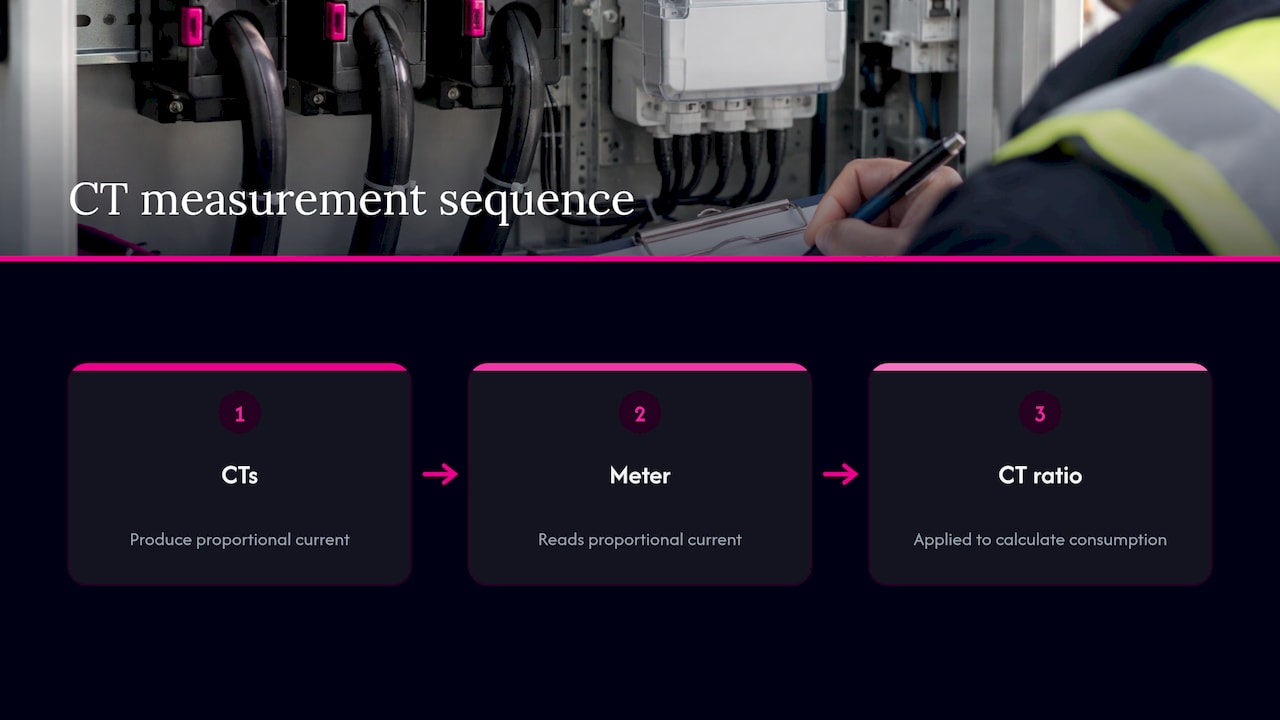
The NSW rules put it simply. Where the assessed load of an installation, or the portion to be separately metered, exceeds the current rating of the metering equipment, the Metering Provider (MP) will require a CT type meter. That is set out in clause 2.12 of the Metering Annexure to the NSW Service and Installation Rules.
The Metering Provider is the business responsible for installing and maintaining the meter. Since 1 December 2017, metering responsibility has moved from distributors to Metering Coordinators, as the NSW Government’s 2025 review of the Service and Installation Rules explains. If those terms are new, our guide to what a Metering Coordinator is covers who does what.
When CT metering is required in NSW
The threshold is the 80A per phase line. The Metering Annexure states that direct-connected metering may be used where maximum demand does not exceed 80A per phase, and that CT metering is required where it exceeds 80A per phase (NSW Metering Annexure, July 2018).
Two related figures cause confusion, so keep them apart:
| Figure | What it decides | Source |
|---|---|---|
| 80A per phase maximum demand | Direct-connected or CT metering | Metering Annexure, July 2018 |
| 100A maximum demand | One phase and neutral, or two or three phases and neutral | Service and Installation Rules, Table 1-1 |
| Motor over 2.0 kW | Three phases and neutral | Service and Installation Rules, Table 1-1 |
The phase rule says a demand not exceeding 100A is supplied by one phase and neutral, while a demand exceeding 100A needs two or three phases and neutral. Maximum demand itself is determined under AS/NZS 3000, the Wiring Rules, not by guessing from the size of the main switch.
What maximum demand means
Maximum demand is the highest load the installation is expected to draw, calculated by the method in the Wiring Rules. It is not the sum of every appliance rating, because not everything runs at once, and it is not the rating of the main switch. A qualified electrician works it out from the circuits, motors, air conditioning, EV chargers, heating and any planned additions. This is why the metering decision belongs at the design stage.
Can you choose CT metering below the threshold?
Sometimes. Distributor connection forms in other states show the same logic: one Victorian distributor’s new connection request form says CT metering is the default and cannot be changed above its supply limit, while below the limit it can be selected or not. In NSW, the Metering Provider decides the equipment, so raise any preference with them early.
What the customer must provide
CT metering shifts a lot of the physical work onto the installation side. Under clause 2.12 of the Metering Annexure, the customer must provide and install:
- equipment mounting facilities and the meter panel
- 10A current-limiting HRC voltage circuit fuses that are suitable for sealing
- meter links, where the service neutral link cannot take all of the metering neutrals
- all cabling, to the specified identification code
- the CTs
- the meter test block
The Metering Provider specifies the CT type, the test block and the meter equipment. In practice, that means you should confirm the specification with the Metering Provider before buying or fabricating anything. A CT that is the wrong ratio or type for the meter is a costly mistake, because the panel may have to be rebuilt.
Panel, height and clearance rules
Clause 2.13 of the same annexure sets out the physical layout for CT metering. The main requirements are:
- a hinged meter panel for CT metering
- the top edge of the meter no more than 2 metres above the ground, floor or platform
- the lowest metering equipment at least 0.6 metres above the ground, unless the Metering Provider approves otherwise
- at least 175 mm from the panel face to the inside face of any enclosure
- at least 200 mm from the panel face to any fixed object when the panel is opened 90 degrees
- no location subject to high-intensity magnetic fields
These numbers are why CT metering needs space. A cramped switchroom or a cupboard that was designed for a basic meter often fails the swing and depth clearances. If you are building or altering a meter position, our notes on meter box clearance requirements in NSW and meter isolation links cover the common trouble spots.
Moving an existing meter position is its own process. See electricity meter relocation rules in NSW before you commit to a layout.
CT and meter standards
The equipment itself must meet national standards. Under the AEMO Metrology Procedure, CTs for the common installation types must comply with AS 61869.1, AS 61869.2 and AS 61869.4, or the IEC equivalents, along with applicable National Measurement Institute specifications. Newly purchased CTs must meet current standards, while in-service CTs must meet the standard applicable when they were installed or purchased (AEMO Metrology Procedure Part A).
The same procedure requires meters to meet AS 62052.11, AS 62053.21 and AS 62053.22 for the common installation types, and new meters need valid National Measurement Institute pattern approval or, until approval exists, a valid type-test certificate from a NATA-accredited laboratory or recognised body. The Metering Provider supplies the meter, so for you the practical point is the CT: ask for its compliance documentation when you source it and keep it with the job file.
Who can do the work, and what gets certified
CT metering is not a job for any licensed electrician on the day. The annexure requires individuals to be authorised by the relevant Metering Provider before they carry out metering work. The Metering Provider then tests the work before connection, including visual and instrument checks such as polarity, phase rotation, insulation resistance and earthing integrity where they apply.
The paperwork follows:
- The installer completes a CCEW and gives copies, within 7 days, to the customer or retailer, NSW Fair Trading and the Metering Provider (Metering Annexure).
- The Building Commission NSW states that meters must be installed following the AS/NZS Wiring Rules and the Metering Annexure, and that the CCEW is submitted as soon as practical and no later than seven days after the electrical test (smart meter safety and installation requirements).
- Since 1 July 2026, all CCEWs must go through the BCNSW eCert portal, and handwritten or PDF forms are no longer accepted (BCNSW eCert portal). The same page records that the Smart Meter Tool was phased out from 1 March 2026.
For owners, the takeaway is simple. Ask who is submitting the CCEW, and keep a copy. It is the record that the work was done by an authorised person and tested.
The distributor’s role: Permission to Connect
Your network distributor sits alongside the Metering Provider. Endeavour Energy, which serves much of western Sydney, states in its Retailer and Market Guide that a Permission to Connect letter is required before a new metering installation can be connected or any alteration is made to the connection point. It also states that:
- underground service works need a Class 2B Accredited Service Provider (ASP)
- overhead service works need a Class 2C ASP
- energising needs a Class 2D ASP
- the National Metering Identifier becomes active in the market system once the ASP submits its Notice of Service Work and the Metering Provider submits its Notice of Metering Work, within 2 business days of finishing
Other distributors have their own manuals, so always read the one for your network. In the Ausgrid area, our guide to avoiding NOSW defects under the Ausgrid service rules shows how a rejected notice stalls a connection. If your project involves new service lines, the overhead service upgrade documents are worth gathering early.
CT metering and a single phase to three phase upgrade
Most owners meet CT metering through an upgrade, not by choice. Moving from single phase to three phase typically happens because load is growing: a workshop, a commercial kitchen, a large air conditioning system, several EV chargers, or a development adding units.
The sequence we suggest is:
- Calculate maximum demand first. Use the Wiring Rules method, including planned additions. If the result is above 80A per phase, plan for CT metering. If it sits close to the line, confirm with the Metering Provider before you finalise the design.
- Check the phase rule. A demand over 100A calls for two or three phases and neutral, and a motor over 2.0 kW calls for three phases and neutral, under the Service and Installation Rules.
- Design the switchroom around the meter panel. The hinged panel, 175 mm and 200 mm clearances and height limits all take space that a standard board does not.
- Get the Metering Provider’s specification in writing for the CT type and test block, then build to it.
- Lodge the distributor requirements. This includes the Permission to Connect where the distributor requires it for the metering change.
- Test, certify and submit the CCEW through the eCert portal within the seven-day window.
A three phase upgrade also usually involves the service and switchboard, not just the meter. See our pages on power supply upgrades and switchboard upgrades for what those involve. If you are also adding a charger, the EV charger installation guide explains how the extra load feeds into the demand calculation.
What has changed recently
The rules are stable at the CT level, but the surrounding process has moved.
- The NSW Government lists the Service and Installation Rules dated April 2026 alongside the Metering Annexure dated July 2018, which remains the current metering annexure (NSW Service and installation rules page).
- The 2025 review made no changes to the annexure. It notes that the Building Commission NSW intends to publish standalone Metering and Installation Rules to replace it once wider building law reforms are enacted (2025 review explanatory statement).
- The AEMC’s accelerated smart meter rule, published in November 2024, commenced its schedules in stages, with Schedule 1 on 1 December 2025 and Schedule 2 on 1 July 2026. It also sets repair timeframes for small-customer metering malfunctions (AEMC rule). That rule is aimed at small customers, so it matters less for a CT site, but it shapes the wider metering market.
- CCEWs are now digital only, as above.
Because a replacement set of rules is signalled, check the NSW Government rules page for the current documents before you design.
Common reasons CT metering jobs stall
These are the points where projects most often lose time, based on the requirements above:
- Demand was assessed too late. The switchroom was built for direct metering and cannot take a hinged panel.
- The wrong CT was supplied. The Metering Provider specifies the type, so buying first and asking second invites rework.
- Clearances were missed. The 175 mm depth and 200 mm swing clearances are easy to lose when a board is packed into a small space.
- Unauthorised metering work. Only people authorised by the Metering Provider can carry it out.
- Paperwork delay. A CCEW not submitted through the portal within seven days holds up the record.
- No Permission to Connect. Where the distributor requires it, the connection cannot proceed without it.
How we handle CT metering jobs
We are a certified Level 2 electrical contractor, and metering services are part of what we offer. Our Level 2 electricians are fully accredited ASP electricians, we are available 24/7 for emergencies, and we offer free site inspections for Level 2 work, so the metering position, switchroom space and service arrangements can be looked at before anything is ordered. Our Level 2 electrician and metering services page sets out the range, and our power supply upgrades page covers single phase to three phase work.
If you manage a strata building or commercial property, the same free inspection lets you plan metering alongside compliance needs. Seniors can ask us about our discounted rates. Call us, or start from our main site, and we will walk through your load, your distributor and the next step.
Our perspective
Most CT metering problems we hear about are not technical failures. They are planning failures. The owner decided on a bigger supply, the board was built, and only then did anyone ask how the meter would be measured.
Our view is that metering belongs in the first conversation. Work out maximum demand, confirm the 80A per phase line, and find out what the Metering Provider and distributor expect, all before the design is fixed. That is why we offer free site inspections for Level 2 work: the space, the service and the load are easier to settle with someone standing in the switchroom.
We also think the paperwork deserves the same care as the wiring. A tested installation with a timely, correct CCEW is what protects you with your retailer, your insurer and the next buyer of the property. Our team is accredited, our work is built around NSW standards, and we would rather you ask early than rebuild a panel.
Christopher
FAQ
Is CT metering required for a home in NSW?
Only if the home’s maximum demand exceeds 80A per phase, which is uncommon for a typical house. Large homes with several heavy loads, or sites with a secondary dwelling or workshop, can reach it. The Metering Provider makes the final call on equipment.
Who supplies the current transformers?
Under the Metering Annexure, the customer provides and installs the CTs, the test block, the meter panel and the cabling. The Metering Provider specifies the CT type, so confirm the specification before you buy.
How long do we have to submit the CCEW?
The installer must submit the CCEW as soon as practical and no later than seven days after the electrical test is completed. Since 1 July 2026 it must be lodged through the BCNSW eCert portal.
Does a single phase to three phase upgrade always mean CT metering?
No. Three phase supply is required above 100A maximum demand, but CT metering turns on the 80A per phase threshold. A three phase supply with demand at or below that level can still use direct-connected metering. Have the demand calculated, then confirm the method with the Metering Provider.
Sources
- Annexure to Service and Installation Rules of NSW, July 2018
- NSW Service and Installation Rules, Table 1-1
- NSW Service and installation rules page
- NSW Service and Installation Rules Review explanatory statement, May 2025
- AEMO Metrology Procedure Part A
- Building Commission NSW smart meter safety and installation requirements
- BCNSW eCert portal
- Endeavour Energy Retailer and Market Guide
- AEMC accelerating smart meter deployment rule
- New connection request form
Recommended
Need Help Fast?
Powering Your Needs with Expertise
If you’re looking for a reliable, experienced, and prompt electrician, look no further than High Demand Electrical. We cater to all your electrical needs, from routine maintenance to emergency repairs and complete system installations. Our skilled team is committed to providing professional service that ensures your electrical systems run smoothly. Whether it's a small task or a large project, give us a call today. Let us meet all your electrical demands with the quality and reliability you deserve.

Licensed Level 2 ASP electricians across Sydney. Same-day service and 24/7 emergency response.
Licence 397193C
ABN 87 051 836 527
